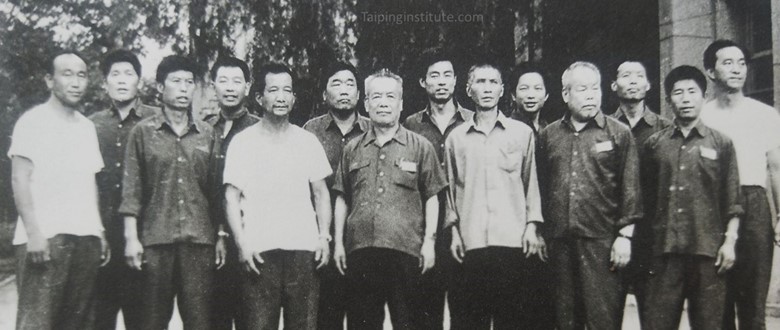
Zhou Yongfu (周永福, 1913 – 2015 ) was born in Weifang, Shandong Province. He was passionate about martial arts since a young and when he was sixteen together with his brother Zhou Yongxiang (周永祥, 1910 – 2004) was able to enter the Qingdao National Martial Arts Institute (青岛国术馆), during which he studied Xingyiquan, Baguazhang and Taijiquan with Tian Hongya (Disciple of Li Cunyi), Meihua Changquan with Ji Yanchang, Yantai Hao Family Meihua Praying Mantis Boxing with Hao Henglu and so forth. He would practice everyday, putting great effort into his practice and as a result he acquired excellent foundation and became talented in martial arts. Due to his skills with the Chain Wip he was nicknamed “Flying Chain Whip Zhou”.
After graduating from the institute he specialized in Wushu and sports teaching. He became a coach at the Qingdao Institute and the Weifang Institute. During 1951-1957, he worked for the Qingdao printing house. He entered competitions in 1953-54,at the latter one there were many well known teachers, such as Wang Ziping with whom Zhou later befriended. In 1935 was the instructor for an Elementary school. In 1936, he he setup classes in his hometown Weifang accepting students/disciples. He also taught in 1941 at the Qingdao Taijiquan Society. Together with his brother Zhou Yongxiang, even back then they were both known as the Two Martial heroes of Shandong. His brother later taught at the Shandong Normal (Teacher’s) University, whilst Zhou Yongfu became the Senior Coach of the Shandong provincial squads.
When the the Shandong Provincial Wushu team was formed in 1958 and Zhou was transferred as coach to the new team. As the Head coach he placed much efforts to ensure the quality of the team and devoted himself to achieve that outcome. He gave his blood, sweat and tears to ensure that later to be known talents the likes of Wang Changkai, Niu Huailu, Yu Hai, Wang Qizeng and Xu Guilin could achieve their best potential. Many of his students achieved outstanding recognition in the martial arts community as well such as Yu Chenghui, Xu Xueli and Gao Xingliang. Truly dedicated, he remained with the team for almost 30 years, retiring from his post in 1989 at already 76 years of age. Together with his brother Zhou Yongxiang they started the foundations of Yuanyang Men in 1992, weaving together elements from his diverse training into a cohesive system emphasizing fluid pairing techniques (hence “mandarin duck,” symbolizing harmonious duality). Honored as one of China’s “Top Ten Martial Arts Coaches” in 1995, he remained active in Qingdao’s martial community well into his nineties.
Zhou Yongfu was also involved in the production of martial arts textbooks which he collaborated with such notables as Cai Longyun, Chang chenfang and Wang Ziping. His also contributed many articles and essays to magazines/publications of martial arts in China. Together with his brother he also wrote two manuals [Meihua Mantis Boxing] and [Zhongguo Xingyi Boxing]. In 2002 he also wrote [Sun Bin Boxing]
In recognition of his dedication and contributions to martial arts, the government recognized Zhou Yongfu as a 9th Duan Wushu Master. He settled down in Qingdao but maintained his involvement in martial arts associations, participating in events until old age. He organized sessions in Qingdao teaching free for fitness and health to the community seven times a week. During the SARS epidemic he also helped the community to understand preventative measures, improving of physical and immune health and really lived up to the expectations of a great Master.
Zhou Yongfu’s legacy endures through his disciples, his published works, and the living tradition of Yuanyang Gate now practiced worldwide. His connection to Wang Ziping, two masters who respected and learned from one another, symbolizes a golden age of Chinese wushu when giants walked the earth not as isolated legends but as teachers committed to transmission. At his funeral, over 200 students gathered from across China to honor a man who, in the words of Qingdao Wushu Association officials, represented “the longest-lived grandmaster in modern Chinese martial history.” Zhou did not merely practice wushu; he was wushu, a century-long embodiment of its discipline, joy, and transformative power.
In his old age, he practiced daily on Qingdao’s Guanxiang Mountain until age 95, advocating “health savings” (jiankang xuchu): the principle that consistent small investments in wellness yield compound returns over a lifetime. Even bedridden in his final years, he would demonstrate techniques from his hospital bed, fingers tracing invisible sword paths through the air. On December 16, 2015, at 3:28 p.m., Grandmaster Zhou Yongfu (周永福) passed away peacefully at Qingdao Central Hospital at the remarkable age of 102