Wang Ziping (1881–1973), the renowned martial artist from Cangzhou, Hebei, stands as one of modern China’s most influential wushu masters. He was an expert of many styles such as Yang Style Cha Quan, Hua Quan, Pao Quan, Bajiquan and Taijiquan. He was well respected in the Martial arts community and when the Nanjing National Martial Arts Institute was established he became the head of a division at the Institute.
A member of the Hui ethnic minority and descendant of a martial lineage, Wang earned the title “Thousand-Catty King” for his extraordinary strength and skill. Beyond his legendary 1919 victory over a Russian strongman in Beijing’s Zhongshan Park, a feat that ignited national pride during a period of foreign domination. Wang dedicated his life to refining and innovating Chinese martial arts. His crowning achievement in weaponry was the Qinglong Jian, or Green Dragon Sword, a system he forged through decades of practice, travel, and cross-cultural study. Unlike many traditional forms passed down unchanged through generations, Wang’s Green Dragon Sword represented a conscious synthesis: rooted in Chaquan gate sword methods yet enriched by principles from Western fencing and Japanese Kendo, creating a uniquely comprehensive expression of swordsmanship for the modern era.
Central to Wang’s Green Dragon Sword system is its elegant three-route structure, a pedagogical progression rarely documented outside family transmission. The complete tradition comprises three distinct routes—Yi Lu (“First Route,” emphasizing Zhan/”Standing”), Er Lu (“Second Route,” emphasizing Xing/”Walking”), and San Lu (“Third Route,” emphasizing Long/”Dragon”). These are not merely sequential forms but embody progressive training principles: the First Route cultivates rooted stability, precise technique, and correct power expression (li dian zhengque); the Second Route develops fluid mobility and traveling footwork; the Third Route manifests the coiling, spirited essence of the dragon itself—unpredictable, flowing, and alive with internal energy. Wang’s systematic approach to sword mastery: from foundation to expression, from form to spirit.
The Green Dragon sword integrates thirteen fundamental sword methods—pi (chop), ci (thrust), dian (point), liao (upward sweep), jiao (twist), gua (hang), jia (block), jian (shear), beng (snap), chou (draw), gong (bow), sao (sweep), and chuan (pierce)—woven together with diverse stances (bow, horse, crouching, empty, rest) and dynamic footwork including cover steps, insert steps, jumps, balances, and independent postures. Crucially, Wang emphasized that “standing” (zhan) does not mean slow or weak movement; rather, it demands crystal-clear technique, correct power points, and a harmonious blend of motion and stillness (dong ding jiehe) that produces a posture both stable and graceful. This foundation of precision and structural integrity prepared practitioners for the increasingly fluid demands of the Second and Third Routes, a progression reflecting Wang’s belief that true freedom in martial expression arises only from disciplined mastery of fundamentals.
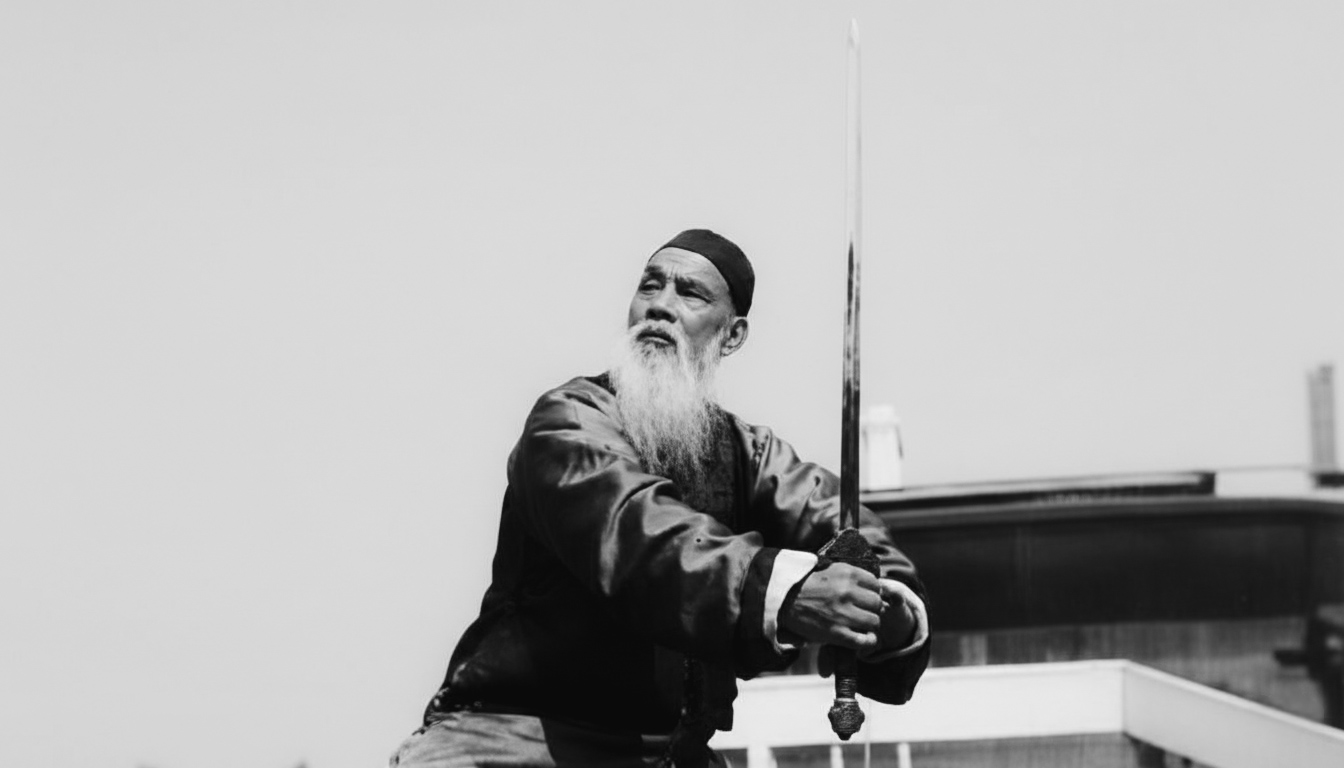
Wang Ziping’s performances of the Green Dragon Sword captivated audiences across China and internationally, earning universal acclaim for their transcendent quality. As his daughter Wang Jurong wrote, when Wang performed, “sword art and essence, energy, and spirit perfectly merged, achieving a state of human-sword unity” (ren jian ronghua yiti). His movements were described as “light, agile, and elegant like a dragon’s movement,” with changes so fluid they appeared “divine and transformative” (chushenruhua). Remarkably, even in advanced age, Wang would seize his walking cane and spontaneously demonstrate Green Dragon Sword sequences with undiminished vitality, a testament to how deeply the art had become part of his being. This embodiment of jing (essence), qi (energy), and shen (spirit) represented the pinnacle of Chinese martial philosophy: technique refined beyond mechanics into living expression.
Wang Ziping’s legacy endures through multiple channels. His Green Dragon Sword influenced China’s first national standardized sword routine, particularly its “three consecutive strikes” (lian huan san ji) combination. The complete transmission survived through his disciples and students, especially his daughter Wang Jurong and her husband/his disciple Wu Chengde, who have preserved the knowledge of all three routes within the family lineage. In Shanghai, Zhou Yongfu an expert of Yuanyang Men, Hao Family Mantis Boxing, Xingyi, Shaolin, Taiji and Xingyi became well acquainted with Wang Ziping who thought highly of his skills to the degree that the Twin Swords were taught by Zhou Yongfu to his daughter Wang Jurong. Zhou was able to exchange and learn skills from Wang Ziping as well. Zhou Yongfu gained recognition as a 9th Duan wushu expert and his disciple, Gao Xingliang studied with M Zhou and also inherited the Qinglong (Green Dragon) Sword, it was then passed on to the Taiping Institute.
Beyond weaponry, Wang’s contributions as a physician of martial trauma (waike), his advocacy for wushu’s inclusion in national physical education, and his lifelong demonstration that Chinese martial arts could stand confidently alongside and learn from global traditions cemented his place as a bridge between classical and modern martial artd. The Green Dragon Sword remains his most poetic testament: a system that honors tradition while embracing evolution, where the dragon’s spirit flows not through mysticism alone, but through the disciplined, joyful unity of body, blade, and breath.