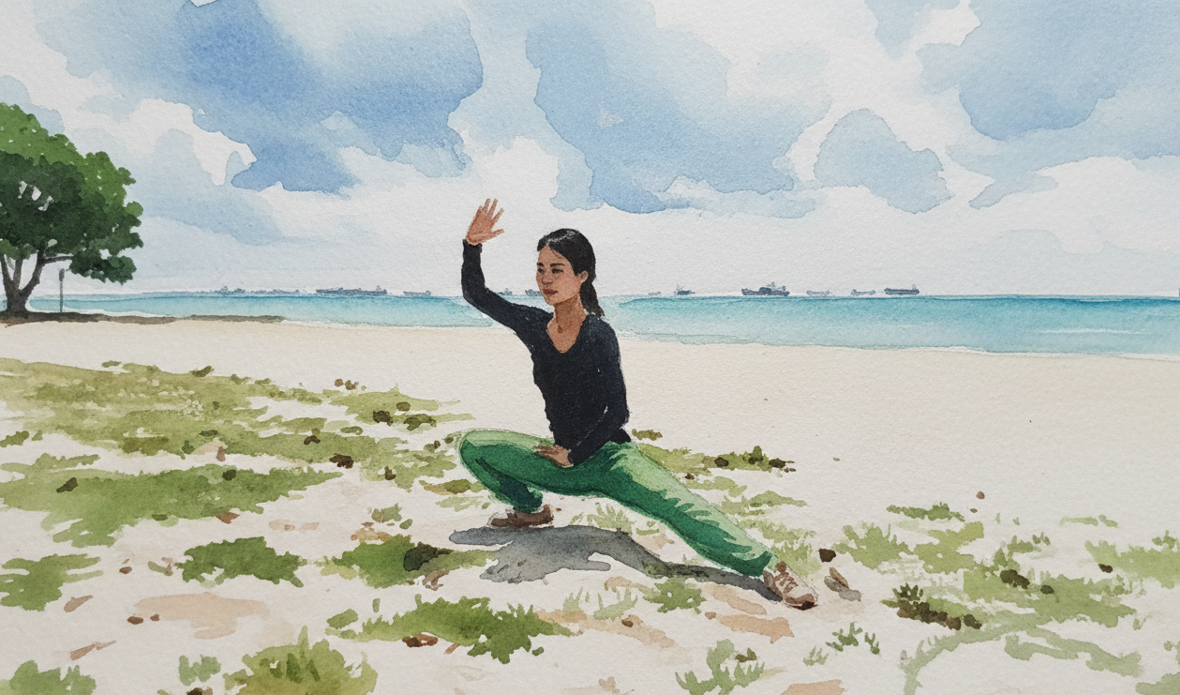
1. Essential: Central Equilibrium (要中正 – Yào Zhōngzhèng)
During practice, it’s common to see practitioners lacking central equilibrium—leaning east and west, tilting forward and backward, their entire body awkward. This is especially true for beginners. First, one must achieve the “Four Levelings” (四平 – Sì Píng): the crown of the head level (head upright), shoulders level (body upright), eyes level (intent upright), heart/mind level (qi upright). Secondly, to achieve a centered, comfortable, and stable posture that supports all directions, one must achieve the “Three External Harmonies” (外三合 – Wài Sān Hé): shoulder harmonizes with kua (hip), elbow harmonizes with knee, hand harmonizes with foot. Using “Brush Knee and Twist Step” as an example: left foot forward in a ‘Chuan’ character stance, the right shoulder harmonizes with the left kua, right elbow with left knee, right hand with left foot. Reverse if the right foot is forward. The Three External Harmonies are like a carpenter bracing a door frame with an “X” to prevent warping. Of course, for practitioners, this harmony is primarily achieved through intent. Central equilibrium in Tai Chi does not mean keeping the body’s center absolutely perpendicular to the ground, but maintaining balance. Take “Golden Rooster Stands on One Leg”: the body must lean slightly to ensure stability—”uprightness within the slant” (斜中寓正 – xié zhōng yù zhèng). Maintain dynamic balance throughout the form.
2. Essential: “Relaxed,” but not “Collapsed” (要”松”、而不”懈” – Yào “Sōng”, ér bù “Xiè”)
When practicing, being listless, joints closed, as if unable to support one’s own weight—head drooping, back bent, kua slack, knees soft, arms and hands likewise, muscles limp. The form is slack, collapsed, muddled, and spiritless. Even after years of practice, enthusiasm is low. In push hands, one is collapsed, resistant, stiff—riddled with flaws. These problems stem from not distinguishing between “song” (relaxation) and “xie” (collapse).
First, lift the spirit, focus on intent leading. Secondly, all joints should open, tendons relax, qi sinks. The energy from above the waist goes upward, from below the waist goes downward. Everywhere, express energy towards the extremities (梢 – shāo). Using intent without brute force is “song”; using neither intent nor force is “xie”. Therefore, the boxing treatise says: “Use intent, not brute force. Using qi, one becomes stagnant; using intent, one becomes nimble. Intent and qi are the sovereign; flesh and bones are the ministers.”
3. Essential: Clear “Opening” and “Closing” (要”开”、”合”分明 – Yào “Kāi”, “Hé” fēnmíng)
Many people, when practicing forms or push hands, know opening but not closing, or closing but not opening. Their form scatters when opening, collapses when closing; opening and closing are separate, far from continuous and uninterrupted. The form is full of angular breaks. In push hands, they resist and collapse, being controlled everywhere.
Opening and closing are two aspects of a contradiction; one cannot exist without the other—they coexist simultaneously. We advocate that when opening, pay attention to closing to avoid scattering; when closing, pay attention to opening to avoid collapse. This prevents separation. The boxing treatise is absolutely correct: “Within opening, store closing; within closing, store opening.” When your skill reaches a certain level, you will feel opening within opening, closing within closing—or one could say, opening again within the open, closing again within the close—reaching a stage where opening and closing are hard to distinguish. This is key to mastering Tai Chi forms and push hands.
4. Essential: Rootedness in the Feet (要足下有根 – Yào Zú xià yǒu gēn)
During form practice or push hands, one is often top-heavy, unsteady,难以自控 even on one foot, unstable even with both feet on the ground. The main issue is poor transformation of substantial and insubstantial (虚实 – Xū Shí). Shifting forward/backward relies solely on leaning forward or backward; shifting left/right also relies on swaying side to side. This is the root cause of lack of rootedness.
The key lies mainly in relaxing the waist (松腰 – sōng yāo) and sinking the kua (落胯 – luò kuà), lowering the center of gravity for natural stability. Specific method: In a bow stance (弓箭步 – gōngjiànbù), when shifting from the rear foot being substantial to the front foot becoming substantial, the rear foot pushes (蹬 – dēng), the front foot supports (撑 – chēng), relax waist and sink kua—achieve the weight transfer and substantial/insubstantial change within the relaxation and sinking. In our terms: “Advance and retreat within relaxation and sinking; relax and sink within advancing and retreating.” This prevents both stiff legs and soft legs, naturally resulting in stable rootedness.
5. Essential: Circular and Lively (要圆活 – Yào Yuánhuó)
Many angular movements, a stiff, hard form, dull and unattractive actions, lacking the flavor of Tai Chi. The main reason is lacking connection between movements (承上启下 – chéng shàng qǐ xià) and “rounding the corners” (抹角 – mǒ jiǎo).
During form or push hands, at the completion of an opening or closing, use a relaxed, sinking energy to seamlessly connect the previous and next postures without gaps. Simultaneously, at the completion point, trace a small arc—this small arc is called “rounding the corner” or “wiping the angle” (抹角 – mǒ jiǎo). It’s like catching a basketball in motion: receive it with a buffer and return it. With connection and rounding the corners, the form naturally becomes relaxed, soft, circular, and lively—continuous and uninterrupted. Manifested, it’s like a great river flowing endlessly; hidden, it’s like water under ice, unseen but present. Possessing this energy not only makes the form beautiful but also plays a vital role in neutralizing energy (化劲 – huà jìn) in push hands. This is also a key difference between “internal” (内家拳 – Nèijiāquán) and “external” (外家拳 – Wàijiāquán) martial arts.
6. Essential: Light, Agile Transitions; Avoid Double-Weighting (要转换轻灵,避免双重 – Yào Zhuǎnhuàn qīnglíng, bìmiǎn shuāngzhòng)
Double-weighting (双重 – shuāngzhòng) is a fault. It manifests as: heavy, sluggish steps in the form; unsteady rising and falling; feeling clumsy and difficult to control; in push hands, meeting force with force wherever attacked or defended, excessive resistance and stiffness, not understanding neutralization and yielding. Even after years of practice, one is controlled everywhere—all due to double-weighting.
First, understand the principle of Yin and Yang. Clearly define your own substantial and insubstantial. Step lightly and agilely like a cat walking. The transformation of substantial and insubstantial is primarily accomplished by the kidneys (肾 – shèn) and the kua (胯 – kuà). Correctly transforming substantial/insubstantial requires the kidneys to naturally “exit and enter” (出入 – chū rù). The exiting and entering of the kidneys in push hands can achieve twice the result with half the effort.
So, how do the kidneys exit and enter? For example, when riding a bicycle: one foot relaxes, sinks, and pushes down; the kidney and kua on that side correspondingly descend (become substantial). The other foot lightly touches, adheres, absorbs, and lifts; the kidney and kua on that side correspondingly rise (become insubstantial). If both feet push down equally, it’s stagnant—the fault of double-weighting.
Thus, during form practice, when stepping forward with the left foot, the left kidney and left kua rise (insubstantial); simultaneously, the right kidney and right kua descend (substantial). Reverse for the right side. In summary: The kidney and kua on the insubstantial leg side rise; the kidney and kua on the substantial leg side descend. This must be achieved whether practicing the form or push hands to fulfill the requirement stated in the boxing treatise: “Exiting and entering the kidneys is the true secret” (出肾入肾是真诀 – chū shèn rù shèn shì zhēn jué).
7. Essential: Relaxed Shoulders and Sunk Elbows (要松肩垂肘 – Yào Sōng jiān chuí zhǒu)
People often interpret “relaxed shoulders and sunk elbows” as pressing the shoulder joints (acromion) down, the more the better, even consciously sinking them, causing tension in the shoulders and back as if carrying a heavy load. This makes the chest board-like and unable to transform, greatly impacting push hands.
The key is understanding the shoulder’s structure. The shoulder is composed of the humeral head, the glenoid cavity of the scapula, and the sternoclavicular joint. Pressing the shoulder down closes the shoulder joint, causes qi to float upward, and creates a feeling of stifled breath. To relax the shoulders, the shoulder joint must open, the tendons relax, and there should be a slight intention of gathering forward. The shoulders and back should feel utterly weightless for qi and blood to flow smoothly. After long practice, the shoulder joints will open naturally. With lively shoulders and a soft chest, one can naturally transform energy, achieving the requirement stated in the boxing treatise: “Transformation is in the chest” (运化在胸 – yùnhuà zài xiōng).
8. Essential: Rounded, Full, and Plump (要圆撑饱满 – Yào Yuán chēng bǎomǎn)
During form practice and push hands, one often finds energy here but not there; present in one place, absent in many others. Convexities, concavities, and breaks are visible everywhere. The form is not round and full, thus one is controlled everywhere in push hands.
9. Essential: Use Intent Comprehensively (要学会全面用意 – Yào Xuéhuì quánmiàn yòng yì)
Under the command of intent (意 – Yì), the entire body should possess a certain Peng energy (棚劲 – Péng jìn). Peng energy should not be simplistically understood as just forward or upward pushing or resisting. Peng is the mother energy (母劲 – Mǔ jìn); all other energies are born from it. Using Peng energy well feels marvelous.
Using intent is training intent. Intent can both take care of the whole body and emphasize key points. Emphasizing key points must also involve caring for the whole. The whole exists for the key points; the key points are the突出表现 (tūchū biǎoxiàn -突出表现) of the whole. This is the holistic concept of Tai Chi. Any change in posture should be preceded by a change in intent. Intent is both the commander and the vanguard. Whether practicing the form or push hands, the body始终保持动态平衡 (shǐzhōng bǎochí dòngtài pínghéng – always maintain dynamic balance) while also undergoing endless changes. This is the theory: “The body’s form does not change; change is in the center. Within change, the unchanging is contained” (身形不变变在中,变中不变在其中 – shēnxíng bù biàn biàn zài zhōng, biàn zhōng bù biàn zài qízhōng).
If we achieve this, the form will naturally be舒展大方 (shūzhǎn dàfāng – expansive and generous) and紧凑圆活 (jǐncòu yuánhuó – compact, circular, and lively). Expansive but not scattered; compact but not collapsed. Without breaks, defects, or凹凸 (āotū -凹凸), with time and practice, one can achieve relaxed sinking and penetration, internal and external unified. Whether performing the form or push hands, one will experience boundless marvel, and the faults of collapse and emptiness will naturally vanish.
Explanation and Article
This text, the “Ten Essentials,” is a profound guide to the internal mechanics and principles of Tai Chi Chuan (Taijiquan). It moves beyond mere external movement to focus on the subtle internal adjustments, mental focus, and energetic qualities that define high-level practice, particularly in the Zhaobao and Chen style.
Core Themes:
- Central Equilibrium & Dynamic Balance (中正 – Zhōngzhèng): This isn’t just static posture. It’s the ability to maintain a stable, centered core while in motion. The “Four Levelings” and “Three External Harmonies” are methods to achieve this structural integrity, guided by intent. The concept of “uprightness within the slant” is crucial—balance is functional, not just geometrical.
- Relaxation vs. Collapse (松 vs. 懈 – Sōng vs. Xiè): This is a critical distinction. Song is an active, alert state where the muscles and joints are released of unnecessary tension, allowing intent (意 – Yì) and qi (气 – Qì) to flow, supported by a underlying structure. Xie is a passive, limp state devoid of both intent and structure—it’s weak and vulnerable. True song is alive and potent.
- Opening & Closing (开合 – Kāi Hé): These are the fundamental pulses of Tai Chi energy. Every movement contains elements of both. Opening is expanding, releasing; closing is gathering, storing. They are inseparable and must flow continuously into one another. Mastering their interplay is key to generating power (Fa Jin) and neutralising incoming force.
- Rootedness (根 – Gēn): Power originates from the ground. Rootedness is not about being stuck or heavy but about creating a stable connection (Di Xian – 地线 – earth connection) through which force can be discharged and received. This is achieved through proper leg usage, sinking the waist and kua, and transforming weight (虚实 – Xū Shí) correctly—never being 100% weighted on both legs simultaneously (double-weighted).
- Circularity and Connection (圆活 – Yuánhuó): Tai Chi avoids straight lines and terminal points. Movements are rounded, and transitions are smoothed over with arcs (“rounding the corners”). This ensures continuous flow, hides intentions, and allows for efficient redirection of energy, making techniques softer yet more effective and unpredictable.
- Substantial & Insubstantial & Kidney/Kua Movement (虚实 & 肾胯 – Xū Shí & Shèn Kuà): This is an advanced internal concept. Shifting weight isn’t just mechanical; it’s led internally by the movement of the intent and the subtle sinking and rising of the energy in the kua (hip/pelvic region) and kidneys (conceptualized as energy centers, not just organs). This internal movement makes external steps light, agile, and powerful, preventing double-weighting.
- Shoulder Structure and Relaxation (松肩 – Sōng Jiān): Proper shoulder relaxation is about opening the joint, not crushing it down. This allows for freedom of movement, connection through the arms ( forming the “bridge”), and prevents tension from blocking the chest, which is the center for transforming energy (运化 – Yùnhuà).
- Intent and Peng Energy (意 & 棚劲 – Yì & Péng Jìn): Intent is the master. Every movement is led and filled by intention. Peng Jing (Ward-Off Energy) is the fundamental supportive energy that permeates the entire body—it’s not a technique but an underlying quality of being rounded, full, resilient, and expansive. It is the basis for all other Jin (energies). Comprehensive use of intent ensures this energy is everywhere, eliminating flat, weak, or broken areas in the posture.
Conclusion:
The “Ten Essentials” provide a roadmap for transforming Tai Chi practice from external choreography into an internal art of self-cultivation, health, and martial skill. They emphasize a mind-body connection where the mind (intent) leads, the body follows with relaxed structure, and energy flows accordingly. Progress involves moving from gross physical adjustments to subtle internal sensations and movements. Like the rising and sinking of the kidneys/kua: ultimately aiming for a state of holistic integration, dynamic balance, and effortless power where the distinction between form and no-form, intention and action, begins to dissolve. This text is not just read but studied and felt through dedicated, mindful practice over many years.