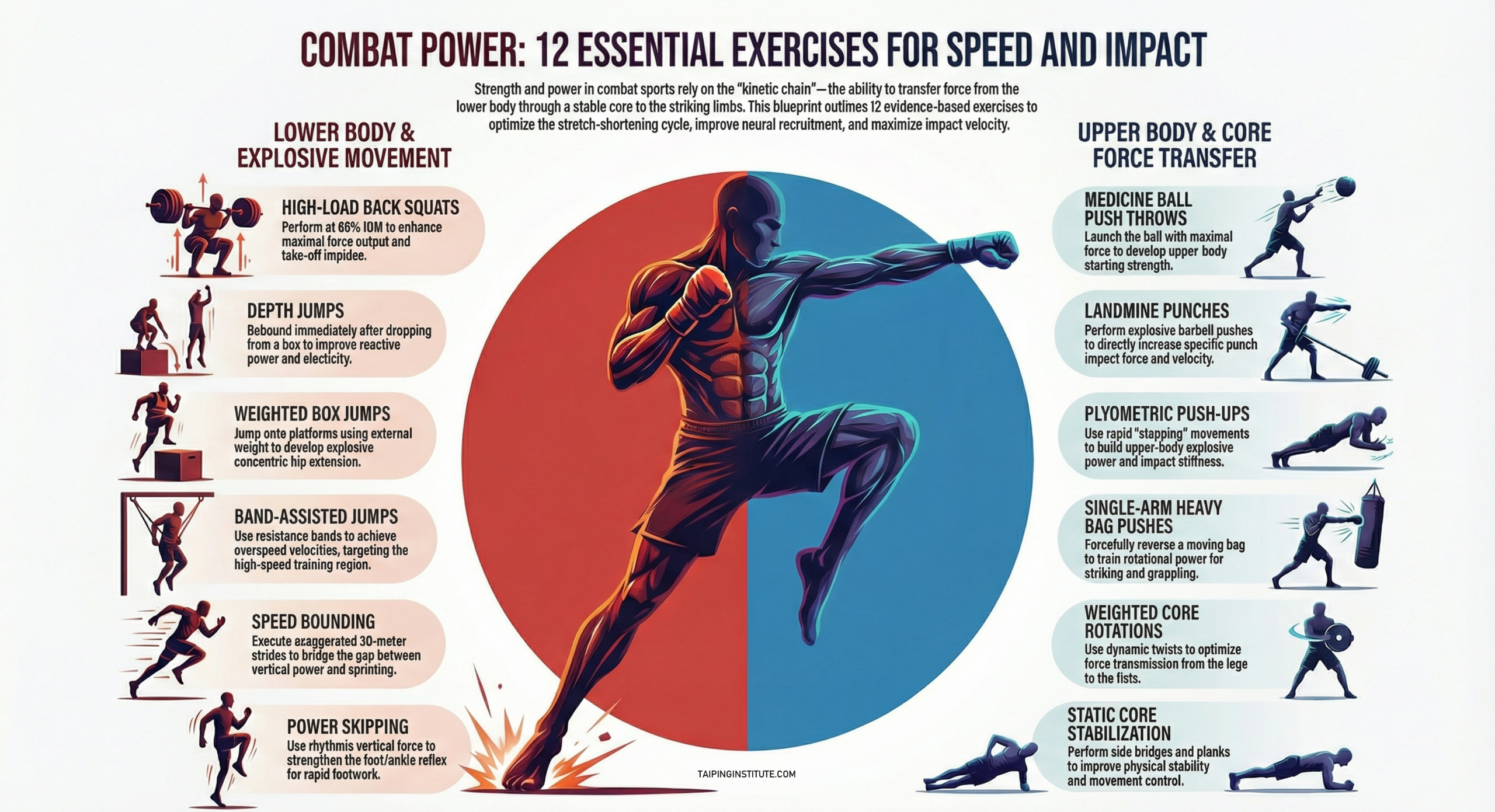
Explosive power, defined as the product of force and velocity, is a critical determinant of success in martial arts combat, governing strike amplitude, execution speed, and postural control. This ability allows practitioners to perform complex maneuvers and deliver high-impact blows by maximizing their neuromuscular capacity. Central to this power is the stretch-shortening cycle (SSC), a physiological mechanism where a muscle stretched rapidly before a contraction subsequently shortens more forcefully. By harnessing the myotatic reflex and tendon elasticity, athletes can produce force outputs significantly greater than those achieved through standard isometric contractions.
Plyometric training serves as a vital bridge between maximal strength and high-speed movement in combat sports. These exercises, such as box jumps and depth jumps, utilize gravity and body weight to condition the nervous system for rapid motor unit recruitment. For example, jumping onto a box trains explosive extension at the hip, knee, and ankle,often called triple extension, which is fundamental to generating take-off impulse. When properly implemented, plyometrics improve the amortization phase, which is the critical transition point between muscle lengthening and shortening. Minimizing this transition time is essential for preserving stored elastic energy and preventing its dissipation as heat during explosive efforts.
The core region acts as a primary hub for power transfer between the extremities, directly influencing the speed of attacking movements. Research indicates that core strength training significantly improves the frequency and impact speed of kicks in Chuojiao and knees within Yanqing Quan. In Bafanquan, core rotation and stabilization allow for the efficient transfer of power from the lower limbs to the fists to maximize impact. Furthermore, a strong core maintains dynamic postural stability through neural regulation, ensuring that force generation is not lost through disruptions in the kinetic chain.
Research into boxing biomechanics reveals that powerful punches are whole-body rotations initiated by the legs and transformed through trunk rotation into horizontal impact force. Elite combatants who demonstrate “high” punch impact forces typically possess greater levels of absolute lower-body maximal strength and explosive power compared to their lower-performing counterparts. Interestingly, while lower-body strength is strongly associated with punch force, upper-body maximal strength often does not differentiate between performance levels. Instead, the upper body relies more on ballistic qualities and rate of force development (RFD) to “stiffen” the limb immediately before impact, creating what is known as effective mass.
Advanced athletes may benefit from French Contrast Training (FCT), a method that integrates heavy compound exercises, plyometrics, and assisted jumps into a single session to target the entire force-velocity curve. This protocol leverages the principles of Post-Activation Performance Enhancement (PAPE), where high-load stimuli (such as 85% 1RM back squats) acutely increase the central nervous system’s excitability and motor unit recruitment. In elite martial arts populations, FCT has been shown to elicit superior improvements in peak power output and rate of force development compared to traditional resistance training alone. Such high-intensity strategies are particularly effective for advanced practitioners, whereas intermediate athletes may require longer recovery windows to manage fatigue.
Effective power training must follow a logical progression to maximize adaptations while minimizing injury risk, moving from stable to unstable surfaces and bilateral to unilateral movements. Practitioners should master double-leg landings before progressing to single-leg hops, which provide a greater proprioceptive challenge and simulate the requirements of cutting or single-leg takeoffs. Training protocols should be sport-specific; for example, boxers might prioritize anti-rotation training to enhance striking power, whereas taekwondo players may focus on single-leg balance and core control to improve kick stability. Finally, adequate recovery intervals are mandatory, as fatigued muscles lose the ability to harness the stretch-shortening cycle effectively.