The shoulder is one of the most mobile yet vulnerable complexes in the human body, serving as a critical hub for dynamic actions ranging from tennis serves to martial arts strikes. Enhancing its function requires far more than simple muscle hypertrophy; it involves a sophisticated neuromuscular coactivation of the rotator cuff and scapulothoracic stabilizers. For athletes in contact or throwing sports, these muscles are vital for maintaining the humeral head within the joint during high-velocity maneuvers. Without this integrated stability, the shoulder cannot safely transfer the forces generated from the lower body through the kinetic chain.
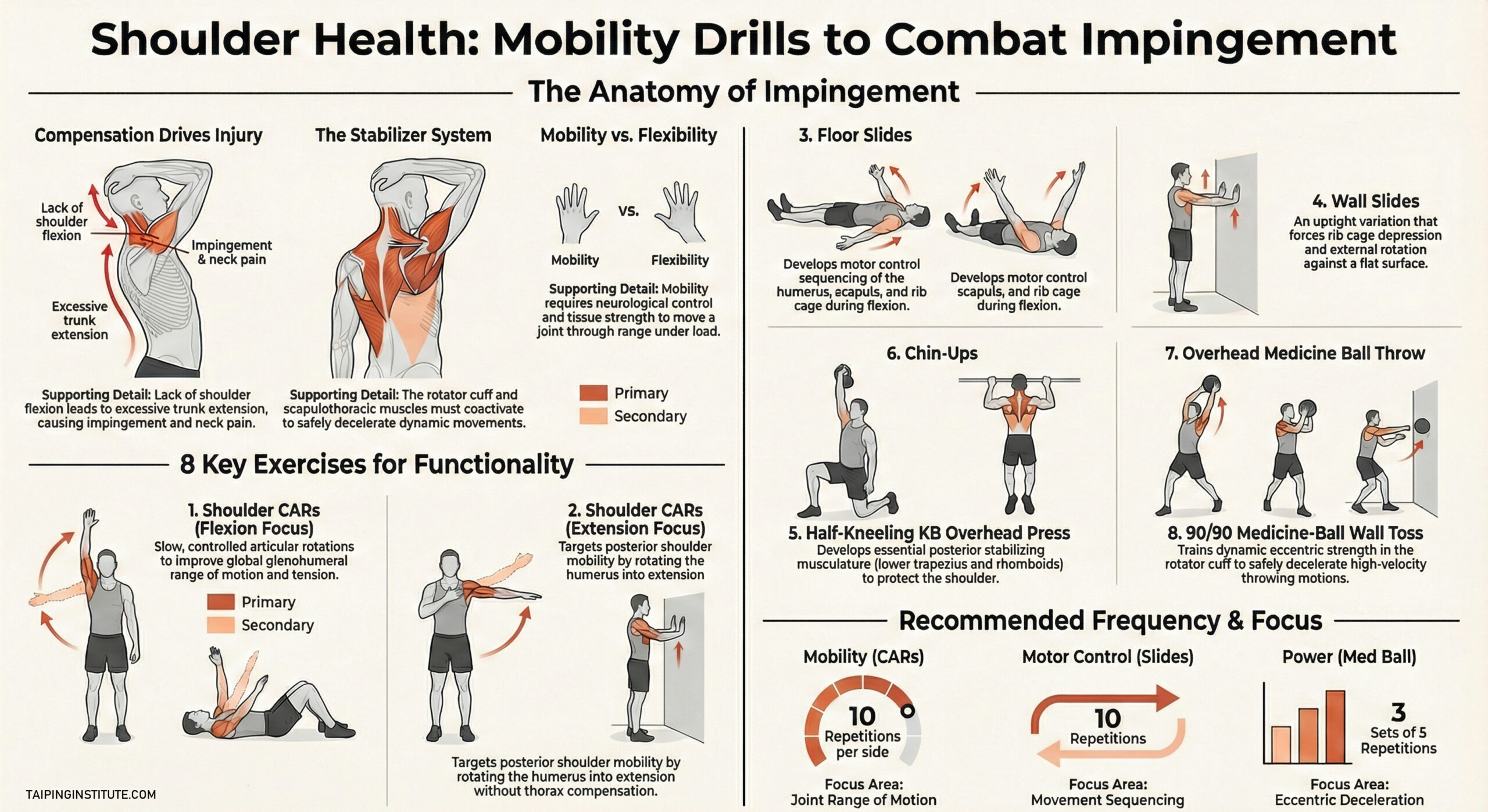
A fundamental step in improving performance is distinguishing between flexibility and mobility: while flexibility is a passive range of motion, mobility requires active neurological control of the joint. This distinction is critical because the body is regionally interdependent, meaning each joint relies on the proper function of those above and below it. When an athlete lacks adequate shoulder mobility, the body often adopts less efficient strategies to complete a task, such as substituting trunk extension for shoulder flexion. These compensatory movements are a primary driver of shoulder pain and long-term joint degradation.
To specifically reduce the risk of shoulder impingement, mobility drills must focus on retraining the motor control sequencing of the humerus, scapula, and rib cage. The Floor Slide is a foundational exercise for this purpose, teaching the trainee to achieve overhead flexion while maintaining rib cage depression. Progressing to a Wall Slide increases the challenge by removing the support of the ground and requiring the athlete to rotate the shoulder against gravity actively. These drills ensure the joint can move independently of the spine, preventing the “pinching” of soft tissues during overhead movements.
Another essential component of shoulder health is the use of Shoulder-Controlled Articular Rotations (CARs), which develop neurological control at the end ranges of motion. Unlike the bench press, which pins the shoulder blades against a bench, closed-chain push-ups allow for the free movement of the scapula. This movement is necessary to develop the serratus anterior and infraspinatus, muscles that stabilize the shoulder girdle during explosive impacts. Furthermore, horizontal pulling exercises like the dumbbell row are vital for building the posterior strength needed to protect the joint capsule.
A comprehensive program should ultimately balance four categories of movement: horizontal pushing, vertical pushing, horizontal pulling, and vertical pulling. Beyond basic strength, overhead medicine ball throws are highly effective for conditioning the shoulder to absorb eccentric stresses during the deceleration phase of a throw or strike. By progressively exposing the nervous system to high-velocity movements and maintaining active joint range, athletes can significantly reduce their likelihood of suffering strain or impingement injuries. These strategies provide the “musculoskeletal braking system” necessary for both elite performance and long-term joint health.