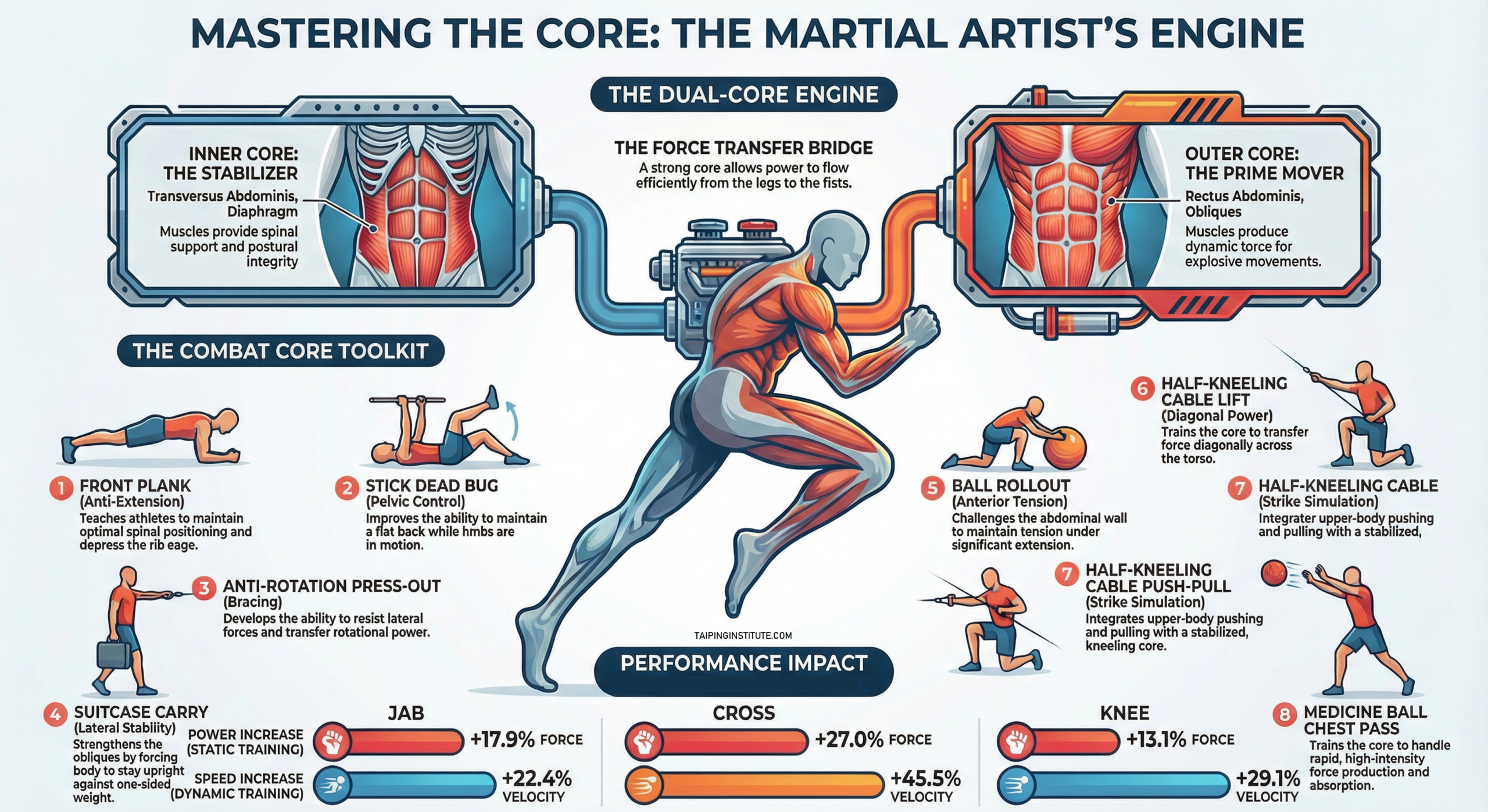
The core is not merely a set of aesthetic abdominal muscles but an integrated system comprising the front abdominals, paraspinal and gluteus muscles, diaphragm, obliques, and pelvic floor. Functionally, it is divided into two subsystems: the inner core and the outer core. The inner core: consisting of the transversus abdominis, multifidus, diaphragm, and pelvic floor, provides internal support and spinal stability, maintaining body integrity during explosive movements. In contrast, the outer core, including the rectus abdominis, erector spinae, and obliques—is responsible for producing dynamic movement and resisting external forces across multiple planes of motion. These systems must work in a coordinated fashion to allow the body to operate as a single, integrated unit.
A functional core is a vital prerequisite for long-term health and injury prevention. It acts as a musculoskeletal braking system, enabling the body to absorb impact and decelerate high-velocity limbs safely. By facilitating proper positioning of the rib cage and pelvis, the core musculature relieves shearing forces on the intervertebral discs. Furthermore, strong core control prevents “trunk dominance,” a lack of stability during jumping and landing that increases torque on the ligaments of the knee; consequently, core training is a primary strategy for reducing the risk of non-contact ACL ruptures. This regional interdependence ensures that one joint can move effectively without causing compensatory stress on the joints above or below it.
Inner-Core Muscles
The inner core is composed of the transversus abdominis, multifidus, diaphragm, and pelvic floor.
• Primary Function: These muscles are primarily responsible for providing internal support and stability for the midsection.
• Role in Movement: They work synergistically to maintain body integrity and optimal posture, especially during explosive plyometric actions like jumping and throwing.
• Safety Mechanism: By maintaining ideal positioning of the rib cage and pelvis, the inner core helps relieve shearing forces on the intervertebral discs.
Outer-Core Muscles
The outer core includes the rectus abdominis, the erector spinae group (iliocostalis, longissimus, and spinalis), and the internal and external obliques.
• Primary Function: These muscles are involved in the production of dynamic movement and external force.
• Specific Actions: They work in a coordinated fashion to execute various maneuvers:
◦ Trunk Flexion: Driven by the rectus abdominis and iliopsoas.
◦ Back Extension: Executed by the erector spinae in combination with hip extensors like the glutes and hamstrings.
◦ Torso Rotation and Lateral Flexion: Facilitated by the internal and external obliques.
Functional Interaction
While the inner core provides a stable base through static contractions and spinal support, the outer core produces the force and power necessary for athletic movements like sprinting and striking. In combat sports, this interaction is critical; for example, a boxer uses core rotation and stabilization to transfer power from the lower limbs to the fists to maximize impact.
Functional training often emphasizes “anti-movement” exercises, where the core acts as an isometric and eccentric controller to buttress the spine and resist unwanted motion during high-velocity activities. Training both systems in a balanced manner is essential not only for enhancing technical performance—such as the speed and power of kicks and punches—but also for reducing the risk of injury by maintaining a solid kinetic chain
In martial arts, the core acts as the primary hub for power transfer between the lower and upper extremities. Research into boxing biomechanics shows that powerful punches are whole-body rotations initiated by the legs and transformed through the trunk into horizontal impact force. Systematic reviews indicate that core strength training significantly enhances striking power, impact speed, and kicking frequency in disciplines such as karate, taekwondo, and Muay Thai. For grappling arts like wrestling and jiu-jitsu, core stability supports the pulling and twisting maneuvers required for throws while protecting the practitioner’s lumbar spine from the stress of manipulating an opponent’s weight.
Modern training methodologies have shifted from traditional flexion exercises, like crunches, toward “anti-movement” protocols. Functionally, the core works primarily as an isometric and eccentric controller to buttress the spine and resist unwanted motion during high-velocity activities. These exercises are categorized by the motion they prevent: anti-extension (e.g., Front Plank or Stick Dead Bug) maintains sagittal plane control; anti-rotation (e.g., Anti-Rotation Press-Out) stabilizes the transverse plane; and anti-lateral flexion (e.g., Suitcase Carry) manages the frontal plane. This approach ensures the core functions as a transducer of force, allowing power generated in the legs to reach the fists or feet without energy leaks in the kinetic chain.
To maximize performance, training should be systematic and sport-specific. A recommended training cycle lasts 6 to 12 weeks, utilizing three sessions per week that integrate isometric holds, dynamic strength, and explosive power drills like medicine ball rotational throws. Practitioners should tailor exercises to their specific needs: boxers may prioritize anti-rotation training to improve punch generation, while kicking-based athletes focus on single-leg balance and pelvic control to stabilize their strikes. Advanced martial artists may also benefit from French Contrast Training (FCT), which combines heavy resistance exercises with plyometrics to stimulate superior neuromuscular adaptations in peak power output and rate of force development.