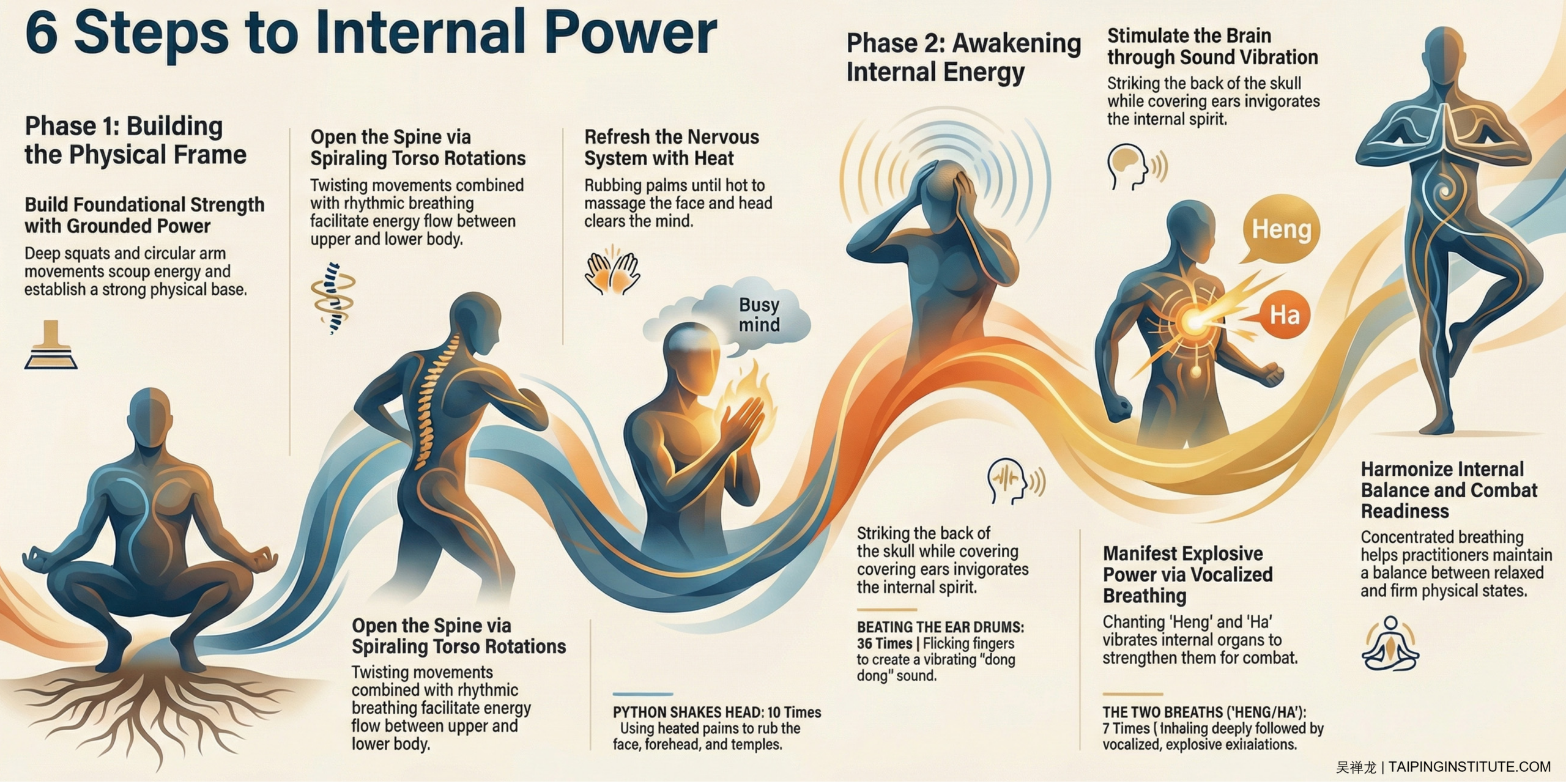
M Zhang taught a specific series of internal power exercises as the foundational method for refining essence into energy. These methods serve as the “mother” of internal development, designed specifically to clarify power and strengthen the internal organs. The series includes seven distinct movements, such as “Lion Plays with Ball” and “Divine Dragon Turns Head,” which bridge the gap between physical motion and internal energy cultivation. Through these exercises, the practitioner establishes a deep connection with the Dantian, ensuring that energy is abundant and flows freely to the four extremities.
The primary biomechanical requirement of these exercises is to “stretch the tendons and pull the bones” (Shen Jin Ba Gu), which increases the body’s elasticity and range of power. Techniques like “Extracting Tendons from Behind the Brain” and “Beating the Ear Drums” specifically invigorate the nervous system and stimulate the internal spirit. Furthermore, the vocalised breathing of the “Heng” and “Ha” sounds is used to vibrate the internal organs, effectively tempering the body’s core. This rigorous internal preparation ensures that the body functions like a “taut crossbow” ready to release explosive force.
The following is a comprehensive outline of seven techniques, their training descriptions, and their specific benefits:
1. Lion Plays with Ball / Lifting the Moon from the Sea Floor (Shizi Tian Qiu / Yue Lao Di Hai – 狮子舔球 / 月捞底海)
Description: This opening sequence involves a deep squat in a horse stance, using circular arm movements to “scoop” energy from below and guide it into the Dantian.Benefits: It builds foundational leg strength and establishes the initial connection between physical movement and internal energy cultivation.
2. Divine Dragon Turns Head (Shen Long Hui Shou – 神龙回头)
Description: A rotation exercise where the practitioner twists the torso while extending the arms, focusing on a deep, rhythmic breath that aligns with the spiraling motion of the spine. Benefits: It opens the joints of the torso and spine, facilitating the smooth flow of energy between the upper and lower body.
3. Giant Python Shakes Head (Da Mang Yao Tou – 大蟒摇头)
Description: Rub the palms together until they are very hot. Use the palms to rub the face, forehead, temples, and then move to the back of the head and the ears. This should be repeated 10 times.Benefits: It refreshes the central nervous system, connect the energy of the spine and brain, and clears the mind for practice.
4. Extracting Tendons from Behind the Brain (Nao Hou Zhai Jin – 脑后摘筋)
Description: This involves massaging and applying specific pressure or “pulling” motions at the base of the skull and the cervical vertebrae. Benefits: It clears the sensory passages (eyes, ears, and nose) and invigorates the nervous system by releasing tension at the “Jade Pillow” gate.
5. Beating the Ear Drums (Er Gu Jiu Qu – 耳鼓九匝)
Description: Cover both ears tightly with the palms. Use the middle fingers to “flick” or strike against the index fingers (or vice versa) so that they hit the back of the skull. This should produce a vibrating “dong dong” sound inside the head. Perform this strike 36 times.Benefits: It is highly beneficial for the hearing and serves to stimulate the brain and internal spirit.
6. The Two Breaths of ‘Heng’ and ‘Ha’ (Heng Ha Er Qi – 内功哼哈二气)
Description: Rub the palms and look upward toward the sky. Inhale deeply through the nose. As you exhale, vocalise the sound “Heng” through the nose with a closed mouth, then repeat with the sound “Ha” with an open mouth. This is typically practiced 7 times. Benefits: It vibrates the internal organs to strengthen them and is a primary method for manifesting explosive internal power (Bao Fa Jin).
7. The Daily Penetration of Empty and Solid (Xu Shi Ri Guan – 内功虚实日贯)
Description: While focusing on the Dantian, rub the hands from the top of the body down to the lower abdomen. Look up at the sky and release a single, long, concentrated breath. Benefits: This advanced exercise harmonises the “Empty” (relaxed/receptive) and “Solid” (firm/expressive) states of the body, allowing the practitioner to maintain internal balance during combat.
Following internal cultivation, the San Ti Shi (Trinity Stance) acts as the essential “gateway” and “mother” of all Xingyi techniques. It is the cornerstone of Zhu Ji Gong (foundational training), where the practitioner seeks “quietness within motion” to cultivate internal intent. The stance utilizes a unique “Chicken Leg” posture with a specific 30/70 weight distribution, creating a “scissors power” between the legs for ultimate stability. Masters like Guo Yunshen and Shang Yunxiang used this stance to develop such a rooted foundation that they became immovable in the face of external pressure.
Technically, San Ti Shi requires the perfect alignment of the Six Harmonies, bridging internal mental intent with external physical structure. The Internal Three Harmonies (Heart/Mind, Intent, and Qi) must correspond exactly with the External Three Harmonies (Hands/Feet, Elbows/Knees, and Shoulders/Hips). While the body remains still, the internal system is highly active, using the waist as the dominant axis to unify the three sections of the body. This alignment ensures that when a movement is finally initiated, it is backed by the practitioner’s entire mass and internal energy.
These internal foundations and stances directly contribute to the mastery of Bao Fa Jin (Explosive Power) by unifying the body into a single, coherent engine. Power is rooted in the feet, controlled by the waist, and expressed through the hands in a continuous chain of force. The process of “Rising, Falling, Drilling, and Flipping” (Qi, Luo, Zuan, Fan) becomes the technical core of this explosive expression. Without the tendon-stretching developed in neigong and the structural rooting of San Ti Shi, the sudden release of energy would be disjointed and weak.
The ultimate expression of this combined training is known as “Flipping Wave Power” (Fan Lang Jin), characterized by a relentless, wave-like explosive force. This power is described as being “sudden as a thunderbolt” and as heavy as “turning over iron soil”. By using the rising and falling of the body unified with internal intent, the practitioner can unleash a “bursting hard power” in one single breath of energy. Consequently, the internal exercises and San Ti Shi provide the essential “bank” of power that allows for the fierce, sudden, and continuous attacks hallmark of the Shang Style.