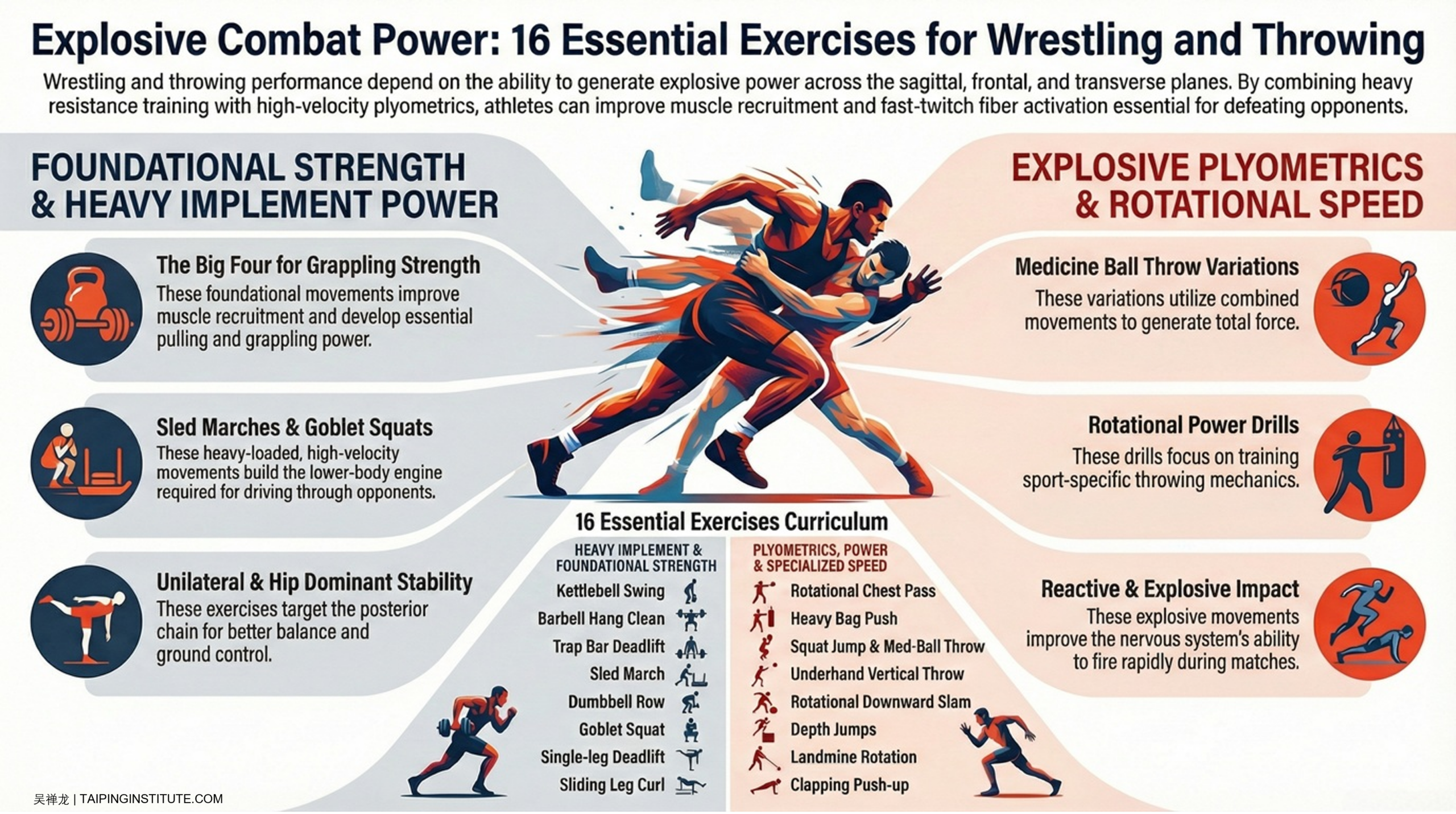
Success in wrestling and throwing disciplines demands more than technical skill,it requires explosive power that can be deployed instantly against a resisting opponent. Research demonstrates that stronger athletes produce greater power outputs, establishing strength as the foundation for explosive performance. Understanding how to develop this power through systematic training can transform an athlete’s ability to execute high-amplitude throws, penetrating takedowns, and dominant positional control on the mat.
The foundation of explosive power in grappling begins with the lower body, specifically through triple extension—the coordinated explosion of the hips, knees, and ankles. This movement pattern appears frequently in jumping, sprinting acceleration, and throwing actions. Exercises like barbell hang cleans, hang snatches, trap bar deadlifts, and kettlebell swings train this fundamental pattern while recruiting fast-twitch muscle fibers essential for moving heavy loads at high velocities. Power cleans specifically help movements become explosive, teaching the neuromuscular system to generate maximal force in minimal time. Sled marching and heavy implement work further develop the raw force production capacity that underpins all explosive actions.
Core strength serves as the critical link between lower-body power generation and upper-body application in grappling scenarios. Core strength forms the foundation of grappling prowess, serving as the powerhouse for executing dynamic movements, maintaining stability, and generating explosive force. Rotational exercises like landmine trunk rotations, medicine ball sit-up chest passes, and split-stance scoop throws develop the ability to generate and control torque through the trunk during throws. Anti-rotation movements such as half-kneeling cable chops and suitcase carries build the stability required to resist unwanted motion while manipulating an opponent’s weight. This multiplanar strength allows wrestlers to safely decelerate during complex transitions and maintain control throughout high-amplitude techniques.
Upper-body pulling and pushing strength proves essential for gripping, controlling, and manipulating opponents. Plyometric exercises capitalize on the stretch-shortening cycle to enhance elastic properties of upper-body musculature. Underhand vertical squat throws specifically target the pulling power needed in wrestling, while medicine ball chest passes, heavy bag pushes, and reactive floor push-ups develop the explosive pushing capacity required for creating space and maintaining pressure. Chin-ups build vertical pulling strength for controlling an opponent’s upper body, and single-arm push passes improve unilateral explosive power. These movements bridge the gap between maximal strength development and the high-speed demands of actually moving another person during live competition.
For advanced practitioners, FCT offers superior neuromuscular adaptations by exploiting Post-Activation Performance Enhancement, where heavy loading acutely increases central nervous system excitability. This method integrates four sequential exercises targeting the entire force-velocity curve: a heavy compound lift (such as 85% 1RM back squat), followed immediately by plyometric exercises like countermovement jumps, then light-load power exercises (approximately 30% 1RM), and finishing with assisted or velocity-emphasized movements. Studies demonstrate that FCT increases rate of force development, movement velocity, and power production. By strategically combining these 16 fundamental exercises with advanced protocols like FCT, combat athletes can systematically develop the explosive capacity required to dominate at elite levels of competition, ensuring they possess not just technical mastery but the physical attributes to impose their will on opponents.