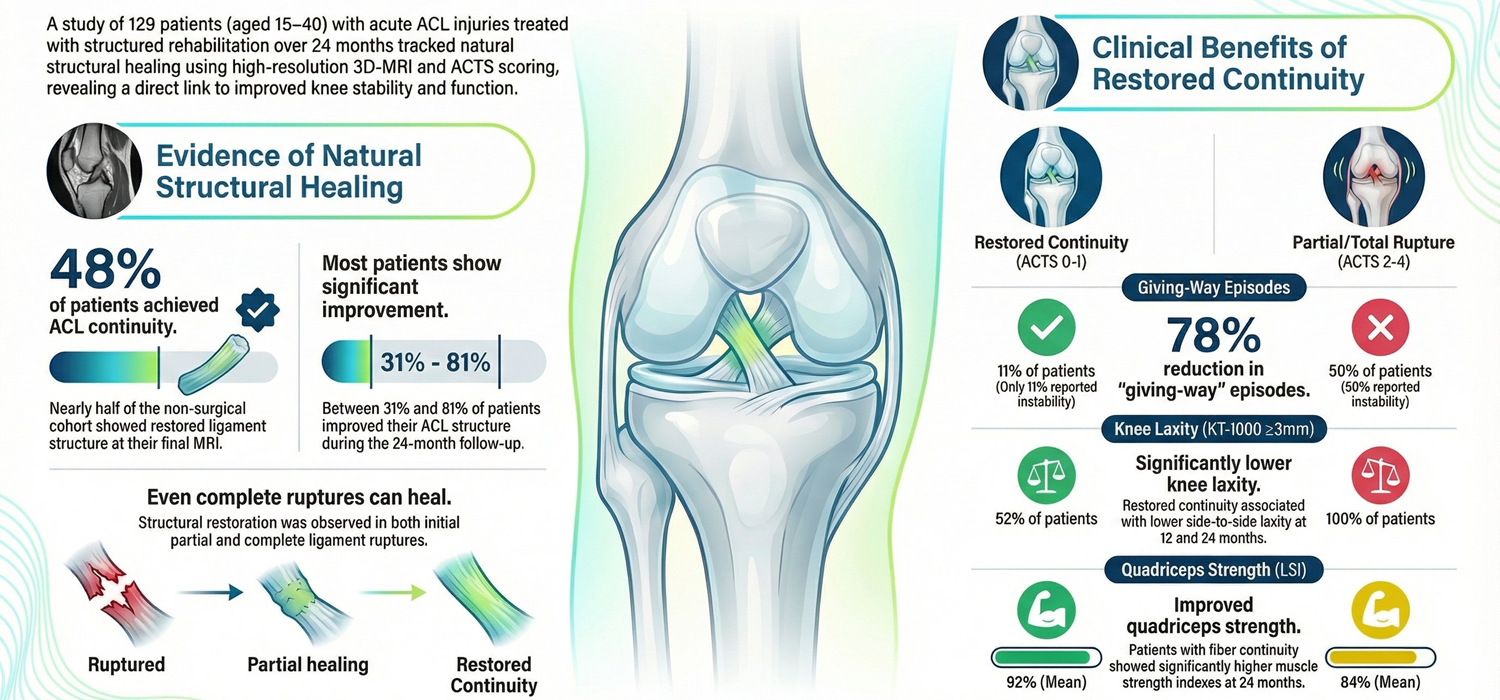
Natural ACL repair is becoming a real option, especially if the tear is new and the knee is otherwise stable. For martial artists, this can mean retaining your own ligament, avoiding surgery, and still being able to play high-level pivoting sports in many circumstances.
MRI now shows that ACLs may mend on their own, not just in stories. In a group that used the Cross Bracing Protocol (CBP), early immobilization at about 90° knee flexion followed by progressive rehab, about 90% of acute ACL ruptures showed a continuous, healed ligament on a 3-month MRI. Those with better healing had higher knee function scores, less laxity, and higher return-to-sport rates at 12 months. For a striker or grappler, that implies the ligament can physically rejoin and act more like a native ACL than a graft. This might help with how the joint feels and how well it controls during cutting, level changes, and scrambling.
Non-operative therapy (including structured bracing and rehabilitation focused on natural healing) can yield functional outcomes similar to those of surgery for isolated ACL injuries. A systematic study and meta-analysis revealed no definitive evidence that reconstruction is superior to conservative treatment regarding subjective outcomes, return to play, or the avoidance of osteoarthritis for isolated ACL injuries, despite surgically repaired knees being passively “tighter.” Pair-matched work in pivoting sports demonstrated comparable 1-year return-to-sport rates (~68%) for both nonoperative and operative groups, encompassing level I sports characterized by significant cutting and pivoting. This means that you might be able to return back to intense sparring and combat without needing a reconstruction right away, as long as you meet the requirements for nonoperative care and promise to go through rehab. Third, preserving your native ligament may be good for your joint health in the long run, which is important if you expect to keep training into your 40s and 50s. An ACL injury is a risk factor for early knee osteoarthritis, and current research does not definitively demonstrate that reconstruction offers superior protection against osteoarthritis compared to high-quality conservative care in isolated tears. Natural healing methods often include ways to improve the joint environment, like low-load cyclical motion, aerobic exercise to improve circulation, and nutrition that supports collagen. These methods may improve the quality of the extracellular matrix and lower stress on the cartilage over time. For martial artists who have been practicing their stances, takedown entrances, and high-impact landings for years, anything that protects their joint cartilage while restoring stability is a big plus
You can use natural healing paths to help you train and recover as a warrior. Clinical commentary on ACL microtrauma says that frequent low-load movement, good sleep, and tailored diet (such vitamin C–enriched gelatin or collagen peptides before loading to increase collagen synthesis) can help ligaments repair faster. Adding these behaviors to your daily routine off the the training area, like steady-state cycling or walking, controlled knee loading, and tissue work, works well with active recovery days and can make your whole training week easier on your joints instead of just hammering strength and conditioning
Non-operative, healing-focused treatments frequently facilitate a more gradual, self-directed return to martial arts skills. After the first phase of bracing in CBP, athletes move on to supervised, goal-oriented rehabilitation that can be personalized to the needs of their activity. Those who healed better on MRI were more likely to return to their prior level of sport. A Shuaijiao player might put more emphasis on closed-chain, controlled grappling situations and put off open-chain pivots that are aggressive. A competitive fighter might bring back straight-line strikes and clinches before big switch kicks and spinning attacks. This sport-specific, stepwise approach respects the biology of healing while also keeping you engaged to your talent. Natural ACL healing isn’t the best choice for everyone, but for the right person, it gives them more options instead of making them choose between “surgery or quit.” When deciding if a healing-focused regimen is right for you, you should think about things like when the rupture happened (acute vs. chronic), whether there was any damage to the meniscus or cartilage, how flexible you are at baseline, and what your competitive goals are. The most important thing for martial artists to remember is that we now have more proof that an ACL can heal and support high-demand, pivoting sports with structured nonoperative care. This means that when you talk to your sports doctor and physiotherapist, you should talk about natural healing methods as well as reconstruction timelines.