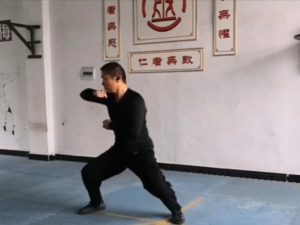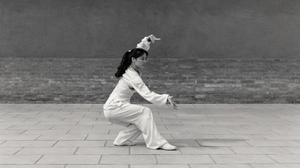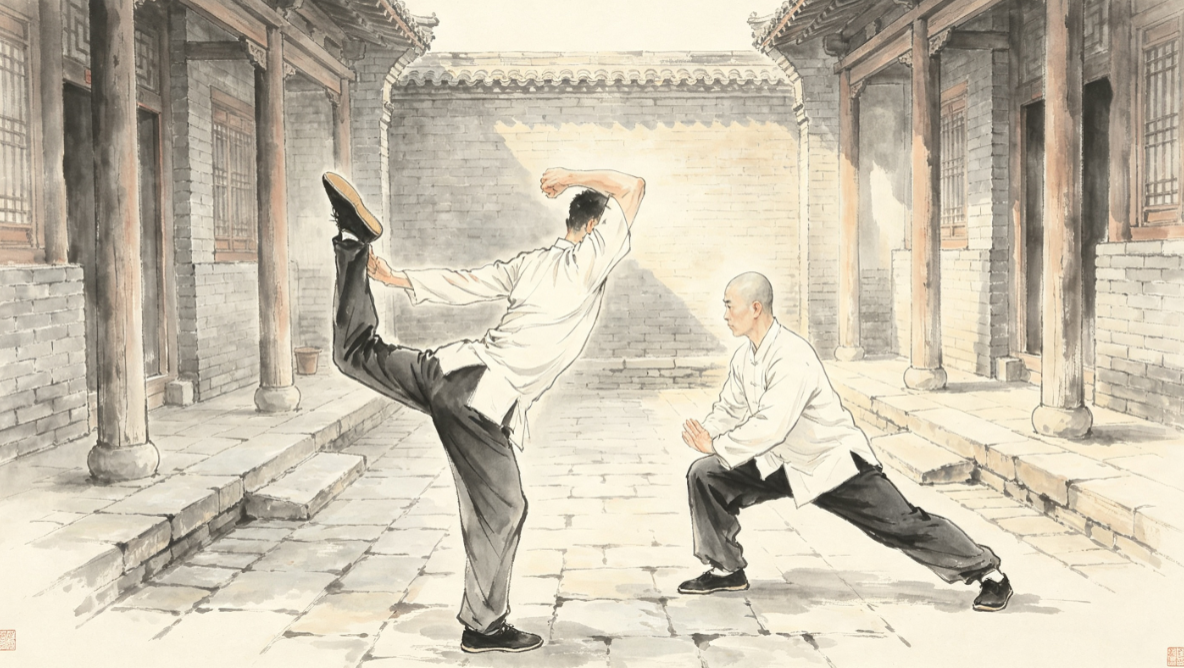
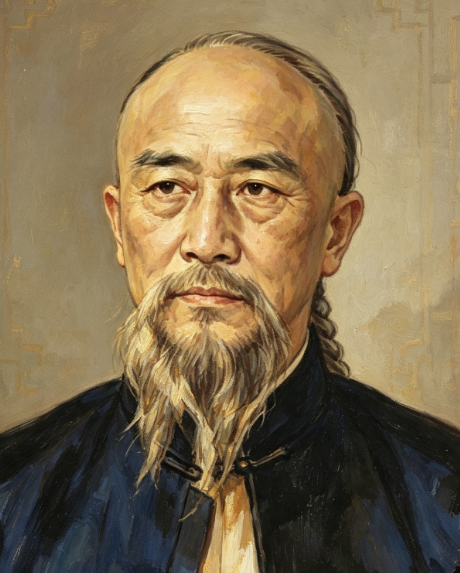
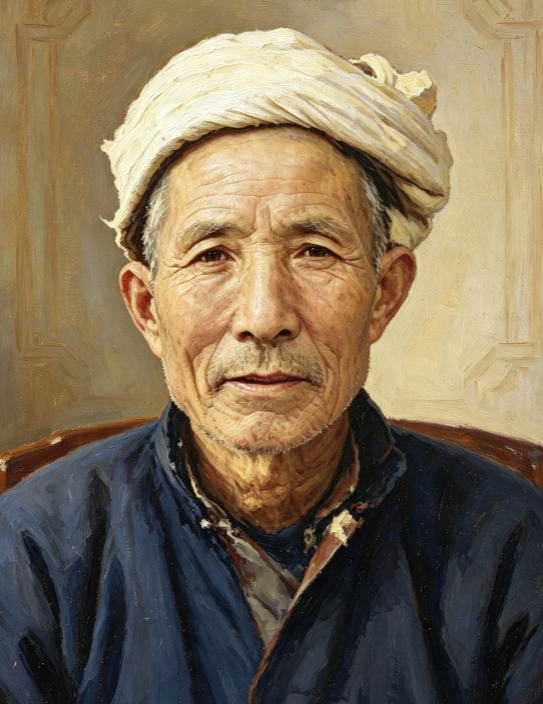
He Yunheng (贺运亨, 1839–1924), a native of Menggao Village, Taigu, Shanxi, and the second Shanxi disciple of Li Laoneng, the founder of Xingyi Quan, and the second‑generation Chuojiao grand master Wei Changyi (魏昌义, est 1835–1915, from Xiqizhuang, Lixian County, Hebei), who was then in charge of the Fuyuan Security Logistics Bureau in Beijing, formed a bond through martial arts.
They had close relations, disregarded sectarian boundaries, learned from each other, and thus promoted exchanges between Xingyi Quan and Chuojiao techniques, creating a celebrated story of mutual transmission of secret skills.
Around 1870–1901, He Laoxi’er (贺老西儿, i.e., He Yunheng) ran a grain shop on Liangshidian Street in Beijing and had close ties with Liu Guanlan (刘观澜) and Wei Changyi, who operated the Fuyuan Escort Agency. Until 1900, when the Eight‑Power Allied Forces invaded Beijing and both the grain shop and the escort agency went bankrupt and closed, the facts of Wei Changyi and He Yunheng mutually exchanging and learning from each other’s Xingyi and Chuojiao skills have been consistently passed down by both sides to this day. Around 1900–1901, due to the corrupt Qing government’s abrupt shift from using the Boxers to “support the Qing and destroy the foreign” to suppressing the “Boxer bandits,” the patriotic martial arts celebrities He Yunheng and Wei Changyi, who had actively supported the Boxers, went together to Menggao Village in Taigu to take refuge. There, He Yunheng introduced Wei Changyi and his disciples to He’s juniors Li Fuzhen and Bu Xuekuan (布学宽), and they mutually transmitted Xingyi and Chuojiao. This fact is not only supported by similar oral traditions, but also by the Yuanyang Jiao routine passed down through generations in Xingyi Quan practitioners, and the Xingyi techniques mastered by the Chuojiao practitioners. In addition, as early as 1982, in response to the national call for the collation of martial arts, the Chuojiao lineage of Lixian County compiled a genealogy that explicitly recorded: “He Laoxi’er introduced Wei Changyi to coach the junior Taigu Xingyi practitioners Li Fuzhen and Bu Xuekuan, and accepted them as disciples,” which also serves as supporting evidence.
To establish the dates of the matter we studied Wei Changyi’s background. This also comes from his direct blood descendants, such as Wei Yanzhong (70 years old, fourth generation below Wei Changyi, great‑great‑grandson of the same clan), Wei Jinliang (魏金良, 82 years old, fourth generation below Wei Changyi, great‑great‑grandson of Wei Changyi’s cousin branch, specifically the great‑great‑grandson of Wei Changyi’s second younger brother Wei Wanxuan 魏万选). Some of the artefacts include: Wei Changyi’s paternal aunt had been granted a chastity archway by the Qing government in the first year of the Jiaqing reign (1795). This archway was damaged during the Cultural Revolution, but remnants of its stone slabs still exist.
The existing Wei family genealogy records that Wei Changyi was one of three brothers: Wei Changyi himself, Wei Jianrang (魏俭让, younger brother), and Wei Wanxuan (魏万选 second younger brother). Wei Jianrang had seven sons, of whom the third was Wei Zankui. Wei Changyi’s nephew Wei Zankui (1854-1951), from Qi County became a member of the Imperial guards and a sworn brother of Da Liuhe Men Liu Dekuan. In 1900, Wei Zankui fought against the Foreign Eight Alliances and protected the Empress Dowager, he became a high rank (Si Jing Daidao) and his boxing named “Yu Fanzi” (Imperial Fanzi) as a result. Wei Zanui’s disciples include Wei Xing, Wei Youcai, Wei Xishen, Wu Zhentang, Xiao Chunrong and Wu Binlou.
At the age of 17 or 18, Wei Changyi went from village to village selling bean sprouts. Because he was weak, villagers from other villages often bullied him, igniting a strong desire to learn martial arts. He first learned Chuojiao foundations from his brother-in-law, who was also the older brother of Liu Guanlan. Every day, he would carry a load of bean sprouts from Qizhuang to Zhaoduanzhuang, a distance of eighteen li, to sell them. After selling the sprouts, he would practice boxing at his brother-in-law’s house and walk back at night. He’d walk those eighteen li back, practicing his kicking techniques along the way. That’s how he developed his infallible “Mandarin Duck Kicks” (Yuanyang Jiao). Only after he had achieved a certain level of proficiency did they allow him to become a formal disciple of Feng Keshan. He then went to Zhaoduanzhuang (赵锻庄) to find his cousin Liu Guanlan and learn Chuojiao boxing under the title of fellow disciple. Liu Guanlan’s elder brother Liu Pangui (刘攀桂) was Wei Changyi’s brother‑in‑law. Liu Guanlan’s younger brother Liu Guixin (刘桂馨) was conferred an official position by the Qing government (evidenced by an extant imperial plaque). Liu Guanlan once operated the Fuyuan Escort Agency at Xizhushikou in Beijing until it declined due to the Eight‑Power Allied Forces’ entry into the capital. The Agency was owned by Liu Guanlan (神腿赛活猴 刘观澜) since 1842 or so, but after Liu’s semi-retirement in Li County, it was predominantly managed by Wang Zhan’ao and Wei Changyi.
Appendix: Visiting the Wei family descendants
On 19 December 2021, Wei Yanzhong, a clansman of Wei Changyi in Qizhuang, Lixian County, once again verified with Wei Jinliang, the grandson of Wei Changyi’s grandson (four generations younger than Wei Changyi). He is now 82 years old and is four generations apart from Wei Changyi, with a difference of 100 years (which happens to fit the general average of 25 years per generation). Wei Jinliang was born in 1940.
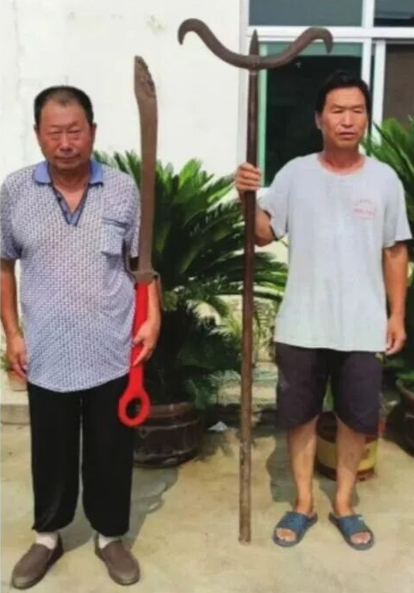
The oldest Chuojiao practitioner in Xiqizhuang today is Wei Yanzhong (魏彦忠). Wei Yanzhong (70 years old, fourth generation below Wei Changyi, great‑great‑grandson of the same clan); Wei Jinliang (82 years old, fourth generation below Wei Changyi, great‑great‑grandson of Wei Changyi’s cousin branch, specifically the great‑great‑grandson of Wei Changyi’s second younger brother Wei Wanxuan); Wei Zhonghe (魏忠贺, fifth generation below Wei Changyi’s direct brother Wei Jianrang); Wei Yankai (魏彦楷); Wei Xinguang (魏新广, fifth generation below Wei Changyi’s direct line).
On the left is Wei Yankai, fifth generation below Wei Changyi, holding the double‑handed long sabre (双手带) that Senior Wei Changyi once used; on the right is Wei Xinguang, of the same generation as Wei Yankai, holding the tang (镗) weapon that Senior Wei Changyi once used. According to the legends passed down through generations of the Wei family, these two weapons rendered great service when following Wei Changyi in suppressing bandits and escorting goods, and are of commemorative significance and great value.
Wei Changyi’s key disciple, Wang Yingfeng (1876-1956) from nearby Zhujiazuo village, Liushi Town of Li county (it is between Zhaoduanzhuang and Qi county). Wang studied from 1889 to 1900, travelling 10km daily to train with Wei Changyi. By that time Wei Zankui had already been an Imperial guard, whilst Wang kept studying with Wei Changyi, apparently inheriting much of his martial arts and records. Wang became a Biaoshi (Security Officer) travelling across the country and harnessing his skills. However, around 1910 as he was travelling southward with some cargo, he heard notice that his teacher Wei Changyi was seriously ill. He immediately left his post and back to be at his teacher’s side. For over 100 days he served as his teachers nurse. So this provides understanding of the last days of Wei Chanyi.
Together with Wei Xinguang (魏新广), a fifth‑generation direct descendant of Wei Changyi, they went directly to the Wei family ancestral graveyard. We examined and photographed the tombstone of Wei Jianrang (魏俭让), Wei Changyi’s second younger brother. Then immediately contacted Teacher Zhang Liwei (张立伟), an epigraphic expert at the Liangbin Huangzhou Memorial Hall in Lixian County, and sent him the results and all the photos. After detailed study and collation, Teacher Zhang sent back the transcribed texts from both the front and back of the stele.
Erected on an auspicious day in the early spring of the 14th year of the Republic of China (1925).
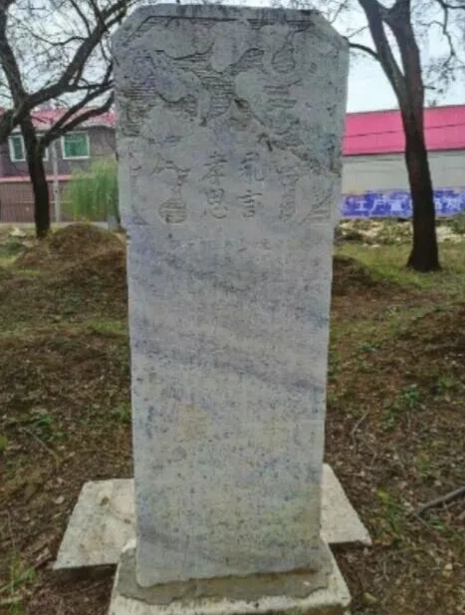
The Gentleman Wei, courtesy name Jianrang, lived for generations in Qijiazhuang, Liwu (Lixian). His late father, courtesy name Yuanheng, had three sons: the eldest was Wei Changyi, the youngest was Wei Wanxuan (魏万选), and he was the second. In his youth he was intelligent and fond of reading. Although he did not study under a teacher for long, he was able to grasp the main ideas of the books. When he reached adulthood, with increasing household expenses, the family fortune gradually declined. Unable to bear burdening his father with the family’s difficulties, he gave up studying and took up farming. He personally managed the household affairs, being diligent and thrifty, and attended to everything himself, so that the family became moderately well‑off. His wife, née Xu, assisted in internal affairs; above, she was filial to her parents‑in‑law, and below, she showed universal love to her nephews and nieces. She personally attended to all household tasks and fully fulfilled her duties as a wife. He was filial to his parents and respectful to his elders, and had good methods in educating his children. At last, heaven favoured him, and his descendants multiplied. He lived to a great old age, which is proof that heaven blesses good people. He passed away on the 19th day of the first month of the 7th year of the Republic of China (1918), at the age of 82. His wife died of illness on the 10th day of the seventh month of the 11th year of the Republic of China (1922), at the age of 86. He had seven sons: the eldest, Zanxing (赞兴), died early; the second, Zancheng (赞成), was adopted as the heir of Wanxuan. Their grandsons and sons, including Zan Kui (Zankui), Shouchang (寿长), and others, planned to carve this stele as a tomb inscription. They asked me, but I am poor at writing and do not know how to embellish, so I have merely recounted his life as follows.
Composed by Xu Jie (徐杰), a former county school student and graduate of the Zhili Superior Normal School.
Calligraphy by Xu Jianbang (许建邦), a graduate of the Beiyang Police Academy and a single‑grade normal school graduate.
Front stele heading: “Source of the wood and head of the stream” (木本水源). Rear stele heading: “Eternal remembrance of filial piety” (永言孝思).
Notes: 1. The characters in brackets are not certain. 2. The meaning of the front stele phrase “Venerable ancestor and mother Wei Wang” (显祖考妣魏王) is not understood.
After studying the stele surface and the inscription, the following conclusions can be drawn:
- The tomb’s occupant is Wei Jianrang. His father was Wei Yuanheng (魏元衡); his elder brother was Wei Changyi, and his younger brother was Wei Wanxuan. Because of family poverty, he gave up studying and took up farming from a young age. He and his wife were filial to their parents and had good methods in raising children.
- He had seven sons; the third was Wei Zankui.
- Wei Jianrang was born in 1837 (the 17th year of the Daoguang reign) and died in 1918 (the 7th year of the Republic of China). Through this re‑verification of Wei Jianrang’s tombstone, we can further confirm that Wei Changyi’s birth year should be prior to 1837. According to most of the current clan members in the village, Wei Jianrang and his elder brother Wei Changyi once studied together, and Wei Changyi stopped studying two years earlier to sell bean sprouts, so he was probably about two years older than Wei Jianrang. On this basis, it is confirmed that Wei Changyi’s more accurate birth year should be 1835.