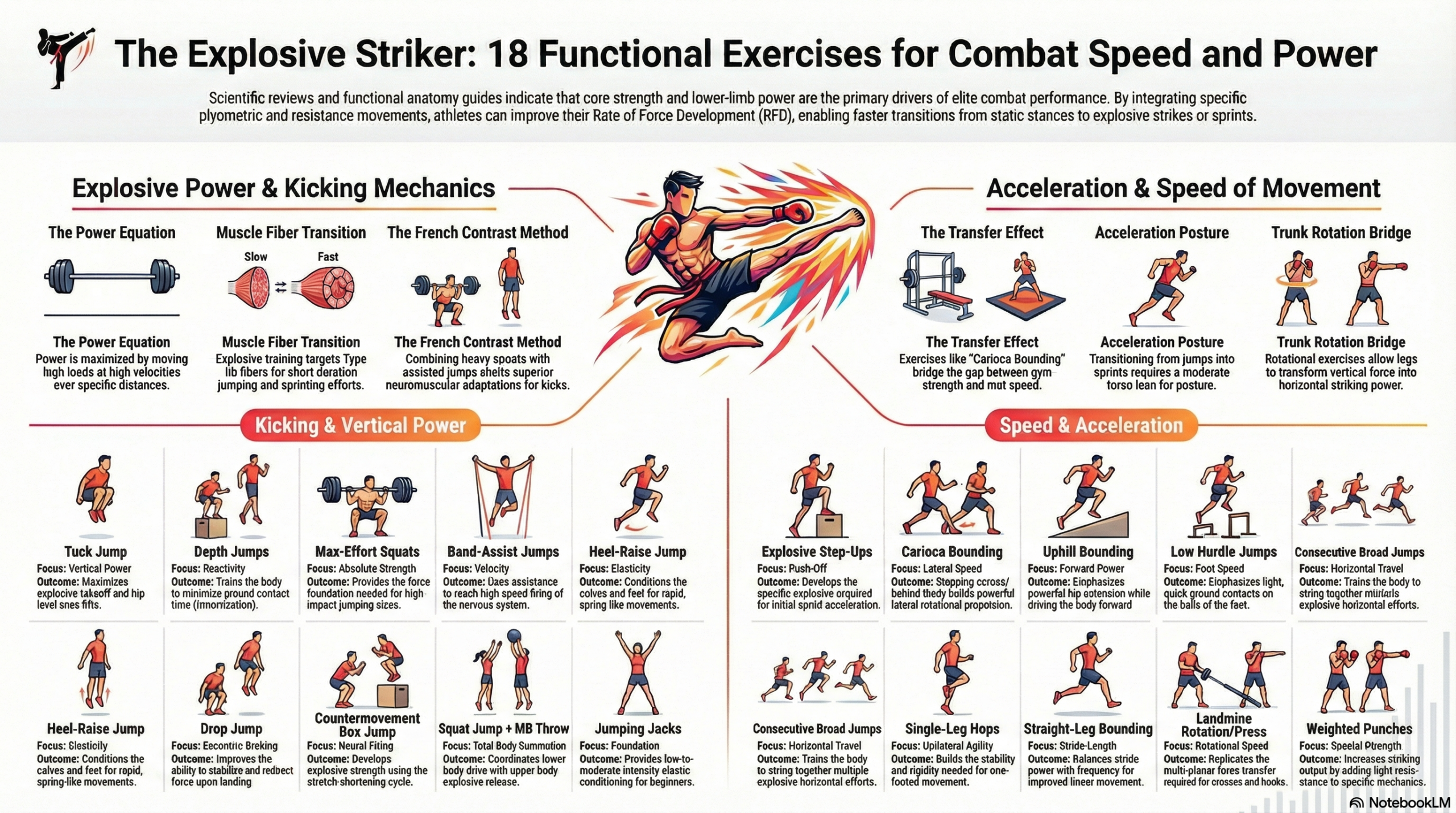
Lower-limb strength and power are critical for martial arts athletes to perform complex maneuvers such as aerial outward swings. These physiological attributes govern execution speed, movement amplitude, and postural control during the high-stress environment of competitive combat. Specifically, maximal strength provides the necessary take-off impulse, while rapid force development and eccentric braking stabilize landings and reduce ground contact time. A well-balanced program for martial arts must include a variety of drills done bilaterally and unilaterally across all planes of motion to prepare for the unpredictability of combat.
Ligament dominance and trunk dominance are two of four neuromuscular imbalances identified by researchers as underlying mechanisms for ACL (anterior cruciate ligament) injuries. While both deficiencies increase the risk of injury during dynamic movements like jumping and landing, they stem from different failures in the body’s stabilizing systems.
Ligament dominance occurs when an athlete relies on their ligaments to control movement instead of using their muscular system to stabilize the body. This is primarily characterized by the hips and knees collapsing inward upon landing, commonly known as a knock-kneed or valgus position. Because the athlete lacks the ability to activate their trunk and hip stabilizers, the primary movers (such as the glutes and hamstrings) fail to control the motion, forcing the ligaments to absorb high forces and causing increased stress at the hip, knee, and ankle joints. Other indicators include a narrow foot landing or the knee moving past the toe.
Trunk dominance, by contrast, is a failure to coordinate the core musculature to control the torso during movement. When an athlete cannot stabilize their center of mass over their base of support, they produce large ground reaction forces that the body cannot properly dissipate. This excessive motion of the trunk creates increased force and torque that is transferred directly to the ligaments of the knee. Key indicators of trunk dominance during assessment include landing off balance, an inability to maintain balance over the base of support, and not landing in the same footprint as takeoff.
The difference lies in where the control is lost: ligament dominance is a failure of lower-limb muscular stabilization leading to joint collapse, whereas trunk dominance is a failure of midsection coordination leading to undissipated impact forces. To reduce these risks, plyometric training is used to teach athletes how to stabilize their center of mass and utilize the musculoskeletal braking system to absorb forces eccentrically rather than relying on connective tissue.
To support jumping kicks, practitioners should focus on foundational plyometrics that maximize vertical separation and explosive hip extension. The Box Jump from a Static Start and the Hurdle Jump train the athlete to forcefully extend the hips, knees, and ankles, often termed triple extension. Tuck Jumps and Heel-Raise Jumps simulate the requirements for clearing obstacles while teaching the hip flexors to cycle rapidly during flight. Additionally, Pogo Jumps and Stair Jumps are essential for developing concentric power and the rhythmic, elastic ground contacts needed for successive aerial strikes.
Acceleration and stepping speed rely heavily on horizontal force and cyclical leg power. Alternate-Leg Bounding, Speed Bounds, and Uphill Bounds build the exaggerated knee drive and hip extension required for powerful, elongated strides. To improve lateral agility and footwork, Carioca Bounds introduce rotational forces between the hips and shoulders, enhancing coordination during multidirectional movement. Power Skipping conditions the reflexive properties of the lower leg, while Explosive Step-Ups specifically target the initial push-off strength required for rapid acceleration from a standstill.
Reactive agility and speed of movement require exceptional single-leg stability and the ability to handle deceleration forces. Single-Leg Hurdle Hops and 45-Degree Bounds prepare athletes for the stressors of cutting and re-accelerating in the sagittal, frontal, and transverse planes. Reaction Box Jumps utilize audible or visual stimuli to reduce reaction time and improve the rate of force development for explosive efforts. Drop Jumps and Ankle Hops focus on eccentric loading and ankle joint stiffness to enhance the body’s elastic response. Finally, the Single-Leg Box Hop from Lunge develops unilateral power for driving into an opponent from low, transitional postures.
Integrating these 18 exercises into a systematic program can significantly enhance technical performance and reduce injury risk. Core strength training provides the necessary hub for this power transfer, improving the striking force and impact speed of roundhouse kicks and whip kicks. For elite athletes, advanced protocols like FCT, which integrate heavy compound exercises with assisted jumps, can elicit superior neuromuscular adaptations in power output. Ultimately, mastering these diverse movements ensures the martial artist possesses the “musculoskeletal braking system” and explosive capacity required for elite competition.