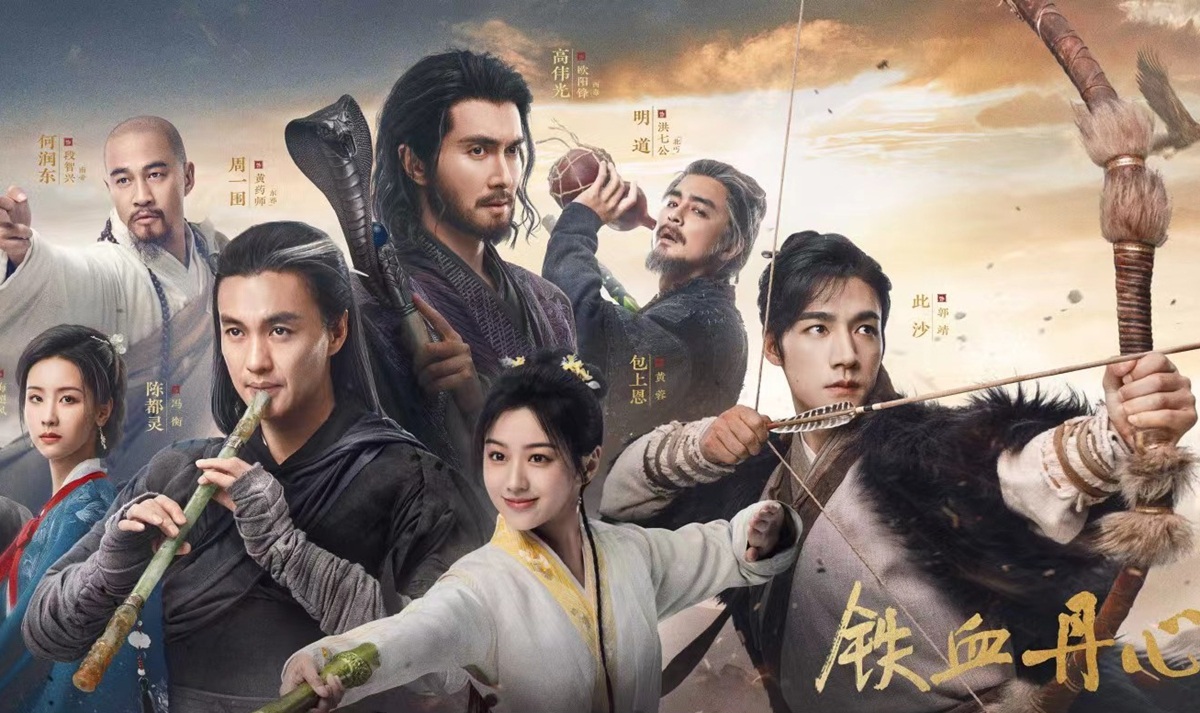
As Jin Yong (金庸, 1924-2018, Louis Cha Leung-yung,查良鏞) just passed away, we write this overview in honour of his legacy.
In the Chinese-speaking world, few literary figures command the cultural gravity of Jin Yong. Born Louis Cha in 1924, he became the architect of modern wuxia fiction, transforming what had been a popular but often formulaic genre into a sweeping literary universe of loyalty, betrayal, romance, patriotism, and metaphysical longing. His novels did not merely entertain. They shaped identity across Hong Kong, Taiwan, Southeast Asia, and mainland China for generations navigating modernity while yearning for continuity with a heroic past.
To understand Jin Yong is to understand wuxia itself.
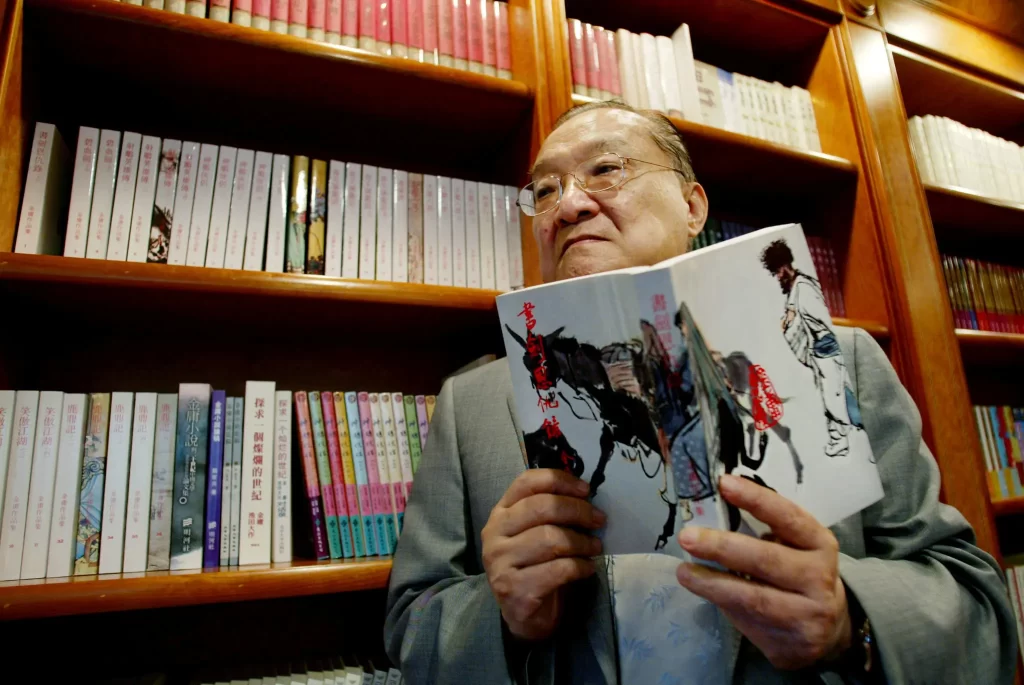
The World of Wuxia
Wuxia, literally “martial heroes,” revolves around wandering swordsmen and women who operate in the jianghu, a parallel society governed less by imperial law and more by codes of honor. These are tales of sect rivalries, secret manuals, forbidden techniques, and moral tests under heaven.
But wuxia is not history, even when it borrows historical settings. The Song, Yuan, Ming, and Qing dynasties appear frequently, yet they function more as dramatic canvases than documentary realities. Warriors leap across rooftops, channel internal energy, survive mortal wounds, and train in caves to master mystical manuals.
In this sense, wuxia resembles the mythic scaffolding of Western superhero lore. Its emotional truths matter more than its physics.
Jin Yong’s Reinvention of the Genre
Jin Yong’s major works such as: The Legend of the Condor Heroes, The Return of the Condor Heroes, The Heaven Sword and Dragon Saber, Demi-Gods and Semi-Devils and The Smiling, Proud Wanderer did something revolutionary. He elevated pulp into epic.
His characters are psychologically layered. Guo Jing is earnest but slow-witted; Yang Guo is brilliant yet rebellious; Wei Xiaobao is opportunistic and morally flexible. These are not cardboard heroes. They struggle with identity, desire, and loyalty in ways that mirror the anxieties of a rapidly changing Chinese world in the twentieth century.
Jin Yong fused Confucian ethics, Daoist metaphysics, Buddhist fatalism, and modern political undertones. Hidden beneath swordplay were questions about nationalism, corruption, exile, and moral compromise. Writing from Hong Kong during periods of ideological upheaval in mainland China, he constructed a parallel moral universe that felt stable when reality did not.
The Marvel and DC Parallel
To grasp the cultural scale of wuxia, one might compare it to Marvel Comics and DC Comics in the United States. Like the superhero universes of Marvel and DC:
- Wuxia operates in a shared mythic logic.
- Power levels escalate beyond ordinary human capacity.
- Moral dilemmas are dramatized through extraordinary abilities.
- Fans debate characters as if they are historical figures.
Just as audiences ask whether Batman could defeat Captain America, wuxia readers debate whether Dugu Qiubai’s sword technique surpasses Zhang Sanfeng’s internal cultivation. The discussions are analytical, passionate, and deeply imaginative. Yet both genres share a crucial trait. They are fantasy.
Superheroes defy gravity and radiation logic. Wuxia masters channel qi to shatter stone and run across water. Neither reflects realistic combat science. Both are heightened mythologies born from cultural archetypes. The difference lies in aesthetic lineage. Marvel and DC draw from pulp science fiction, industrial modernity, and urban anxiety. Wuxia draws from classical Chinese philosophy, knight-errant folklore, and dynastic memory.
Fantasy After the Fact
Interestingly, wuxia presents itself with historical gravitas. Dynasties, emperors, Mongol invasions, and sects appear grounded in recognizable timelines. But the martial abilities are symbolic rather than documentary. In that sense, wuxia is historical fantasy. It resembles a cultural memory refracted through imagination.
This is similar to how Norse sagas became superhero myth in modern comics. Captain America fights Nazis; Guo Jing fights Mongol invaders. Both narratives reinterpret historical trauma through heroic idealization. The fantasy element serves a purpose. It allows societies to dramatize moral clarity in eras where reality was morally ambiguous. In wuxia, righteous individuals can still alter destiny. In real history, power often overwhelms virtue.
Cultural Impact Beyond Literature
Jin Yong’s works were adapted repeatedly into television dramas and films across Hong Kong and mainland China. Actors who portrayed his heroes became household names. Entire generations learned loyalty, romantic devotion, and notions of honor through these serializations. Universities study his work. Politicians reference his characters. Even business leaders quote his aphorisms about strategy and human nature. Few novelists in any culture have achieved that scale of influence. In this regard, Jin Yong stands alongside global mythmakers rather than mere genre writers.
Why It Endures
Wuxia endures because it satisfies a deep psychological need. It offers:
- Moral structure in chaotic times
- Brotherhood and sect identity
- Transcendence through discipline
- Romance elevated to destiny
- Power achieved through cultivation rather than accident
In contrast to modern superhero narratives where powers are often bestowed by mutation or technology, wuxia emphasizes cultivation. Mastery is earned through hardship, lineage, and internal refinement. This emphasis resonates particularly strongly in societies shaped by Confucian educational discipline and Daoist internal cultivation traditions.
Myth as Cultural Infrastructure
Ultimately, Jin Yong did not simply write stories. He constructed a mythic infrastructure for modern Chinese identity. Like Marvel and DC, wuxia is not literal. It is fantasy shaped into ethical theater. But within that fantasy lies cultural memory, philosophical depth, and archetypal resonance.If superheroes reflect the American imagination of power, wuxia reflects the Chinese imagination of virtue under heaven. And at the center of that imagination stands Jin Yong, the novelist who turned swordplay into civilizational myth.
碧血剑 | Sword Stained with Royal Blood
Set in the final years of the Ming dynasty 1640s, Yuan Chengzhi is the son of the loyal general Yuan Chonghuan, who was unjustly executed by the Chongzhen Emperor; trained in martial arts at Mount Hua, Yuan inherits the Golden Serpent Sword and the legacy of the mysterious Xia Xueyi, becoming a formidable swordsman whose personal quest for justice evolves into national struggle. He joins the rebel forces of Li Zicheng to topple the corrupt Ming court, sabotages foreign-supplied cannons, funds the uprising, and organizes militias to defend the Han Chinese nation, while attempting to assassinate the Manchu ruler Hong Taiji in Mukden. Despite resentment toward the throne, he saves the emperor from internal treachery and becomes entangled romantically with Wen Qingqing and Ajiu, the latter secretly Princess Changping. Disillusioned when Li Zicheng’s regime proves as corrupt as the fallen dynasty and as the Ming general Wu Sangui opens Shanhai Pass to the Manchus, enabling the rise of the Qing, Yuan ultimately withdraws from the doomed political struggle and sails into exile, embodying the tragic wuxia ideal of loyalty, patriotism, and moral integrity amid dynastic collapse.
雪山飞狐 | Flying Fox of the Snowy Mountain
Set on a single day in 1780 during the reign of the Qianlong Emperor, the story unfolds in the Changbai Mountains as rival martial artists clash over a mysterious saber tied to a century-old vendetta rooted in the rebellion of Li Zicheng. At its center stands Hu Fei, the “Fox Volant of the Snowy Mountain,” son of the slain hero Hu Yidao, whose death resulted from intrigue and poison amid a multigenerational feud between the Hu and Miao families. Raised in obscurity yet grown into a formidable swordsman, Hu Fei becomes entangled in the tragic legacy of misunderstanding and revenge, culminating in a fateful duel with the great warrior Miao Renfeng, who wrongly believes Hu dishonored his daughter. As the Qing dynasty looms in the background and the echoes of Ming loyalist conflict persist, the novel closes on an unresolved cliffside confrontation, capturing the wuxia themes of honor, inheritance, and the inescapable weight of history.
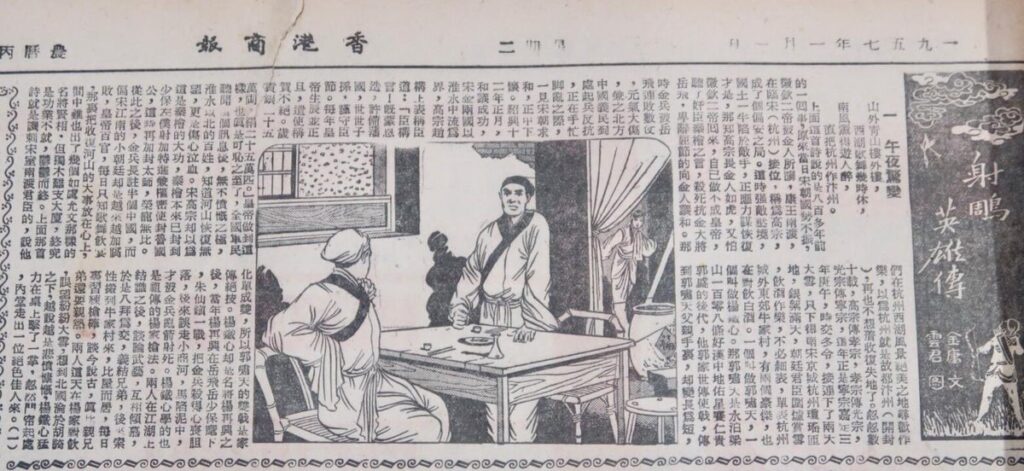
射鵰英雄傳 | The Legend of the Condor Heroes
Set against the wars between the Jurchen-led Jin Empire and the Han-led Song dynasty, the story centers on Guo Jing, the son of a slain Song patriot who is raised in Mongolia under Genghis Khan and trained by elite martial masters, growing into a paragon of loyalty and righteousness despite his humble, slow-witted demeanor. In stark contrast stands Yang Kang, the son of another fallen hero, who is raised as a Jin noble and ultimately betrays his Han heritage in pursuit of power and status. As Guo Jing journeys through the martial world alongside Huang Rong and encounters the legendary Five Greats, he uncovers the truth behind his father’s death and witnesses the shifting tides of empire, including the Mongol destruction of the Jin and the looming threat to the Song. Refusing to aid Mongol conquest against his ancestral homeland, Guo Jing returns south to defend the Song, embodying the wuxia ideal of moral steadfastness amid dynastic conflict, while Yang Kang’s treachery leads to his poisoned death, leaving behind a son, Yang Guo, whose destiny will shape the next generation.
神鵰俠侶 | The Return of the Condor Heroes
The story follows Yang Guo, the orphaned son of the disgraced Yang Kang, who is briefly raised by Guo Jing and Huang Rong before being sent to the Quanzhen School, where he suffers mistreatment and flees to the Ancient Tomb sect. There he becomes the disciple and eventual lover of Xiaolongnü, a romance forbidden by martial world convention and tested by separation, misunderstanding, and poison. After Xiaolongnü departs promising to reunite 16 years later, Yang Guo wanders the jianghu, refining his skills under eccentric masters and a giant eagle, transforming from a rebellious youth into the era’s greatest hero. Set during the Mongol campaigns against the Song dynasty, Yang Guo ultimately defends his Han homeland, striking a decisive blow by killing Möngke Khan at the Battle of Xiangyang, before finally reuniting with Xiaolongnü and withdrawing from the martial world, embodying wuxia’s fusion of tragic romance, personal redemption, and patriotic duty amid imperial upheaval.
倚天屠龍記 | The Heaven Sword and Dragon Saber
Set in the waning decades of the Mongol-led Yuan dynasty, the story centers on Zhang Wuji, an orphan of divided loyalties whose parents die protecting the secret of the Dragon-Slaying Saber, one of two legendary weapons said to grant supremacy in the martial world. Born to a Wudang father descended from Zhang Sanfeng and a mother linked to the Ming Cult, Zhang Wuji masters the Nine Yang Manual and the Heaven and Earth Great Shift, rising to leadership of the Ming Cult and reconciling its bitter conflict with the orthodox sects. As rebellion against the Yuan intensifies, he becomes a pivotal yet reluctant revolutionary figure, entangled in complex romances including the Mongol princess Zhao Min, who ultimately wins his heart. Though poised to shape the new order, Zhang Wuji withdraws from power, allowing Zhu Yuanzhang to consolidate the rebels and establish the Ming dynasty, embodying the wuxia ideal of moral restraint, personal sacrifice, and the tension between heroic destiny and political ambition.
天龍八部 | Demi-Gods and Semi-Devils
Spanning the fractious era of Song–Liao rivalry, the novel interweaves the destinies of three sworn brothers: Qiao Feng, Duan Yu, and Xuzhu. Duan Yu, a reluctant Dali prince and devout Buddhist, accidentally masters supreme martial arts despite rejecting violence, navigating tangled romances and hidden parentage. Xuzhu, an earnest Shaolin monk, unwillingly inherits immense power and leadership, ultimately reconciling Buddhist compassion with worldly responsibility. Yet the emotional core rests with Qiao Feng, the heroic chief of the Beggars’ Sect, whose life unravels when he discovers he is a Khitan amid the bitter conflict between the Song and the Liao under Yelü Hongji. Branded a traitor and murderer, he endures exile, tragic love, and divided loyalty between ethnic identity and moral conviction. In the climactic standoff at Yanmen Pass, Qiao Feng forces peace between the rival empires before taking his own life to prevent further bloodshed, elevating the tale beyond martial adventure into a meditation on identity, loyalty, and the tragic cost of honor in a world fractured by history.
笑傲江湖 | The Smiling, Proud Wanderer
Set amid the factional rivalries of the jianghu, the novel centers on Linghu Chong, a free-spirited yet honorable swordsman whose life is upended by intrigue surrounding the coveted Bixie Swordplay Manual. Initially the senior disciple of Yue Buqun of Mount Hua, Linghu Chong masters the formidable Nine Swords of Dugu and later the dangerous Cosmic Absorbing Power, only to be cast out by his hypocritical master when suspicion and political ambition poison the Five Mountains Sword Schools Alliance. As the so-called orthodox sects descend into paranoia and bloodshed, Yue Buqun reveals his true colors by secretly mastering the self-mutilating Bixie technique in a bid to dominate the martial world. Disillusioned with both righteous posturing and demonic ambition, Linghu Chong rejects power struggles between the alliance and the Sun Moon Holy Cult, ultimately helping prevent further tyranny before withdrawing into seclusion with Ren Yingying. The novel becomes a sharp critique of moral hypocrisy, showing that in wuxia the true divide is not between orthodox and evil, but between integrity and the corrupting lure of power.
鹿鼎記 | The Deer and the Cauldron
Set in the early Qing dynasty, the novel follows Wei Xiaobao, a streetwise, illiterate rogue born in a Yangzhou brothel who rises through sheer cunning and audacity to become a confidant of the Kangxi Emperor while secretly serving the anti-Qing Heaven and Earth Society. Navigating the volatile politics of the 17th century, Wei helps the young emperor remove the regent Oboi, undermines the rebellion of Wu Sangui, facilitates campaigns that consolidate Qing rule including the defeat of Ming loyalists in Taiwan, and even plays a role in diplomacy with Russia during the era of Sophia Alekseyevna. Unlike traditional wuxia heroes defined by martial virtue, Wei relies on deception, bribery, and opportunism, embodying survival rather than chivalry. Torn between loyalty to the Qing throne and brotherhood with Ming loyalists, he ultimately rejects both power and ideology, choosing exile with his wealth and seven wives, leaving behind a legend that blurs friendship, treachery, and statecraft in a turbulent imperial age.