They are some of the fittest men on earth, able to summon superhuman power on a mountain pass one day and sprint for glory the next. For three weeks every July, the Tour de France presents a spectacle of seemingly boundless human endurance. But beneath the lycra and the glory, a less visible race is unfolding, one that the cyclists are losing. A growing body of sports science is revealing that the Tour doesn’t just test the limits of athletic performance; it systematically dismantles the very machinery that makes it possible.
It is a brutal paradox. These athletes consume up to 8,000 calories a day, fuelling themselves with a “carbohydrate revolution” of gels and specially formulated drinks to match their energy expenditure. Yet, despite this deluge of fuel, their bodies are not being built up. They are being broken down.
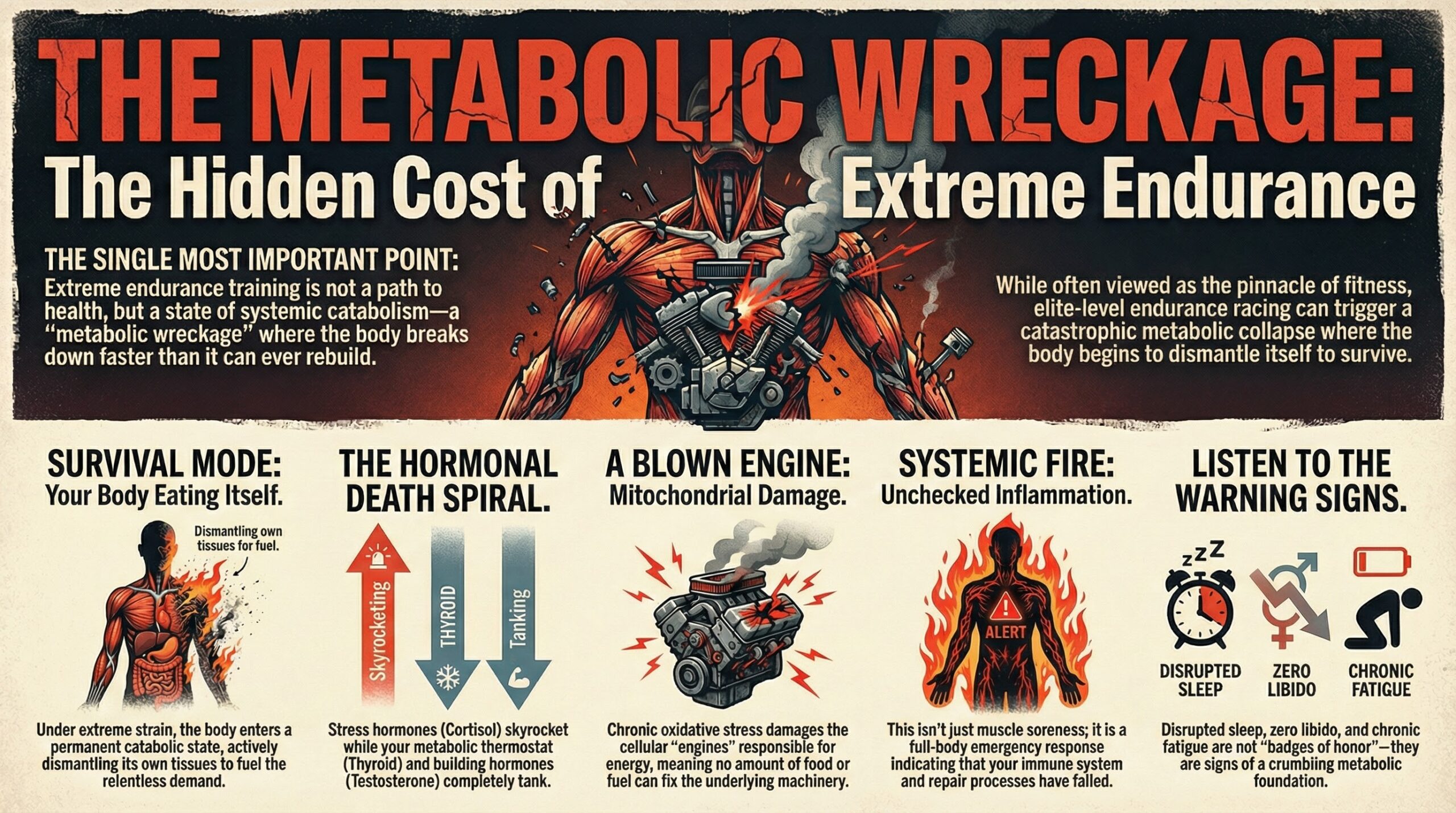
Recent studies tracking athletes through periods of high-intensity, sustained competition are painting a picture of profound metabolic crisis. After just nine days of a training camp, one study showed, both sprinters and endurance athletes experienced significant spikes in cortisol, the primary stress hormone . This isn’t the brief, adaptive burst that follows a hard workout. This is a chronic, sustained elevation that signals the body has entered a state of emergency.
When cortisol dominates and testosterone plummets, a pattern well-documented in male endurance athletes, the body abandons its long-term construction projects. “The body begins to prioritise conservation over performance,” explains an analysis of Relative Energy Deficiency in Sport (RED-S). Muscle repair slows, bone density maintenance is compromised, and the metabolic rate begins to fall. You can be eating like a king and still be in a state of starvation as far as your hormones are concerned.
This hormonal shift is accompanied by a thyroid crash. The thyroid is the body’s metabolic thermostat, and under the relentless pressure of a three-week race, it simply turns down the heat. The result is a systemic inability to oxidize fuel efficiently. The problem isn’t the availability of glucose, but the damaged cellular machinery, the mitochondria, trying to process it. High-intensity effort generates massive oxidative stress, damaging the organelles responsible for turning fuel into sustainable energy.
The evidence is not just in the blood but in the riders’ very survival. Journalists at this year’s Tour observed a “hygienic convent” in the peloton, with riders keeping distance from reporters and each other. This isn’t antisocial behaviour; it’s the instinct of an immune system on the brink. “By pulling on the machine, it finally gives way,” wrote one cycling journalist, observing riders like Mathieu van der Poel struck down by illness immediately after a rest day. “Not with a snap of the fingers. But insidiously”.
The rest day, paradoxically, can be a trap. When the relentless physical demand suddenly stops, the nervous system relaxes, body temperature drops, and immune defences, previously held in a state of high alert by stress hormones, can falter. A rider might survive three weeks of racing only to be felled by a common cold.
Even sleep, the most fundamental pillar of recovery, becomes compromised. A Flinders University study tracking riders in the 2020 Tour found that those pushing hardest, the ones at the top of the leaderboard, slept the least and reported the lowest sleep quality. While most riders still managed over eight hours, the restorative quality of that sleep was noticeably diminished during the race.
The most sophisticated teams are acutely aware of this metabolic tightrope. They use algorithms, power meters, and daily well-being questionnaires to monitor for signs of energy deficiency. They employ ultrasound to ensure riders aren’t losing the wrong kind of weight—the lean muscle mass from their quads and calves that is essential for power . Biannual DEXA scans check for bone density loss, a hidden consequence of long-term hormonal disruption.
As Søren Lavrsen, a nutritionist for the Visma-Lease a Bike team, notes, the goal is a small, calculated deficit over a long period. “Riders can’t stay healthy and can’t recover from training if they’re too much below their natural weight for long,” he told Velo. “It just leads to lower training availability and reduced performance in the grand scheme.”
This is the new reality of professional cycling. The pursuit of marginal gains has become a battle against metabolic catastrophe. The Tour de France is no longer just a bike race; it is a three-week study in human decreation, a reminder that even at the pinnacle of fitness, the body has limits that no amount of pasta or power gels can overcome. The riders cross the finish line in Paris not just exhausted but fundamentally altered, their hormonal systems in disarray, their immune defences depleted. They have survived, but for a time, they have ceased to be the finely tuned machines they once were.