Many like to box people and things into categories. In the realm of martial arts there is no such thing. A martial artist may have systems/styles as a foundation, as respect for their heritage and even as identity. However, true martial arts have no boundaries; they learn from all. With that many years ago, I travelled home to search for the history of my grandfather’s blade work; coming from the borderlands of Bella Union and Artigas, in Uruguay through to Uruguaiana and Porto Alegre, in Brazil, where our ancestors are from, he used both knives/short swords and boleadoras, not to mention his fists, kicks and quick throws. Whilst we did not carry the knives overseas, I still remember the boleadoras hanging in the living room. With that in mind, I focused on understanding that heritage, so I have included a short summary here.
The history of tango is often told as though it began with music, but the deeper history begins with the body. Long before tango became a codified urban dance, the Río de la Plata was a region in which riding, fighting, cattle work, weapon handling, competitive physical display and dancing were all part of everyday life. The gaucho was not simply a rural horseman with a romantic image attached to him. He belonged to a difficult frontier society in which physical competence could determine survival. Horsemanship, balance, rapid changes of direction, weapon handling, knife fighting, throwing weapons, wrestling, cattle work and the ability to remain composed under physical pressure all formed part of a practical bodily culture. When this culture entered the cities, it did not necessarily survive as a recognizable martial art. It could survive instead as habits of movement, ideas about masculine physical skill, methods of competition, gestures, steps and ways of occupying space. It is within this broader transformation that the later emergence of tango becomes historically interesting.
The story should begin in the Banda Oriental, the territory that became Uruguay, rather than in Buenos Aires. The region was a frontier in the fullest sense. Indigenous peoples, Spanish and Portuguese settlers, criollos, Africans and people of mixed ancestry interacted through warfare, commerce, cattle exploitation, migration and military service. The physical environment itself encouraged mobility and practical skill. Vast areas of open country made the horse indispensable, while the enormous herds of cattle created an economy in which men spent their working lives handling animals at speed, often from horseback. The technologies of the frontier were therefore bodily technologies. A man had to control his horse while using a knife, lance, rope or other implement. He had to mount and dismount rapidly. He had to throw, pull, cut and restrain while maintaining his own balance. These were not abstract athletic exercises. They were skills developed because the environment demanded them.
The gaucho’s martial capacity consequently cannot be reduced to the knife, although the knife eventually became one of its most recognizable symbols. The horse was arguably his most important martial platform. A skilled mounted rider possessed mobility that transformed every other weapon. He could approach, withdraw, pursue, escape, scout, carry messages, herd animals, and fight from a position that gave him considerable advantage over someone on foot. The lance, or chuza [lance], provided reach. The boleadoras [weighted throwing cords] provided a means of striking or entangling from a distance. The knife or facón [large fighting knife] operated at close range. The poncho [cloak] could be manipulated as a defensive covering or used to interfere with an opponent’s weapon. The rebenque [riding whip] belonged primarily to the working equipment of the horseman, although the same object could become a weapon in a confrontation. What emerges is not a single formal martial art but a practical system in which the body had to move intelligently across several ranges.
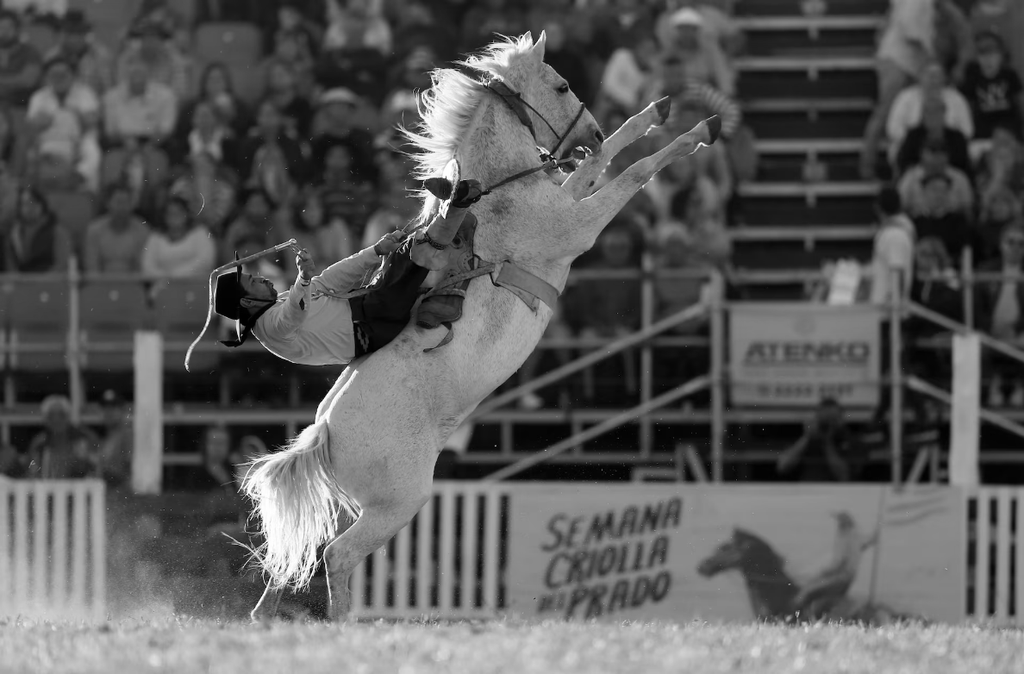
The technique known as jineteada [horse-breaking and riding] developed from this environment. Accounts of the traditional practice describe men capturing horses with the lasso or boleadoras and learning to remain mounted through the violent movements of animals that had never previously accepted a rider. This was not merely entertainment. It produced exceptional balance, grip, timing and confidence on horseback. That physical education had obvious military consequences. A mounted man could travel enormous distances, pursue an enemy, escape pursuit, carry messages, scout, drive livestock or attack from a direction that an opponent could not easily predict. The horse multiplied his mobility and allowed weapons to be employed from a moving platform. The lance became more formidable when combined with a charging horse. The boleadoras could be thrown while mounted. The rider could withdraw before an opponent had time to establish a stable position. The gaucho’s skill was consequently not reducible to knife fighting. His greatest martial advantage was the ability to combine horse and weapons into a single system of movement.
Nor was this mounted warfare uniquely a gaucho invention. The Indigenous peoples of the Pampas and neighboring regions developed formidable cavalry traditions of their own, and the frontier was a zone of warfare, trade, migration, alliance and technological exchange. Indigenous horsemen became extremely effective at using mobility, terrain and weapons against colonial and later republican forces. The history of the gaucho therefore belongs to a much broader South American martial environment. Techniques and weapons circulated between Indigenous and criollo populations, and the frontier was an arena in which practical effectiveness mattered more than abstract cultural ownership.
The boleadoras are an especially clear example of this exchange. Long before the gaucho became the celebrated figure of the South American plains, Indigenous peoples were using weighted cords to hunt and immobilize animals. Archaeological research places bolas and related throwing weapons among Indigenous populations of the southern cone long before the emergence of the gaucho as a recognizable social type. Their basic tactical principle was simple but ingenious.
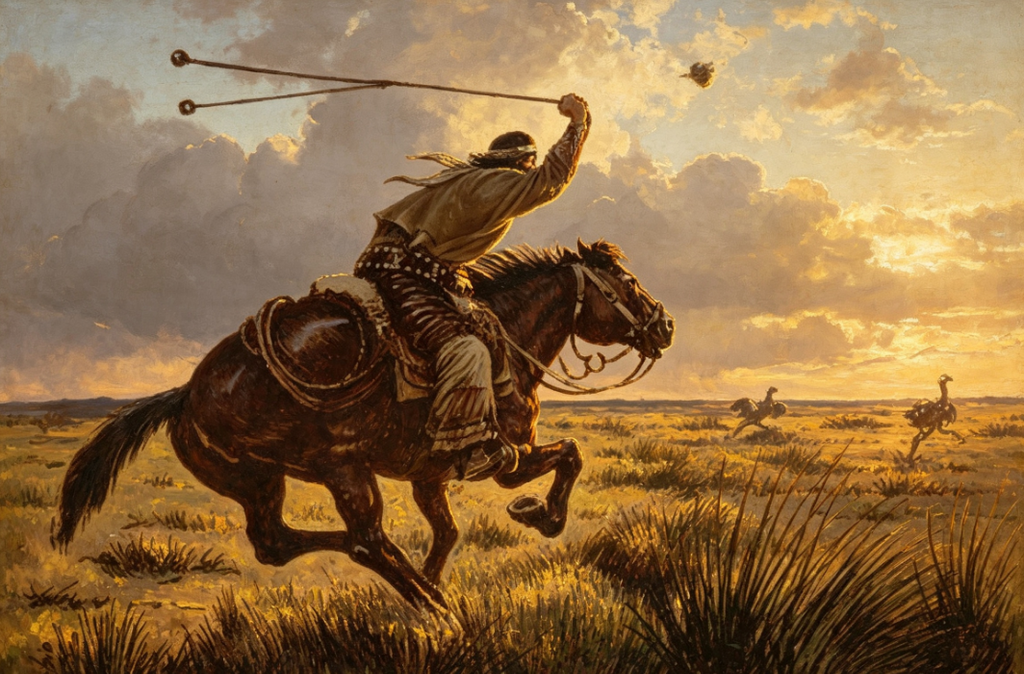
The rotating weights could be directed around the legs of a moving target, entangling them and destroying the target’s mobility. The gaucho adopted the weapon into his own equipment. Once that happened, a hunting device became part of a wider martial repertoire. The same principle could be used against a horse or rider. The weapon demanded timing, distance judgment and an understanding of movement, because releasing it too early or too late meant missing the target entirely. The distinction matters because it prevents us from imagining the gaucho as the isolated creator of every element of his physical repertoire. The martial culture of the Río de la Plata developed through contact, adaptation and appropriation among Indigenous and colonial populations. The gaucho inherited a landscape and a technological environment that already possessed its own sophisticated methods of movement and control.
The frontier consequently produced something very close to what modern martial artists would call cross-training, although nobody at the time would have used that term. The same man might learn to ride, throw a lasso, use boleadoras, work cattle, handle a knife and serve in a militia. Each skill reinforced the others. Riding developed balance and mobility. Cattle work developed timing and strength. The lasso developed coordination and distance judgment. The knife demanded precision. Military service introduced formation fighting and larger weapons. Life in the countryside provided countless opportunities to observe experienced men and imitate their methods. This is one of the reasons the gaucho should not be imagined as an untrained brawler. His training system simply did not look like a modern martial arts school. There was usually no master standing before a class of students and teaching a numbered sequence of techniques. Knowledge was acquired socially. A boy watched older men ride. He learned to handle cattle. He was shown how to use a knife. He accompanied experienced workers and soldiers. He learned through repetition and correction. The most useful techniques survived because they worked. The useless ones disappeared.
What later generations called esgrima criolla [Creole fencing] should not be imagined as though a single founder had established a standardized school with a fixed curriculum. The historical evidence is better understood as a family of practical fighting traditions associated with gauchos and subsequently with urban malevos [urban toughs or ruffians], compadritos [urban working-class toughs] and cuchilleros [knife fighters]. The knife fighter had to solve problems that were fundamentally physical: distance, timing, balance, deception, angular movement, control of the weapon arm, protection of the body and the ability to attack without exposing himself unnecessarily. The poncho complicated the encounter further by giving the fighter a movable defensive screen. In close combat, the feet and hips were as important as the hand holding the knife. A fighter who could not control his weight could be knocked off balance, trapped, or forced into an unfavorable position.
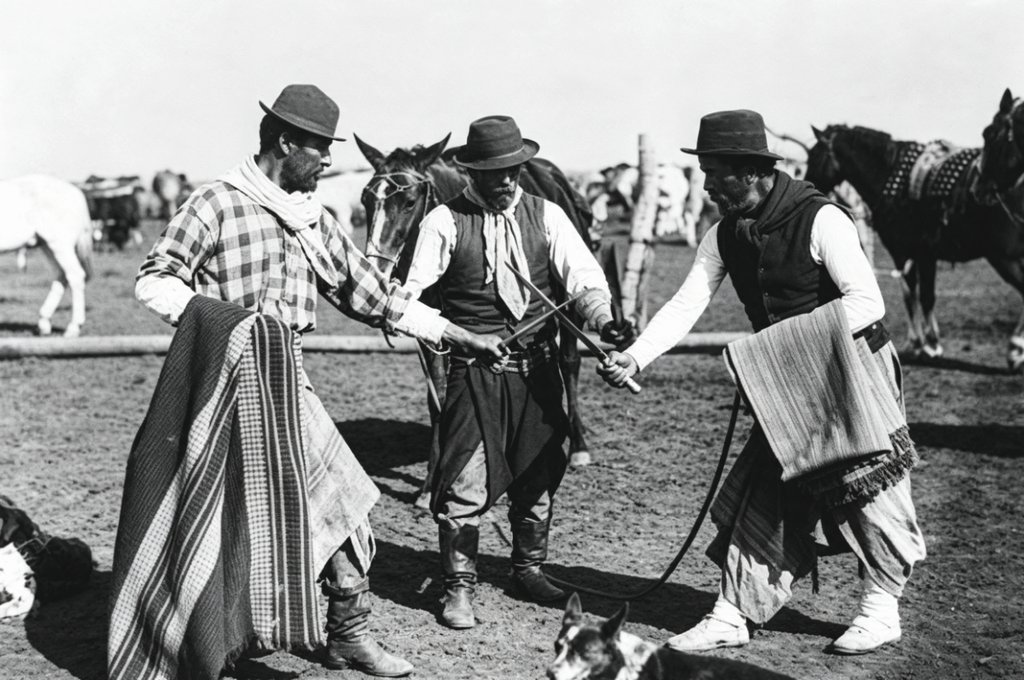
Knife fighting is an unforgiving discipline because the range is so short. With a firearm, distance can provide a degree of protection. With a lance, the length of the weapon creates space between the fighters. With a knife, that space almost disappears. The combatant must therefore solve several problems simultaneously. He must determine how to approach without being struck, how to remain balanced while attacking, how to prevent the opponent from controlling his weapon arm and how to exploit the instant when the opponent’s balance or attention fails. This makes footwork central. The knife fighter does not simply stand in front of his opponent and swing the blade. He continually adjusts the distance between the two bodies. A small step forward can turn a harmless feint into a real threat. A small step backward can remove the opponent’s target. A lateral movement can change the angle of attack. A badly placed foot can leave the fighter unable to retreat or redirect his body. The fight is therefore a contest over geometry as much as aggression.
The body is normally positioned so that the weapon is difficult to reach and the fighter can advance or retreat without having to reorganize his stance. Modern reconstructions of esgrima criolla describe a characteristically mobile, partially profiled stance, with the knees flexed and the weight distributed so that the fighter can move rapidly in several directions. Such reconstructions should not be treated as proof that every gaucho in every period adopted an identical stance, but they are consistent with the central tactical problem of the tradition: maintaining a stable base while constantly manipulating distance. The left hand was equally important. A knife fighter who treated his non-weapon hand as useless would surrender half of his defensive possibilities. In the gaucho system, the left arm could be protected and enlarged by the poncho. This transformed ordinary clothing into an active component of combat. The poncho could be gathered around the arm, creating layers of cloth between the body and the opposing blade. It could also obscure the knife and interfere with the opponent’s perception.
The poncho therefore served several purposes simultaneously. It could protect, conceal, distract and occupy the opponent’s attention. Some traditions describe the use of the flecazo [whip-like movement of the poncho’s fringes toward the opponent’s face] and the manteada [a forceful manipulation of the cloth]. Historical certainty is stronger for the general defensive use of the poncho than for every dramatic technique preserved in modern demonstrations, but the combination of knife and poncho is a genuine and distinctive feature of the criollo fighting tradition. The tactical principle behind this is more sophisticated than it initially appears. A fighter does not necessarily have to injure an opponent to gain an advantage. If he can disrupt the opponent’s vision, interfere with the weapon arm or force the opponent to react to the poncho instead of the knife, he has created an opening. The weapon and the cloth therefore worked together. The knife created danger. The poncho created uncertainty.
The most famous of these knives was the facón. The terminology of criollo knives was not perfectly standardized, and historical examples varied considerably in size, form and construction. The facón could be a substantial single-edged blade, sometimes incorporating a guard, while related weapons included the daga [dagger], puñal [stabbing knife] and verijero [shorter knife traditionally associated with carrying at the waist]. What mattered tactically was that the knife was sufficiently substantial to serve as a serious fighting weapon while remaining compatible with the practical life of the rural worker. The knife occupied a special position because it was always close at hand. Unlike a lance or firearm, it did not require a military expedition to justify its presence. It could be used to cut meat, work leather, slaughter animals or perform countless ordinary tasks. The same object could become a weapon during an argument. This blurred boundary between tool and weapon was central to the culture. The man did not necessarily carry a knife because he expected a fight. He carried one because a man in his occupation needed a knife. The possibility of violence was simply contained within the object.
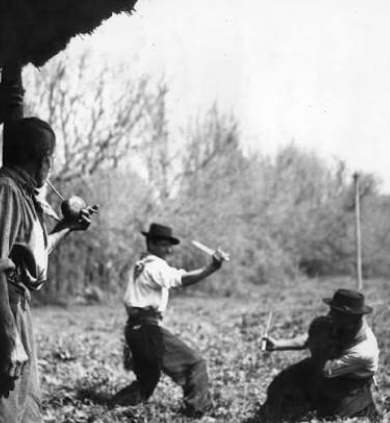
There was also a training culture surrounding these skills. The practice known as visteo [mock knife fighting or knife-training exercise] is particularly significant because it demonstrates that gaucho combat knowledge was not merely an instinctive response to violence. Visteo involved practicing against another person and developing the reflexes, timing and composure necessary for actual confrontation. Historical descriptions associate such training with the transmission of knowledge from experienced practitioners to younger men. Descriptions of the practice refer to the use of a charred stick, a wooden knife or a finger marked with soot, with the objective of touching or marking the opponent. A historical account published by La Nación describes the practice as something learned from childhood, sometimes beginning with empty-handed play, wooden knives or a soot-blackened finger used to mark an opponent’s face. The surviving evidence is fragmentary, and later accounts undoubtedly contain elements of folklore, but the basic point is important. The knife fighter’s body was trained. He learned to read another person’s movement, regulate distance and react rapidly while maintaining control of his own body. The frontier therefore functioned in effect as a distributed martial school, although not as an institution in the modern sense.
The importance of visteo was not that it reproduced a real knife duel perfectly. It trained the attributes that made survival possible: perception, timing, distance, balance and rapid reaction. The fighter had to read the opponent’s movement and anticipate where the attack would arrive. He learned not to react blindly but to recognize the beginning of a movement. This distinction between combat and training is important. A society in which men carried knives did not require every disagreement to become a lethal duel. In fact, a mature fighting culture would have practical reasons for developing safer methods of demonstrating superiority. Visteo provided a way to test skill, courage and reflexes without necessarily paying the price of a real wound. It was therefore both training and social competition. The fighter’s objective in an actual duel was not necessarily to perform elaborate combinations. Real violence rewards simplicity. The essential principles were distance, deception, balance and timing. A feint could provoke a defensive movement and create an opening elsewhere. A sudden change of direction could force an opponent to reposition his feet. An attempt to seize the weapon arm could turn the encounter into close grappling. A momentary loss of balance could be more important than raw strength.
This is also why the popular image of the gaucho as an invincible knife master should be treated cautiously. Not every man who carried a facón was an expert. Nor was every reported duel conducted according to an elaborate code. The historical record contains genuine fighters, professional soldiers, criminals, ordinary workers, braggarts and literary creations. Later generations frequently transformed the cuchillero into a heroic or tragic archetype. The frontier nevertheless produced men with genuine martial experience. Some served in armies and militias. Others participated in local violence or political struggles. Still others acquired their reputation through repeated contests and the social pressure of a male environment in which backing down from a challenge could damage one’s standing. The ability to handle a knife was therefore both practical and symbolic.
War accelerated this process. The Banda Oriental became one of the great military crossroads of the southern continent during the late colonial and revolutionary period. The region experienced Spanish and Portuguese rivalry, the revolutionary campaigns, Artiguist warfare, Brazilian intervention and the conflicts that eventually produced the independent state of Uruguay. Rural men were repeatedly drawn into military service, and their existing abilities made them particularly valuable as mounted troops. José Gervasio Artigas himself provides an excellent example of the connection between rural life and military experience. Before becoming the central military and political figure of the Oriental revolution, he had worked in the countryside, travelled extensively through the Banda Oriental, acquired intimate geographical knowledge and entered the Blandengues cavalry regiment, whose responsibilities included combating cattle theft and smuggling and protecting the frontier with Brazil.
The Battle of Las Piedras in 1811 demonstrates the extent to which rural society could be converted into a military force. The Oriental army was composed largely of militias from the countryside, reinforced by Blandengues. These were not simply professional soldiers transported into the countryside. They were men whose previous lives had already accustomed them to horses, weapons and the terrain. The creation of the Ejército Oriental [Oriental Army] consequently represented a transformation of existing rural capabilities into organized warfare. The distinction between soldier and gaucho could remain remarkably fluid. A man could spend part of his life working cattle and another period campaigning. He could become a militia cavalryman without abandoning the techniques of the countryside. The horse remained his means of transportation, the knife remained a personal tool and the open landscape remained familiar territory. Military service did not replace his rural physical culture. It intensified it and gave it a new purpose.
This frontier warfare also explains why the gaucho’s martial reputation involved considerably more than personal duelling. He had to endure long rides, poor food, exposure, fatigue and uncertainty. He needed to know how to move through country where roads were rudimentary or nonexistent. He needed to recognize water, grazing and routes of travel. He needed to handle a horse after hours of riding and still be capable of fighting. In an irregular war, the ability to remain mobile and self-sufficient could be as important as the ability to strike an opponent. This is the first major element needed to understand the later urban transformation. Martial knowledge did not have to be transferred through a martial arts school. It could travel with people.
As the nineteenth century progressed, the world that had created the gaucho began to change. Political consolidation, expanding settlements, changing landholding patterns, modern firearms, professional armies and the enclosure of the countryside reduced the independence of the traditional horseman. But his physical culture did not simply vanish. Some of it travelled into the towns. People from the countryside entered Montevideo and other urban centers. The city was not simply a place where an already completed European dance tradition was waiting to become tango. It was a meeting point between rural criollo culture, Afro-Uruguayan communities, European immigrants, sailors, laborers, soldiers and the urban poor.
Montevideo was crucial to this transformation. The city was not simply an urban endpoint for a rural culture. It was already a complex meeting place where criollo, African and European populations interacted. During the second half of the eighteenth century, the port of Montevideo was the principal entry route for enslaved Africans into the Río de la Plata, and by the end of the century people of African descent constituted a very substantial portion of the city’s population. The Municipality of Montevideo gives an estimate of approximately 35 percent. African communities maintained their own organizations, religious practices, music and dances, creating a powerful Afro-Uruguayan cultural presence within the city.
That population created one of the other great physical traditions that would eventually enter the history of tango. Candombe [Afro-Uruguayan musical and dance tradition] developed through African-derived cultural practices preserved and transformed in Montevideo. The first known recorded use of the word candombe in Uruguay dates to 1830, although the underlying practices were considerably older. The Salas de nación [mutual-aid and cultural associations organized around African ethnic identities] provided spaces in which music, dance and ritual could survive and evolve. The neighborhoods of Barrio Sur and Palermo later became especially important centers of this culture. The Mediomundo conventillo [collective tenement] in Barrio Sur and the Reus complex in Palermo are associated with distinct traditions of candombe rhythm, while the streets and courtyards of these neighborhoods provided spaces where music and movement were part of ordinary communal life.
This environment produced a second major physical vocabulary. Candombe developed within Afro-Uruguayan society and should not be reduced to an early form of tango. It was its own musical and choreographic tradition, rooted in African-descended communities and transformed within the Río de la Plata. At the same time, Afro-Uruguayans participated in the transformation of European dances such as the polka, mazurka, waltz and habanera. Research by Gustavo Goldman has been particularly important in reconstructing this process in Montevideo during the later nineteenth century. His work demonstrates that the urban dance environment was one of continual interaction and transformation rather than the product of a single ethnic source.
The gaucho dance known as malambo [gaucho footwork dance] is especially important in this context. Malambo belongs to the gaucho cultural sphere and is characterized above all by highly developed zapateo [foot stamping] and mudanzas [movement sequences]. Its competitive character is central. Performers demonstrate speed, precision, endurance, rhythmic control and increasingly complex footwork. Thus, Malambo contains distinctive stepping, weight shifting, balance and evasive qualities that demonstrate how closely dance and combat can be intertwined. The urban successor of the gaucho was not simply a smaller gaucho with a different hat. He became a different social type. The guapo [tough, feared or physically formidable man], malevo and compadrito represented overlapping but not identical figures. They were associated with the working districts, the suburbs and the male culture of reputation. Some were legitimate workers, including slaughterhouse workers, cart drivers and other occupations requiring physical strength. Others became involved in political patronage, protection, criminal activity or prostitution. The image of the knife fighter became inseparable from this urban world. Montevideo’s popular culture therefore preserved a memory of the rural fighter while transforming him. The man no longer needed to ride across the open plains to demonstrate his physical ability. He could demonstrate it in a street, tavern, courtyard or dance hall. The knife became an urban symbol of personal courage. The old frontier problem of balance and distance was compressed into the much smaller physical space of the city.
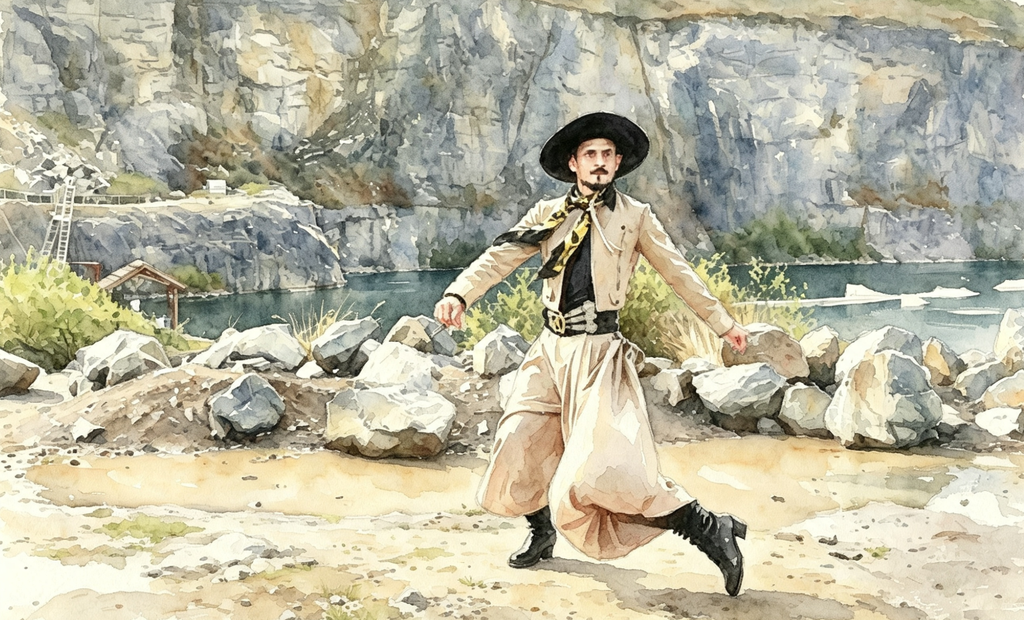
The connection between the compadrito and knife culture is not merely a later tango invention. Pedro Figari’s paintings and writings about the Río de la Plata repeatedly associated the compadrito with masculine display, elegant clothing, dancing and of a knife fight. The Museo Figari describes the figure explicitly as a character associated with both courtship and violent competition between men. The knife therefore became part of a performance of masculinity. The way a man stood, walked, dressed, looked at another man and responded to an insult could communicate his willingness to fight before a blade ever appeared. This is an important development because martial culture is not only about techniques. It is also about behavior before combat. A reputation can prevent a fight, provoke one or determine whether another man believes a challenge is worth making.
This is the world into which early urban dance emerged. Montevideo’s candombe provided a powerful rhythmic and physical environment. The milonga [Río de la Plata musical and dance form] developed through another set of interactions between rural and urban culture. The Uruguayan Ministry of Education and Culture describes the milonga as a shared regional tradition with distinct Uruguayan and Argentine forms and identifies the broader Río de la Plata cultural field as the environment in which tango emerged. It also emphasizes that tango was born among popular classes on both sides of the river through the interaction of European immigrants, descendants of enslaved Africans and criollos. The physical relationship between these traditions is especially interesting. Candombe was a dance and musical practice with its own history, not simply an embryonic tango. Milonga was likewise its own form. Yet movement from one environment could enter another. Rhythms could be borrowed. Steps could be transformed. Gestures could acquire new meanings. Social groups that had previously danced separately could meet in urban academies, courtyards, conventillos and entertainment districts.
The word tango itself has an older and complicated history. In colonial Montevideo, tango was used in connection with gatherings, dances and celebrations of Black communities, while terms such as tangó and tambó appear in historical discussions of Afro-Río de la Plata culture. The existence of the word at an early date does not prove that the modern tango already existed. The Ministry of Education and Culture’s survey of Uruguayan tango history specifically warns that the etymology of the word and the genealogy of the later musical and dance form are separate questions. This distinction is essential when discussing martial influences.
It is tempting to construct a neat line from knife fighting to tango and declare that every dramatic tango movement was once a combat technique. The historical evidence does not justify that level of certainty since tango had its own path of evolution afterwards. However, it is likely that the sophisticated balance, footwork and leg work did not appear from nowhere. The absence of a surviving document stating that a particular tango movement was copied directly from a particular fighting technique does not mean that the relationship between combat and dance can simply be dismissed.
The remarkable complexity of early tango footwork demands an explanation. Movements such as the sacada [leg displacement], gancho [leg hook], parada [leg stop], barrida [sweep] and the abrupt cortes [interruptions] and quebradas [angular breaks] involve precise control of balance, weight, timing, distance and the opponent’s movement. These are not arbitrary qualities. They are fundamental problems that combatants have had to solve in countless fighting traditions, particularly those involving close contact, evasion and the manipulation of an opponent’s balance. The question, therefore, should not be reduced to whether a modern tango step can be matched one-for-one with a documented knife-fighting technique. The more productive question is whether the bodily knowledge developed through combat, wrestling, evasive movement and other forms of physical competition entered the dance indirectly, providing principles that dancers subsequently transformed into an extraordinarily sophisticated movement vocabulary.
Indeed, the martial interpretation was not invented by twenty-first-century observers looking backward at tango. In the 1920s, Miguel Andrés Camino proposed essentially such a theory. He connected the movements of the old tango with knife fighting and specifically associated figures such as the ocho [eight], asentada, media luna [half moon] and paso atrás [backward step] with the movements and evasions of a knife fighter. Jorge Luis Borges subsequently discussed Camino’s hypothesis. Borges did not present it as proven fact. On the contrary, he acknowledged uncertainty. But the historical importance of the episode is that observers relatively close to the old tango were already asking whether its physical vocabulary reflected the bodily habits of the cuchillero. This does not prove Camino’s explanation. It does something more useful. It establishes that the perceived resemblance was historically recognizable before modern tango technique had completely standardized the dance. The hypothesis therefore belongs to the history of tango itself, not merely to a modern romantic mythology.
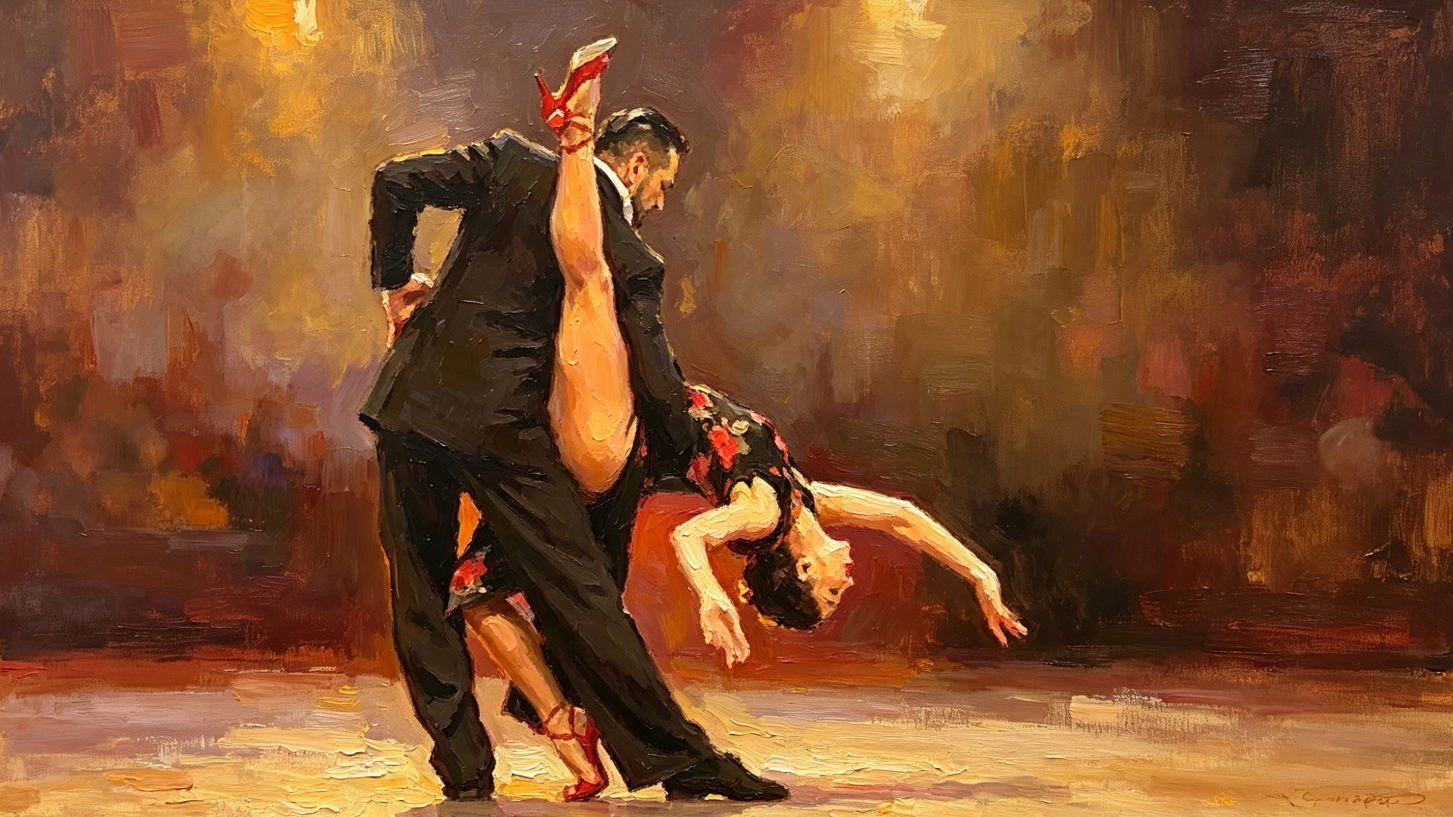
What can be defended is a broader continuity of physical culture. The same urban society contained men who had inherited the values and movement habits of the rural horseman and knife fighter, alongside Afro-Uruguayan dance traditions and European partner dances. The tango developed inside that environment. Its famous cortes and quebradas belonged to a dance vocabulary that developed through the interaction of these traditions. The transformation was cultural rather than a simple conversion of martial techniques into choreography. That distinction actually makes the story more interesting. A knife fight and a tango are not the same activity, but both require an acute awareness of another person’s position at very close range. Both involve deception, timing, balance and controlled changes of direction. Both can involve sudden interruptions of movement. Both require one person to react to another person’s body. The tango did not have to inherit a literal knife technique to inherit something of the physical world in which knife fighting mattered.
The most important transformation was therefore not the conversion of a particular strike into a particular dance step. It was the conversion of confrontation into controlled interaction. The man who once had to maintain his balance because a loss of footing could expose him to a knife eventually entered a dance in which balance remained fundamental. The man who had learned to read another man’s movement in a duel now had to read a partner’s movement. The close proximity that had once represented danger became the foundation of the embrace.
Buenos Aires entered this story as the other great urban center of the Río de la Plata, but it is important not to project its later dominance backward onto the earlier period. The tango’s modern identity was ultimately shared by Montevideo and Buenos Aires. Uruguay’s Ministry of Education and Culture explicitly describes tango as a cultural phenomenon belonging to both shores of the Río de la Plata, while UNESCO’s inscription recognizes it jointly as a cultural tradition of Buenos Aires and Montevideo. The social figure of the compadrito, however, appears clearly in Buenos Aires by the middle of the nineteenth century, and the urban knife-fighter tradition became deeply embedded there as well. Scholarship examining the term places its Buenos Aires usage by at least the 1840s and 1850s. This was later than the older rural martial culture of the Banda Oriental and should not be confused with the origins of the gaucho’s fighting tradition itself. As Buenos Aires expanded and the two cities became increasingly connected through commerce, migration and cultural exchange, the martial archetype of the compadrito became common to the wider Río de la Plata imagination. The knife fighter was no longer simply a frontier survivor. He was an urban character, recognizable by his clothes, posture, walk, language and reputation. The knife was now simultaneously a weapon, a badge of identity and a theatrical prop in the performance of masculine toughness.
Jorge Luis Borges later became one of the great literary interpreters of this world. His knife fighters, compadritos and guapos should not be mistaken for documentary portraits, but they reveal how profoundly the knife had entered the cultural memory of Buenos Aires and the Río de la Plata. Borges understood that the knife duel could function as a compressed version of an entire masculine code. A man’s reputation, courage, self-control and willingness to accept risk could be tested within minutes. The literary mythology sometimes makes these men appear almost superhuman. The historical reality was harsher and less romantic. Knife fighting could produce terrible injuries and death. A fighter could be skilled and still be killed by a single mistake. Courage did not guarantee survival. A reputation for fearlessness could even increase the likelihood that a man would be drawn into dangerous confrontations. The culture of the knife therefore contained a contradiction. It celebrated mastery while constantly reminding its participants that mastery could fail.
That contradiction also explains the importance of controlled practice. Visteo allowed men to display skill without necessarily paying the full price of combat. Rural games, demonstrations and mock fights created a space in which the fighter could develop timing and reputation while reducing the chance of fatal injury. In that sense, the practice was not peripheral to the martial tradition. It was evidence that the culture understood the difference between possessing a weapon and knowing how to use it.
The deeper martial achievement of the gaucho was therefore the integration of weapons, movement and environment. The facón was only one part of the system. The poncho altered the geometry of a knife fight. The horse transformed mobility. The boleadoras controlled movement from a distance. The lance extended reach. The rebenque offered another range of attack. The terrain affected movement. The clothing could become equipment. The body itself had to remain balanced and mobile. This was an ecological martial art. Its techniques made sense because they belonged to a particular landscape and way of life. The open plains encouraged mounted mobility. Cattle work developed coordination and strength. The lack of formal infrastructure encouraged self-sufficiency. Frontier warfare rewarded speed and endurance. The prevalence of knives made close combat a practical possibility. Urbanization later compressed these skills into a different social environment.
What survived into the compadrito was therefore not necessarily a formal syllabus of gaucho techniques. What survived was a physical ideal. The man should be balanced. He should be difficult to intimidate. He should know how to handle himself. He should know how to ride if his circumstances required it. He should understand weapons. He should not display unnecessary fear. He should be able to react quickly. And he should possess enough control over his body that another man could not easily dominate him. That ideal could then be transformed by the city. The horse gradually disappeared from the urban scene. The lance disappeared. The open frontier became distant memory. The knife remained. Then even the knife increasingly became symbolic rather than practical. But the body language endured. The swagger, the controlled walk, the sudden stop, the sideways stance, the challenge, the close encounter and the theatrical demonstration of physical skill all became part of the mythology of the urban male. Eventually, the same cultural environment produced tango.
Tango was not therefore the gaucho’s martial art disguised as a dance. That is too simple and cannot be demonstrated historically. Nor was tango merely a European ballroom form transplanted to South America. Its origins were considerably more complex. The Uruguayan Ministry of Education and Culture describes its emergence as a Río de la Plata synthesis involving criollo, African and European populations, while Montevideo’s cultural history emphasizes the connections among candombe, milonga and tango. What tango inherited from the martial world was something more elusive and more fundamental: an understanding of the body as an instrument of controlled movement in close proximity to another person.
The knife fighter had learned to watch the opponent’s shoulders, hips and feet. The dancer learned to read the partner’s body. The knife fighter had learned that balance could be destroyed by a badly timed movement. The dancer learned that balance was the foundation of the embrace. The knife fighter had learned to move without unnecessarily exposing himself. The dancer learned to move without breaking the connection between the two bodies. The transformation was therefore profound. The relationship between two men that might once have been a contest of courage became a relationship between two dancers. The distance that once separated attacker from target became the embrace. The sudden change of direction remained, but its purpose changed. The movement that once created an opening for a blade could become a flourish in music.
This is perhaps the most historically defensible way to understand the martial shadow inside tango. The knife did not become a dance step. The fighter did not simply become a dancer. The entire physical culture of the Río de la Plata changed its purpose. The gaucho’s world had taught generations of men to ride, balance, evade, pursue, throw, cut and survive. The frontier had turned those abilities into military skills. Montevideo transformed part of that rural population into an urban working class in which the knife became an emblem of masculine reputation. Afro-Uruguayan communities maintained powerful traditions of rhythm and dance. European immigrants brought new musical and social forms. Milonga emerged from this increasingly complex cultural environment. Tango followed.
The final result was one of the most extraordinary transformations in the history of physical culture. A civilization of horsemen and knife fighters eventually produced a dance in which the most important weapon was no weapon at all. The essential contest became one of balance, timing, sensitivity and control. The old world had demanded that a man remain on his feet because falling could mean death. The new dance demanded that two people remain balanced together. The facón disappeared from the embrace. The martial intelligence remained. And Montevideo, standing at the meeting point of the Banda Oriental’s rural frontier, the Atlantic port, Afro-Uruguayan culture and the wider Río de la Plata world, was one of the places where that transformation became possible. Buenos Aires would later become the enormous international engine of tango, but the deeper history begins further back, in the countryside and battlefields of the Banda Oriental, and then in the streets of Montevideo where the old martial body encountered a new urban culture.