Daoyin Yangsheng Gong
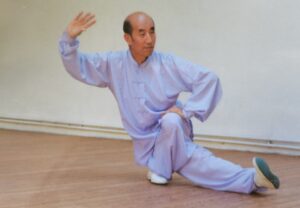
Daoyin Yang Sheng Gong (Health-Preserving Daoyin Exercises) is a comprehensive system of medical health cultivation exercises developed by Master Zhang Guangde (1931-2022), a professor and…
Daoyin Yang Sheng Gong (Health-Preserving Daoyin Exercises) is a comprehensive system of medical health cultivation exercises developed by Master Zhang Guangde (1931-2022), a professor and…
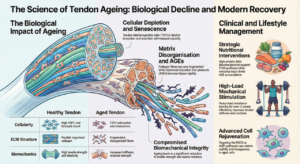
Tendon aging is a multifactorial process that compromises both the biological and mechanical properties of this essential connective tissue.
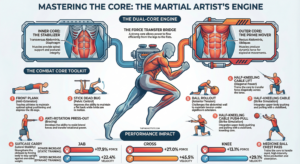
The core is defined as an interconnected system of muscles including the abdominals in the front, the paraspinal and gluteus muscles in the back, the diaphragm above, the obliques on the sides, and the pelvic floor and pelvic muscles below. Training this region is essential because it acts as the primary hub for power transfer between the upper and lower extremities.
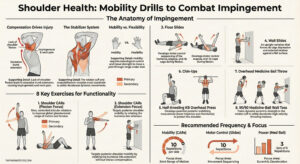
The shoulder is one of the most mobile yet vulnerable complexes in the human body, serving as a critical hub for dynamic actions ranging from tennis serves to martial arts strikes. Enhancing its function requires far more than simple muscle hypertrophy; it involves a sophisticated neuromuscular coactivation of the rotator cuff and scapulothoracic stabilizers.
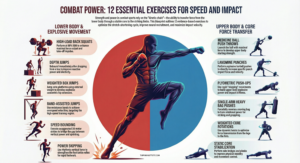
Explosive power, defined as the product of force and velocity, is a critical determinant of success in martial arts combat, governing strike amplitude, execution speed,…
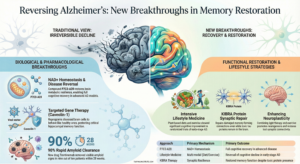
For over a century, Alzheimer’s disease has been considered a one-way street of cognitive decline, but recent scientific breakthroughs are beginning to challenge the deep-seated…
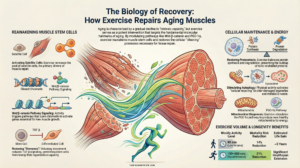
Exercise repairs ageing muscles by reversing biological hallmarks of decay. It stimulates stem cell regeneration, increasing the satellite cell pool required for effective tissue repair. It maintains proteostasis through autophagy, which removes damaged proteins that hinder muscle health. It restores mitochondrial function, improving energy production efficiency within muscle fibres. Exercise also promotes epigenetic rejuvenation, shifting gene profiles to support youthful muscle growth.
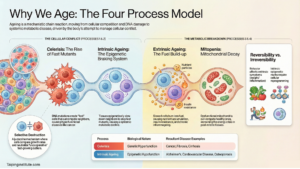
For decades, the standard scientific explanation for ageing has been almost apologetically vague: it is a "complex, multifactorial process" involving a slow accumulation of cellular errors. This view suggests that our bodies simply wear out, like old machinery, due to unavoidable DNA damage and toxic by-products. However, a unifying new "four process model" suggests that ageing is not a random slide into chaos, but a structured sequence of biological events driven by the forces of natural selection occurring within our own tissues.