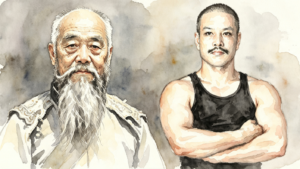
Wang Ziping and the warlord, Ma Liang.
Wang Ziping being born in Cangzhou, Hebei, residing in the YiheJie street area behind the great mosque, within the moslem quarter. He was allowed to…
Wang Ziping being born in Cangzhou, Hebei, residing in the YiheJie street area behind the great mosque, within the moslem quarter. He was allowed to…
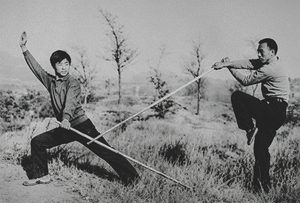
Wenshui Changquan 文水长拳, also known as "Zuojiaquan" (左家拳 Left Family Fist), originated in Xiaoziqu Village, Wenshui County, and is prevalent in Wenshui and surrounding areas.…

A haunting black-and-white photograph captures a moment of raw, defiant humanity in the early days of China's full-scale war against Japanese invasion. It shows a…

Wudang Taijiquan (武当太极拳) is a primary pillar of the Wudang martial arts system, originating from the sacred Wudang Mountain (also known as Taihe Mountain) in…

Baguazhang thus emerges not merely as a fighting system, but as a complete philosophy of movement, breath, and consciousness. In the words of the tradition, the practitioner becomes like water flowing around stone, wind bending through bamboo, and ultimately, the dragon that commands both earth and heaven with equal mastery.
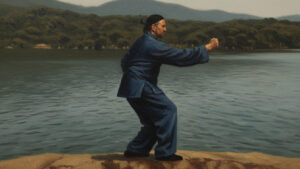
"One Horse, Three Arrows" (Yi Ma San Jian - 一马三箭) is a signature combination technique defined by its relentless, explosive speed. The strikes are meant to be fired off one after another without pause, penetrating the opponent’s defense like a volley of arrows.
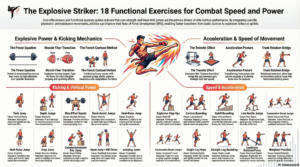
Lower-limb strength and power are critical for martial arts athletes to perform complex maneuvers such as aerial outward swings. These physiological attributes govern execution speed, movement amplitude, and postural control during the high-stress environment of competitive combat.
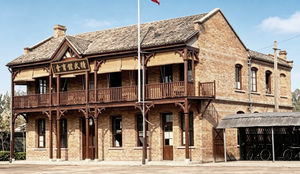
Understanding the Jingwu system requires separating two commonly conflated structures: the Three Sets of Ten Forms (三组十路拳) and the Three Graduation Levels (三等毕业制). The former organizes technical content; the latter certifies developmental maturity. When properly examined, these two systems intersect without overlapping, forming a coherent model of structured martial education.