Legendary Origins
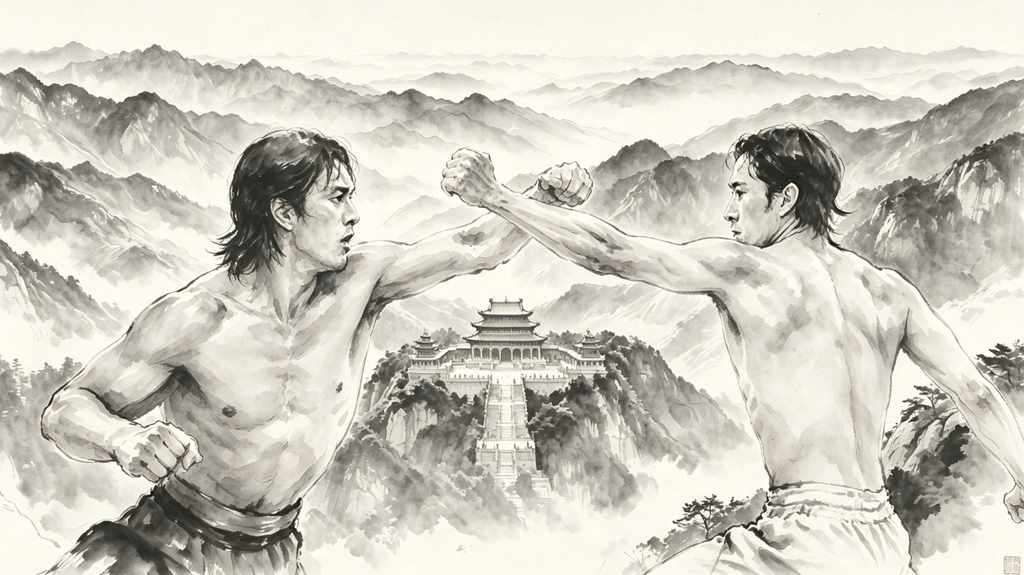
According to some records, in the past, the Shaolin Temple martial arts were spread into 3 families and 4 styles. The 3 families being Hong, Kong and Yue. The Four styles were Dasheng Men, Luohan Men, Erlang Men and Weituo Men. The specific origin and history of “Erlang Quan” is difficult to verify. It is said that Erlang Quan was created in the late Ming and early Qing dynasties.
At the end of the Ming Dynasty, Wei Yiguang and Kong Yiming, disciples of the Shaolin Temple, left the temple one after another, each living in a separate places, hiding in the mountains and forests, listening to the chirping birds, comprehending the mysteries of Shaolin, visiting famous martial arts masters, and after many vicissitudes of life, both of them separately achieved outstanding martial arts skills.
During the famine in the Year of Locust, the two were on the way to visit relatives and happened to meet at an inn on their way back home. After chatting, discovered that they were brothers from the same Shaolin school. When they talked about martial arts, they became very intrigued. They got up to fight with each other. After more than a hundred rounds, they were evenly matched. They vowed to work together to teach students. They named the boxing “Erlang Boxing”. Another theory, is that Erlang Quan is so named because it is mainly practiced by two people. Passed down from generation to generation, the disciples spread across dozens of provinces such as Henan, Hebei, Shandong, and Shanxi. Lastly, is that it was inspired by Erlang Shen, a Daoist deity (with Zorastrian influence).
History and Development of Erlang Quan
Like many old systems, their early origins are either based on folklore as above, or have different versions among its branches. In some Erlangquan records, it is that Zhang Dalai, who was from Shengfozhen in Cangzhou Yanshan, had joined general Qi Jiguang in fighting against the pirates during the Ming Dynasty. After exchanging with many experts specialising in weapons and methods, gaining experiences, he developed Erlangquan into a comprehensive system. After settling back in Shengfozhen, he passed on the martial arts.
The 11th‑generation inheritor of the Erlang Men, Zhang Yuting (张玉亭), a martial artist from Shengfo Town (圣佛镇), Yanshan County (盐山县), introduced Erlang Quan to Zhang Fanggui (张芳贵 1914-1969) and others in Macun (马村), Nanpi County (南皮县). From then on, Erlang Quan took root and flourished in Macun. Among the disciples he taught, Zhang Fanggui (张芳贵) was the most outstanding. He emphasized practical striking, excelling particularly in Sanda (散打), wrestling, and weightlifting, and had defeated countless masters from famous families. Among Zhang Fugui’s disciples, Dai Junfeng (代俊峰), Qi Changde (齐长德 1933-2011), and Han Shoucheng (韩守成) were highly skilled in martial arts and possessed noble martial ethics, becoming well‑known martial artists in Nanpi County. Later, Erlang Quan masters from Macun introduced this boxing style to Zhanzhuang Village (占庄村), Wang Guozhen Village (王国针村), Dashujin Village (大树金村), Xujiaheng Village (许家桁村), Quzhuang Village (曲庄村) in Nanpi County, as well as to Leling City (乐陵市) and Ningjin County (宁津县) in Shandong Province (山东省), and Liaoning Province (辽宁省).
In the 13th year of the Tongzhi reign (同治十三年, 1874) of the Qing Dynasty, a wandering monk, Hua Cheng (华程), resided in the ancient temple of Macun (马村), Luguan Township (潞灌乡), Nanpi County (南皮县), and taught Erlang Quan. Among his many disciples, Liu Daishan (刘代山) was the most outstanding. Thereafter, Liu Daishan carried on his teacher’s legacy and taught many disciples in his own village, especially his senior disciple Liu Yuxian (刘玉贤), who deeply grasped the true essence of Erlang Quan. Liu Yuxian later accepted Zhao Hongsheng (赵洪升) from the same village as his apprentice.
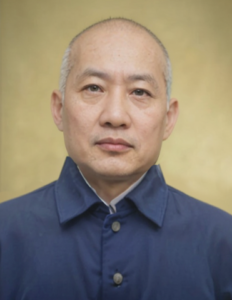
In Shengfozhen, the earliest recorded generation of Erlang Quan, was Ai Lianchi and was then passed to Huang Santai and Wang San (from Hejian) in the third generation. Wang was nicknamed “Flying Kicks Wang” and he taught Cui Li (崔笠), who was a devout orphan buddhist from Yanshan, that had lost his parents when he was young and then became a devout buddhist. Cui Li, a native of Yan Mountain (盐山), lost his parents at a young age and begged for a living. During this time, he met a Wang-surnamed martial arts master in Daxing County, known by the nickname “Fei Tui Wang” (飞腿王), and became his disciple to learn martial arts. The Wang master appreciated Cui Li’s intelligence and integrity, and since his wife was Cui Li’s cousin, he taught Cui Li all the skills of the Erlang Men (二郎门) style. In the 15th year of the Daoguang Emperor’s reign (1835), Cui Li returned to his hometown and established a martial arts training hall to pass on his skills. As Cui Li had no children, he later passed on all the techniques of Erlang Men to his disciple Wang Tianwei (王天维). Wang Tianwei broke the tradition of single-line transmission and, centered around the Shengfo Temple, established branch training halls in over 70 surrounding villages. He did not accept gifts or payment and openly took in disciples. Due to his profound martial arts skills, he often stood up for local people.
He was once hired as a bodyguard by Zhang Zhidong (张之洞), the Viceroy of Guangdong and Guangxi during the Qing Dynasty. Wang Tianwei’s son, Wang Jinggui (王景贵), was invited to establish training halls in 80 villages in present-day Ningjin County, Shandong Province, which is how Shandong’s Erlang Quan originated. Wang Jinggui’s son, Wang Yushan (王玉山), fully inherited the Erlang Quan techniques. He once stood up for workers in Northeast China whom the Japanese military bullied and later taught martial arts in Tangshan. Notable anti-Japanese heroes Jie Zhenguo (节振国) and Cao Kunshu (曹昆树) were among his disciples. Wang Yushan’s son, Wang Chunming (王春明), began learning martial arts at the age of seven and had a strong foundation. After participating in the resistance against Japan, he formed a martial arts company and taught hundreds of disciples.
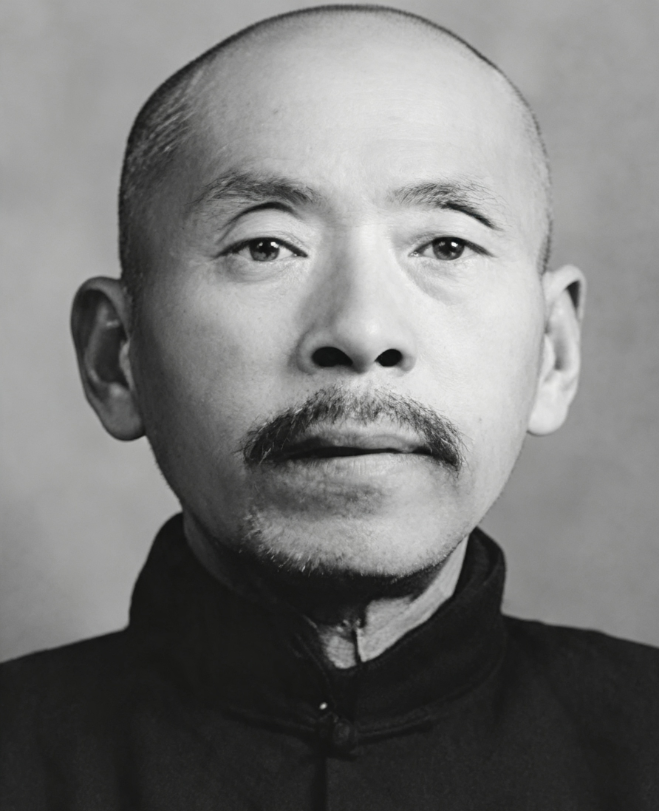
Feng Wensheng (冯文昇) was born in 1875 in Shengfo Township (圣佛镇), Yanshan County (盐山县), Cangzhou Prefecture, Hebei Province, a place long renowned as the heartland of the Erlang Quan style. His martial lineage ran deep: his grandfather had been a top disciple of Cui Li (崔笠), a famous master who had brought Erlang Quan to the Shengfo Temple area during the Daoguang reign of the Qing Dynasty. From the age of seven, Feng began training under his father, and under the combined tutelage of his father and grandfather, he devoted himself to relentless practice and serious study, eventually attaining profound skill and a deep understanding of the art. In 1918, driven by famine and hardship, Feng Wensheng moved his entire family to Dalian (大连), a port city in Northeast China, where they sought refuge with a fellow Hebei native, Zhang Zhaozhu (张兆珠), a renowned master of the Mizong Quan (秘宗拳) style. Zhang generously arranged housing for the Feng family near his own home, in the vicinity of a small bridge by the Dahegou (大河沟) stream in Xianglujiao (香炉礁), and also secured jobs for Feng and his three sons. Once the family was settled, Feng Wensheng resumed teaching Erlang Quan in his spare time. Zhang Zhaozhu’s eldest son, Zhang Hongshuang (张洪双), married Feng Wensheng’s eldest daughter, while Feng’s second daughter wed Zhou Jinsheng, another Hebei native living in Dalian.
Feng Wensheng’s eldest son, Feng Guangzhi (冯广志), later took up employment at the “Shipbuilding Dock” (Sensho, 船渠) factory, which was then under Japanese management. During a trial voyage, he sabotaged and destroyed a Japanese military transport vessel,an act that forced him to flee. With the help of underground Party organizations, he joined the Northeast Anti‑Japanese United Army (东北抗日联军), becoming a guerrilla fighter against the Japanese occupation. Meanwhile, after the Marco Polo Bridge Incident (七七事变) on July 7, 1937, which marked the full‑scale outbreak of the Second Sino‑Japanese War (全国抗日战争), Feng Wensheng made a momentous decision. He resolutely led his wife and his two younger sons, Feng Guangyuan (冯广元) and Feng Guangming (冯广明), back to their native Hebei hometown, where they joined the anti‑Japanese forces commanded by General Huang Hua (黄骅), a prominent Communist military leader in the region. In this new role, Feng Wensheng was entrusted with teaching Erlang Quan to the soldiers, adapting his family’s martial heritage for practical combat training within the guerrilla units.
Empty hand methods
Erlang Quan is powerful and forceful, with simple and practical movements, rigorous structure, and tight offense and defense. Every technique in the routines has combat value. Its routines move in straight lines, with punches and palm techniques requiring direct strikes and quick retractions, no empty frames, and strong explosive power. The basic training of Erlang Quan includes leg‑stretching drills, stance training, side splits, front splits, stretching, and thrust punches, all aimed at training the body and qi, and combining body and qi to produce force.
Practicing Erlang Quan places great emphasis on the coordination of hand techniques and footwork. There are 18 hand techniques: grind, cut, lift, wrap, frame, cut, block, separate, press, pull, send, hook, angle, snatch, bring, stick, push, and strike (研、削、掀、绕、架、切、挡、分、压、挽、送、钩、钓、抢、带、粘、搭、推). There are 14 footwork methods: step‑up, forward sliding (backward sliding), rushing step, retreating step, stamping step, horse‑riding stance, striking step, backward step, linked‑branch step, immortal step, body‑turn step, mud‑wading step, dragging step, and twining‑flower step (垫步、前游步、后游步、冲步、撤步、踏步、坐马步、击步、倒步、连枝步、仙人步、翻身步、趟泥步、拖步、绞花步).
The theory of Erlang Quan is very clear, requiring practitioners to:
The three natures inside and outside unite in one place;
The five elements and four extremities all exert their power.
Three levels, six coordinations, and five‑element force;
Use intention to move qi, reaching the root and tips.
The techniques of Erlang Quan are highly variable: one technique splits into many, one hand substitutes for many. It includes kicking, snapping, stamping, sweeping, wading, hooking, striking, and smashing. Top strikes, cuts, separations, and joint‑locking are commonly used methods. It emphasizes offense, striking after the opponent moves, meeting and borrowing force, and using force to subdue the enemy.
The Long Fist of Erlang Quan features deeper stances, with extended and graceful movements, using obvious explosive force. Fast movements are like a violent storm, slow ones like a gently flowing stream. It emphasizes the unity of shoulders, elbows, waist, and hips, and places equal importance on hand, eye, mind, foot, essence, qi, spirit, and technique, each movement combining hardness and softness, simple and unadorned. The Short Fist has short and fierce power, steady and crisp. It emphasizes the integration of hand, eye, body, technique, dodging, stretching, leaping, and shifting, focusing on “inch power” (寸劲) in punches, requiring explosive force upon delivery. In practice, it is “fast as the wind, slow as an eagle, light as a needle, heavy as iron.“
San Pan, Liuhe and Wuxing []
“Three Levels” (三盘): Shoulders, elbows, and hands form the upper level (上盘); waist and hips form the middle level (中盘); knees and legs form the lower level (下盘):
Upper level trains: dodging, fighting, leaping, shifting, pulling, striking, locking, sealing (闪、战、腾、挪、搂、打、锁、封).
Middle level trains: pressing, leaning, squeezing, bumping, carrying, hooking, collapsing, shaking (挨、膀、挤、靠、携、挎、崩、摇).
Lower level trains: kicking, snapping, sweeping, hooking, turning, stomping, lifting, wading (踢、弹、扫、挂、蹁、踹、提、趟).
“Six Coordinations” (六顺): The two eyes, two hands, and two feet must be coordinated, achieving: “Mind and intention unite, intention and qi unite, qi and force unite. Hands and feet unite, elbows and knees unite, shoulders and hips unite.”
The routines of Erlang Quan are unified with practical application: there are no techniques outside the routines, and no empty movements within the routines. The techniques within the routines allow for “striking in all directions” with endless variations. Routines and Combat are unified, they are the comprehensive embodiment of training the eyes, hands, mind, feet, essence, qi, spirit, and technique. Through practicing the routines, one develops skill; with an instructor’s guidance, the techniques can be applied practically. In other words, paired practice is combat foundational training. By learning the paired routines, one also gains some combat skills.
| 八趟弹腿 8 Roads of Tantui (Spring Kicks) 十八趟鸳鸯腿 18 Sequences of Mandarin duck kicks 二郎门 五行短拳 (金, 木, 水, 火, 土) 5 Sets of Short Boxing (5 Elements) 二郎门 八卦长拳 (乾,坎,艮,震,巽,离,坤,兑) 8 Sets of Long Boxing ( 8 Trigrams) 二郎门八趟陆春 8 sequences of Luchun |
Weapons of Erlang Quan:
| 开山刀 Open Mt Saber 开山棍 Open Mt Staff 盘龙棍 Coiling Dragon Staff 金锁刀 Golden Locking Saber 六合刀 Six Harmonies Saber 开山大斧 Open Mt Long handled axe | 五虎断门枪 Breaking Gate Spear 梨花枪 Pear Blossom Spear 昆吾剑 Kwun Wu Sword 钟馗剑 Zhongkui Sword 匕首 Daggers 虎头双钩 Double Hooks | 六角鸳鸯钺 Six angled Crescent Blades 双捶 Double Hammers 春秋大刀 Spring Autumn Blade 三尖两刃刀 Three Pointed Blade 方天画戟 Halberd 双头枪 Two headed Spear |
Erlang Quan emphasizes sinking the qi to the dantian (气沉丹田), while simultaneously directing qi into punching power. Hands and feet are used together, with punches delivering inch power (寸劲) and following up with inch‑length kicks. The main leg techniques include hook‑and‑link kicks (钩挂连环腿). The Sanda techniques of Erlang Quan synthesize the essence of wrestling, striking, and joint‑locking, and also include pressure‑point striking, all of which have high practical value for combat. When an opponent attacks and I evade and then counter, this is called the entering method (进法). When an opponent attacks and I simultaneously receive and counter, this is called the intercepting method (截法). When an opponent attacks and I evade and transform, with transformation containing a strike, this is called the transforming method (化法). Among these three methods, each surpasses the previous; the third is the most profound and can only be used effectively when one’s skill has reached the level of perfection. This method is like a shadow following its form, the body is always positioned behind the attacker’s force point, and in Erlang Quan it is called the “Immortal Exchanging Shadows” (仙人换影).
The combative characteristic of Erlang Quan is to win through speed. Speed is paramount. It emphasizes striking the unprepared, with hands as fast as lightning and retractions as swift as a burn. Erlang Quan greatly values leg techniques and footwork, as expressed in the saying: “Hands are the two gate‑doors, but victory relies entirely on the feet, better to take two punches than one kick.” In combat, legs are primary, fists secondary. Its hand techniques: striking, swinging, chopping, lifting, butting, bumping, leaning, are combined with leg techniques, snapping, sweeping, intercepting, stomping, swinging, kicking, hooking. Hands strike while feet kick, feet snap while hands strike, upper and lower coordinated, with interweaving of real and feigned attacks, achieving victory through the feet. Force is the foundation of combat; as the saying goes: “Fists don’t overcome strength, strength doesn’t overcome skill.” Hence the proverb: “If you practice boxing but not strength, you cannot withstand a strike.”