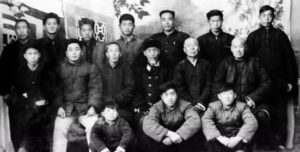
Our Xingyiquan is predominantly from the teachings of Chu Guiting and Shang Yunxiang, disciples of Li Cunyi. We present the foundation principles of six harmonies as they apply in concept and in combat. In Xingyiquan, the Six Harmonies (六合, Liu He) are a fundamental theoretical pillar of Xingyiquan practice, representing the total integration of the practitioner’s internal and external systems. They are divided into the Internal Three Harmonies and the External Three Harmonies.
The Internal Three Harmonies (内三合)
These harmonies focus on the mental and energetic alignment required to manifest internal power:
- Heart/Mind and Intent (Xin yu Yi he): The emotional center or mind aligns with the mental intent.
- Intent and Qi (Yi yu Qi he): The mental intent directs and harmonises with the internal energy (Qi).
- Qi and Power (Qi yu Li he): The internal energy aligns with physical strength to express power.
The External Three Harmonies (外三合)
These harmonies govern the physical coordination and structural alignment of the body’s sections:
- Hands and Feet (Shou yu Zu he): The extremities of the upper and lower limbs must move in coordination.
- Elbows and Knees (Zhou yu Xi he): The middle joints of the limbs align to support each other and unify motion.
- Shoulders and Hips (Jian yu Kua he): The “roots” of the limbs align with the torso to ensure power is generated from the waist and core.
Training and Significance
- Unity of Motion: The ultimate goal of training these harmonies is to achieve a state of Internal and External Unity (Nei Wai He Yi), where the whole body functions as a single, coherent unit. In this state, when one part of the body moves, nothing remains still, and the internal intent is perfectly expressed through physical action.
- The Role of San Ti Shi: The San Ti Shi (Trinity Stance) is regarded as the primary tool for cultivating these harmonies. It requires the practitioner to align the hands, feet, and nose on a single line while ensuring the internal harmonies are maintained through quiet focus.
- Three Sections Correspondence: The External Harmonies are based on the “Three Sections” theory, where the hand/foot are the “ends,” elbow/knee are the “middle,” and shoulder/hip are the “roots”. For unified power to manifest, these joints must correspond and reach their destination simultaneously.
- Waist Dominance: While the limbs must harmonise, the sources emphasize that all movement should be dominated by the waist, which acts as the axis for the Six Harmonies to function correctly.
In combat, the Internal and External Harmonies unify to transform the practitioner’s body into a single, coherent unit of explosive power where intent and action are indistinguishable. This unification is achieved through the following mechanisms:
The Command of the Waist
The waist acts as the central axis that bridges internal intent with external physical expression. The sources emphasize that for the Internal and External Harmonies to unify, all motion must be “dominated by the waist,” which ensures that power generated from the “roots” (hips and shoulders) is transmitted effectively to the “ends” (hands and feet).
Up and Down Correspondence (Shang Xia Xiang Sui)
In a combat engagement, the upper and lower sections of the body must move in perfect synchronicity. This is the practical application of the harmony between hands and feet, elbows and knees, and shoulders and hips. When a practitioner strikes, the hand and the foot must reach their destination simultaneously; if they do not, the internal power (Qi) will not fully manifest as physical force (Li).
Intent-Driven Manifestation
Combat effectiveness relies on the sequence where the Mind/Intent leads and the Qi follows.
- Internal Unification: The Mind aligns with the Intent, which then directs the energy (Qi) [previous turn info].
- External Unification: This energetic state is then expressed through the physical structure. The sources describe this as reaching a state of “Trinity in One” (San Ti He Yi), where the internal spirit and the external form are so aligned that when “one part of the body moves, nothing remains still”.
Arousing the “Four Extremities” (Si Shao)
To unify internal and external systems during the heat of combat, the practitioner must “arouse” the Four Extremities: the hair, tongue, teeth, and nails.
- Teeth and Tongue: Clenching the teeth and pressing the tongue to the palate stimulates the internal spirit and helps align the Internal Three Harmonies.
- Nails and Hair: This arousing of the “tips” of the body allows the internal power to penetrate through to the extremities, ensuring the External Three Harmonies are saturated with internal intent.
Application in Weapons
This unification is not limited to empty-hand combat. In Shang Style Xingyiquan, the weapon is treated as an extension of the limbs. The same Six Harmonies apply: the point of the spear or edge of the sabre must harmonise with the footwork and the practitioner’s internal intent, ensuring that “the power is rooted in the feet, controlled by the waist, and expressed through the weapon”.
Unified Explosive Power (Bao Fa Jin)
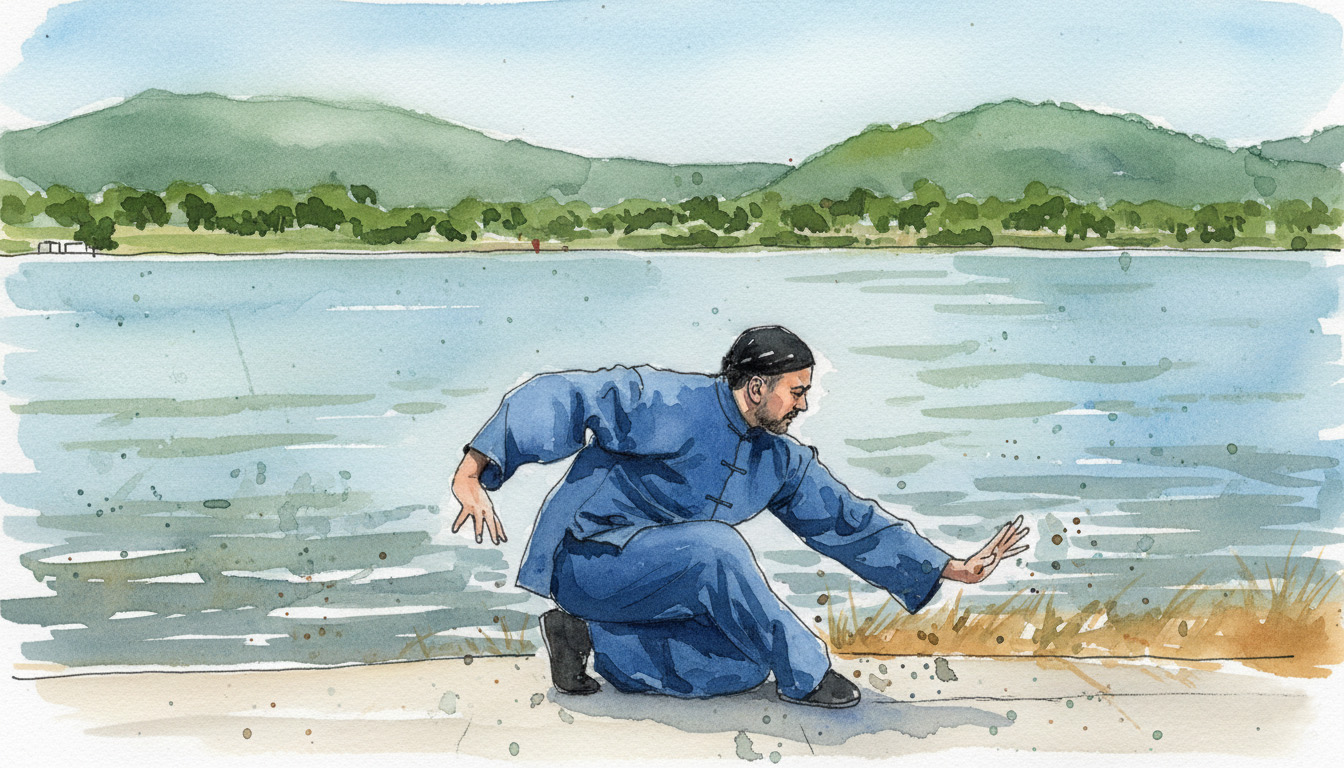
When internal and external systems are unified, the practitioner can express “Flipping Wave Power” (Fan Lang Jin), a type of explosive, continuous force that is compared to the crashing of water. This state allows the practitioner to be “quiet as a virgin” when still but “sudden as a thunderbolt” when moving, with the entire body weight and internal energy backing every strike.
In Shang Style Xingyiquan, Flipping Wave Power (Fan Lang Jin – 翻浪劲) is the technical manifestation of total combat unification, representing the representative form of the core mechanics: “Rising, Falling, Drilling, and Flipping” (Qi, Luo, Zuan, Fan),,.
The role of Flipping Wave Power (Fan Lang Jin – 翻浪劲) in combat unification is defined by the following characteristics:
Integration of Rising and Falling
Flipping Wave Power unifies the body’s vertical and horizontal energies. According to the sources, “Rising is going, and falling is hitting”. This creates a continuous, wave-like force where the act of attacking and the act of settling into a stance are indistinguishable. The transition between rising (Qi) and falling (Luo) is not just physical height change, but an internal “drilling and flipping” (Zuan Fan) that makes hitting and falling as relentless as a crashing wave,.
Expression of the Six Harmonies
This power acts as the physical proof of the Internal and External Harmonies being unified.
- The Axis: For Flipping Wave Power to manifest, the waist must act as the dominant master, coordinating the “Six Harmonies” so that the power rooted in the feet is transmitted through the hips and shoulders to the hands,.
- The Result: When internal intent (Yi), energy (Qi), and physical strength (Li) align with the physical joints, the result is a sudden, explosive power described as being “sudden as a thunderbolt”.
Combining Hardness and Softness
Flipping Wave Power allows the practitioner to unify Hard (Gang) and Soft (Rou) energies.
- It is often referred to as “Friction Power” (Mo Suo Jin) or “Rowing Power” (Hua Jin) because it involves a subtle, internal rubbing or stroking motion that hides explosive hardness within a soft exterior,.
- In combat, this allows the practitioner to be “quiet as a virgin” while still, yet able to unleash a “bursting hard power” instantly upon contact,.
Grounded Momentum (Tang Jin)
The role of this power is to ensure that the practitioner’s momentum is unified with the ground. It is described as achieving a state where one is “going like a whirlwind rolling on the ground”,. The stepping (Tang Jin) must be fast and fierce, while the “plucking” or flipping of the hands is as heavy and rooted as “turning over iron soil” (Tie Li Fan Di).
The “Eagle Catch” Training Method
The sources identify Ying Zhuo (Eagle Catch) as the “mother technique” specifically designed to seek and experience Flipping Wave Power,. By practicing the specific “drilling and flipping” of the Eagle Catch, the practitioner learns to experience how the rising and falling of the body creates a unified, explosive force that can then be applied to all other fists, such as the Five Elements Fists,.