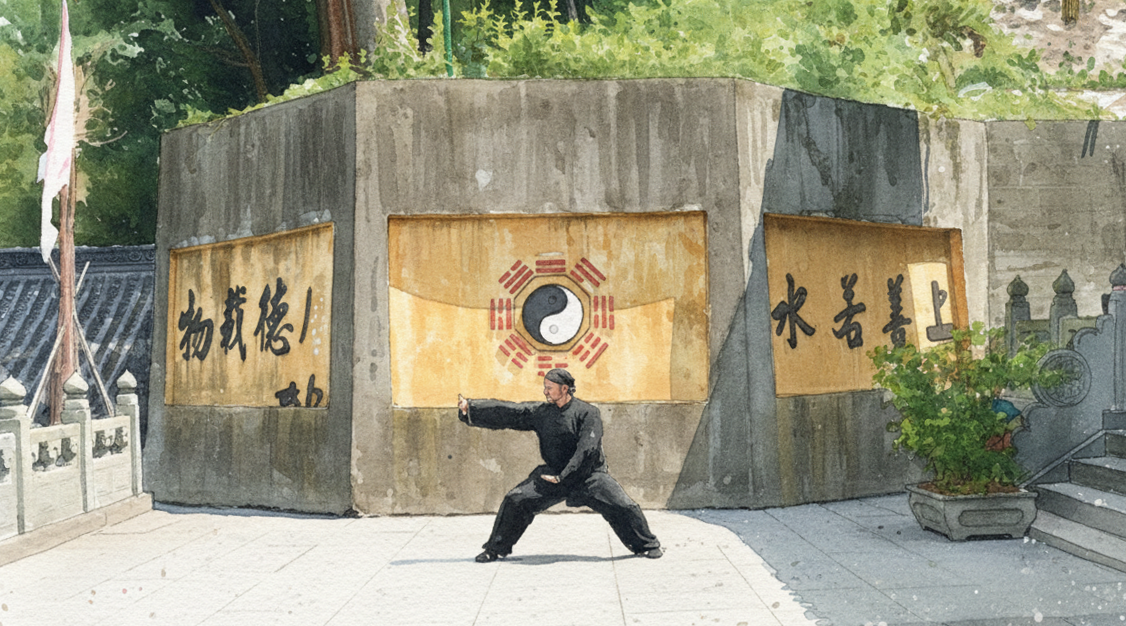
Baguazhang (八卦掌), literally “Eight Trigrams Palm,” stands as one of the most distinctive and philosophically rich internal martial arts of China. Unlike the linear approaches of many fighting systems, Baguazhang practitioners move in endless circles, their bodies coiling and uncoiling like dragons, their palms striking from angles that seem to defy geometry itself.
The Foundation: Body Alignment and Structure
The art begins not with techniques, but with precise body mechanics that transform the human frame into a instrument of power. The practitioner must maintain what the tradition calls “empty chest and elevated crown” (空胸拔顶), creating a vertical axis of power while the waist sinks downward (下含腰). This isn’t mere posture, it’s a biomechanical configuration where the hips twist (拗胯), the knees grip inward (拿膝), and the feet claw the ground with intention. The shoulders drop heavily (沉肩坠肘) while the forward palm extends, and crucially, the eyes must look through the tiger’s mouth, the space between thumb and forefinger, creating a unified line of sight, intention, and striking force.
The Unique Mechanics of Palm Change
What makes Baguazhang truly distinct is its approach to hand techniques. The rear elbow folds first, with the hand turning and following forward in what becomes a spiraling, protective motion. When the hand reaches the forward elbow, the practitioner achieves what masters call “embracing power” (合抱力), a spherical force where front and back hands form “one ball of spirit” (一团神). The stepping method resembles pushing a millstone, with bent steps and straight feet extending forward. The knee follows the hip, the waist twists with the foot, yet remarkably, “the eyes see three sides without the body swaying.” This is walking meditation transformed into martial application.
The Principle of Continuous Change
Baguazhang rejects static positions. One side alone is considered insufficient, left and right must cycle endlessly. When the left changes, the right follows; when the right transforms, the left adapts. The body withdraws and reverses naturally, finding its own organic timing. As steps turn, hands follow without hesitation. The rear palm threads forward as the front palm withdraws, going and returning without distinction, “like arrows flying from a bowstring.” During this threading motion, the finger-palm stays close to the elbow, and the rear shoulder becomes the forward shoulder, all while maintaining precise distance and stepping directly into the opponent’s center line.
Internal Cultivation: Breath and Spirit
The chest must be empty so qi can sink; the back stays tight while shoulders drop and intention extends forward. When breath reaches the dantian (丹田), the practitioner contracts the perineum (谷道) and pulls energy straight up through the crown, threading精神 (jingshen, essential spirit) through the entire structure. While walking, the whole body remains stable, relying entirely on the interchange of the knees. Though the lower level emphasizes level knees and hips, the middle level still requires descending legs and waist. The lips press together, mouth closed, tongue touching the palate, with breathing conducted entirely through the nose. At moments of extreme exertion, force releases through the sounds “heng” and “ha”, this mixing of breath and power achieves the “primordial unified qi” (浑元一气).
Palm Shape and Striking Method
The tiger’s mouth must stretch round and open. The middle and ring fingers create a spreading gap. The technique strikes first with a stabbing motion, then transforms into a strike utilizing wrist bone, accompanied by relaxed shoulders, extended waist, and following steps that dart forward.
The Art of Advance and Retreat
When advancing, the hips join together; when retreating, they separate. When changing palms and forms, the body lowers. Entering and retreating, retreating and entering, all follow opportunistic势 (shi, strategic advantage), requiring only that the waist and legs arrange themselves cleverly. Baguazhang differs fundamentally from other martial arts: when advancing, one lifts the forward foot first, this alone brings achievement. When retreating, one withdraws the rear foot first. When crossing steps, one must stay to the outside, leaving the center.
The Strategy of Yielding and Attack
Another distinction: before the hand moves, the shoulder attacks first. Before extending forward, one first contracts backward, inhaling fully before exhaling to create singular abundance of force. The art operates on deceptive principles: to strike west, first make sound in the east. Pointing up while striking down, who can know? The pearl rolls back in reverse current with even greater divine skill. Masters speak of “three penetrations” (三穿) that must be feared in natural refined technique. Not walking the outer gate would be wasteful effort. When the opponent walks the outer path, the practitioner walks the inner, extending the hand to obtain victory without difficulty.
Multi-Directional Attack
Using only one side of the palm achieves no merit, at minimum, one still needs two-sided attack. “One horizontal, one vertical, triangular hands”, this makes people feel as though they’re held within your embrace. When opponents are high, go low; when they’re low, rise up. Slant the body and circle-step without hurry. Slant-turning and reverse-turning require waist power, and when turning reaches the extreme point, force must be firm.
The Balance of Hard and Soft
People say palm methods excel in hardness, but master Guo once stated that softness hides within. Some among practitioners know this taste, the mutual assistance of hard and soft is the true strength. Hard first with soft hiding after; or soft first with hard expanding later. Others’ softness lies in waist and hand; for the Baguazhang practitioner, it manifests through drawing in the waist while steps remain stable and elevated.
Transformation Through Footwork
When usage reaches its extreme, one must turn the body, escaping and transforming like a shadow leaving no trace. How does one transform? It depends fundamentally on stepping, exiting and entering, advancing and retreating, with the waist extending first. The divine nature of palm rotation transmits through the neck bones. When turning and twisting the neck, the hands lead the way. When changing, contract the neck; when releasing, extend it, one must resemble a divine dragon with head and tail connected.
Generating Power from Root to Branch
Striking people relies on the hand, but the shoulder serves as the root. Since the shoulder resides at the shoulder’s end and cannot extend, when desiring to advance, advance the forward step. Advancing the rear step wastes spiritual energy. Power sufficient to issue forth comes from sinews and bones. From bones emerges hardness, but sinews must follow. The heel’s great sinew connects through the spinal cord to the brain, when releasing techniques while following with steps, power can crush obstacles.
The Three Truths and Four Arrivals
“Following arrives, hand arrives, waist and leg arrive” (跟到手到腰腿到). When heart is true, spirit is true, and power is true, these “three truths and four arrivals” combine at one point. This provides more than enough for self-defense and enables one to control others.
The Philosophy of Hardness and Softness
Force wants hardness but also needs softness. When hard and soft are imbalanced, skill becomes difficult to harvest. Excessive hardness breaks, this is true physics. When 優柔 (gentle pliability) becomes too abundant, it equals cessation.What does “mutually assisting hard and soft” mean? Hard and soft supporting each other presents no difficulty whatsoever. When properly applying hard and soft, use “heaven and earth hands” (乾坤手), uplifting heaven, revealing earth, creating waves on the ocean.
Responsive Strategy
When people are hard, I am soft, this is the correct method. When I am hard and people are soft, the method is also good. When hard and soft meet, the waist seeks victory. To resolve this entanglement, footwork must be strong. When footwork moves, the waist lifts first, contracting and harmonizing appropriately displays divine mystery. If the foot wants to move but the waist doesn’t move, one staggers forward, missing the crucial moment.
Precision in Combat
When turning body and changing methods, steps shouldn’t be long. Scrape the ground while moving without panic. Look clearly at the incoming path before extending the hand, like a clever maiden threading a needle, stabilizing the balance of soft and firm. When people hold sharp weapons, the practitioner doesn’t rush. Even if flying swords arrive at the body’s side, watch their incoming path and avoid with “heng” and “ha” sounds. “Evil cannot overcome rightness”, these words prove quite good. When short weapons meet in seeming difficulty to defend, why fear even if sharp as fish-gut dagger? Extend the hand to receive as if catching objects from a bag, pointing at mountains while grinding reveals wonders hidden within.
Against Multiple Opponents
When people are many and I am few, power seems hard to withstand, but cleverly breaking thousand-pound force requires no hurry. One hand doesn’t labor, relying on finger power, even a plowing ox fears the reverse bow’s tension.
Adapting to Conditions
When extending the hand without seeing the forward palm extend, and without oil lamps illuminating the opponent’s body, contract the eyelids and exert the eyes to look, the foundation level palm usage displays divine mystery. In icy heaven, snowy earth, and muddy rain slipperiness, the front foot cuts horizontally without error. When turning the body, rigorously avoid spiral spinning; avoiding high and low tightly proves excellent.
The Supreme Principle: Spirit
In application, what’s most essential is spirit-essence (精神 jingshen). When spirit flourishes brilliantly, ears and eyes become true. Regardless of others’ flying swallow hands, when ants sing, the practitioner hears tiger and dragon roars.
Baguazhang thus emerges not merely as a fighting system, but as a complete philosophy of movement, breath, and consciousness. Its circular walking patterns mirror the endless transformations of the Yi Jing’s eight trigrams, while its practical applications demonstrate that the softest path, the circle that yields and redirects, often proves the strongest. In the words of the tradition, the practitioner becomes like water flowing around stone, wind bending through bamboo, and ultimately, the dragon that commands both earth and heaven with equal mastery.