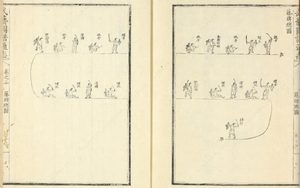
【御定武艺图谱通志20】藤牌谱、藤牌总谱、藤牌总图

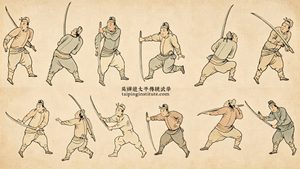
【御定武艺图谱通志20】藤牌谱、藤牌总谱、藤牌总图 其中提到的技术招势有:1起手势、2跃步势、3低平势、4金鸡畔头势、5低平势、6跃步势、7低平势、8滚牌势、9低平势、10仙人指路势、11埋伏势、12埋伏势、13滚牌势、14埋伏势、15仙人指路势、16埋伏势、17滚牌势、18埋伏势、19跃步势、20斜行势。戚继光《纪效新书》藤牌八势图诀藤牌八势谱:1.懒扎衣势、2.斜行势、3.仙人指路势、4.滚牌势、5.跃步势、6.低平势、7.金鸡畔头势、8.埋伏势其中的懒扎衣势,也就是朝鲜谱中所说的起手势。朝鲜谱中的藤牌20势,去除重复的技术招势,与戚继光书中的8势一致。

Continue Reading【御定武艺图谱通志20】藤牌谱、藤牌总谱、藤牌总图

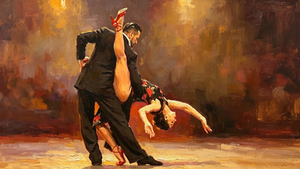
The Knife, the Horse and the Frontier: The Martial World of the Gaucho “Hombre de Nadie”

This frontier warfare also explains why the gaucho's martial reputation involved considerably more than personal duelling. He had to endure long rides, poor food, exposure, fatigue and uncertainty. He needed to know how to move through country where roads were rudimentary or nonexistent. He needed to recognize water, grazing and routes of travel. He needed to handle a horse after hours of riding and still be capable of fighting. In an irregular war, the ability to remain mobile and self-sufficient could be as important as the ability to strike an opponent.

Continue ReadingThe Knife, the Horse and the Frontier: The Martial World of the Gaucho “Hombre de Nadie”

Cangzhou Traditional Medicine and Martial Arts – Ma Zhendong, 50 Years of Free Medical Service for Over 10,000 People

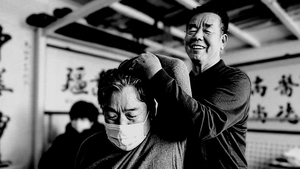
There is an old saying in the martial arts world: "One who practices martial arts is half a doctor" (武林有句俗话“一个武半个医”). Those who train in martial arts often suffer injuries, so skilled practitioners also tend to learn bone-setting and massage techniques. In the ancient city of Cangzhou (沧州), there is a renowned martial arts master named Ma Zhendong (马振东), who, while training in martial arts, also mastered the advanced skills of bone-setting and massage. He teaches people martial arts for fitness while also providing free medical treatment.

Continue ReadingCangzhou Traditional Medicine and Martial Arts – Ma Zhendong, 50 Years of Free Medical Service for Over 10,000 People

华佗五禽戏

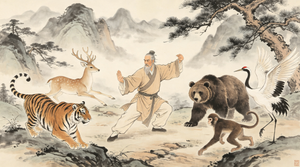
Wu Qin Xi was created by Hua Tuo at the end of the Eastern Han Dynasty. Hua Tuo’s contributions to physical fitness and health preservation were outstanding. Based on the theory of the "Inner Classic" (Nei Jing) of traditional Chinese medicine, the theory of Yin-Yang and the Five Elements, and the movement patterns of the body's organs, meridians, Qi, and blood, Hua Tuo observed the habits and postures of various birds and beasts. He selected the characteristics of the tiger (fierce), deer (agile), ape (intelligent), bear (steady), and bird (harmonious) to form the Wu Qin Xi routine. This is a health-preserving Qigong that combines internal and external cultivation, perfecting the ancient (导引) and Tu Na (吐纳) breathing exercises

Continue Reading华佗五禽戏

Yu Dayou, the underestimated martial arts master and his Staff Manual

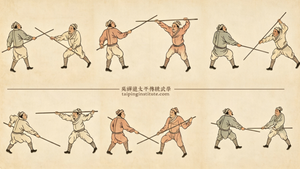
The Jian Jing manual is not a collection of techniques, rather it is a method of controlling distance, line, rhythm, and force so that the staff becomes an extension of the whole body, and the body becomes a formation. One of the main problems with those that have not studied the staff, is that often wiggle around the staff without attention of the body, and in chinese martial arts, and in the Jian Jing, significant focus is on distance, stepping, as well as the lines of forces.

Continue ReadingYu Dayou, the underestimated martial arts master and his Staff Manual

五行通背拳谱

通背者何也?通即通达之意、贯通之法;背乃人之脊背,动作之则。本由背,背通肩,肩通肘,肘通腕,腕通手掌,手通指;肩背向下通腰,腰通胯,胯通膝,膝通 足,足通步,步通身,身通手,身通于眼,眼通心,心通神,神通意,意通胆,胆通气,气通血,血通筋,筋通力。力由背发,根在于足,始由足,贯于背,由背贯 于指掌全体,内外贯通一气,法则放长击远,此之谓通背。

Continue Reading五行通背拳谱