An encounter with Chuojiao and Xingyi Quan

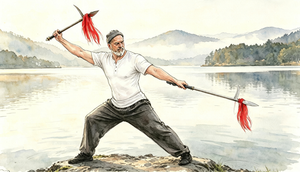
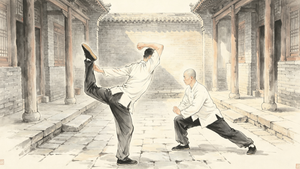
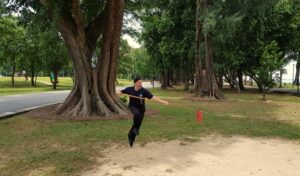
He Yunheng (贺运亨, 1839–1924), a native of Menggao Village, Taigu, Shanxi, and the second Shanxi disciple of Li Laoneng, the founder of Xingyi Quan, and the second‑generation Chuojiao grand master Wei Changyi (魏昌义, est 1835–1915, from Xiqizhuang, Lixian County, Hebei), who was then in charge of the Fuyuan Security Logistics Bureau in Beijing, formed a bond through martial arts.

Continue ReadingAn encounter with Chuojiao and Xingyi Quan

Wang Zhan Ao (王占鳌): The Iron-Armed Logistics Security Officer

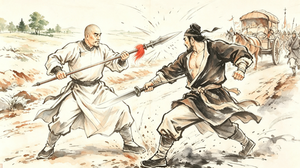
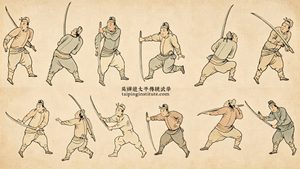
With single-arm strength, Wang Zhan Ao (王占鳌) executed "Dragon Coiling the Sea" (盘龙搅海), then "Golden Rooster Nods" (金鸡乱点头), forcing Li Gong to retreat. A final strike, "Kun Peng Spreads Its Wings" (鲲鹏展翅), sent the spear whipping toward Li Gong like lightning. The bandit barely dodged, but the shaft grazed his back, knocking him down.

Continue ReadingWang Zhan Ao (王占鳌): The Iron-Armed Logistics Security Officer

Explosive Striker: 18 Essential Exercises for Jumping Kicks and Combat Acceleration

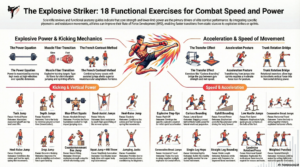
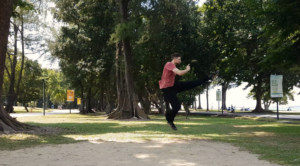
Lower-limb strength and power are critical for martial arts athletes to perform complex maneuvers such as aerial outward swings. These physiological attributes govern execution speed, movement amplitude, and postural control during the high-stress environment of competitive combat.

Continue ReadingExplosive Striker: 18 Essential Exercises for Jumping Kicks and Combat Acceleration

Introductory principles of Chuojiao

Chuojiao, one of China's traditional martial arts schools, unconsciously embodies and applies this philosophical thought. Every move in Chuojiao reflects the concept of unity of opposites, allowing two opposing elements to coexist and transform into each other. It skillfully combines contradictory elements such as attack and defense, advance and retreat, emptiness and solidity, upper and lower, hardness and softness, extension and contraction, movement and stillness, and applies them flexibly and masterfully, elevating one's combat skills to a new level.

Continue ReadingIntroductory principles of Chuojiao

Sample techniques in Chuojiao

As stated in the Chuojiao Boxing Theory: "The hands are the vanguard, and the feet are the commander. The fists strike in six directions, and the feet kick in eight." In practical combat, Chuojiao emphasizes the coordinated use of hand and foot techniques. The hands defend the upper body, while the feet attack the lower body. The hands guide the feet, and when the hands move, the feet follow. When the feet retract, the hands defend. This synchronization is crucial.

Continue ReadingSample techniques in Chuojiao

Importance of Leg techniques in Chuojiao

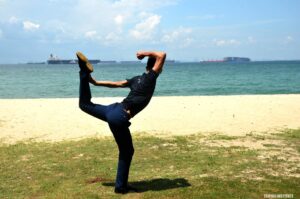
"In martial arts, practicing leg techniques is fundamental. If leg techniques are well-trained, the Five Elements will be in harmony, and the Six Harmonies will be aligned. If one does not train their legs, the Five Elements will not be in harmony, the Six Harmonies will not align, movements will not be swift, advancing and retreating will lack agility, and it will be difficult to utilize the tendons and bones effectively. Therefore, one must first focus on developing leg strength.

Continue ReadingImportance of Leg techniques in Chuojiao

戳脚 “手为先锋,脚为主帅”

世间万物,均是以既对立又统一的形式存在的。辩证唯物主义认为:“任何事物的发展都根源于事物自身对立面的同一和斗争。一切矛盾着的对立面,既相互依赖又相互排斥,既相互同一又相互斗争。使双方力量处在此消彼长的不断变化之中。一旦矛盾双方的力量对比起了根本的变化,双方力量地位便发生相互转化,于是新事物取代旧事物。”作为我国传统武术流派之一的戳脚,也在不知不觉中体现并运用了这一哲学思想。戳脚拳术的每一个招势都体现了对立统一思想,使两个对立面相互依存、相互转化。

Continue Reading戳脚 “手为先锋,脚为主帅”