Compiled and arranged by Wang Zhenhai (王振海)
The Legend of a Martial Prodigy
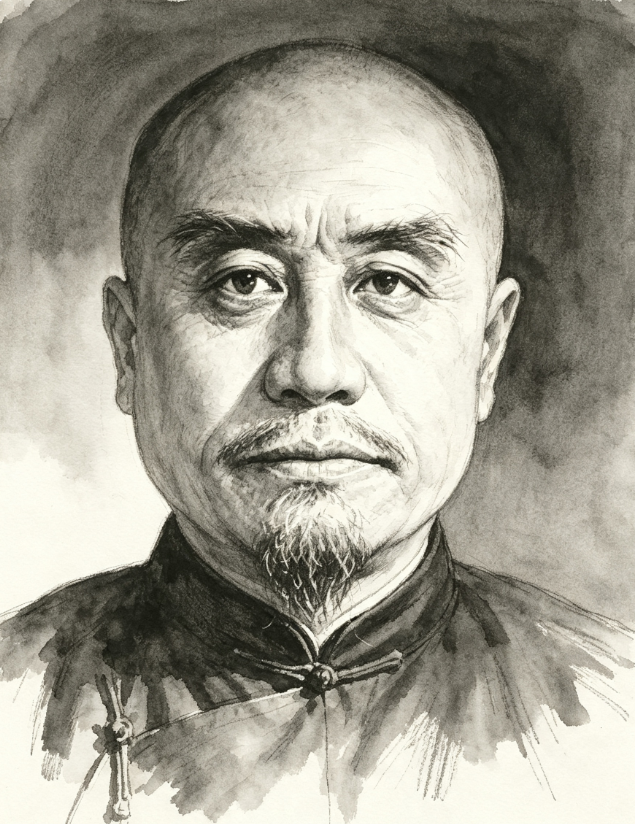
Wang Zhan’ao (王占鳌, 1854–1916), courtesy name Yatou (丫头), was a native of Nanxukou Village, Daqudi, Lixian County (蠡县大曲堤南绪口村). He held the sixth‑rank official cap and was a martial artist of the late Qing dynasty. He was the eldest son of Wang Jiguo (王技国), a major transmitter of the northern Fanzi (翻子) and Chuojiao (戳脚) styles, and himself a renowned escort master of the late Qing period. Both father and son are listed in the Modern Hebei Martial Artists Directory.
Wang Zhan’ao was born into a martial arts family. His father, Wang Jiguo, courtesy name Laoji (老技), was highly skilled in martial arts and was well known in his hometown for his Shaolin Fanzi. Wang Zhan’ao was naturally intelligent, possessed extraordinary arm strength, and had a well‑developed physique, through which he forged formidable skills. In numerous competitions, he became famous in the martial arts world for his “iron arm.” He studied under the renowned martial artist Liu Guanlan (刘观澜)*, a major transmitter of Chuojiao. He studied diligently and later operated the “Fushun Escort Agency” (福顺镖局) in Beijing, and subsequently took over his teacher Liu Guanlan’s “Fuyuan Escort Agency” (福源镖局), serving as its head, establishing a training hall, and accepting disciples to pass on martial arts. At the same time, he also worked as a bodyguard and boxing master for the princely mansions. Over years of feuds and conflicts in the Jianghu, he made powerful enemies and was forced to flee back to his hometown, where he lived in seclusion and taught martial arts, carrying forward and promoting the art. His fame shook the martial arts world, and stories about him have been passed down from generation to generation in his hometown.
The mother river of Lixian County flows eastward and then north into Baiyang Lake, eventually reaching the Hai River. On the west bank, in the courtyard of a farmhouse, training racks were set up with spears and sabres, where his father Wang Jiguo taught more than a dozen disciples from surrounding villages. At that time, Fanzi was taught by a hired labourer from Shandong*. Young Wang Zhan’ao watched intently from the side, his eyes fixed on every move and posture. Because he had a hot temper and struck ruthlessly, his father refused to teach him directly, fearing that he would bring trouble upon himself. Instead, he first sought to temper his character and constantly taught him the principles of proper conduct, that one must cultivate virtue before learning martial arts. But Wang Zhan’ao was not convinced. He watched and memorised, and at night, when no one was around, he practised on his own. Not only did he learn the skills his father taught his senior fellow disciples, but he also picked up many of his father’s secret techniques.
One night, in high spirits, he kicked repeatedly at the earthen wall of his family’s yard until the wall was levelled to the ground. The next day, after the wall had been rebuilt, Wang Jiguo asked his disciples who had knocked it down. Unable to conceal the truth, they told him it was Wang Zhan’ao. That evening, Wang Jiguo called his son into the yard and asked him how the wall had fallen. He then told him to try kicking the wooden stakes used for stance training. Wang Zhan’ao said, “That’s simple,” and with one kick each, he broke all eight stance‑training stakes, boasting as he did so. Seeing his arrogance, Wang Jiguo’s anger flared and he said, “Boy, dare to have a few rounds with your father?” With that, he kicked at Wang Zhan’ao, a kick that would have broken even a jujube wood stake in half. Wang Jiguo expected his son to dodge, but Wang Zhan’ao did not move. When the kick landed on Wang Zhan’ao’s leg, Wang Jiguo only felt pain in his foot; his toenail broke and bled. Looking at his son’s leg, there was only a white mark. Though his foot ached, Wang Jiguo was secretly pleased that his son was gifted for martial arts. He put on a stern face and taught him the importance of martial virtue. “All things are created by the mind; before learning the art, one must cultivate the heart. Every move can be fatal. The mind must remain calm in all situations. If you do not strike, be willing to suffer losses; do not be arrogant and do not strike ruthlessly.”
In the days that followed, while teaching Wang Zhan’ao martial arts, Wang Jiguo also strictly trained him in lifting stone locks and stone rollers to build arm strength, as well as plum‑blossom stance training. He trained in the bitter cold of winter and the sweltering heat of summer. In winter, he would run in thin clothes to warm up, then lie shirtless on the ice of the Zhulong River (潴泷河) until his body left an imprint, and then perform several boxing routines on the ice, if one could stand firm on ice, one would be faster and more stable on land. “The sharp edge of a sword comes from grinding, and the fragrance of plum blossoms comes from the bitter cold.” Through long and arduous training, he laid a solid foundation for his later dominance in the martial arts world.
The Iron Arm Shakes the Martial World
While receiving strict instruction from his father, Wang Zhan’ao also studied Chuojiao from the renowned master Liu Guanlan*, a family friend. He formally became Liu’s disciple and learned Chuojiao, Ditangquan (Ground Tumbling Boxing), and other Chinese martial arts. He forged formidable skills, with deep internal strength, great martial attainment, and extraordinary arm power. Once, while playing near a well at Likou, he placed two stone rollers in an inverted V shape beside the well. When he moved them apart with equal force, one of them accidentally fell into the well. When people heard of this, they invited him to use both hands to push them apart, and the story became legendary.
On another occasion, a disciple of Wang Jiguo from Nanxukou went to the market in Gaoyang. On the way, he encountered a Master Wei from Weijiazuo, Gaoyang, who was teaching martial arts. Seeing that Wei’s instruction was not very refined, the disciple made some disrespectful remarks, a quarrel ensued, and he was injured. Upon returning to the village, he told Wang Zhan’ao, falsely claiming that Master Wei had insulted Wang Jiguo. Wang Zhan’ao flew into a rage and went to Weijiazuo the next day to seek an explanation. When Master Wei saw that the eldest son of the Nanxukou master Wang Jiguo had come to visit, he welcomed him and held the door curtain aside for Wang Zhan’ao to enter. But Wang Zhan’ao, being a martial artist and suspicious of a trap, threw a “black tiger steals the heart” punch straight at Master Wei. Caught off guard, Master Wei was struck and had two ribs broken. In great pain, he said, “Let’s stop here today. In a hundred days, we will have a match.” After returning home, Wang Zhan’ao told his father, who severely reprimanded him, saying that holding the curtain was a gesture of goodwill and that striking first was improper. Wang Zhan’ao also felt he had been discourteous and planned to go to Weijiazuo later to apologise.
Some time later, an invitation arrived from Weijiazuo, Gaoyang, summoning famous martial artists from Gaoyang and Lixian to gather for a competition in Gaoyang county town. To ensure fairness, the Gaoyang county magistrate was also invited to serve as referee. Seeing that there was no turning back, Wang Jiguo took Wang Zhan’ao to the match on the appointed day. After the magistrate’s opening speech, Master Wei said, “How shall we conduct the match today?” Wang Jiguo knew that a real fight would result in injury, so he thought of demonstrating hard‑style skills to find a way to settle the matter peacefully. He said, “Let us exchange skills with restraint. My son was disrespectful and struck too harshly. Let us first see his hard‑style skill before comparing fists and feet.” He then called to his son: “Yatou, lie down and stretch out your legs for the cart to run over.” Turning to the other side, he said: “Bring the cart over, and have several people stand on it to run over his legs.”
Wang Zhan’ao lay down, and an iron‑wheeled wooden cart carrying several people, pulled by five horses, raced over his legs. Wang Zhan’ao sprang up with a carp leap, completely unharmed. Wang Jiguo then said, “Yatou, now your arms.” Seeing Wang Zhan’ao’s impressive hard‑style skill, the other party loaded more than a dozen people onto the cart, intending to break his arms. The heavily loaded cart rolled over Wang Zhan’ao’s arms. He stood up and laughed, saying, “Father, what’s next, where shall we have them roll over?” Wang Jiguo smiled and said, “Put a few more people on the cart, we’ll roll over the head! Yatou, lie still, they’ll roll over your head.” The Gaoyang county magistrate, fearing a fatality that would be difficult to explain, called Master Wei aside for a consultation. Master Wei, already drenched in cold sweat from the leg and arm rolling, realised that continuing would not be in his favour, and took the opportunity to back down. Thus, the competition turned into a demonstration, and the two sides shook hands and became friends. Master Wei even became a disciple of Wang Jiguo. Wang Jiguo’s clever demonstration of Wang Zhan’ao’s hard‑style skill avoided actual conflict and injury, and Wang Zhan’ao became known throughout the martial world as the “Iron Arm.”
Competition in the Capital
As the Wang father and son’s fame spread far and wide, not only did the number of students from surrounding villages increase, but they also accepted many disciples in Anxin and Gaoyang. One of Wang Jiguo’s disciples had opened a martial arts school in Beijing to teach, but was bullied by rivals. He sent word back home, requesting assistance. After discussing it with his father, Wang Zhan’ao decided to go to Beijing himself to help resolve the situation. After a three‑day journey from his hometown in Lixian, he arrived in Beijing, tired from the long trip, but without rest he went straight to the rival martial arts school.
The school occupied a five‑room courtyard, where dozens of people were training under the guidance of Master Li. Leather sandbags hung in the yard, and the disciples were practising punches and kicks with great effort. After exchanging pleasantries, Wang Zhan’ao walked over to a sandbag and said with a smile, “Master Li, is this bag sturdy? I hope you won’t make me pay if I break it.” Li replied, “It’s fine, you won’t have to pay – just go ahead and hit it.” Before he finished speaking, Wang Zhan’ao delivered a toe‑kick to the sandbag using his acupoint‑striking technique, tearing a large hole through the oxhide bag, and sand poured out onto the floor. He then punched another sandbag, tearing another large hole, with sand spilling out again. Wang Zhan’ao said, “These sandbags are not very sturdy, not as sturdy as you people, really. Come on, let’s have a few rounds.” As Master Li was about to accept the challenge, the senior disciple called him aside and whispered, “Let us go first. We can see his techniques, and also tire him out after his long journey, so you can face him later.” He then said to Wang Zhan’ao, “Master Wang, let me have a round with you first. If I lose, then my master will take over.” Wang Zhan’ao asked, “What shall we compete in?” The opponent suggested staff techniques. Wang said, “I find one opponent not satisfying enough, all five of you come together.” Taking a thick waxwood staff from the rack, Wang Zhan’ao channelled his full power to his wrists, and with a flick of the staff, it moved like a noodle as he whirled it left and right, sweeping the five opponents off their feet. One was even tossed onto the roof, while the others lay on the ground groaning.
Master Li, watching from the side, was stunned. He realised that even if he went up himself, it would be futile. Quickly seizing a way to save face, he said to his disciples, “Your real master has arrived, kneel!” Then turning to Wang Zhan’ao, he said, “You should teach at this school. I am not your equal and cannot mislead the students.” With that, he prepared to leave. Wang Zhan’ao quickly urged Master Li to stay, saying that all martial arts under heaven come from the same source, and invited him to stay and teach together. Master Li not only admired Wang Zhan’ao’s peerless martial skill, but also respected his high martial virtue. They became sworn brothers and taught together. With the help of his teacher Liu Guanlan, Wang Zhan’ao established the Yongsun Escort Agency (永顺镖局) and began his Jianghu career as an Logistics Security Officer.
Escorting Across the South, Shaking the Martial World
While running his martial arts school in Beijing, Wang Zhan’ao also established the Yongsun Escort Agency. As his teacher Liu Guanlan grew old and returned to his hometown, the Fuyuan Escort Agency he had founded was also taken over by Wang Zhan’ao. Over the years, his escort work mainly followed the southern route, initially transporting valuable goods such as gold and silver. Because his escorts were safe, timely, and conducted with integrity, he sometimes also transported imperial robes and tribute items for the palace.
In the late Qing dynasty, there were eight major escort agencies in the area in front of Beijing’s Qianmen Gate. These agencies were responsible for transporting money, goods, and grain, earning a perilous living. Escorting was divided into water routes and land routes, with the agency dispatching escorts for protection. Yongsun Escort Agency operated along the southern route, reaching as far as Shanghai and Nanjing. At that time, there were two main official roads southward, called the East Avenue and the West Avenue. In years of escort work and Jianghu wanderings, Wang Zhan’ao never met his equal. He became arrogant and overbearing. He not only had a flag made for his escort agency with the words “Kicking both banks of the Yellow River, fisting both capitals of north and south” but also claimed that “standing atop the city gate tower and looking south, there is no one who can match me,” as he brandished his flag and announced his presence.
When his teacher Liu Guanlan heard of this, he was greatly displeased and admonished Wang Zhan’ao, saying: “Among the strong, there are always stronger; behind every capable person, there is another. Do not be arrogant.” Wang Zhan’ao put aside his pride, refined his martial arts further, and made friends with many fellow martial artists from Lixian, including Gao Qingtian (高擎天), Wei Changyi (魏昌义), Master He (何武师), as well as Liu Yuxiu (刘玉秀), Han Luma (韩路马), and Duan Dianchen (段殿臣) from Gaoyang. He also passed the military examination in Baoding Prefecture and, through introductions by Wei Changyi and Master Qi Laogong (齐老公) from Daqudi, took up a post in the princely mansion as a martial arts instructor, receiving the sixth‑rank official cap. He made multiple trips to the Nanjing Manufacturing Bureau to escort imperial robes.
While serving in the princely mansion, Wang Zhan’ao, relying on his talent and arrogance, inadvertently offended powerful officials at court. They plotted to kill him on his way to Nanjing, at Tongzhou in Beijing. When Master He, Han Luma, and Master Qi Laogong learned of this, they sent word warning him not to go to Nanjing on official business, and also sent him a sword for self‑defence, telling him that if necessary, he could kill. Wang Zhan’ao went immediately to the princess’s inner quarters, knelt, and begged for a way to escape with his life. The princess agreed to let him hide under her carriage and slip out of the city. At that time, the authorities had posted notices and sealed the four city gates to arrest Wang Zhan’ao. After leaving the city, the princess pretended to need to relieve herself, ordered the guards to turn away, and allowed Wang Zhan’ao to crawl out from under the carriage and flee. Wang Zhan’ao escaped in a flash back to his hometown in Lixian.
Retreat to the Countryside, Studying Martial Arts and Teaching Disciples
After returning to his hometown, Wang Zhan’ao saw clearly the fickleness of the world and no longer involved himself in Jianghu affairs. He devoted himself to refining his martial skills and, at home, made friends through martial arts. Together with his senior and junior fellow disciples, he accepted many students, and the Wang family name of Xukou spread far and wide. Among his many disciples, an innumerable number were invited to serve as escort masters, bodyguards, and instructors.
One of Wang Jiguo’s outstanding disciples, Xu Zhaoxiong (徐兆熊), established training grounds in the Northeast and Shandong, becoming the first‑generation transmitter of Fanzi and Chuojiao in the Northeast. He had many disciples, including Hao Mingjiu (郝鸣九), Yang Junfeng (杨俊峰), and Yu Boqian (于伯谦). Yu Boqian served as secretary to Zhang Xueliang and participated in the famous Xi’an Incident. Another outstanding disciple of Wang Jiguo, Wang Feixiong (王飞熊), set up a school and taught in Gaoyang and Anxin, while also excelling in bone‑setting medicine, continuously developing and promoting the martial art. Yet another outstanding disciple, Zhang Jingtian (张敬天), was not only highly skilled in martial arts but also possessed noble martial virtue, and often treated bone injuries for the villagers, earning widespread praise.
After Wang Jiguo’s death, his disciples Zhang Jingtian and other villagers erected a stele in honour of his virtue, commemorating his lifelong merits. The front of the stele is inscribed with four large characters: “Merits Equal to a Good Physician” (功同良相). The back records the deeds of the Wang father and son in aiding the village and relieving the needy, as well as the process of raising funds for the stele from several hundred donors over a hundred‑li radius. The names of Wang Jiguo, Wang Zhan’ao, Xu Zhaoxiong, Zhang Jingtian, and others are included in the Modern Hebei Martial Artists Directory.
Appendix:
*Liu Guan Lan (刘观澜, 1820-1910), styled “Lao Guan” (老观), was born in Zhao Duan Zhuang Village (赵锻庄村), Lai County (蠡县). Born into a martial arts family, he and his two brothers, Liu Pan Gui (刘攀贵) and Liu Jun Jie (刘俊杰), began training Taizu Changquan 太祖长拳 under their father, Liu Shang (刘尚), from a young age. In 1828 (the 8th year of the Daoguang Emperor’s reign), they, along with Gao Qing Tian (高擎天) from Zhang Village (张村), Wei Lao Fang (魏老方) from Qian Liu Shi (前刘市), and others became disciples of Feng Ke Shan (冯克善), Yang Jing (杨景), and Tang You Yi (唐有义), masters of Chuo Jiao (戳脚), Di Tang Quan (地躺拳), and 13 Animal Patterns (十三型). His father also helped fellow villager and martial arts expert Wang Ji Guo (王技国), who imparted Fanziquan (翻子拳) to his children and students there too.
Though small in stature, Liu Guan Lan was agile, swift, and precise. His leg techniques were as fluid as his arms, and his “Jue Zi Jiao” (蹶子脚, a striking technique targeting pressure points) was particularly legendary. Combined with his lightness skill (轻功), his martial arts were uniquely refined, earning him the title of “the finest among heroes.”
Through such arduous training, he achieved unmatched lightness and agility, his body as light as floating cotton, his leaps as swift as a gibbon swinging through trees, and his movements as effortless as walking on flat ground. Fellow martial artists praised him as “Sai Shi Qian” (赛时迁, rivaling the legendary outlaw Shi Qian) and “Shen Tui Sai Huo Hou” (神腿赛活猴, divine legs rivaling a living monkey).
In 1838 (the 18th year of the Daoguang Emperor’s reign), Liu Guan Lan was sent by his masters to travel the jianghu (martial world) and in Western Beijing (京西), he shocked the martial community by defeating an Iron-Headed Monk (铁头和尚) in a famous duel, earning a reputation that echoed through the capital. The Miyun County (密云县) government soon hired him as a martial arts instructor, and he founded the “Fu Yuan Escort Agency” (福源镖局) in Beijing. In his middle age, Liu Guan Lan often returned home to teach, where he crossed paths with Wang Zhan Ao, a master of Fan Zi Quan from the same hometown. After a combat match, Wang lost, then he (Liu Guanlan) accepted Wang Zhan Ao as his disciple, merging the strengths of both martial arts styles and refining them to perfection.
In his later years, Liu Guan Lan retired, teaching in his home village, living to the ripe old age of 90. Both local dignitaries and the martial arts community held him in high regard. To honour his contributions, a stela (碑) was erected at the entrance of his home, commemorating his lifetime of achievements and martial virtue.