Hook Sickle Spear (钩镰枪, Goulian Qiang) is a type of cold weapon from ancient China.It was used in infantry combat and was one of the weapons in ancient chariot warfare tactics. Its form consists of a long spear with a barbed hook on the sharp blade of the spearhead, specifically designed to counter enemy cavalry.
Many practitioners of Xingyi Quan (形意拳) encounter a very real predicament: during daily practice, the Five Elemental Fists (五行拳) are performed with formidable power, the routines are memorized to perfection, and movements flow like water. Yet once they put on boxing gloves and engage in sparring, their minds instantly go blank. They frantically search their memory
Wang Ensheng was master of the brush and the sword. He created the most works for Tianjin publishers. Before the Cultural Revolution, Wang Ensheng painted approximately thirty comic books for various publishing houses in total. He also created some short comic book pieces for various comic book periodicals and art journals. It can be said that he was one of the representative outstanding comic book artists of the first generation in Tianjin. As well as being an inheritor of the Wudang Sword.
Warlord Cao Kun (曹锟), noting the martial spirit of the Cangzhou region, specially recruited soldiers there to form a martial arts battalion. The battalion appointed Liu Yuchun, Ren Xiangrong, and others as instructors to teach the two‑handed sabre technique, which was called “Miao Dao” (苗刀). Hence, the battalion was also known as the “Miao Dao Battalion.” In fact, only one battalion specialised in training Miao Dao, and Tong Zhongyi (佟忠义) served as its company commander.
He Yunheng (贺运亨, 1839–1924), a native of Menggao Village, Taigu, Shanxi, and the second Shanxi disciple of Li Laoneng, the founder of Xingyi Quan, and the second‑generation Chuojiao grand master Wei Changyi (魏昌义, est 1835–1915, from Xiqizhuang, Lixian County, Hebei), who was then in charge of the Fuyuan Security Logistics Bureau in Beijing, formed a bond through martial arts.
With single-arm strength, Wang Zhan Ao (王占鳌) executed “Dragon Coiling the Sea” (盘龙搅海), then “Golden Rooster Nods” (金鸡乱点头), forcing Li Gong to retreat. A final strike, “Kun Peng Spreads Its Wings” (鲲鹏展翅), sent the spear whipping toward Li Gong like lightning. The bandit barely dodged, but the shaft grazed his back, knocking him down.
By reviewing precious old photographs and publications from the Republican era, we are able to glimpse the true appearance of the Jiangsu Provincial Martial Arts Institute (江苏省国术馆). It was the official orthodox martial arts institution of Jiangsu Province at that time, and also the most prosperous testament to the martial arts movement in Jiangsu during the Republic of China period.
The Han Dynasty (汉朝) saw the rise of the Huán shǒu dāo (环首刀), The Tang Dynasty (唐朝) introduced the liuyedao (柳葉刀), the khanda (खंडा), a double-edged straight sword and The scimitar (saif al-muqawwar سيف المقور),
A sword needed much more than just a sharp edge to be useful. In addition to a blade geometry suitable for its intended function, it required a controlled combination of hardness, toughness, strength, elasticity, edge retention, and fracture resistance
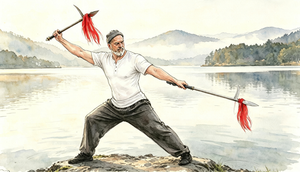 Hook Sickle Spear (钩镰枪, Goulian Qiang) is a type of cold weapon from ancient China.It was used in infantry combat and was one of the weapons in ancient chariot warfare tactics. Its form consists of a long spear with a barbed hook on the sharp blade of the spearhead, specifically designed to counter enemy cavalry.
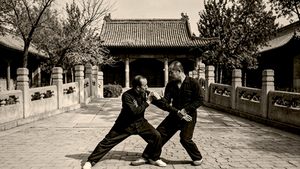 通背者何也?通即通达之意、贯通之法;背乃人之脊背,动作之则。本由背,背通肩,肩通肘,肘通腕,腕通手掌,手通指;肩背向下通腰,腰通胯,胯通膝,膝通 足,足通步,步通身,身通手,身通于眼,眼通心,心通神,神通意,意通胆,胆通气,气通血,血通筋,筋通力。力由背发,根在于足,始由足,贯于背,由背贯 于指掌全体,内外贯通一气,法则放长击远,此之谓通背。
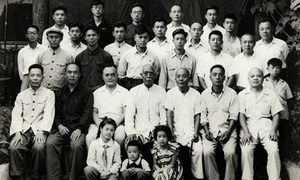 陈氏太极拳老架一路 陈氏太极拳老架一路74式,一路拳以柔为主,柔中有刚,架势舒展大方,步法轻灵稳健,身法中正自然,内劲统领全身,以缠丝劲为核心,运动以腰为轴,节节贯串,运动如行云流水,绵绵不断,发劲时松活弹抖,完整一气。 练习时要求,虚领顶劲,立身中正,松肩沉肘,含胸塌腰,松胯圆裆,呼吸自然,快慢相间,外形走弧线,内劲走螺旋,逐渐产生一种似柔非柔,似刚非刚,极为沉重而又极为灵活善变的内劲。整套拳没有平面,没有直线,没有断续处,没有凹凸处,没有抽扯之形,没有提拔之意,浑然一圆,方为合格。 老架一路 74势 太极起势, 金刚捣碓, 懒扎衣, 六封四闭, 单鞭, 金刚捣碓, 白鹅亮翅, 斜形, 搂膝, 拗步, 斜形, 搂膝, 拗步, 掩手肱拳, 金刚捣碓, 撇身捶, 青龙出水, 双推手, 肘底看拳, 倒卷肱,… Read more: 陈氏大架太极拳 拳谱
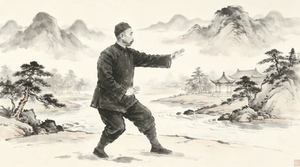 郭云深文武双全,不仅拳法独步一时,又熟练兵书,对形意拳理论,进行过系统的研究和总结,遗著有《能说形意拳经》一书。对形意拳理论的论述,其要点如下:“形意拳有三层道理,有三步功夫,三种练法。三层道理是:一练精化气,二练气化神,三练神还虚。三步功夫是:一易骨,二易筋,三易髓。三种练法是:明劲,暗劲,化劲。”郭云深在论述形意拳理论时,特别强调桩功,指出三体式(形意拳基本桩法)为万形之基础。这些理论对于后人学习形意拳有着重要的帮助。
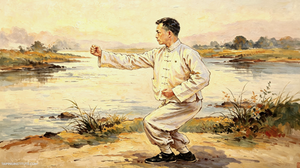 Many practitioners of Xingyi Quan (形意拳) encounter a very real predicament: during daily practice, the Five Elemental Fists (五行拳) are performed with formidable power, the routines are memorized to perfection, and movements flow like water. Yet once they put on boxing gloves and engage in sparring, their minds instantly go blank. They frantically search their memory
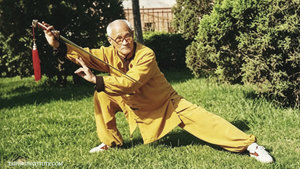 Wang Ensheng was master of the brush and the sword. He created the most works for Tianjin publishers. Before the Cultural Revolution, Wang Ensheng painted approximately thirty comic books for various publishing houses in total. He also created some short comic book pieces for various comic book periodicals and art journals. It can be said that he was one of the representative outstanding comic book artists of the first generation in Tianjin. As well as being an inheritor of the Wudang Sword.
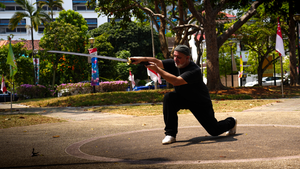 Warlord Cao Kun (曹锟), noting the martial spirit of the Cangzhou region, specially recruited soldiers there to form a martial arts battalion. The battalion appointed Liu Yuchun, Ren Xiangrong, and others as instructors to teach the two‑handed sabre technique, which was called “Miao Dao” (苗刀). Hence, the battalion was also known as the “Miao Dao Battalion.” In fact, only one battalion specialised in training Miao Dao, and Tong Zhongyi (佟忠义) served as its company commander.
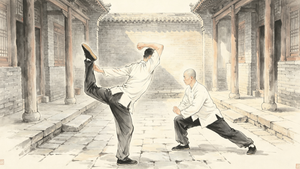 He Yunheng (贺运亨, 1839–1924), a native of Menggao Village, Taigu, Shanxi, and the second Shanxi disciple of Li Laoneng, the founder of Xingyi Quan, and the second‑generation Chuojiao grand master Wei Changyi (魏昌义, est 1835–1915, from Xiqizhuang, Lixian County, Hebei), who was then in charge of the Fuyuan Security Logistics Bureau in Beijing, formed a bond through martial arts.
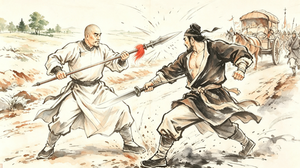 With single-arm strength, Wang Zhan Ao (王占鳌) executed “Dragon Coiling the Sea” (盘龙搅海), then “Golden Rooster Nods” (金鸡乱点头), forcing Li Gong to retreat. A final strike, “Kun Peng Spreads Its Wings” (鲲鹏展翅), sent the spear whipping toward Li Gong like lightning. The bandit barely dodged, but the shaft grazed his back, knocking him down.
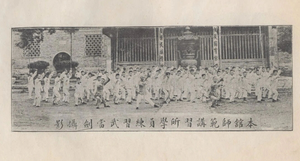 By reviewing precious old photographs and publications from the Republican era, we are able to glimpse the true appearance of the Jiangsu Provincial Martial Arts Institute (江苏省国术馆). It was the official orthodox martial arts institution of Jiangsu Province at that time, and also the most prosperous testament to the martial arts movement in Jiangsu during the Republic of China period.
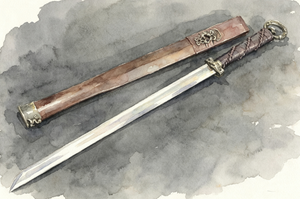 The Han Dynasty (汉朝) saw the rise of the Huán shǒu dāo (环首刀), The Tang Dynasty (唐朝) introduced the liuyedao (柳葉刀), the khanda (खंडा), a double-edged straight sword and The scimitar (saif al-muqawwar سيف المقور),
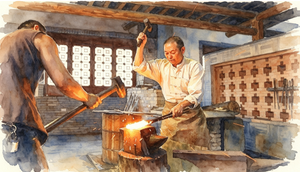 A sword needed much more than just a sharp edge to be useful. In addition to a blade geometry suitable for its intended function, it required a controlled combination of hardness, toughness, strength, elasticity, edge retention, and fracture resistance