The sword was a universal technological challenge faced by swordsmiths across China, India, Persia, Central Asia, the Islamic world, Japan, and Europe. The core problem was transforming iron, a relatively soft material, into steel, an iron-carbon alloy whose properties depend on carbon concentration, impurities, microstructure, and thermal history. A functional sword required a balance of hardness, toughness, strength, elasticity, edge retention, and fracture resistance, all tailored to its intended use. Historical swordmaking was not a competition to discover a universally superior metal but a series of localized solutions shaped by ore availability, fuel types, furnace technology, trade networks, manufacturing organization, armor, cavalry, infantry tactics, and smithing skill. Metallurgical studies confirm that blade quality must be understood through the entire production process, from ore extraction and smelting to refining, carbon control, forging, welding, heat treatment, and grinding.
The Foundations of Sword Materials
The primary distinction in swordmaking is between iron and steel. Pure iron is soft, so swordsmiths relied on carbon introduced during smelting or processing to increase hardness and strength. However, excessive carbon could make the material brittle. Smiths had to control not only carbon quantity but also its distribution, alongside other elements like phosphorus, manganese, silicon, sulfur, and trace alloys, which influenced mechanical properties. Modern metallurgy confirms that steel properties depend on phases like ferrite, pearlite, cementite, and martensite, as well as grain size, inclusions, residual stresses, and blade geometry. Historical smiths lacked modern tools but achieved remarkable control through empirical experimentation.
The bloomery furnace (bloomeria or comparable local terms) was the first major technological tool. It reduced iron ore to metallic iron without fully melting it, producing a bloom: a porous mass of iron, slag, and varying carbon concentrations. Smiths consolidated this material through repeated heating and hammering, a process distinct from blast furnaces, which produced liquid cast iron with higher carbon content. European metallurgy relied on bloomery production for centuries, refining techniques in ore preparation, furnace design, slag removal, and carburization. Controlling carbon concentration remained a persistent challenge.
Charcoal (炭, tan in Chinese and later Japanese) was essential as both fuel and a chemical agent in ironmaking. Its availability influenced the location of iron industries, while ore quality determined the properties of the resulting metal. Some traditions gained reputations due to favorable combinations of ore, fuel, and refractory materials, but success depended on the skill of the metallurgical system in converting raw materials into usable steel.
China and Large-Scale Iron Production
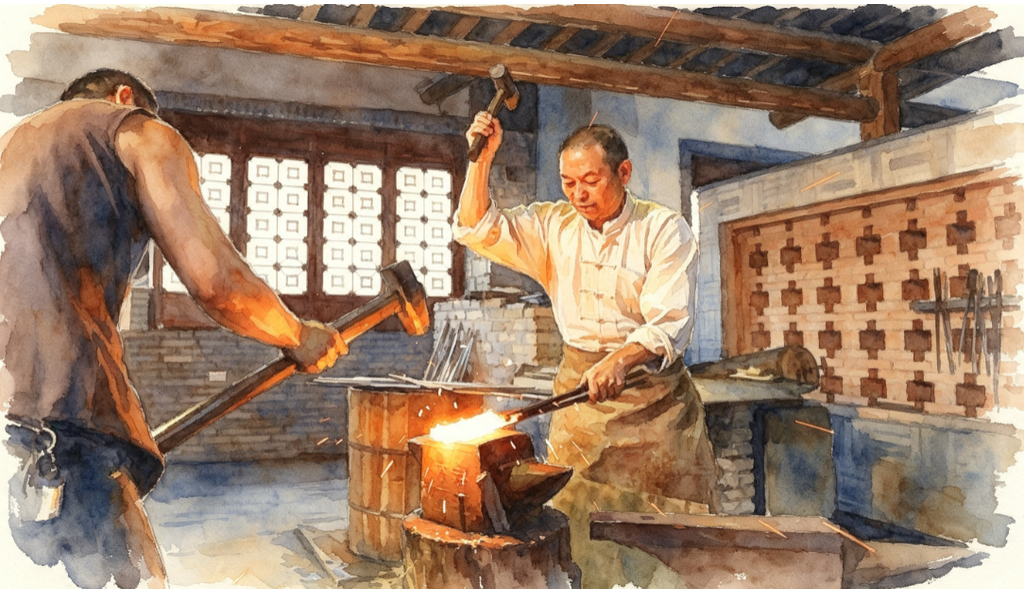
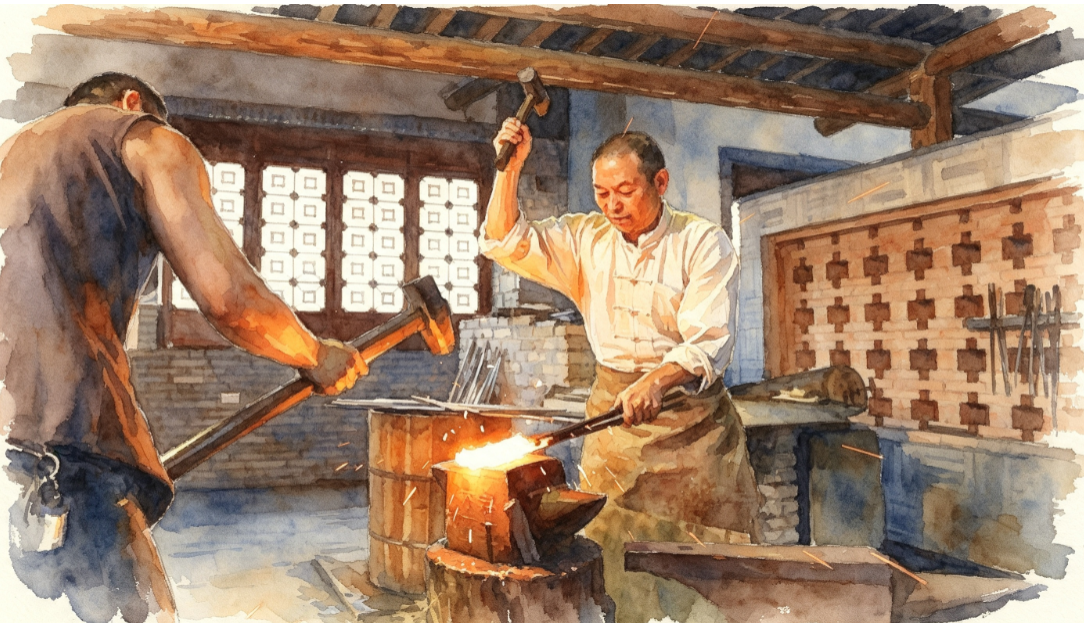
China’s metallurgical history diverged from Europe and Japan. By the Han period, China used blast furnaces (高炉, gaolu) to produce cast iron on a large scale. Cast iron is brittle, so Chinese metallurgists developed fining and decarburization to control carbon content. By the medieval period, China’s iron and steel industry operated at an extraordinary scale, with regions producing substantial annual outputs. This industrial capacity allowed China to equip large armies and standardize production, providing a military advantage.
Chinese swords included the straight double-edged jian (劍) and the single-edged dao (刀), which evolved into various forms such as straight blades, curved sabers, and broad chopping weapons. By the third century BCE, iron and steel dao replaced bronze in warfare, while the jian retained elite status. During the Sui and Tang periods, high-quality steel blades were produced, and Chinese metallurgical knowledge influenced Japan via Korea. Chinese swordmaking also employed composite construction, such as inserted-edge techniques like qiangang (嵌鋼) and sanmei (三枚), where harder steel edges were combined with softer bodies. These methods demonstrated an understanding that the best material for the edge did not need to be the best for the entire blade.
India, Persia and the use of Crucible Steel
In South India, metallurgists developed crucible steel production, known as wootz in South India, bulad in Central Asia, and jauhar in Arabic traditions. By the middle of the first millennium BCE, wootz ingots were exported across Asia and the Middle East, becoming critical for blades associated with Damascus steel. Crucible steel differed from bloomery metallurgy by producing high-carbon steel in sealed ceramic crucibles at temperatures around 1400–1450°C. The resulting steel had a distinctive internal structure, with cementite (Fe₃C) networks forming a watered appearance when polished and etched. This pattern was not created through forge welding but through the steel’s internal crystallization.
Scientific studies confirm that genuine wootz produced remarkable microstructures, including cementite nanowires, but claims that Persian smiths deliberately created carbon nanotubes are unsupported. The performance of wootz is better explained by its high-carbon composition and controlled cementite microstructure. Neutron studies reveal that not all Indian blades were made of wootz, as multiple metallurgical traditions existed. Wootz was an elite material, not a universal military steel.
Persian swordmaking became significant due to its use of crucible steel, which moved through trade networks from India to Central Asia, Iran, and the Islamic world. Persian metallurgists adapted imported materials to local weapon designs, such as the shamshir (شمشیر), a curved sword optimized for cavalry warfare. The shamshir’s geometry encouraged a slicing action, compatible with mounted combat, and its effectiveness depended on blade curvature, mass distribution, edge geometry, and steel properties. High-quality watered steel remained prestigious in Persian swordmaking into the eighteenth century.
The reputation of Persian smiths, such as Asadullah of Isfahan, is difficult to authenticate, as signatures on blades often span broad chronological ranges, suggesting later attributions or forgeries. Scientific analysis of the blade itself is more reliable than inscriptions for assessing quality.
Japan and Composite Blade Engineering
Japanese swordmaking relied on steel produced in tatara furnaces (たたら) from iron-rich sand called satetsu (砂鉄), resulting in tamahagane (玉鋼), a heterogeneous material with varying carbon concentrations. The folding process, kitae (鍛え), was a method of material selection and refinement, not a magical strengthening technique. Smiths selected portions of tamahagane, forge-welded them into a billet, and repeatedly folded and forged it to create a laminated structure. This process redistributed carbon and reduced inclusions, while manipulating fold directions to create grain patterns called jihada (地肌).
Japanese smiths combined harder outer steel, kawagane (皮鉄), with a softer core, shingane (心鉄), to balance edge retention with toughness. The differential hardening process, yaki-ire (焼入れ), involved coating the blade with clay (yakibatsuchi, 焼刃土), heating it, and quenching it in water. The edge cooled rapidly, forming martensite, while the spine cooled slowly, retaining softer structures like ferrite and pearlite. The hamon (刃文), or hardening pattern, marked the boundary between these regions and was not purely decorative. The curvature of Japanese blades resulted from dimensional changes during quenching. This process was technically demanding, as errors in temperature, clay thickness, or timing could ruin the blade.
Bloomery Steel
European swordmaking relied on bloomery metallurgy, producing heterogeneous iron that required refinement. Smiths used carburization, forge welding, and composite construction to create steel within iron objects. Pattern welding (known by various local terms) became a visually distinctive technique in early medieval Europe. Smiths combined rods or bars of iron and steel, welded them, and manipulated the composite through twisting, folding, and forging to create surface patterns. Metallurgical analysis shows these blades often had low-carbon steel edges combined with iron bodies, making them genuine composite structures rather than mere decoration.
Pattern welding was not inherently superior to homogeneous blades, as performance depended on material quality, weld integrity, geometry, and heat treatment. Later pattern-welded objects were sometimes produced for prestige rather than function. Ppattern welding is different from wootz, as their patterns arise from different mechanisms.
European sword design evolved in response to armor developments. Early medieval broad blades were effective against soft targets and light armor, but as mail and plate armor improved, swords required stiffness, point strength, and thrusting capability. This led to changes in cross-sectional geometry, blade proportions, and points. The longsword was not a stronger version of earlier swords but an adaptation to new tactical demands.
Toledo and Solingen: Centers of Sword Production
Toledo became a renowned swordmaking center due to its tradition of skilled forging and finishing, not a mysterious “Toledo steel.” Spanish swordsmiths adapted to changing civilian and military needs, such as the rapier (espada ropera), a thrust-focused weapon with a long, narrow blade and elaborate guard, optimized for fencing. Toledo and Solingen became principal centers for rapier production, with blades circulating internationally.
Claims that Toledo blades could be bent into semicircles and return to their original form should be treated cautiously. Elasticity alone does not indicate superiority, as excessive softness may compromise edge retention, while excessive hardness may lead to brittleness. The goal was a balance of hardness and toughness suited to the weapon’s function.
Solingen emerged as a major center for edged tools and swords, particularly in the early modern period. Its significance lay in industrial organization, enabling the production of reliable weapons through specialized labor, water-powered machinery, grinding facilities, and commercial institutions. This distinction between craftsmanship and manufacturing capacity grew more important after the medieval period. While individual smiths in Japan, India, or Persia could produce exceptional blades, European centers like Solingen developed systems for standardized, large-scale production.
The Interdependence of Material and Processing
The greatest lesson from historical swordmaking is that steel quality cannot be separated from processing quality. A high-quality raw material could be ruined by poor forging or heat treatment, while imperfect material could be transformed through skilled processing. Smiths controlled variables such as chemical composition, temperature, deformation, cooling rate, geometry, residual stress, and surface condition. Heat treatment was particularly critical, as the same steel composition could yield vastly different properties depending on thermal history. Historical smiths empirically controlled these transformations, even without modern terminology. This explains why the best blades were often associated with individual workshops or smiths rather than entire nations. A region with excellent ore and furnaces could still produce mediocre swords, while a skilled smith could create exceptional weapons from difficult materials.
Modern tests where swords strike each other provide limited insights. Results depend on blade thickness, geometry, edge angle, hardness, toughness, mass distribution, impact velocity, and the properties of the opposing blade. A heavy Chinese dao striking a Japanese sword does not prove Chinese metallurgy’s superiority, nor does a Persian shamshir’s poor performance in edge-to-edge collisions reflect its effectiveness as a cavalry weapon. A rapier, optimized for fencing, would perform poorly in chopping tests. Scientific comparisons require testing weapons according to their intended mechanical functions.
Strength is not a single property but a combination of hardness, fracture toughness, yield strength, tensile strength, fatigue resistance, edge retention, and elastic behavior. Historical smiths balanced these competing requirements rather than maximizing one universal measure. Swords designed for different purposes, such as cavalry sabers, infantry backswords, Japanese tachi (太刀) or katana (刀), Persian shamshir (شمشیر), Chinese dao (刀), and European longswords, addressed distinct mechanical problems. Their geometries were inseparable from their historical contexts.
Periods of Technological Advantage
From antiquity to the early medieval period, China led in iron production scale and sophistication. Blast furnace technology and methods for converting cast iron into usable steel enabled large-scale production, supporting extensive military establishments. This did not mean every Chinese sword was superior, but China could manufacture iron and steel in quantity.
From the first millennium BCE, South Indian crucible metallurgy offered a different advantage. Wootz provided high-carbon steel with distinctive carbide structures, later influencing Central Asia, Iran, and the Islamic world. Persian and Islamic swordmaking became influential in developing curved sabers and using crucible steels, particularly for cavalry warfare. The shamshir (شمشیر) exemplified this synthesis.
From the late first millennium, Japanese smiths developed sophisticated systems for transforming heterogeneous steel (basically poor qualituy material) into composite blades. Techniques like tamahagane, kitae (鍛え), lamination, kawagane (皮鉄), shingane (心鉄), and yaki-ire (焼入れ) allowed spatial manipulation of hardness and toughness. These blades became highly refined examples of empirical materials engineering.
During the High and Late Middle Ages, European swordmaking adapted to armor improvements, with blade geometry emphasizing stiffness and thrusting. Centers like Toledo and Solingen gained reputations for high-quality blades, while water-powered machinery and organized production shifted focus from craftsmanship to reproducibility.
By the eighteenth and nineteenth centuries, modern metallurgy began to surpass traditional methods. Industrial processes enabled precise chemical composition control, reducing the need for folding, composite construction, and other compensatory techniques.
The Hierarchy of Historical Swordmaking
Comparing swordmaking traditions does not involve ranking them from worst to best. China excelled in large-scale iron production and carbon manipulation. India pioneered crucible steel with distinctive carbide structures. Persia and the Islamic world developed elite swords using high-carbon steels and cavalry-oriented geometry. Japan refined heterogeneous steel manipulation and differential hardening. Europe adapted to changing armor and warfare, eventually transitioning to industrial production.
The quality of a historical sword resulted from five interacting layers: raw material quality, smelting and refining sophistication, forging and material distribution control, heat treatment, and blade geometry. A sixth factor was the wielder’s training and the tactical environment. Great swords emerged when resources, metallurgy, craftsmanship, geometry, and warfare converged. The samurai sword is famous for its synthesis of these elements, but it is part of a broader history where smiths across Asia and Europe solved the same fundamental problem through different material and technical combinations.
The greatest sword was never simply the one made from the best steel. It was the sword where material, processing, heat treatment, geometry, and warfare demands achieved the most successful balance.