Hung Kuen organizes its bridge-arm doctrine into two distinct sets that are often confused because they share the word “bridge” (橋 kiu):
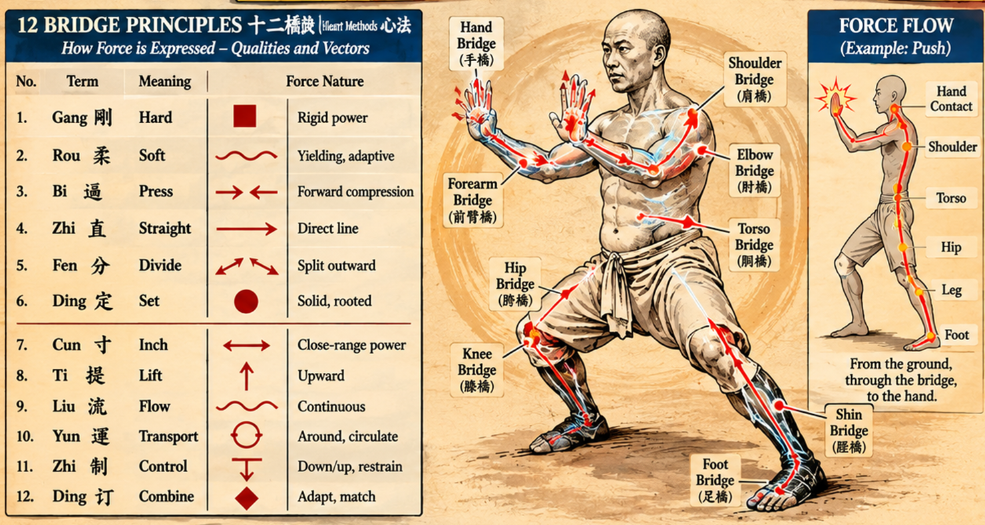
- The 12 Bridge Principles (十二橋訣) : twelve qualities of force , these are heart-methods (心法): attributes of how energy is expressed, not specific techniques.
- The 12 Bridge Hands (十二橋手法) : twelve concrete applications performed with the bridge against an opponent’s arm. These are hand-methods (手法): things you physically do.
They are governed by the maxim 橋來橋上過,無橋自造橋 — “if a bridge comes, go over it; if there is no bridge, build one.”, or as M. Ng would say “build a bridge and get over it” (造橋過橋). A third sibling set exists, the 12 Bridge Stances (四平馬, 子午馬, 伏虎馬, etc.), completing the trinity of energy, hand, and horse. It is outside the scope of this outline. Other principles include the 5 elements, 5 major animals, which together with Yin/Yang form the the 10 heavenly stems and the 10 animals (Will write about those in a future article). Here we represent a simple introduction to the Bridges, of course in practice there is a lot more depth and examples.
The 24 terms fall into three functional categories. Recognising which category a term belongs to resolves most of the apparent overlap and duplication:
- Qualities (no direction): the texture or mode of force. Hard vs soft, stable vs adaptive. These answer “what kind of energy?”
- Vector forces (directional): energy with a clear line of application: forward, downward, upward, along, around. These answer “where does the force go?”
- Applications (verbs on the opponent’s bridge): concrete actions performed against an opponent’s arm. These answer “what do I do?”
A single application (e.g., Sink) can be executed with any quality (hard sinking, soft sinking) and through several vector forces. The sets are orthogonal, not redundant.
Part I: The 12 Bridge Principles (十二橋訣)
Sung as a memorization couplet; taught as one system, not twelve isolated tricks.
1. Gang 剛 (Gong) Hard
- Meaning: Rigid, committed, unyielding power.
- Mechanics: Full muscular tension through the bridge, structure locked from ground to contact point, tendons visibly engaged. Trained through dynamic tension, and with supplements like the rings, roller bars, and with breath-sound coordination.
- Manifestation in the set: The tension phases of Tit Sin Kuen; strikes intended to end the exchange immediately.
- Practical implication: Overwhelm with committed power when the opening is real but hard power spends itself; if it doesn’t finish, you are momentarily emptied. Gong is the opening word of the couplet and pairs with Yau as the system’s first Yin-Yang pair.
2. Rou 柔 (Yau) Soft
- Meaning: Supple, yielding, borrowing force.
- Mechanics: Relaxed bridge that receives incoming force and redirects it rather than opposing it. Strength remains underneath — softness without structure is collapse. In some lines, Yau is specifically used to train tiger-claw gripping, softening the hand while the fingers strengthen.
- Manifestation: Absorbing and turning an attack; continuous pressure that never gives the opponent a hard surface to push against.
- Practical implication: Against superior force, borrow and return it. Yau is the second word of the couplet: “hard as heaven, soft as earth” (以剛為天,以柔為地) is the traditional framing — the remaining ten bridges are built on this pair.
3. Bi 逼 (Bik) Press
- Meaning: Crowding, constraining force applied into the opponent.
- Mechanics: Forward-driving compression through the bridge, usually with a step, taking away the opponent’s space to chamber or retreat. Lam Sai-Wing glosses it as “constraint.”
- Manifestation: Continuous forward pressure that puts the opponent on their heels; the Bik Kiu deflection that rides an attack while advancing.
- Practical implication: Forcing the opponent to defend, because defending means losing the initiative. Direction: forward/inward. Distinct from Cham/Sink (downward) and Tai/Lift (upward).
4. Zhi 直 (Jik) Straight
- Meaning: Direct, straight-line force.
- Mechanics: Power emanating from the waist, transmitted along a straight arm (elbow not locked) to the target. The shortest path used when there is no time or need for a cleverer route.
- Manifestation: Thrust-punch entries, the fire-punch line of the old texts; “if you lose contact, continue like a spring with straight attacks.“
- Practical implication: Directness as a tactical choice: when the centerline is open, take it in a straight line. Direction: along the shortest path. Lam Sai-Wing glosses it as the “last resort reaction in a dire situation” no decoration, just line.
5. Fen 分 (Fun) Divide
- Meaning: Separating, wedging force.
- Mechanics: Force that splits the opponent’s arms apart or dislodges a grip. Often a two-armed simultaneous action splitting outward from the center. It can also be the energy of separation no matter which part of the body.
- Manifestation: The Fan Gam Cheui (dividing bridge punch) practiced in Gung Ji and Tit Sin Kuen; escaping a clinch or double-limb control is the most common way of showing it.
- Practical implication: When both his arms work together against you, make them work separately. Direction: outward, laterally splitting.
6. Ding 定 (Ding) Set / Solid
- Meaning: Stability, steadiness, immovable rootedness.
- Mechanics: A fixed, rooted state the bridge and stance become one immovable object. Force that pins or holds position without yielding ground.
- Manifestation: Holding a bridge position under pressure; the rooted phases of the Iron Wire set where the practitioner becomes, briefly, a wall. It is not static, however; it is an outward pressure with central stability, that is project energy outwards without sacrificing one’s own balance. It keeps the assailant away while allowing the practitioner to break through, no matter what is in contact.
- Practical implication: Some moments call for refusing to be moved protecting structure, buying time, giving the opponent a fixed resistance they must commit against. This is positional force with no attack vector: it says “here, and no further.”
7. Cun 寸 (Chyun) Inch
- Meaning: Short-range explosive power at minimal distance.
- Mechanics: Force generated and delivered within roughly an inch of travel body mass and tendon snap substituting for wind-up. The close-quarters engine of Hung Kuen
- Manifestation: Finishing blows from bridge-contact distance; strikes that land with no visible chamber. Some lines write this character as 串 (thread/pierce), a known lineage variant.
- Practical implication: Once you are bridged, you never need to withdraw to strike. The “inch” is a distance concept, not a direction: the power itself can travel any vector.
8. Ti 提 (Tai) Lift
- Meaning: Upward, floating force.
- Mechanics: Force that raises the opponent’s bridge or structure, uprooting their root. Often paired with an upward rotation of the forearm or an elbow-leading action.
- Manifestation: Lifting the opponent’s guard to expose the lower line; the uprooting actions that set up throws or off-balance.
- Practical implication: For every press (Bik) there is a lift (Tai) if he is heavy downward, go up. Direction: upward. This is the classic counter-axis to sinking force.
9. Liu 流 (Lau) Flow / Retain
- Meaning: Continuous, staying force. Written 流 (“flow”) or in older texts 留 (“retain/keep”) lineage variants of the same bridge.
- Mechanics: Force that does not fire and stop.
- Manifestation: The continuous-bridge, pressure that follows an opponent’s retreat instead of resetting. It adheres in a sense but not necessarily sticky but rather it does not allow the direction to alter. As an exception it is if the opponent is stepping to look for space but you stepping does not allow it because it is also continuous adapting. If look for space but you are already where it is going when it retracts you follow if it turns you are already there in flow.
- Practical implication: A bridge that comes alive only at contact and dies at loss of contact is only half a bridge. Lau keeps the connection through the transition. Direction: along the opponent’s motion.
10. Yun 运 (Wan) Send / Transport
- Meaning: Circulating, mobile force.
- Mechanics: Moving force through the body and around the opponent’s structure the bridge does not resist the line, it transports the energy around it. Lam Sai-Wing glosses it as “movement, motion.”
- Manifestation: Circular transitions between bridges; re-routing power from a blocked line to an open one without breaking flow.
- Practical implication: When the direct line is jammed, wheel the power around rather than abandoning it. Direction: around, re-routed.
11. Zhi 制 (Jai) Control
- Meaning: Suppressing, dominating force.
- Mechanics: Physically expressed as a paired force: the uppercut and the press-down in one composite movement control is exercised in both directions at once. A blend of Gong and Yau.
- Manifestation: The downward check that pins a bridge and denies it recovery; the upward constraint that denies posture.
- Practical implication: Control is not the strike, it is what makes the strike available. Pin the bridge so it cannot threaten you while the free hand works. Direction: downward (and its paired upward half).
12. Ding 订 (Deng) Set / Combine
- Meaning: Matching, adapting, coordinating. Different character from #6’s 定 despite the same sound.
- Mechanics: Reading the opponent’s change and matching it, the bridge adapts its shape, angle, and force to whatever is presented. Lam Sai-Wing glosses it as “change or Transformation.”. This the versatility of all the bridges, essentially it is the skill of automatically applying the relevant hardness/softness or particular bridge according to circumstances, so called “perfectly”.
- Manifestation: The transitions of the set, where one bridge converts into another as the situation flips.
- Practical implication: The closing word of the couplet: after all specific forces are trained, what remains is the ability to match the opponent Never applying a favorite bridge, always the appropriate one. Jai and Deng (control and adapt) bracket the system together with Gong and Yau.
Structure of the Twelve
- Gong + Yau (first pair) and Jai + Deng (last pair) form a Yin-Yang frame around the middle eight. They are modes of force or behaviour not fixed vectors.
- Vectors: Bik (in), Jik (straight line), Fun (outward), Tai (up), Lau (along), Wan (around), Jai (down/up composite), Chyun (short-distance, any vector).
Part II The 12 Bridge Hands (十二橋手法)
These are the classical bridge-hand applications of Hung Kuen. Each is a concrete action performed on the opponent’s bridge.
1. Chuan 穿 (Chyun) Pierce
- Action: Threading the hand through the gap or over the top of the opponent’s bridge.
- Mechanics: A narrow, linear penetration along the centerline, slipping between or above the guarding arms before they can close.
- Manifestation: Entry when a seam opens, the pierce is an offensive bridge, built to reach the target, not to manage the arm.
- Practical implication: The fastest answer to “no bridge” is to create one by going through the hole in his.
2. Chen 沉 (Cham) Sink
- Action: Dropping weighted force down onto the opponent’s bridge.
- Mechanics: Body mass, not arm muscle: the bridge falls with the waist and stance dropping into it. Gravity-fed, economy of effort.
- Manifestation: Collapsing an opponent’s raised guard downward; the sinking actions named in Chum Kiu-type material (“sinking bridge” 沉橋).
- Practical implication: The cheapest heavy force you own is your own weight, deliver it downward through the bridge. Direction: down. This is the counterpart of Tai/Lift and the gravity-side twin of Pik/Hack.
3. Fen 分 (Fun) Split
- Action: Forcing the opponent’s arms apart.
- Mechanics: Simultaneous outward pressure through both bridges, wedging the guard open at its seam.
- Manifestation: Splitting a closed guard to expose the centerline; the “divide” application of the twelve.
- Practical implication: Shared character with Principle #5 (分) but here it is applied: the wedge that opens the door, done with the arms rather than as a quality of force.
4. Jia 架 (Ga) Support
- Action: Bracing or framing over the opponent’s bridge.
- Mechanics: Structural interception, the forearm sets a roof over the incoming limb, letting bone alignment (not muscle) carry the load.
- Manifestation: The overhead cover against a descending attack; frame positions that shelter the centerline.
- Practical implication: When you cannot evade or pierce, frame: present structure the attack breaks against. A passive-shape bridge, unlike the offensive Pierce.
5. Mo 摸 (Mo) Feel
- Action: Touching and reading the opponent’s bridge, light contact that gathers information.
- Mechanics: Minimal-pressure contact so the opponent’s intent (direction, commitment, tension) telegraphs through the skin and bones of the forearm.
- Manifestation: The initial touch of bridging exchanges; the sensing hand before commitment. Same character as the 摸 of southern sticky-hand sensitivity training.
- Practical implication: Information before action, a bridge that grips or strikes without first reading is guessing. Note: same sound as #8 磨, different character and function.
6. Tui 推 (Teui) Push
- Action: Driving the bridge away or the opponent back in a straight line.
- Mechanics: Linear pressure through the palm-heel or forearm from the stance, continuous rather than percussive.
- Manifestation: Displacing the opponent’s structure; creating space, breaking their root, moving them into position.
- Practical implication: Not a strike a positional tool. The push moves the man so the strike has a better target. Direction: outward/forward, sustained.
7. Xun 寻 (Cham) Search
- Action: Seeking out the bridge when none presents itself, building the bridge that doesn’t exist.
- Mechanics: Probing extension of the bridge toward contact, typically with a guarded shape so the search itself cannot be exploited.
- Manifestation: The deliberate closing of distance to establish first contact; Wong-style leading-hand entries that invite a reaction to become the bridge.
- Practical implication: The literal implementation of “no bridge, build one.” Note: same sound as #2 沉 (Cham), different character. Search finds the bridge, Sink drops force through it.
8. Mo 磨 (Mo) Rub
- Action: Grinding along the opponent’s bridge.
- Mechanics: Maintained contact with tangential motion, the bridge doesn’t collide or leave, it works along the arm’s length, redirecting via sustained friction.
- Manifestation: Rolling the opponent’s forearm out of the line by working along it; the peel-off that comes from maintained contact rather than a fresh interception.
- Practical implication: Contact is an asset, once touching, use the surface. Rub converts a static touch into a working redirection. Same sound as #5 摸, different character: Feel reads, Rub acts.
9. Gua 挂 (Gwa) Hang
- Action: Hooking and draping the bridge over the opponent’s arm.
- Mechanics: The forearm hooks their limb and stays there, weighting it — the opponent now carries your arm as well as their own.
- Manifestation: Hanging over an extended arm to drag it out of position; the draped control that rides their retraction.
- Practical implication: A hanging bridge converts their motion into your advantage: when they pull back, they carry your weight and open their own line.
10. Zhuang 撞 (Jong) Smash
- Action: Colliding through the bridge with committed impact.
- Mechanics: The whole body’s momentum is delivered through the bridge into their arm, not deflection but destruction of the bridge itself.
- Manifestation: The crashing forearm entries of hard southern boxing; bridge-breaking strikes aimed at the limb, not past it.
- Practical implication: When their bridge is the problem, make their bridge the target. The most Yang of the twelve hands, pure Gong energy in application.
11. Suo 锁 (So) Lock
- Action: Seizing and immobilising the opponent’s bridge.
- Mechanics: Catching the limb and fixing it, folding it against its own joint line or trapping it against your body, so it cannot participate further.
- Manifestation: The seizing-fist (chin-na) controls that end the arm’s involvement; the limb-trap that sets up the free-hand strike.
- Practical implication: A locked bridge is a removed threat: one arm to control theirs, one arm to finish. The bridge version of capture, not impact.
12. Pi 劈 (Pik) Hack
- Action: Chopping down across the bridge.
- Mechanics: Percussive downward force delivered through the bridge or hand edge, cutting across the opponent’s arm line with committed weight.
- Manifestation: The chopping counters of the pillar forms; bridge-strikes that punish an extended arm.
- Practical implication: Like Smash but on the downward axis: the arm presented can be hit, not merely deflected. Direction: downward-across, twin to Sink (Chen) but percussive where Sink is weighted.
Cross-Reference: The Three Categories at a Glance
| Category | Principle terms | Hand terms | Shared axis |
|---|---|---|---|
| Qualities (no direction) | Gong/Yau | Hard/Soft Ding/Ding | Static/Dynamic | — | Texture of force |
| Downward force | Jai (control’s down half) | Chen sink, Pi hack | weight & percussion down |
| Upward force | Tai lift | — (within Jai’s up half) | uprooting |
| Forward/inward | Bik press, Jik straight | Zhuang smash, Chuan pierce | entry & pressure |
| Outward/lateral | Fen divide | Fen split, Jia support | opening & framing |
| Along / continuous | Lau flow, Wan transport | Mo rub, Gua hang, Tui push | maintained contact |
| Information & seeking | — | Mo feel, Xun search | pre-contact reading |
| Capture & restraint | Jai control, Ding-定 set | Suo lock | denial of use |
| Short-distance engine | Cun inch | — | close-range power |
Known Character Traps & Lineage Variants
- 寸 (Cun/inch) vs 穿 (Chuan/pierce): both chyun in Cantonese, a principle vs an application.
- 定 (solid) vs 订 (combine/adapt): both ding, one is rootedness or placement, one is matching/adapting. They represent the Yin/Restraint and Yang/Action
- 摸 (feel) vs 磨 (rub): both mo, one reads (sensitivity), one acts (Rubs towards an action).
- 沉 (sink, Chen) vs 寻 (search, Xun): both cham, one drops force, one finds the bridge
- Older texts write 迫 for 逼 (press) and 留 for 流 (flow/retain); some lines use 串 for 寸. These are transmission variants.