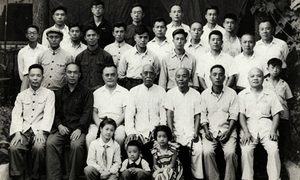
Starting from scratch, 18 men fought their way to incredible achievements, becoming an iron-willed force spanning four eras: the War of Resistance Against Japan, the War of Liberation, the Korean War, and national infrastructure construction,they participated in every battle.
Japanese Army Colonel Ryeikawa (赖川) was dead. He died in a small village few had heard of at the time: Wulongtang (仵龙堂), Cang County (沧县). On September 2, 1940, Ryeikawa set out with four military trucks from Yanshan (盐山) bound for Cangzhou (沧州), passing the entrance of Wulongtang village. He probably never imagined that 13 advance cavalrymen had been wiped out cleanly at the very same spot just two days earlier. This time it was his turn. Guns hidden in a temple beside the road opened fire. Ryeikawa was dragged back to Cangzhou and died of his wounds. He was not the first senior Japanese officer eliminated on the North China battlefield, but he was the highest-ranking Japanese officer killed in the Hebei-Shandong (冀鲁) border region since the fighting began there. The unit that pulled the trigger had been founded less than a month earlier.It was called the Bohai Hui Detachment (渤海回民支队). A unit you will almost never find named in history textbooks.
1940, 18 men, and a mosque square
The story of the Bohai Hui Detachment begins with a band of men who were practically bare-handed. On July 20, 1940, in Weiji’an (魏家庵), Ningjin County (宁津县), the Hebei-Shandong Border Region Hui National Salvation Association was proclaimed. At the same time, an armed force of fewer than 20 men was hastily thrown together, drawn from 18 cadres and soldiers transferred from the Jinnan Detachment and the Cang County county brigade. According to battle records, at the start there were only “twenty to thirty men and a dozen or so guns.” You read that right: 18 men. A dozen rifles.
On August 1, 1940, on the square of the mosque in Xinxian Town (新县镇), southeast of Cang County (today’s Mengcun Hui Autonomous County 孟村回族自治县), a celebration meeting was held with residents from 12 Hui villages, and the “Hebei-Shandong Border Region Hui Anti-Japanese Battalion” formally raised its banner. Battalion commander Liu Zhenhuan (刘震寰), political commissar Wang Lianfang (王连芳).
Who was Liu Zhenhuan? A native of Dabuzhaohe Village (大北赵河村), Cang County, Hui ethnicity, who joined the Chinese Communist Party in 1935. Before this, it was not his first time facing the Japanese head-on. In August 1938, he led men in an ambush against a Japanese cavalry unit of the Japanese at Wulongtang on the Cangzhou-Yanshan road, killing a Japanese colonel and more than 50 cavalrymen in one stroke, and capturing horses and rifles, which caused a sensation across the southern Tianjin (津南) region. What did a farm youth without formal military training rely on to lead troops? According to witnesses, Mengcun (孟村) was a hometown of martial arts, and Liu Zhenhuan, together with Wang Zhenhuan (王振环), Sun Zhenhuan (孙振环) and others, were all top disciples of Yin Yuzhi (尹玉枝), grandmaster of Tongbei Pigua boxing, “each with superb skills and extraordinary courage.”
The Bohai Hui Detachment always emphasized martial arts training and formed a dedicated broadsword squad. The broadswords they used were not ordinary single-hand sabers but specially made weapons: “the handle slightly longer than a single saber, with an iron ring on the grip tied with red and green silk ribbons. In use, you gripped the handle with both hands, so it could be wielded as a blade to hack, and also used like a spear to thrust or deflect.” Yin Yuzhi, grandmaster of Tongbei Pigua boxing, and Yang Jishan (杨积善), grandmaster of Tongbei Praying Mantis boxing, nicknamed “Yang Baleng” (杨八楞), personally taught the “Chuangwang (闯王) broadsword method” in the army, and the soldiers’ “broadsword technique improved by leaps and bounds.”
Picture this scene: on the Hebei-Shandong plains of the 1940s, a band of Hui men with pistols at their waists and special broadswords strapped to their backs, slipping under cover of night into an enemy stronghold. The sound of blades falling was especially crisp in the silence. This is more outlandish than any anti-Japanese TV drama script, but it genuinely happened.
High-voltage warning for the comments section: what follows contains a detail that will send chills down your spine. The Japanese tried every means to divide China with a “use Hui against Hui” strategy, only to find that facing them were inheritors of Baji boxing and Pigua boxing. History’s dark humor hides in the cracks between blood and fire.
The Japanese arsenal was not limited to guns and cannons. After 1939, the traitor Liu Peichen (刘佩忱), commander-in-chief of the “Communist Suppression” forces of the Japanese and their puppet regime, used the puppet “Islamic Federation,” a religious organization, to exercise tight control over the Hui areas of Mengcun and Hui villages across the Hebei-Shandong border region. They loudly promoted treasonous slogans like “Sino-Japanese friendship” and “Hui fight for their faith, not for their country,” and forced Hui and Han youths to join the puppet “Imperial Association People-Protection Army.” This was a vicious scheme. The Japanese sought to exploit the estrangement between Hui and Han created by historical policies of ethnic oppression, using religious identity to dissolve national identity, and conjuring the illusion of a “Hui state.” But they miscalculated. One statistic says it all: the Hui battalion, which began with only 18 men and a dozen guns, “grew from about twenty people at founding to more than one hundred in just over a month, and many Han youths eagerly enlisted too.”
By 1941, the unit had grown to more than 400. By victory in the War of Resistance, it reached more than 2,300. Why would a unit flying a “Hui” banner attract eager Han recruits? Because on this land, Hui and Han civilians faced the same enemy and the same suffering. On the eve of Spring Festival 1942, the Japanese carried out a major sweep of villages in Huanghua County (黄骅县, today’s Huanghua City 黄骅市). Civilians were herded into a threshing ground, and the invaders killed an elderly woman holding her granddaughter: after only a few words of questioning, the gunshots rang out. Later they seized an old man to guide them to the guerrillas; the old man did not know the way, and was thrown alive into a fire to burn, “when he rolled out, they pushed him back in; the old man was burned to death alive.” These scenes of torture, killing, and plunder were not aimed at any one ethnic group. They were aimed at all Chinese people. Ma Benzhai (马本斋) of the Central Hebei Hui Detachment once wrote on his Communist Party membership application: “I am determined to fight to the end for the liberation of the Hui people, and the liberation of the Hui people can only be achieved under the leadership of the Communist Party.” The Hui soldiers of the Bohai Hui Detachment carried the same conviction carved in their hearts: “Protecting the nation is protecting the faith; loving the country is loving oneself.” That is why they refused the poisoned bait of “use Hui against Hui.” That is why they took up their blades in silence.
The bloody battle of Huazhai: a lone hero captures a Japanese officer alive
What came next was a textbook ambush. Remember this place name: Huazhai (花寨), Huanghua. In October 1944, intelligence indicated that 70 or 80 Japanese troops and more than 200 puppet troops were setting out to seize grain, and the Bohai Hui Detachment set up an ambush ring in the Huazhai area. Only after the shooting started did they discover the Japanese force far exceeded expectations: not 70 or 80 men, but “a dense, black mass.” The enemy held absolute superiority in numbers, and the gap in firepower was even greater. But the Hui detachment did not flinch. The commanders exploited the terrain, weaving back and forth between the village edge and the ditches, organizing charge after charge. “Several attempts in a row failed.” Such was the difficulty of the assault. A battalion-level commander was seriously wounded and carried off the line, yet the soldiers “fought all the way until dark.” The result? The enemy was routed in a crushing defeat and never again dared come to this area to seize grain or cause trouble. Detachment commander Liu Zhenhuan captured the Japanese officer Morita (森田) alive in this battle.
The most stunning detail concerns a Hui soldier named Ding Yuqi (丁玉起). According to battle archives, Ding Yuqi was the Hui detachment’s “lone hero”; in that hellish melee, he single-handedly captured a Japanese soldier alive. With what? The memoirs of veteran soldiers reveal a spine-chilling true detail: they had fought the invaders with hay-cutting knives. By victory in the War of Resistance, the Bohai Hui Detachment had fought the invaders more than 100 times, taken more than 40 strongholds large and small, destroyed more than 2,300 Japanese and puppet troops, and captured more than 2,600 rifles and pistols. Achieving the greatest results with the fewest men: this unit’s battle record, together with Ma Benzhai’s Central Hebei Hui Detachment, ranks as the “twin jewels” of Hui armed forces in the War of Resistance. The Central Hebei Hui Detachment fought more than 870 engagements large and small, destroyed more than 36,000 enemy, and was praised by Mao Zedong (毛泽东) as “an ever-victorious Hui detachment.” Though the Bohai Hui Detachment was smaller in scale and its battle history far less known, it achieved a record equally worthy of reverence. As the PLA Daily commented, the Bohai Hui Detachment “used flexible and mobile strategy and tactics, pulling out strongholds, digging up roads, tearing up railways, blowing up bridges, striking Japanese and puppet troops like ghosts and shadows.” Though their designation disappeared, their bloodline continued in the Chinese military for nearly half a century.
From the shores of Bohai to the Korean battlefield: the hidden history of an iron army
In September 1945, Japan surrendered. The Hui detachment was reorganized as the 63rd Regiment of the 21st Brigade of the 7th Division of the Shandong Liberation Army and ordered to push into the Northeast (东北). In the Liberation War that followed, this unit fought brutal battles on the black soil of the Northeast. While retaining the “Hui Detachment” designation externally, it was incorporated into the 2nd Division of the Railway Corps of the Northeast Field Army, campaigning north and south with the torrent of the Liaoshen (辽沈) and Pingjin (平津) campaigns, then rush-repairing the Tianjin-Pukou (津浦) Railway and restoring railway bridges at Luohe (漯河), Changtaiguan (长台关), and elsewhere. In 1951, Liu Zhenhuan led this unit into Korea (朝鲜), where on the Korean battlefield it undertook railway rush-repair missions, taking part in the Fifth Campaign, the counter-“strangulation war,” and the battle against flood crests to repair railways, and earning the DPRK’s Order of the National Flag, Second Class, and the Order of Freedom and Independence, Second Class. Afterward, the unit moved from the Railway Corps sequence into the Capital Construction Engineering Corps, was reorganized in 1984 as the 3rd Engineering Department of the 12th Engineering Bureau of the Ministry of Railways, and in 1998 was converted and restructured into an enterprise group. The Hui detachment’s designation ultimately vanished into the long river of military reorganization history. But it retained an extremely special record: it was “the ethnic-minority armed force with the longest developmental history and widest area of operation in our army’s history.” Behind that word “longest” lies a red bloodline spanning nearly half a century: from the Cangzhou mosque to the Korean battlefield, from railway bridges to an enterprise group, from 18 men to an army of ten thousand, from broadsword hacking to laying railway tracks. It never truly disappeared; it simply existed in a different form.
Why was the “other Hui detachment” forgotten for the better part of a century?
Reading this far, many readers will have a question: why do we only know Ma Benzhai’s Central Hebei Hui Detachment, yet have almost never heard of Liu Zhenhuan’s Bohai Hui Detachment? This is precisely the “black box” this article most wants to open.
First, the Central Hebei Hui Detachment was larger in scale with more glorious achievements: more than 870 battles, more than 36,000 enemy destroyed, Mao Zedong’s personal inscription “an ever-victorious Hui detachment,” and the heroic story of Ma Benzhai retold again and again in films, novels, and textbooks. The Bohai Hui Detachment, meanwhile, long operated in the Jinnan-northern Shandong area, a remote corner, so its natural radius of transmission was limited.
Second, the historical materials of the Bohai Hui Detachment were long left uncollected. According to academic research, although former political commissar Wang Lianfang wrote many memoir articles, and scholars such as Liu Baojun (刘宝俊) devoted great effort to compiling precious volumes like the “Veritable Records of the Bohai Hui Detachment: 1940-2000” (《渤海回民支队实录:1940-2000》), “memoir materials must be corroborated with documentary materials,” and a systematic battle history remained a gap waiting to be filled. By comparison, the memoirs and research papers on the Central Hebei Hui Detachment number several times as much. The depth of historical memory often depends on the number of times it has been told.
Third, it is closely tied to the detachment’s subsequent fate. Ma Benzhai died of illness in 1944, and the Central Hebei Hui Detachment’s glory froze at the harshest years of the war, naturally carrying a tragic narrative power. The Bohai Hui Detachment, by contrast, fought all the way from the Northeast to Korea, then from Korea back to the Northwest, constantly changing designations, finally vanishing into an engineering department and an enterprise group. This unit lived long enough and traveled far enough, yet precisely because of its constant “invisibility,” it never left behind a final, shining moment memorable enough to be remembered.
But precisely for that reason, we should all the more not forget it.
A word from the author
Some units win fame across the land; some are buried by the dust. The Bohai Hui Detachment belongs to the latter. But I have never considered “being forgotten” a regret. Quite the opposite: the spiritual core of this unit lies precisely in seeking no fame, only a clear conscience. When they raised their banner before the Cangzhou mosque, it was not to be written into history. They simply refused to be divided by the poisonous scheme of “use Hui against Hui,” and refused to stand by at the moment of national extinction. In their own way they proved: when foreign invaders come, Hui and Han, blade and gun, martial art and tactics, every boundary can dissolve into the two words “compatriots.”
Today’s peace did not fall from the sky. It was fought for, shot by shot and cut by cut, by units whose names you may never have heard, armed with the plainest of convictions. To remember the six characters “Bohai Hui Detachment” is to tell history: heroes who do not flaunt themselves will likewise never be forgotten.