Summary
- The lion dance (舞獅, wǔshī) entered China through Han dynasty tribute lions from Central Asia, matured as a court and Buddhist performance in the Tang, and split into a Northern Lion (北獅, běi shī) and Southern Lion (南獅, nán shī) lineage as populations moved south between the Song and Ming periods.
- The Southern Lion or Awakened Lion (醒獅, xǐngshī) is generally credited as originating in Foshan (佛山), where it fused with Lingnan customs, Cantonese opera face-painting, and southern school martial arts, giving rise to the legend of the Nian beast (年獸) and the ritual of plucking the green (採青).
- The two great schools of the Southern Lion are the Futsan style (佛山獅) and the Hoksan school (鶴山獅), the latter created by Feng Gengzhang (馮庚長), who modelled the lion on a cat and earned the title “King of Lions” in Singapore.
- The Green Lion (青獅, qīngshī) is not one tradition but a family of them: the Buddhist green lion of Manjusri, the Minnan and Taiwanese green lion arrays descended from Ming military shield formations, the Jieyang Green Lion of Chaoshan, and the lion-fighting (刣獅, thâi-sai) performances of Quanzhou.
- The Hakka peoples maintain separate beast dances for the Qilin (麒麟) and the Pixiu (貔貅), both bound to Hakka martial arts, while Taiwan developed its own open-mouth and closed-mouth lion types and a square wooden “box lion” (盒仔獅).
- The Dragon Dance (舞龍, wǔlóng) is an older, distinct tradition with more than seven hundred regional variants, and modern sport lion dance on plum blossom poles (梅花樁) has globalised the Awakened Lion since the 1980s.
1. Early history: how the lion came to China
The lion is not native to China, and the animal itself arrived as diplomacy. The Erya (爾雅), China’s oldest dictionary, describes a beast called the suanni (狻麑) that preys on tigers and leopards, and the Western Jin commentator Guo Pu (郭璞) identified it as the lion, “coming from the Western Regions”. During the Eastern Han, tribute missions repeatedly brought lions to the Chinese court: the Yuezhi sent lions in the year 87 CE, Parthia (安息) sent them in 89 and again in 101, and Kashgar sent one in 133, records preserved in the Book of Later Han (後漢書). Stone lions carved soon after, such as the pair made by Liu Han outside the eastern gate of Luoyang and the pair at the Wu family shrines in Jiaxiang, are among the earliest Chinese lion images and already carry the inscription “shizi” (師子).
The performance tradition is older as performance than as lion. Han texts describe “mime people” (象人) who dressed as fish, dragons and phoenixes in the baixi (百戲) variety shows, and the Han scholar Dong Zhongshu prescribed clay dragon dances for rain-making. The earliest clear record of a lion in procession comes from the Northern Wei: in his Record of the Buddhist Temples of Luoyang (洛陽伽藍記), Yang Xuanzhi (楊衒之) describes a lion leading the procession of a Buddha statue from Changqiu Temple, driving off evil before the entertainers and clergy. By the Northern Zhou and Tang, the court piece “Peaceful Music” (太平樂) had performers weaving animal hair into a lion costume while two entertainers teased the beast with ropes and whisks, essentially the modern two-dancer format with a teaser. The Tang poet Bai Juyi (白居易) described it in his poem “Xiliang Ji” (西涼伎): masked Central Asian men with a wooden-headed, silk-tailed lion, gilded eyes and silver-plated teeth, its ears moving, “as if come ten thousand li from the flowing sands”. A Tang painted figurine excavated in 1960 from tomb 336 at Astana in Turpan shows two performers inside a striped lion, four legs visible, confirming the two-person costume in the eighth century.
In the Tang court the dance was performed as the “Lion Dance of the Five Directions” (五方獅子舞), five large lions of different colours and moods led by twelve lion lads each and accompanied by 140 singers. The dance reached Japan by the eighth century, where it evolved into the one-performer shishi-mai (獅子舞). During the Song dynasty the dance became a common festival entertainment; the Southern Song chronicler Zhou Mi (周密), in his Old Affairs of Wulin (武林舊事), lists among the puppet and dance acts of the Lantern Festival an item called “lions, leopards and barbarian shields” (獅豹蠻牌), the first hint of the tie between lion performance and martial display. Song paintings such as the “Hundred Children at Play in Spring” (百子嬉春圖) attributed to Su Hanchen (蘇漢臣) show children dancing a lion, and notably the lion they carry is green.
2. The green lion as a Buddhist and imperial symbol
Before it was a dance, the green lion was an image. With the spread of Buddhism in the Northern Dynasties, the lion took its place as a guardian beneath the lotus throne, and in the Sui and Tang the iconography of Manjusri Bodhisattva (文殊菩薩) riding a green lion, paired with Samantabhadra (普賢菩薩) on a white elephant, became a fixed convention of Buddhist painting. It appears in the cave temple of Dunhuang from 642 onward and in the Yulin and Mogao caves through the mid-Tang, where the green lion is shown unruly and roaring, mane curling. Through this channel the green lion became an emblem of auspicious power, a “auspicious beast” (瑞獸) rather than a strange beast, and this colour symbolism, green as the lion of wisdom and dignity, echoes through every later green lion tradition, from Song and Ming paintings to the Minnan dance. The “Green Lion” also appears in imperial art: in the “Bamboo Court Lantern Entertainment of Emperor Xianzong” (明憲宗元宵行樂圖) of 1485, the tribute lion from Samarkand is painted, contrary to its real appearance, as a green lion, and the great Ming cityscape scroll “Prosperous Scenes of the Southern Capital” (南都繁會景物圖卷) shows Nanjing lantern festival crowds watching performers dance a green lion.
3. The split of north and south
The conventional periodisation holds that during the Song, Liao and Jin, when north and south were ruled separately, the single tradition divided. Warfare and migration carried the lion dance south with Central Plains refugees, where it merged with Lingnan customs. The southern style kept the martial character visible in the Song “lions, leopards and barbarian shields” acts, but grafted it onto southern school martial arts and Cantonese opera culture. The northern style, by contrast, remained closer to the old court and acrobatic tradition.
4. The Northern Lion (北獅)
The Northern Lion is performed as a pair, usually a male and a female, with a gold-painted wooden head and shaggy red and yellow fur, a red bow marking the male and a green bow the female. Its face resembles a Pekingese or a temple guardian dog rather than a fierce animal, and its temperament is playful and lifelike. Two dancers share an adult lion, a single dancer works a small young lion, and troupes often perform a whole lion family, the “great lions” (太獅) and “little lions” (少獅), led by a warrior carrying a ball. The emphasis falls on acrobatics: lifts, balancing on stacked stools, rolling on giant balls, high-wire acts. The most spectacular regional variant is the “Heavenly Tower Lion Dance” (天塔獅舞) of Xiangfen County in Shanxi, in which lions climb a tall tower built of wooden stools. Regional troupes survive in Ninghai near Ningbo, Xushui in Hebei, Dalian in Liaoning and Beijing, where the Baizhifang troupe, some 270 years old, has struggled to find successors. The style is said to descend from the Northern Wei court performances and was already called the Northern Lion by the Song. A broad classification running through many regional forms divides performances into the civil lion (文獅), which acts out the animal’s docile, comic character, and the martial lion (武獅), which emphasises energy and stunts; a celebrated civil-lion routine is “Luohan Playing with the Lion”.
5. The Southern Lion and its Foshan origins
The Southern Lion of Guangdong is the best-known lion outside China and the ancestor of most diaspora troupes. Its head is built of papier-mâché over a bamboo frame, painted and furred, with a single horn, and its body is layered cloth trimmed with fur. Tradition places its birth in Foshan. The martial arts historian Huang Jianheng (黃鑒衡), in his Spring and Autumn of Guangdong Martial Arts (粵海武林春秋, 1982), records that in the early Ming a monster appeared in Foshan with great eyes, a wide mouth and a single horn, crying “nian”, which the people called the Nian beast (年獸) and which ravaged livestock and crops until villagers frightened it away with colourful constructed “lions”. To welcome the auspicious lion, households hung “greens” (青) of vegetables tied with a red packet above their doors, and the lion’s plucking of the green (採青) became the climax of every performance; over time the New Year lion visit hardened into custom. The names themselves carry Cantonese wordplay: “dancing lion” (舞獅), “auspicious lion” (瑞獅) and “awakened lion” (醒獅) are near-homophones carrying the senses of wakefulness, alertness and good fortune, and the awakened lion was said to rouse the people, hence “the lion awakens in Nanhai” (獅醒南海), the phrase that marks Foshan’s Nanhai district as the birthplace. The origin legend is folklore, but it encodes the real social function: from its first records the Foshan lion was used to expel misfortune and welcome blessing.
Foshan was also the cradle of southern school martial arts, home to Wong Fei-hung (黃飛鴻), Lam Sai-wing (林世榮), Leung Jan (梁贊) and Ip Man (葉問), and the root styles of Choy Li Fut (蔡李佛拳), Hung Ga (洪拳) and Wing Chun (詠春). Nearly every martial arts school in the city kept a lion society, and the lion dance absorbed the southern stances wholesale: the four-level horse stance (四平馬), the meridian horse (子午馬), the T-character horse (丁字馬), the crossed sitting step (盤坐步) and the hanging-hoof horse (吊蹄馬), together with footwork such as the qilin step (麒麟步), horse stance, bow stance, rapid small steps (碎步), empty stance (虛步), probing step (探步) and inserting step (插步). The saying “learn the fist before the lion” (未學獅,先學拳) captures the dependency, since a weighted lion head cannot be worked convincingly without martial foundations. Wong Fei-hung himself folded Hung Ga technique into the established lion routines, and the lion head came to be painted after the opera face-paintings (臉譜) of the heroes of the Three Kingdoms, binding the Awakened Lion to Cantonese opera as well as to kung fu. The result is a lion of speed, power and spirit, described in the literature as “form and spirit together” (形神兼備).
The Futsan lion itself is fierce and prestigious: a squared face with large eyes and nose, a high forehead, curved lips and a sharp horn, traditionally bristled rather than furred, with pop-up teeth and tongue, swivelling eyes, gold-foiled rims and a gilded collar on the back bearing the troupe’s name, a long tail with a white underside, bells, and a square diamond-patterned tail design. Modern heads are lighter, furred, with fixed eyes and shorter, curvier tails. The Futsan style is the style of the kung fu schools, demanding deep stances and powerful head work, and traditionally only advanced students performed it.
6. The Hoksan school and the Lion King of Heshan
The second great school arose in Heshan (鶴山), and its founder Feng Gengzhang (馮庚長) is among the best documented figures in lion dance history. A native of a Heshan village who had trained from childhood in the martial arts, he studied orthodox Futsan lion art and martial skills under Feng Liaoxing (馮了性) in Foshan, then returned home to open a school and devote himself to the dance. In his school he kept cats, observed their movements, temperament and habits daily, and fused feline grace with the lion, reforming the Futsan inheritance into a new style. The Hoksan lion is lighter and kinder in appearance, with a narrow face and a duck-billed mouth, built for quick footwork and cat-like curiosity, and its heads are easier to construct than the exacting Futsan craft, which helped the style spread.
Its fame was made abroad. In the early 1920s the Heshan lion performed at the celebrations of Sun Yat-sen’s inauguration as President in Guangzhou and caused a provincial sensation, and in the 1940s and 1950s it toured celebrations across China and Southeast Asia. At national celebrations in Singapore it outshone all rivals, and the masters of the craft jointly inscribed for it the words “King of Kings of Lions” (獅王之王); the newspapers ran headlines such as “The Lion King on Parade”, and the National Archives of Singapore still displays large photographs of it in Sentosa. The Hong Kong writer Chan King (陳勁) recorded the tradition in his Lion King of Guangdong, Feng Gengzhang (廣東獅王馮庚長) in the 1940s, judging that “the Awakened Lion of the South originated in Foshan and came to flower in Heshan, and Feng Gengzhang deserves the greatest credit”.
The lineage continued in detail. Feng’s student Li Hongguang (李洪廣) of Longkou taught over a thousand disciples across Heshan and neighbouring counties, among them Huang Shiqin (黃仕勤) of Xin Village, Guli, where the dance had nearly died out in the 1930s and 1940s before Huang rebuilt it as the “lion on the staff” (棍上獅), with a fierce lion type and the resounding Seven Stars drum (七星鼓). Feng Kunjie (馮昆杰), a fourth-generation inheritor, spent ten years compiling a handwritten manual of more than two hundred pages and fifty thousand characters, Awakened Lion of the South (南國醒獅), to preserve the art, and his contemporary Huang Yong’an (黃永安) has taught it in Heshan schools, where the school’s “lion virtue” (獅德) of loyalty, filial piety, propriety and righteousness (忠、孝、禮、義) is aligned with moral education. Today’s Heshan lion keeps Feng’s essentials while adding new routines.
Other Southern Lion variants complete the family: the Fut-Hok hybrid created in Singapore by Kong Chow Wui Koon (岡州會館) in the 1960s, and the lion of the Jow family schools (周家).
7. The Green Lion of Jieyang and Chaoshan
The Chaoshan region has its own Green Lion, the Jieyang Green Lion (揭陽青獅), known familiarly as the “green lion with white eyebrows” (青獅白目眉) and also called the open-mouth lion (開口獅). It is some three hundred years old and unique to the Chaoshan region, with a high forehead, eyes like bronze bells, a very wide mouth, long whiskers, curly mane and the signature white eyebrows, a fierce and imposing figure. It integrates dance, acrobatics and martial arts, performed to the great gongs and drums of Chaoshan (潮汕大鑼鼓). In 2011 it was inscribed in the third batch of the national intangible cultural heritage list as “Lion Dance (Green Lion)” (獅舞(青獅)), with Sun Shuqiang (孫淑強), head of the Sun Shuqiang Lion Art and Martial Arts Hall in Jieyang, as its representative inheritor.
Its construction is distinctive and laborious. A clay mould is carved into the lion’s shape and braced with wooden strips, but the face uses no wire or bamboo at all: layers of kraft paper are pasted from the inside outward, with two or three layers of gauze in the middle, until the shell is thick enough to paint, carve and fit with ears and eyebrows of rabbit fur, the whole head taking about a month. The tradition has become a civic emblem: the lion art hall maintains an eight-thousand-square-metre Green Lion base opposite the Jinxian Gate in Jieyang’s old city, combining performance, heritage display, Yingge (英歌) experience and cultural products, and the lion has appeared at the Shanghai World Expo and international festivals. The Chaoshan context matters: the region’s great festival tradition, including the Yingge dance itself and the Teochew gong-and-drum processions, gives the Green Lion a performance ecosystem quite distinct from Cantonese Futsan and Hoksan.
8. The lion arrays of Quanzhou and the Minnan green lion
In southern Fujian the lion tradition took the form of the lion array (獅陣), performed as a martial formation rather than a mere dance, and the practice of “lion fighting” (刣獅, thâi-sai in the local tongue), in which armed performers battle the lion. The classic Quanzhou lion head was the “dustpan lion” (簸箕獅): a round sieve stretched with medicine-boiled yellow oxhide, dried under layers of tung oil, hung with bells inside, covered in black or brown homespun ramie cloth, with a coloured mane stitched along the spine and a tail of hemp fibre. Heads of exactly this form are recorded across Anxi, Yongchun and Dehua, in Jinjiang’s villages, in Nanao’s Taoyuan, and formerly in Shishi’s Lucuo and Shamei, as well as in the Gaizai lion (蓋仔獅) of Jieshi in eastern Guangdong.
The origin of this round-faced green lion appears to lie in the Ming army. The Fire God Temple in Yongning, Yanqing, Beijing, originally a military banner shrine of the Yongle era, carries murals of Ming battles in which soldiers in the front rank hold up shields painted with green lion heads. The military encyclopaedia Record of Arms (兵錄) by He Rubin (何汝賓), completed in 1606, illustrates the same lion-headed shields on great shields and cavalry shields, and early Qing paintings of the Kangxi expedition to Tibet show rattan shield troops from Fujian carrying the same round green-lion shields. The military training system of the Ming, built on Taizu fist (太祖拳) and the “mandarin duck” formations (鴛鴦陣) of Qi Jiguang (戚繼光) and Yu Dayou (俞大猷) against the pirates, supplied the drill; when the Qing banned civilian martial training, the system is thought to have survived by transforming into the folk lion arrays. The Xiiazhou Green Lion Array (霞洲青獅陣) of Licheng, Quanzhou, historically called the Songjiang lion array (宋江獅陣), used the dustpan lion until the 1990s, when the craftsman Cai Jingchuan (蔡景川) redesigned the head after the stone lions of the Tianhou Temple, producing the fuller-maned, livelier green lion seen today; the array is now based at the Xiiazhou Mazu Temple and serves as a cross-strait cultural window. Under the Ming loyalist Zheng regime the lion arrays travelled to Taiwan, and in the late Qing they spread with Five Ancestors fist (五祖拳) to Southeast Asia, so that round-headed lion arrays survive today in Taiwan, Singapore and Malaysia. The Minnan-speaking world, in short, maintains a green lion lineage that is martial, array-based and iconographically continuous with the Buddhist green lion and the Ming shield, and it is this lineage, rather than the Cantonese Awakened Lion, that the term Green Lion (青獅) most precisely denotes, though the Chaoshan Jieyang lion shares the name and the white-eyed fierce visage.
9. Taiwan: open-mouth, closed-mouth and Hakka lions
Taiwan inherited Minnan lion culture under the Zheng regime and developed its own typology, dividing at Hsinchu into a “northern” and a “southern” lion, in the island’s internal geography. The northern Taiwan lion, popular in the north, has a very wide open mouth, traditionally made from a winnowing basket (kán-á in Taiwanese), and is therefore called the basket lion (𥴊仔獅) or open-mouth lion (開口獅). Its repertoire is extensive and ritualised, with named sequences such as treading the Seven Stars, stepping the Eight Trigrams, biting the foot, biting lice, biting the tail, the sleeping lion, the turned lion, the four gates, killing the lion, rescuing the lion, crossing the bridge, biting the green, saluting the temple, and two lions biting each other, accompanied by a distinctive drum pattern. The southern Taiwan lion, also called the Minnan lion (閩南獅), has fixed eyes and a mouth without moving parts, hence closed-mouth lion (閉口獅). Both descend from the Fujian arrays and are embedded in the temple festival system, where the lion troupe performs alongside the Songjiang Battle Array (宋江陣), the folk martial formation especially strong in Neimen, Kaohsiung, and the golden lion arrays (金獅陣).
The Hakka of Taiwan keep their own lion, the Hakka lion (客家獅), a square box-headed beast with a hinged wooden mouth that opens and closes freely, often called the box lion (盒仔獅) and weighing as much as thirty kilograms. Its most documented lineage is the Zhao’an Hakka open-mouth lion (詔安客家開口獅) of Yunlin, founded in 1831 when the Liao clan, harassed by bandits in the Houniupu area, brought the master Liao Jinsheng (廖金生) from Zhao’an county in Fujian to establish the Golden Lion Linked Array Martial Hall (金獅連陣武野館), teaching the cloth-chicken fist (布雞拳) and the lion set called the Golden Lion Linked Array open-mouth lion; the line has passed through five generations. Related to the lion but distinct is Taiwan’s modern remix, the Electric-Techno Neon Gods (電音三太子), temple performers of the child god Nezha dancing to electronic music, whose troupes typically also field dragon and lion dances.
10. The Hakka Qilin dance
The unicorn dance (舞麒麟) of the Hakka is the most important beast dance after the lion in the Hakka world. The qilin (麒麟) ranks second only to the dragon in the Chinese mythical hierarchy, but for the Hakka it is the supreme auspicious animal, and they carried the dance south from their Central Plains homeland during their migrations; accounts give the tradition more than four hundred and fifty years. The costume has a dragon-like head, a scaled body and a flowing tail, worked by a head dancer with the body behind, and the music is Hakka percussion with the suona (嗩吶) horn, quite distinct from Lingnan lion drumming. The dance is inseparable from Hakka martial arts, above all Pak Mei or White Eyebrow fist (白眉拳) and related styles from the Huizhou area of Guangdong, and a Hakka kung fu school is often recognisable by its qilin. It is performed at Lunar New Year, weddings, birthdays, ancestral hall inaugurations, housewarmings and the receiving of guests, to ward off evil and summon prosperity.
Its heartland is eastern Guangdong. Zhangmutou (樟木頭) in Dongguan, an entirely Hakka town, was named “Home of the Qilin” and made a national training base for the dance, and the Dongjiang qilin dance performed at the 2010 Shanghai World Expo. In Hong Kong the Hakka Unicorn Dance, notably the Hang Hau tradition of Sai Kung, is inscribed on the intangible cultural heritage representative list and is built around a numbered sequence of nine movement sets (“nine numbers”), taught as part of martial training. Other qilin lineages exist in Hebei and near Mount Emei in Sichuan, showing that the unicorn dance is not exclusively southern, though its living strength is.
11. The Pixiu dance
The Pixiu dance (舞貔貅) is the qilin’s sibling, performed by the Hakka in Guangdong and Hong Kong’s New Territories. The pixiu (貔貅) is a mythical creature associated with protection and the attraction of wealth, and the dance shares the qilin’s structure of blessing, formation changes and exorcism, and its foundation in Hakka martial arts. In Hong Kong it is recognised intangible heritage and survives in village festivals such as the Hung Shing Festival at Ho Sheung Heung. Together with the dragon, lion and qilin dances it forms the four great beast performances of the Hong Kong tradition.
12. The Dragon Dance
The dragon dance (舞龍) is older in the Chinese record than the lion. Han dynasty rain rituals used clay dragons whose number, length, colour and performers varied with the season, according to Dong Zhongshu’s (董仲舒) Luxuriant Dew of the Spring and Autumn Annals; the baixi shows featured “mime people” dressed as dragons and the famous fish-dragon transformation act (魚龍曼延), in which a beast turned into a flounder and then a dragon before the court. Song sources describe candle-lit dragon lanterns (龍燈) paraded at the Lantern Festival. The modern dance uses a long segmented puppet on poles, the head and tail joined to hooped sections, and the longer the dragon the greater the luck; the competitive modern dragon is small and light for speed, while the traditional southern dragon is heavier and grander, built for parading. More than seven hundred regional variants are counted, among them the Tongliang dragon dance (銅梁龍舞) of Chongqing with roots in snake totem worship, the Fenghua cloth dragon (奉化布龍) of Zhejiang from the thirteenth century, the human-chain dragon of Zhanjiang in Guangdong whose body is formed entirely of performers, and the bench dragon of Pujiang in Zhejiang built on wooden stools. Retired dragons are traditionally burned, which makes the surviving nineteenth-century diaspora dragons, such as the 1878 head at the Bok Kai Temple in Marysville, California, and the 1901 dragon Loong at Bendigo, rare artefacts.
13. Minority and peripheral traditions
Beyond the Han mainstream, lion dances appear across China’s regions and peoples. The Hui Muslim community of Shenqiu County in Henan keeps the Wen lion (文獅), and Yongdeng County in Gansu maintains its own form. The Tibetan snow lion dance (seng-geh gar-cham) presents the mythical snow lion of Buddhist lore as a symbolic dance, distinct from but parallel to the Han traditions. The wider East Asian family includes the Japanese shishi-mai, Korean lion dances, and the Vietnamese pair of terms in which múa sư tử denotes the northern style and múa lân the southern. In the Himalayas and Southeast Asia further related masked-beast dances exist, some independent of the Chinese lineage.
14. Occasions, function and modern development
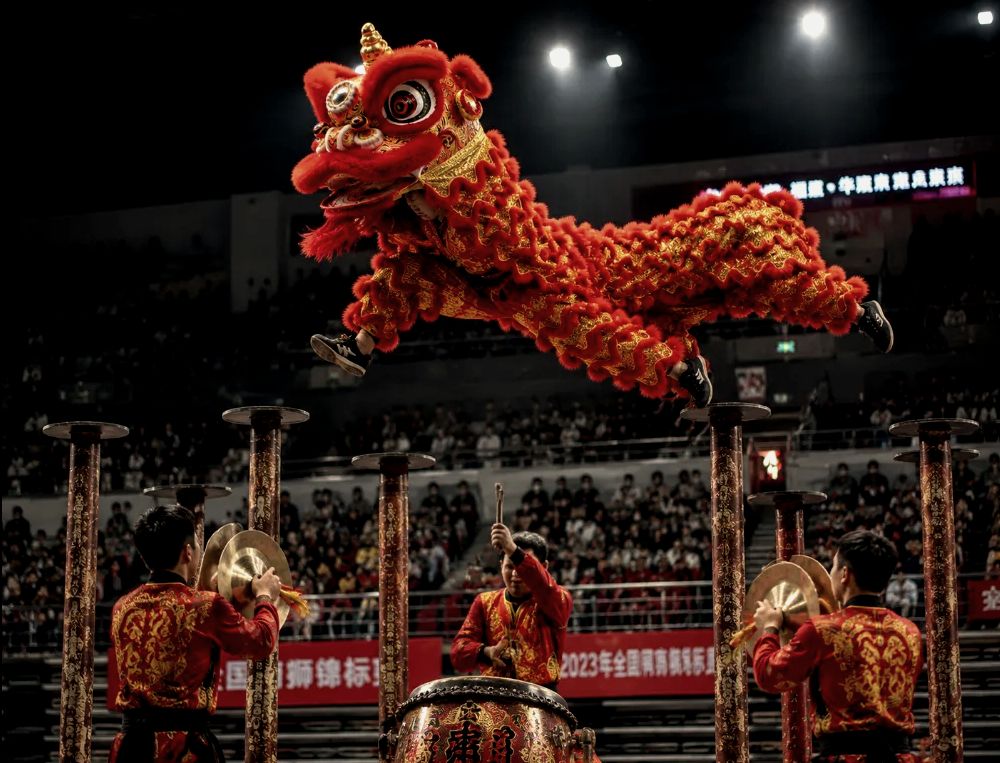
Across every tradition the beast dances share a social grammar: they appear at Lunar New Year, temple festivals, business openings, weddings, housewarmings and ancestral ceremonies, expelling misfortune and summoning prosperity, and they have always been vehicles for martial training and community identity, from the Foshan martial schools to the Hakka villages and the Taiwanese temple arrays. The modern era has formalised and globalised them. Since the first plum blossom poles (梅花樁) were introduced at the 1983 world championship in Malaysia, competitive Awakened Lion dance on pole sets of twenty-one or more poles has become an international sport, and mainland China and Hong Kong have inscribed the Awakened Lion, the Jieyang Green Lion, the Hakka unicorn, the Pixiu dance and the Tongliang dragon on their heritage lists. Heritage tourism now drives revival, as the Jieyang old city and Quanzhou’s world-heritage status demonstrate, and diaspora institutions from Singapore’s Kong Chow Wui Koon to the Sentosa archives preserve the history of the styles.
15. The music: drum, gong and cymbals
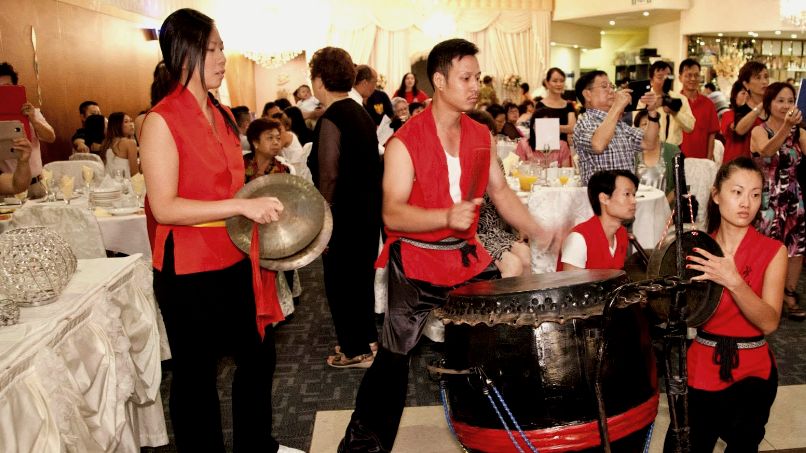
A Southern Lion performance is led throughout by a live trio of instruments: the drum (鼓), the gong (鑼) and the cymbals (鈸). The drum is the lion’s heartbeat and the true conductor of the dance, signalling every change of mood and movement, while the gong and cymbals are traditionally said to represent the lion’s thoughts, accompanying and punctuating what the drum commands.
The music is not decorative; an experienced head dancer reads the drum as closely as the drummers read the lion. The repertoire is codified into named rhythms, of which the Three Stars (三星) and Seven Stars (七星) patterns are the most famous, the latter associated with the Heshan tradition through Huang Shiqin’s resounding Seven Stars drum; Wong Fei-hung is credited with codifying the “dance of the three stars” in Foshan. The rhythm vocabulary includes distinct passages for the lion waking, sleeping, being suspicious, being frightened, eating and celebrating, and players of the school learn them in strict order, with the youngest and newest members beginning on the cymbals or gong before being trusted with the drum. In the northern style the same principle holds, with the drum driving the acrobatic sequences and the warrior’s ball. Recorded music is rejected by traditional troupes precisely because the dialogue between drummer and dancer, a call and response in rhythm, is the substance of the art.
16. The Big Head Buddha and the cast of characters
Lion dances are rarely the lion alone. The comic figure who opens the way, teases the lion and rouses the crowd is the Big Head Buddha (大頭佛, daai tau fat in Cantonese), a grinning bald mask in monk’s robes, often accompanied by the pin-masked monk (笑面佛) and other masked figures. Folklore gives him the role of the monk who advised the villagers how to frighten away the Nian beast, and in performance he is the lion’s tamer and foil: in the traditional southern style he lures or subdues the lion with a fan, a rake or a horsewhip, hiding from it, mocking it and leading it to the greens. The character is comic on the surface but structurally important, since his antics give the lion its entrances, set up the plucking of the green, and provide the crowd with the clowning that balances the lion’s martial gravity. In the Hakka qilin dance the equivalent role is filled by the Sun Monkey (孫悟空), who teases the unicorn, and some traditions add the tiger or other beasts as companions, so that the performance becomes a small cast play rather than a solo animal.
17. Plucking the green, eating and the sequence of a performance
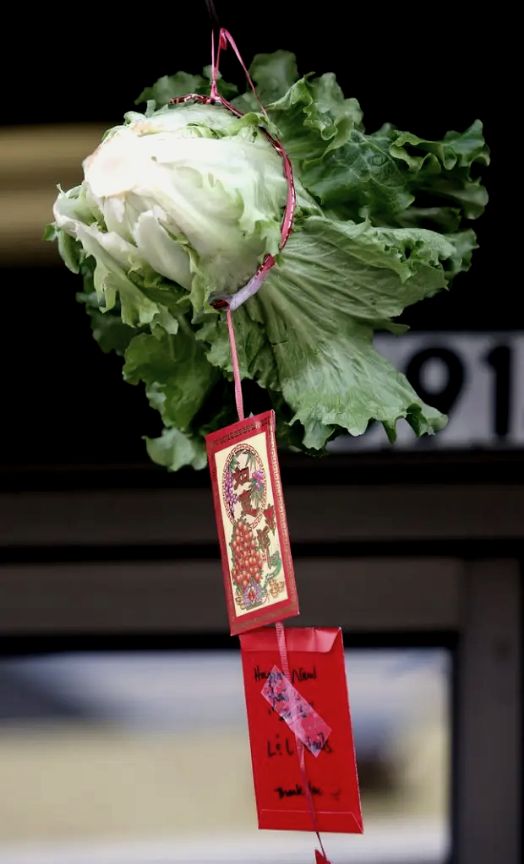
The climax of nearly every Southern Lion performance is the plucking of the green (採青, coi cheng in Cantonese). The green (青, cheng) is a bunch of leafy vegetables, usually lettuce, tied with a red packet of money and hung above a door or on a pole. The word cheng puns on wealth and freshness, and lettuce (生菜, sang choi) puns on “growing wealth” (生財), so the lion’s eating of the green is a literal consumption of prosperity on behalf of the host. The lion approaches with the full sequence of suspicion, courage and play: it circles the green, examines it, is startled, tests it, then bites, chews and shreds the leaves before spitting them out over the crowd and the premises. Being struck by the scattered greens is itself considered a blessing and a guard against misfortune, and hosts sometimes collect the leaves to place on their counters or altars. The red packet is left for the troupe, traditionally suspended with the green so that the lion must reach for both.
The whole performance follows a traditional grammar. One classic formulation lists the eight elements of the basic routine as sleeping, waking, playing, searching, fighting, eating, closing and sleeping again, and each stage has codified reactions: the lion should be happy at the sight of green, startled by the colour red, curious at its own reflection when crossing a bridge, inclined to bite at wood, and tempted to climb any post it passes. It bows to elders, deities, business owners and red doors, blinks and scratches, grooms itself, chases its tail and, where two lions meet, may play together, rolling and head-biting in mock combat. The “eating” of the green is therefore one beat in a moral little drama of appetite overcome by courtesy, and the same grammar underlies the Minnan and Hakka beast dances, each with its own named sequences.
Standard routines include ‘lion climbs the pagoda’, ‘crossing the heavenly bridge’, ‘lion crosses three hills’, ‘lion descends the mountain’, ‘lion exits the cave’, ‘lion descends the mountain’, ‘tumbling lion’, ‘lion spits out the pearl’, ‘lion explores the sea’, Lion eating the snake, 7 Stars and the Moon, ‘Lion Rolling over’, ‘lion crosses the broken bridge’, ‘lion walks on posts’, and ‘lion plucks the greens’.
18. Feats of balance and strength
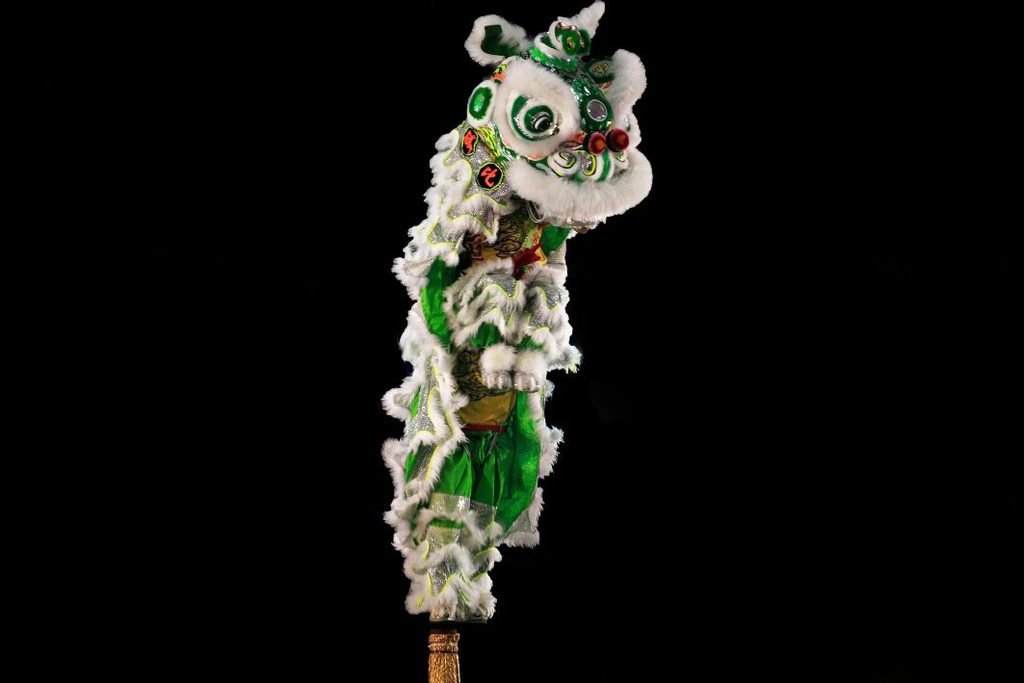
The martial character of the lion shows most clearly in its feats. In the traditional ground performance the lion climbs stacked tables and stools, balances on spheres, walks narrow benches and performs lifts and throws drawn from its school’s kung fu. The modern extreme is the pole discipline introduced at the 1983 world championship in Malaysia: the lion travels across a field of plum blossom poles (梅花樁) of varying heights, originally around eighty centimetres, now raised in competition to several metres, leaping gap to gap on stances carried straight from Hung Ga and related arts.
In the Chaoshan and Fujian traditions the feats are different but equally demanding: the Quanzhou lion-fighting (刣獅) performances have armed fighters assault the lion with real weapons while it defends itself through its school’s forms, and some southern troupes demonstrate strength by cracking a coconut with a single blow of the lion’s jaw or head at the moment the green is taken, a display of the power in the lion’s bite. The Heavenly Tower Lion Dance of Shanxi, in which northern lions climb a tall tower of stools, is the northern counterpart. In every case the feat is not spectacle alone: achieving the green at height, under risk, dramatises the overcoming of obstacles that the blessing is meant to promise the host.
19. Blessings, fireworks and the social occasion
The lion dance is hired and performed as a transaction of blessing. Businesses book lions to “wake” their premises, drive off bad luck and draw customers; the lion bows three times to the door, to heaven, earth and man, salutes the owner, consumes the green and scatters fortune over the staff. At New Year the troupe parades from shop to shop, and the popping of firecrackers (爆竹) is integral: the noise completes the ancient function of frightening away evil spirits, and the lion’s composure amid the explosions is itself a display of courage.
Firecrackers accompany the entrance of the lion, the taking of the green and the departure, and in Southeast Asia the smoke and red paper on the ground are part of the expected scene. Households invite lions to bless new homes, weddings pair lions chosen for their colours, and temples expect the lion to pay formal respects to the altars before anything else. The red packet, the greens and the firecrackers together constitute the ritual exchange: the host gives honour and fee, the troupe gives the lion’s auspicious visit, and both sides gain the public demonstration of community standing that the performance always was.
20. The colours of the lion heads
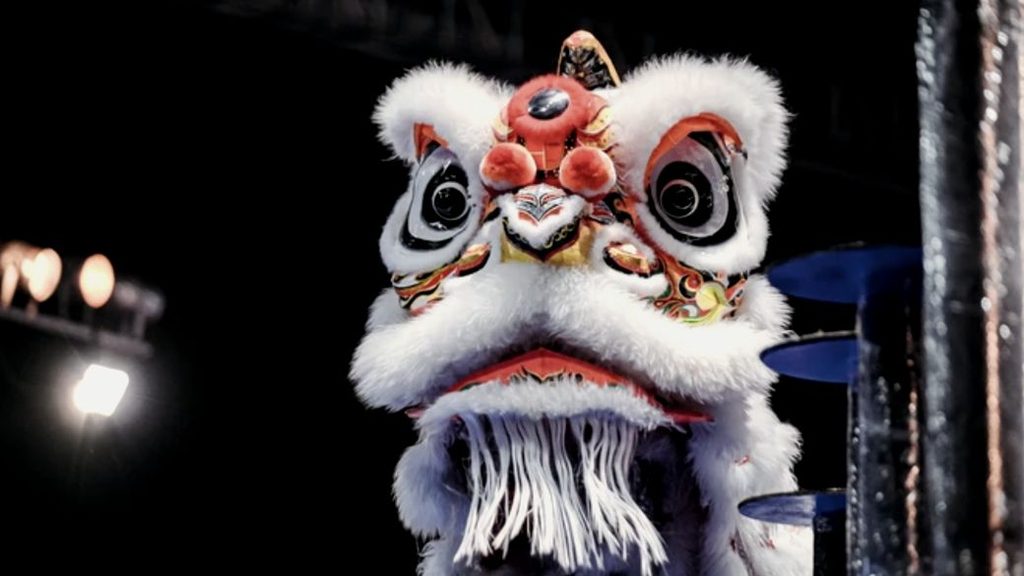
The traditional Southern Lion head is a character portrait, and the classical system identifies five types drawn from the Three Kingdoms heroes whose opera face-paintings inspired the Foshan lion. The Auspicious Lion (瑞獅, rui shi) has a seven-coloured face, white beard and white brows, and represents Liu Bei (劉備), carrying the meanings of wisdom, benevolence and integrity; it is the elder statesman of lions, suited to milestones and solemn occasions. The Awakening Lion (醒獅, xing shi) has a red face, black beard and brows and a green nose, and represents Guan Gong or Guan Yu (關公), carrying bravery, loyalty and righteousness; red and gold lions of this type dominate New Year and corporate performances. The Fighting Lion (鬥獅, dou shi) has a black face, short black beard and a black and white body, and represents Zhang Fei (張飛), carrying the courage, aggression and playfulness of youth; its routines are the most acrobatic and combative. The Respected Lion (老獅, lao shi) has a yellow face with silvery white beard and brows and represents the aged general Huang Zhong (黃忠), embodying righteousness in old age. The Heroic Lion (漢獅, han shi) has a green face with an iron horn and teeth and represents Zhao Yun (趙雲), embodying heroism. Later designs added gold for high immortals, silver for lesser ones and blue for ferocity, and modern troupes add colours freely for spectacle, but connoisseurs still read the head closely: the beard tells the lion’s age and temperament, the horn and mouth tell the school, Futsan heads carrying taller horns and fiercer lines, Hoksan heads shorter horns and rounder faces.
21. Rules of engagement between lions
Because the lion dance grew out of rival kung fu schools, a detailed etiquette governs meetings between lions and troupes, and breaches were historically taken as challenges.
When two lions meet head on, both must bow, traditionally three times, and the drummers must not attempt to drown one another out, the heads being held at equal height so that neither lion asserts dominance; schools traditionally exchanged identification cards or letters during the bow. A lion must never stand on one leg while holding the head in the presence of another lion, a posture read as disrespect or provocation, and a lion must never bite or sniff at another lion’s tail.
Three bows are also owed on parting, and a lion passing a statue of the Buddha, or entering a temple, bows three times to heaven, earth and man before proceeding. The lion’s own body language encodes submission and respect: a lowered head is courtesy, a raised head a challenge. These rules made the lion dance a way for schools to meet in public without violence, since the exchange of bows, the matched drumming and the equal head heights allowed two rivals to acknowledge one another’s strength while keeping the peace, and the same protocol survives today in the courtesy exchanged between troupes at competitions and festivals.