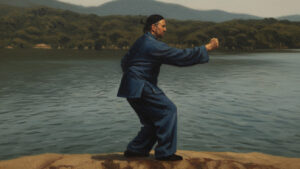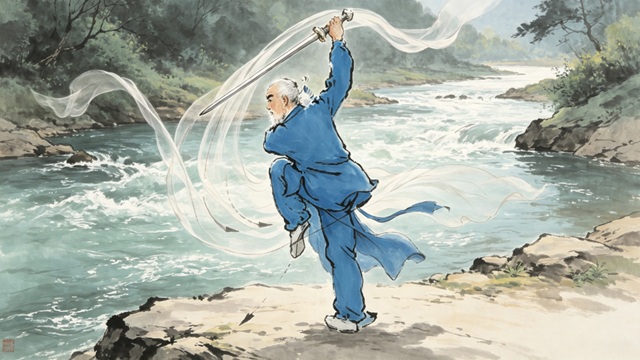
Our GM Tong Zhongyi (佟忠义) hailed from a Manchu martial family with a lineage spanning over three hundred years. In his youth, he earned the title of one of the “Two Heroes of Cangzhou” (沧州二杰) alongside Wang Ziping (王子平). Not only was he highly skilled in mounted archery and proficient in projectile techniques, but he also mastered over a hundred traditional routines, including those for the sword, sabre, staff, spear, flexible and rigid weapons, as well as paired drills, within the Cangzhou Liuhe Men (六合门, Six Harmonies School). He seamlessly integrated his family’s inherited methods of qinna (擒拿, joint-locking and seizing) and wrestling with the Liuhe system, synthesizing the strengths of various schools to develop his distinctive “Tong-style combat methodology,” grounded in the principle of “a hundred paces treading plum-blossom footwork” (百步行走梅花边) and characterized by the triad: “first strike, second seize, third throw” (一打二拿三摔). In the early years of the People’s Republic, those who witnessed his performance of the “Eight Immortals Sword” (八仙剑) and other forms invariably offered high praise.
I. Sword Techniques and the Coordination of Hand, Eye, Body, Footwork, and Mind
Cangzhou Daliuhe Men Master Tong Zhongyi’s Daoist “Eight Immortals Sword” was acquired in his youth while he served as chief instructor in Cao Kun’s military garrison in Baoding, Hebei Province, where he learned it from a Daoist of exceptional martial prowess. The complete set comprises seventy-eight postures and requires approximately three and a half minutes to perform. The form places paramount emphasis on footwork, with movements that are continuous, fluid, and cyclical, evoking an air of elusiveness. Its turns, flips, rises, drops, advances, and retreats unfold with natural harmony, akin to a rushing wind, a swallow’s tail, or a wandering dragon.
The sword methods of the “Eight Immortals Sword” encompass the essence of swordsmanship, executed with strict precision and meticulous attention. They include: 劈 (chop), 砍 (hack), 扫 (sweep), 撩 (lift), 刺 (thrust), 崩 (spring), 绞 (twist), 云 (cloud), 挂 (hook), 剪 (shear), 挑 (pick), 错 (interlock), 点 (point), 抛 (cast), 拨 (deflect), 摸 (probe), 冲 (charge), 截 (intercept), 削 (slice), and 攒 (gather). These are employed with refined nuance, avoiding the common pitfall of undifferentiated application.
The agility of hand techniques depends entirely on the wrist. If the wrist is stiff, even wielding legendary blades like those of Ganjiang (干将) or Moye (莫邪) (from story/legend that refers to magificantly forged sword – “peerless, ultra-sharp, mythical blades.”) would be futile. Master Tong’s wrist training comprised both empty-hand and sword-holding exercises, employing the five principles of 翻 (turn), 拧 (screw), 裹 (wrap), 云 (cloud), and 抖 (shake), in an interplay of yin and yang. The left hand, regardless of its position, is always held in the sword-finger gesture (剑诀), serving as an auxiliary to the right arm. The arms are kept with sunk shoulders and dropped elbows, curving like a half-moon in imitation of Taiji (太極), thereby preventing the outward leakage of internal energy. A distinctive feature of Master Tong’s swordplay was his ability to alternately wield the sword with both hands, rendering his technique elusive and bewildering to opponents.
The eye method requires that the eyes follow the hands, and that the gaze reaches the target before the sword. Amidst shifts in body posture and complex footwork, the practitioner must perceive the opponent’s slightest movements before they are fully executed, and remain unflinching even when weapons approach. Thus, during solo practice, one must constantly attend to eye coordination; with time, proficiency will naturally develop.
The body method moves like a roaming dragon, soars like a phoenix, and coils like a serpent. The sword is essentially dynamic. The body must be as supple as cotton yet as firm as steel. The sword has no fixed pattern, no stagnation, neither clinging nor distancing, appearing suddenly before, then instantaneously behind. The body impels the sword forward, and the sword responds to every shift of the body, without any strain, embodying adaptability and spontaneity. At the pinnacle of practice, the extended arm seems to surpass normal reach, while the contracted body appears to fold into a compact space. In the early years of the Republic, when Master Tong was already over seventy, his performance of the “Eight Immortals Sword” was ethereal. In the posture “Plucking the Stars and Changing the Moon” (摘星换月), which involves a left turning waist-drop into a sitting-squat, with the right sword thrusting upward from under the left armpit, where his entire frame coiled into the size of a child, eliciting astonishment.
The footwork of the “Eight Immortals Sword” is the most exquisite, encompassing all stepping methods used in bare-hand and weapon forms. Its primary feature is versatility and the capacity for rapid transitions and foldings, all rooted in the concept of “roaming,” which vividly conveys the characteristic demeanors of the Eight Immortals.
As for the mental principles (心法), they may be summarized succinctly: “A martial artist who cannot coordinate hands, feet, eyes, and ears is like a general who cannot command his troops.” Hence it is said: “Hand, eye, body, footwork, the mind is the master.” External forms, postures, and techniques, however, cannot reach higher levels without the foundation of internal skill. All martial practitioners understand this principle, and Master Tong’s “Eight Immortals Sword” is no exception.
II. Internal Training (Neigong) for the “Eight Immortals Sword”
Internal training, or qigong (氣功), employs systematic and scientific methods to regulate yin and yang, cultivate and augment vital energy (zhenqi, 真氣), and ensure the unimpeded flow of energy through the viscera, meridians, sinews, and flesh. This strengthens bodily functions, enriches vitality, and builds physical power. It is truly “the secret to nurturing one’s nature and the essential path to self-cultivation.” Generally, internal training methods are associated with Daoist traditions, and most Daoist adepts are well-versed in them. Master Tong’s “Eight Immortals Sword,” being a quintessential Daoist sword style, greatly benefits from preliminary internal training, which yields twice the result with half the effort.
The internal training for this sword style comprises thirty-six movements, with the complete routine taking about half an hour. The first twenty-seven movements are primarily stationary and crouching stances (mazhuang, 馬樁, and puzhuang, 仆樁), which, through bare-hand practice combined with specialized breathing techniques, facilitate the opening of the senses, the nurturing of vital energy, and the strengthening of marrow. This constitutes the foundational phase of internal training, essentially a preparatory step for learning swordsmanship. The final nine movements serve both as the foundation of sword technique and as an advanced stage of internal training. Through varied wrist and footwork drills, combined with sword-shaking (doujian, 抖劍) and clouding (yunjian, 云劍) exercises, the practitioner develops wrist agility, balanced hardness and softness, nimble footwork, and versatility, establishing a solid groundwork for learning the complete sword routine.
Master Tong’s internal training methods are not only suitable for sword study but also beneficial as supplementary training for other bare-hand and weapon forms. To this day, as a health practice, they offer countless benefits to the hands, feet, waist, and legs, with no adverse effects whatsoever.
III. Tracing the Origins of the “Eight Immortals Sword”
Master Tong’s Daoist “Eight Immortals Sword” has a history of at least three hundred years. If traced further back beyond the reign of Emperor Kangxi of the Qing dynasty, its origins become difficult to verify.
In the 1930s, when Master Tong established the “Zhongyi Martial Arts Society” (忠义拳术社) in Shanghai, he printed a series of manuals for his disciples. Among these, the manual for the “Eight Immortals Sword” listed the seventy-eight postures and concluded with a seven-character poem:
“Old Man Li’s Daoist arts are sublime, 拐李先生道法高
Zhongli’s bearing is most majestic. 钟离架势甚英豪
Dongbin carries his sword, a guest of the breeze, 洞宾背剑清风客
Guolao rides his mule, paring the phoenix’s plume. 果老湛虞削凤毛
The Royal Uncle moves, alarming spirits and ghosts, 国舅走动仙鬼悝
Caihe’s four gates emit brilliant light. 彩和四门放光毫
The Immortal Maiden arrays the Eight Immortals formation, 仙姑摆下八仙阵
Xiangzi’s soul-chasing strikes, no escape from fate.” 湘子追魂命难逃
Interestingly, within the Qing dynasty novel Peng Gong An (《彭公案》) by Yang Yidian (杨挹殿), there is the following passage in Chapter 143:
“After fighting for some time, the Daoist priest struck directly at Ma Yulong’s head with his saber… Ma Yulong leaped out of the circle to examine his sword and found it unharmed. They resumed battle, and Ma Yulong executed the ‘Eight Immortals Sword’ with full force. How was it? As the poem attests:
‘Old Man Li’s swordplay is supreme, 拐李先生剑法高,
Dongbin’s art is truly hard to depict. 洞宾先生实难描
Zhongli bears his sword, a guest of the breeze, 钟离背剑清风客
Guolao rides his mule, paring the phoenix’s plume. 果老跨驴削风毛
The Royal Uncle moves, alarming ghosts and spirits, 国舅走动神鬼瞿
Caihe’s four gates emit brilliant light. 彩和四门放光毫
The Immortal Maiden arrays the Eight Immortals formation, 仙姑摆下八仙阵
Xiangzi’s soul-returning—no escape from fate. 湘于归魂命难逃。’”
This passage describes a fierce duel between the loyal knight Ma Yulong (马玉龙), a supporter of Governor Peng, and the rogue Daoist Yu Changye (于常业). Ma Yulong had learned the “Eight Immortals Sword” from the Iron-Plate Daoist Zhuge Shanzhi (诸葛山直) of Qingyang Prefecture. Comparing these two poems, though separated by three hundred years, only minor textual variations exist (as indicated by marked characters in the original text).
This suggests the following: First, both Master Tong’s version and the one in the novel belong to the same Northern Daoist sword tradition, prevalent in Hebei, Shanxi, and Shaanxi for centuries. Second, the “Eight Immortals Sword” was evidently popular in the Qing dynasty, as even the novel’s author could describe its techniques in some detail. Third, the Daoist teacher from Hebei from whom Master Tong learned and the setting of the novel coincide geographically. Therefore, it is reasonable to conclude that Master Tong’s “Eight Immortals Sword” and the one described in the Qing novel share a common lineage.
It is worth noting that many schools and lineages possess their own versions of the “Eight Immortals Sword,” with over ten distinct styles and dozens of routines bearing the same name. For example, we also practise the Eight Immortals Sword from Bajiquan, Wudang Boxing, Chahua Men, Praying Mantis and other styles.
IV. The Artistic Conception: “The Eight Immortals Riding the Wind”
Throughout history, fantastical tales of sword immortals and chivalrous swordsmen have often misled martial arts enthusiasts into confusion, a pitfall practitioners should avoid. Master Tong’s “Eight Immortals Sword” seeks not to evoke superstition but to create an artistic conception of “The Eight Immortals Riding the Wind” (八仙凌风) through ethereal footwork, soaring body movements, and elusive swordplay.
The form draws inspiration from the imagery and actions associated with the Eight Immortals to embody the defensive and offensive principles of swordsmanship. In an era when cold weapons were essential for survival, the sword was a tool of life-and-death combat. Yet it was equally natural for practitioners to invest their swordsmanship with personal ideals, emotions, and aspirations. Master Tong’s art is deeply intertwined with Daoist self-cultivation, naturally evoking associations with “immortal demeanor” and “ascending to transcendence.” While discarding any superstitious interpretations, the aesthetic conception of “The Eight Immortals Riding the Wind” offers a meaningful dimension of personal sentiment, refinement, and moral cultivation.
The footwork of the entire routine emphasizes lightness and agility, particularly in “walking steps” (xingbu, 行步). These are of two kinds: rigid and soft. In rigid walking steps, the front foot’s ball strikes the ground with a crisp, snapping force; in soft walking steps, the front foot lands with a gentle, buoyant quality. Movements such as “Chasing the Wind and Moon” (追风赶月) and “Following the Wind to Guide the Robe” (顺风领衣)—both semi-circular walking steps, exemplify the ethereal and unrestrained elegance associated with Lü Dongbin (吕洞宾) and Cao Guojiu (曹国舅).
The “soaring” body method is a hallmark of this sword style. It employs sudden turns, fluid somersaults, and nimble foldings to convey an air of transcendence. For example, the “Turning Internal and External Furnace Lift” (转身内外提炉) showcases abrupt directional changes; “Lotus Leaves Swaying in the Wind” (风摆荷叶) demonstrates smooth rolling turns; and “Plucking the Stars and Changing the Moon” (摘星换月) exemplifies agile folding—all of which vividly animate the spirited personas of Han Zhongli (汉钟离), He Xiangu (何仙姑), and Lan Caihe (蓝采和).
The elusive swordplay of Master Tong’s “Eight Immortals Sword” is rooted in its internal training. Specialized drills such as sword-shaking and clouding enable the blade to weave unpredictably, striking east while threatening west, appearing south then vanishing north. Techniques like “The Immortal Maiden Threads Flowers” (仙女插花), “Parting the Waters to Find the Path” (分水寻路), and “Sweeping the Autumn Waters” (扫底秋水) exemplify the sublime qualities associated with Zhang Guolao (张果老), Han Xiangzi (韩湘子), and Li Tieguai (铁拐李).
The “Eight Immortals Sword” paints a serene and refined tableau, “The bright moon hangs high, while a clear breeze casts sparse shadows”, immersing the practitioner in the realm of “The Eight Immortals Riding the Wind,” bringing joy, delight, and spiritual fulfillment.