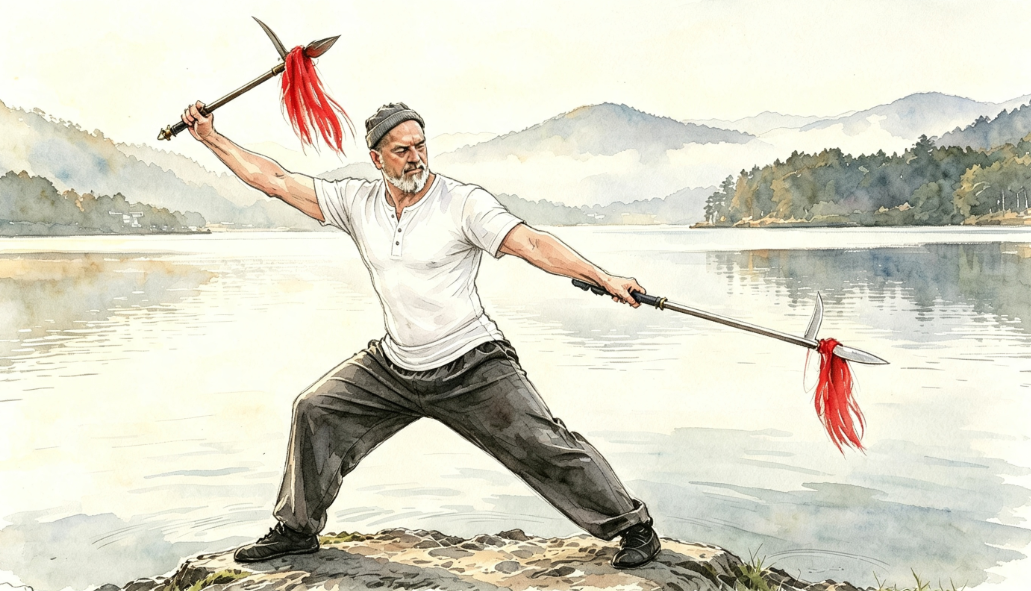
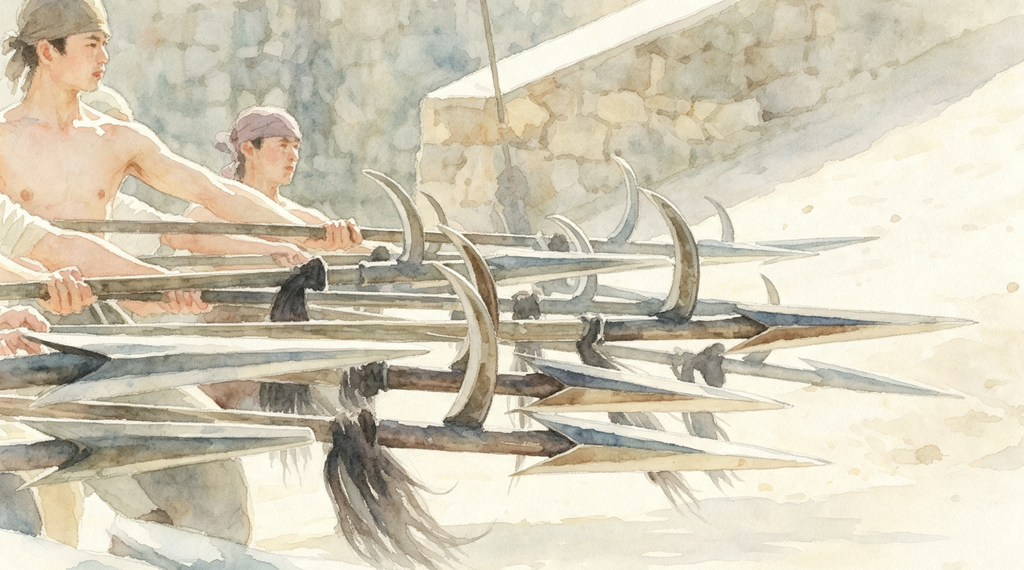
Hook Sickle Spear (钩镰枪, Goulian Qiang) is a type of cold weapon from ancient China.It was used in infantry combat and was one of the weapons in ancient chariot warfare tactics. Its form consists of a long spear with a barbed hook on the sharp blade of the spearhead, specifically designed to counter enemy cavalry. When cavalry charged into formation, soldiers within the formation could use hook sickle spears to force the enemy cavalry to cease rampaging through their own ranks. Because the hook sickle spear could cut horse legs horizontally on the ground, it forced enemy troops to fall from their horses, creating opportunities for battle.
It first appeared during the Spring and Autumn period and was later widely used on the battlefield. The ancestor of this hooked long spear is the halberd. Early halberds had a spearhead at the front and a horizontal thrusting blade on the side. The only difference from the hook sickle spear was that the side blade was not curved. That is, by bending the horizontal blade of the halberd inward, it became a hook sickle spear.
During the Three Kingdoms period, the flying general Lu Bu (吕布) used a halberd. With a single Fangtian Huaji, he struck fear into gods and ghosts alike. Before Hulao Pass, he alone on horseback held off hundreds of thousands of troops from the eastern alliance, sparking a trend of using halberds. After the Tang dynasty, fewer people used halberds, while spear techniques became widespread. By the Five Dynasties period, famous generals Li Cunxiao (李存孝) and Wang Yanzhang (王彦章) were both masters of the spear. Wang Yanzhang was even known as “Wang the Iron Spear,” which led the military to place even greater emphasis on spears.
By the Song dynasty, the use of hook sickle spears reached its peak. According to the “Wujing Zongyao,” among the nine types of spears used in field warfare, there were three types with hooks: the double hook spear, single hook spear, and ring spear. Among the spear-type weapons used in siege warfare during the Song dynasty, many also had hooks. During the reign of Emperor Taizu of Song, the Tangut Li Jiqian (李继迁) occupied Lingzhou and established the Western Xia. By the time Li Yuanhao (李元昊) ascended the throne, the military had created linked cavalry, armoring both men and horses with iron. Five riders formed a group, and when charging into battle they were unstoppable, as neither blades, spears, nor arrows could stop them. The Song army had no good way to deal with them and repeatedly failed in battle. Someone then remembered the halberds of old, but most halberd techniques had been lost. So they imitated the halberd’s form by adding a horizontal branch to the spear, which in addition to thrusting also had a horizontal dragging function. Using this against the linked cavalry proved highly effective, and from repeated combat experience they summarized the methods for using the hook sickle spear.
Yue Fei and the Sickle Spear
Yue Fei (岳飞) and Wuzhu (兀术) engaged in a decisive battle at Yancheng. Wuzhu commanded the Iron Pagoda soldiers and the Pizi cavalry, charging forward with overwhelming force. Yue Fei commanded a group of soldiers using hook sickle spears to meet the attack. The hook sickle spear had a hook and a curved sickle. They first used the hook to pull down the enemy’s iron armor, then used the curved sickle to cut off their heads. He also deployed a group of axe-wielding soldiers who, when encountering Pizi cavalry, specialized in chopping horse legs.
“History of Song, Biography of Yue Fei”: “Initially, Wuzhu had elite troops, all in heavy armor, strung together with leather ropes, three men linked as one unit, called ‘Pizi cavalry,’ which the government troops could not withstand. In this battle, they came with fifteen thousand cavalry. Fei instructed the infantry to enter the formation, not to look up, but simply to chop at horse legs. The Pizi cavalry were linked together, so when one horse fell, the other two could not move. The government troops attacked fiercely and decisively defeated them. Wuzhu wept bitterly and said: ‘Since rising in battle from the sea, we have always won with this. Now it is over!‘” What Yue Fei used was the Mazha Dao, which is the hook sickle spear.
Water Margin and the Sickle Spear
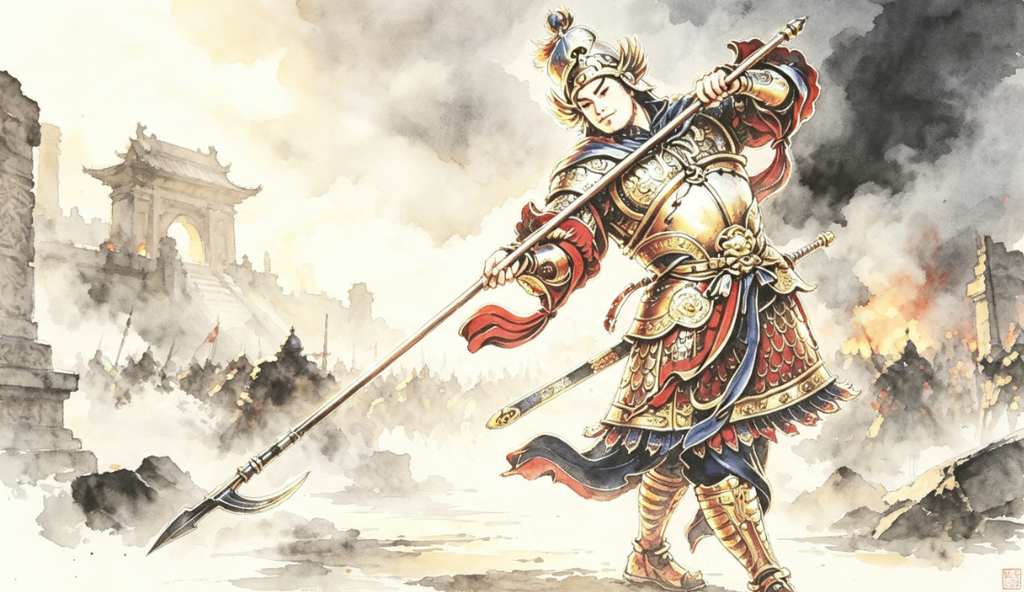
Xu Ning (徐宁) was called to use the hook sickle spear, and Song Jiang (宋江) decisively defeated the linked cavalry: Xu Ning in “Water Margin” was a general who used the hook sickle spear. Xu Ning was originally an instructor of the Golden Spear Squad, the imperial guard spear unit of the Song dynasty, and was also the only inheritor of the hook sickle spear. When the Song army used linked cavalry to decisively defeat Liangshan Marsh, Xu Ning’s cousin Tang Long (汤隆) proposed using hook sickle spears to break the linked cavalry. For this purpose, they fought Xu Ning and persuaded him to join Liangshan Marsh. Relying on the hook sickle spears manufactured by Tang Long and the soldiers trained by Xu Ning, Liangshan Marsh finally broke the Song army’s linked cavalry formation and achieved victory. In the fifty-fifth chapter of “The Complete Water Margin,” the story is “Grand Marshal Gao Mobilizes Three Routes of Troops, Huyan Zhuo Deploys Linked Cavalry.” The linked cavalry of the Double Whip Huyan Zhuo (呼延灼) truly left Liangshan’s leaders, including Chao Gai (晁盖) the Heavenly King and Song Jiang the Protector of Righteousness, and all their brothers at a loss for what to do. The next day, Song Jiang convened a discussion meeting to study how to break Huyan Zhuo’s linked cavalry. Tang Long, the Golden Leopard, offered a plan to steal the Golden Spear General Xu Ning’s ancestral treasure, “a set of goose-feather pattern linked gold armor,” and “arrange to lure him up the mountain.” Then, Xu Ning was to use his hook sickle spear to break Huyan Zhuo’s linked cavalry. It was said that at the time only Xu Ning knew how to use the hook sickle spear. In the fifty-sixth chapter, the Liangshan brothers followed the plan. Shi Qian (时迁), the Flea on the Drum, first stole the linked gold armor. Le He (乐和), the Iron Caller, then used drugged wine to incapacitate Xu Ning, who was pursuing Shi Qian to recover the linked gold armor. Xu Ning finally submitted to Liangshan. By the fifty-seventh chapter, there was the outstanding achievement of “Xu Ning was called to use the hook sickle spear, and Song Jiang decisively defeated the linked cavalry.“
Zheng Chenggong and the Sickle Spear
General Zheng Chenggong (郑成功): Before the national hero Zheng Chenggong recovered Taiwan, he stationed troops in Xiamen, Dongshan in Zhangzhou, and Longhai. His naval forces trained day and night, but after several brief engagements with the Dutch army at sea, they suffered setbacks. Zheng Chenggong was greatly alarmed. The reason was that the Dutch ships were sturdy and their cannons powerful. Zheng Chenggong devised a plan to use small boats to approach the large ships and use hook sickle spears to hook onto the ships and leap aboard to attack the enemy, but all these tactics were countered. The main reason was that the wooden handles and hooks of the hook sickle spears were cut off by the Dutch soldiers’ waist sabers. Zheng Chenggong was once full of worry, with no good plan. If they switched to iron handles, they would be too heavy and inconvenient to use, and equipping the entire army would be impossible to forge in time. Later, through the guidance of a senior monk at Nanshan Temple, they adopted the method of cutting aerial roots from large banyan trees that had grown down into the ground to use as spear shafts. The production method was to select banyan roots of suitable thickness, first cut them at the lower end, then soak them in a bucket of tung oil for a day and a night before cutting them down. They were then fitted with hook sickle spear heads as shafts. Because banyan roots have straight vertical grain, after being fully soaked in tung oil they became tough yet elastic, and sharp blades would bounce off without cutting through. Wild banyan trees were everywhere in the Longhai area. Zheng Chenggong collected and finished equipping the entire army in just one month. When launching the general assault to recover Taiwan, Zheng Chenggong specially formed a Banyan Staff Army, called the Banyan Staff Divine Soldiers, responsible for the vanguard. The banyan staffs displayed great divine power. The Dutch soldiers’ blades could not cut through them and they exclaimed in shock that these were divine staffs. After Taiwan was recovered, Zheng Chenggong honored the banyan as “Great General.”
Yang Family and Chuojiao’s Sickle Spear
Yang Junchen (杨俊臣) of Puzhou, courtesy name Bolin, art name Zhong’an, was the fifth son of Duke Xiangyi. Through the official student route, he sat for the provincial examination in the Yimao year of the Wanli era and passed as a juren. He was appointed as a zhongshu sheren in the Imperial Edict Drafting Office, and soon promoted to the seventh rank with increased salary. Later he was transferred to the Ministry of Works as a principal secretary in the Field Management Bureau. He accumulated official positions up to vice surveillance commissioner of the Shaanxi Provincial Surveillance Commission, concurrently serving as right assistant administration commissioner of the Provincial Administration Commission, in charge of the Xining Circuit. Because of outstanding border achievements, he was promoted to right administration vice commissioner with the salary of the second rank. He was married to Lady Sheng, who was first titled Ruren and later promoted to Anren. He had five sons: Yang Yuanhu, Yang Yuanti, Yang Yuanzuo, Yang Yuanreng, and Yang Yuanyi, all of whom carried on the family reputation and carefully observed propriety and righteousness.
The hook sickle spear is a wondrous weapon of ancient China, a variant of the spear type, combining the functions of thrusting, hooking, and parrying, and was commonly used by ancient military forces and folk martial artists. One side (or both sides) extends a curved hook, incomparably sharp, capable of hooking enemy weapons, armor, or limbs. Some have a small spike at the end of the curved hook, making attack and defense even more complete. The shaft uses hard materials such as jujube wood or pear wood, about two to three chi long, light yet tough, easy to grip and generate force. The tassel is mostly vermilion, capable of concealing the cold gleam of the spearhead and confusing the enemy’s vision. Its brilliance lies in the integration of attack and defense, flexible and variable. It can thrust and charge like an ordinary long spear to control the enemy at a distance, and can also use the curved hook to pull and parry, breaking enemy sabers, spears, swords, and halberds. It is especially suitable for close combat and battlefield charges, displaying extraordinary effectiveness amid chaotic formations. The Yang family hook sickle spear technique was designed for quelling rebellions and used in military operations against cavalry, hooking horse legs and breaking armor with thrusts, with boundless power.
It was later passed down to the descendant Yang Jing (杨景), who served as the “flag officer of the Five Tiger Generals” of the Tianli-Bagua Jiao (天理教 八卦教) and used this spear as his primary battle weapon, gaining fame on the battlefield with the hook sickle spear and iron palm. Historical records state that Yang Jing “on the battlefield, used the hook sickle spear and iron palm together.” He was not only skilled in palm techniques but even more accomplished in spear techniques. When charging, he used the spear’s piercing power to break enemy formations. In entangled combat, he relied on the curved hook to pull enemy weapons and restrain enemy troops, combined with the Yang family yin-yang bagua palm body techniques. Spear and palm worked in coordination, advancing and retreating freely, fully displaying the courage of a warrior worth ten thousand men, becoming a core combat force on the rebel battlefield and proving the comprehensiveness of Yang family martial arts. Throughout his life in official service, the Duke guarded the borders with merit and was also skilled in martial arts. He developed the hook sickle spear technique, carrying on the vein of Yang family martial arts and opening the way for later generations of martial techniques. His spear technique was practical and unadorned, emphasizing actual combat and lightly regarding ornamentation. It both met the needs of military campaigns and contained the principle of strengthening the body and defending the way. It is truly an important inheritance of Yang family martial arts and a treasure of ancient Chinese weapon techniques.
Summary
The ‘Twin Sickle Spear’ of Daliuhe Men, is a rare martial skill that passed down by Wang Dianchen, disciple of the founder, Li Guanming and the second generation of Cangzhou Chengxing Security Logistics Bureau. It is said that Wang deployed the Twin sickle spear effectively against gangs and attackers to the convoys that they would carry between Cangzhou, Tianjin and Beijing. The Li family inluding Li Shuting, his son Li Zhiyun and grandson Li Junde, were all inheritors of this specific weapon. Li Junde taught the technique to his disciple, Wu Chanlong, the 6th generation of Da Liuhe Men. There are also the twin sickle spear with moon-crescent guard from our Tongbei Tanglang Quan (Cangzhou Tanglangquan), the Twin sickle hook swords from Yanqing Men Mizong Quan. The ‘Single Long Sickle Spear’ is also a weapon such as the Sickle Spear of Chuojiao Men, was passed down by Yang Jing, to Liu Guanlan, the founder of the Beiping Fuyuan Security Bureau, who then taught his Deyi disciple, Zhao Zhenji. The Sickle Spear of Southern Taizu Quan was passed down by Xiyi Tang, and the Sickle Spear of Yingmen Quan, or Yuejia Quan, from Jiujiang and Nanchang, was taught by the Mao family.