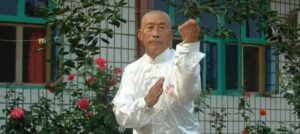
Wenshui Changquan 文水长拳, also known as “Zuojiaquan” (左家拳 Left Family Fist), originated in Xiaoziqu Village, Wenshui County, and is prevalent in Wenshui and surrounding areas. It is derived from Tantui and the Cangzhou Mian Zhang and Taizu Chang Quan styles but after inheritance to the Zuo family and their experiences, has made Shaanxi it’s home.
The founder of Zuojiaquan, Zuo Changde, travelled throughout 13 provinces (seven southern provinces: Hubei, Hunan, Guangdong, Guangxi, Jiangxi, Yunnan, Guizhou, Sichuan, and Zhejiang; six northern provinces: Shanxi, Shandong, Henan, Hebei, Shaanxi, and Gansu) during his career as a bodyguard, never suffering a defeat and earning widespread renown. This demonstrates that Zuojiaquan is an invaluable legacy of Chinese martial arts. To explore the legendary skill of Zuojiaquan, one must first understand its founder, Zuo Changde (also known as Zuo Erba), and the land that nurtured him.
Wenshui is known as one of the “Hometown’s of Martial Arts.” Martial arts have a long history in the county, dating back to the Spring and Autumn Period. Since the establishment of the county in 514 BC, the people of Wenshui have always been known for their martial spirit and bravery, and their strong and resilient character. According to the “Wenshui County Gazetteer of the Ninth Year of the Guangxu Emperor’s Reign,” during the Ming Dynasty, 28 people from Wenshui passed the military examinations, 2 passed the imperial military examinations, and 5 became military officers; during the Qing Dynasty, 113 people passed the military examinations, 8 passed the imperial military examinations, and 7 became military officers. In the fourth year of the Jiajing Emperor’s reign (1525), Magistrate Li Chao built a martial arts training ground covering more than 300 mu (approximately 20 hectares) about 2 li (approximately 1 kilometer) northwest of the county seat. It was in this environment, one that revered martial arts, was skilled in martial arts, had a strong local culture, and produced many talented individuals, that fertile ground was provided for the growth, development, and expansion of Zuo Jia Quan (Left-Hand Boxing), playing a significant role in the inheritance of Chinese martial arts. In fact, martial arts were already prevalent in the county during the Tang Dynasty. Empress Wu Zetian, a woman of great learning and skill in archery and horsemanship, not only understood the classics and history but also possessed exceptional martial arts knowledge. During her reign, in the first year of the Tian Shou era (1231), she established the martial arts palace examination system to select the top martial arts scholar, greatly promoting the development of martial arts at that time.
Wenshui has historically produced numerous martial arts elites. During the Tang Dynasty, Wu Shiyue, Wu Sansi, and Wu Chengsi not only authored military treatises but were also highly skilled in martial arts. During the Northern Song Dynasty, the renowned general Di Qing was from Dijia Village in Wenshui, rising to the position of Privy Councilor. Locals Lu Zheng and Yang Mei respectively served as military governors of Wuqin and Baojing. During the Qianlong era of the Qing Dynasty, Cheng Yuanzhen, a martial arts graduate, rose from garrison commander to general. In the early Qing Dynasty, Wenshui also produced a martial arts prodigy, Zhai Yushan, who was a sworn brother of the martial arts master Dou Erdun. The creation and development of Zuojiaquan (Left Family Boxing) was influenced by these cultural figures and flourished there. Even today, a saying circulates in Beijing: “Wang Family Spear (Pingyao, Shanxi), Dai Family Hand (Qixian, Shanxi), Zuo Family Spring Leg (Tantui) travels the world.” [王家枪、戴家手、左家弹腿 天下走]
The Lüliang Mountains (吕梁山) rise and fall, and the Fen River flows through them. In Wenshui County, the hometown of Empress Wu Zetian, stands a majestic mountain, lush with trees and rugged incense, named Longshou Mountain (龙首山 Dragon head Mountain) because it resembles a dragon’s head. Nestled on its slopes is a beautiful and tranquil village, Xiaoziqu Village in Maxi Township, Wenshui County. Zuo Changde, the founder of Zuo Family Boxing, was born here. The Zuo Family Boxing style he became famous for was created under the deep influence of his father and environment.
Zuo Changde’s father, Zuo Wenfa, was well-versed in martial arts, especially the Springing Leg technique (弹腿), and had also received instruction from Shaolin monks. The elder Zuo was a kind and strict father. He had three sons, and Changde, born in 1808 (the thirteenth year of the Jiaqing reign of the Qing Dynasty), was the second oldest. He loved martial arts from a young age, showed the best aptitude, and deeply inherited his father’s skills. Because of his exceptional martial arts skills, extraordinary strength, and renowned boxing style, he was affectionately known as “Second Master Zuo.”
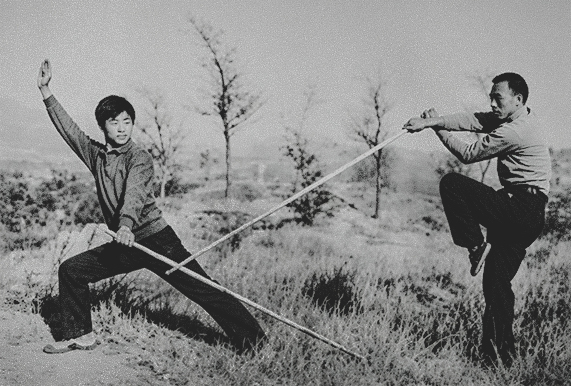
Zuo Erba learned martial arts from his father from a young age, practicing with spears and staffs. Among the three brothers, Changde was the most quick-witted and hardworking, so his martial arts skills improved rapidly.
At the age of seventeen, in 1825 (the fifth year of the Daoguang Emperor’s reign), Zuo Erba left his mother and brothers to accompany his father to Beijing. His intention was to assist his father in managing the axle business in Beijing while also broadening his horizons and seeking opportunities there. After arriving in Beijing, Zuo Erba indeed made many friends among influential figures, broadened his knowledge, and greatly improved his martial arts skills.
Zuo Wenfa was a kind and generous man. He was sworn brothers with Zhang Demao, the head Biaoshi (Security Officer) of the Yuyong Biaoju (escort agency) in Suzhou. Zhang Demao (张德茂) was originally from Cangzhou, Hebei, known for their martial arts prowess, whose family practised Mian Zhang (sometimes known as Lianhuan Mian Zhang) as well Chang Quan (Taizu Chang Quan), and was nicknamed White eyebrow Daoist (长眉道人), he was at the time over fifty years old but had no children. Zuo Wenfa then asked Zhang Demao to be the Godfather for Zuo Erba to recognize him as his godson. Zhang Demao, grateful for Zuo Wenfa’s kindness, readily agreed. Zuo Erba stayed with Zhang Demao and studied martial arts and helped with the Logistics security bureau business.
In 1836, the sixteenth year of the Daoguang Emperor’s reign, the twenty-eight-year-old Zuo Erba bid farewell to his master and returned to Beijing to find his father, intending to revive the family business and resume the axle trade. However, after Zuo Erba left, his father’s business declined, and his longing for his son led him to fall ill and die in his hometown. On his deathbed, Zuo Erba happened to travel a long distance back to his hometown and saw his father one last time. Father and son, reunited after a long separation, faced a life-or-death reunion, their emotions a mixture of sorrow and joy. Zuo Wenfa insisted on arranging a marriage for Zuo Erba. He instructed Zuo Erba to go south to Suzhou to find his friend Zhang Demao and see if he could find work at the Yuyong Escort Agency, to support his family and maintain the business. Zuo Erba was overwhelmed with guilt, knowing his father had fallen ill because of him and had long been grieving for him. Therefore, after burying his father, he went south to Suzhou to find Zhang Demao.
Fortunately, Zhang Demao was a kind and compassionate man. He treated Zuo Erba as his own son and entrusted him with managing the escort agency. Zuo Erba was not only bold and meticulous but also possessed high moral character, achieving a successful first escort mission. Thus began his long and arduous career as a Biaoshi 镖师 (escort/bodyguard). It was during this time that he traveled throughout the country’s famous mountains and ancient temples, visited martial arts masters from all directions, and befriended virtuous and talented people everywhere. He single-handedly carried a cart on Shandong Road, impressed the Taoist priest at Baiyun Temple with his superb skills, outwitted the abbot at Feiyun Temple, cleverly captured a female knight-errant blocking his way at Niangniang Beach, disguised himself as a cart driver to beat up a group of thugs, and dealt a heavy blow to Japanese ronin, expressing his strong nationalistic sentiments… truly a figure who shook the Central Plains and became famous throughout the world, leaving behind countless legendary tales of chivalry for posterity. After spending time together, Zhang Demao had unwavering faith in Zuo Erba’s character and martial virtue, and thus entrusted the Yuyong Escort Agency entirely to him. Zuo Erba lived up to expectations, diligently managing the agency, renaming it “Changlong logistics security Escort Agency,” and establishing branches in Huizhou and his hometown of Wenshui. He vigorously developed the agency while supporting his brothers and younger siblings in learning martial arts, gradually building a thriving escort business. During this period, Zuo Erba forged deep friendships with various escorts from Shanxi. Because of his exceptional martial arts skills, Zuo Erba became sworn brothers with Dai Erlu, a renowned master of Xin Yi Quan (a style of Chinese martial arts) from Qixian County, and Wang Zhengqing, the “Divine Spear King” from Pingyao. The three were hailed as the “Three Heroes of North my country.” Zuo Erba worked as a Biaoshi 镖师 (officer for the security logistics escort agency) for over thirty years, never losing a shipment or losing his reputation. He was renowned throughout six northern provinces and seven southern provinces, earning the title “Seven in the South, Six in the North.”
In 1844, during the reign of Emperor Daoguang, Zuo Erba bravely accepted an imperial mission to escort the famous Suzhou embroidery “Seven Birds” to Beijing for the governor of Suzhou. He was rewarded by Emperor Daoguang, who personally bestowed upon him a yellow riding jacket and a yellow dragon Biaoju (security logistics escort agency) flag.
Legend has it that when Emperor Daoguang knelt before Zuo Erba, holding the flag handle, to present the flag, Zuo Erba, fearing the crime of deceiving the emperor, dared not turn the flag upside down. To commemorate this event, the flag of the Changlong security agency was later always displayed upside down on the 镖车 (escort vehicle). Ordinary thieves, recognizing the escort vehicle as belonging to the second-in-command of Suzhou, dared not act rashly.
The escort agency (镖局) arose in the late Ming and early Qing dynasties, a time of nascent commerce and underdeveloped transportation. Large sums of cash required skilled martial artists for escort, especially for the commercially prosperous Shanxi merchants. Ultimately, escort agencies (镖局) emerged and developed alongside the Shanxi merchants. By the mid-Qing dynasty, with the rise of Shanxi banks (票号), escort agencies began to decline. Large sums of cash no longer required the arduous transport of escort agencies and guards; banks could simply transfer funds between themselves, collecting a small fee, to facilitate the exchange of silver. This reduced risk and saved significant amounts on escort payments. At this time, with the proliferation of banks and the corruption and incompetence of the Qing government, China’s doors were forced open by foreign powers, introducing modern firearms and ending the era of cold weapons. Furthermore, the Taiping Rebellion and other peasant uprisings across the country further restricted commercial exchanges between the north and south of the Yangtze River. These three factors led to the decline of the镖局 (bodyguard agency), resulting in widespread unemployment among its guards. This was a consequence of economic development and a reflection of the progress of the times. Zuo Erba, at the time, failed to grasp this reality and was deeply distressed by the agency’s gradual collapse.
Under no circumstances could Zuo Erba accept this reality. He entrusted the agency to his son, Zuo Anmin, and grandson, Zuo Bingxin, to barely maintain it. He himself retired to his hometown in 1871 to teach. In 1879, Zuo Erba passed away at home.
After Zuo Erba’s death, his son Zuo Anmin and grandson Zuo Bingxin inherited the business, barely managing to keep the business afloat until the establishment of the Republic of China. They then closed the agency, and the uncle and nephew returned to their hometown, where they set up a martial arts school to teach and spread the valuable Zuo Family Boxing style 左家拳.

Throughout his life, Zuo Erba traversed the perilous world of martial arts, venturing into the Jianghu (martial arts world). He was not only highly skilled in martial arts but, more importantly, possessed noble martial ethics. Throughout his life, he upheld justice and chivalry, combining the essence of various martial arts styles such as Shaolin, Cangzhou, Xinyiquan, and Bagua to create the unique Zuo Family Fist. He was known for his loyalty, integrity, and compassion, always acting with the virtue of helping the needy and needy. He treated others with honesty and kept his word; he made friends through his martial arts and won people over with his skill; he was kind and courteous, truly a paragon of virtue and skill. His legendary story is still talked about today, a testament to the spirit of martial arts and a source of pride for future generations.
Through generations of inheritance, Zuo Family Fist has continuously developed and perfected itself, from internal energy principles to external techniques, from fitness to combat, gradually forming a complete and rigorous system. Among its many strengths, Zuo Changde and his disciples created the “Face Palm,” “Springing Leg,” and “Double Hook,” considered the “Three Wonders of Zuo Family Fist.” The general requirements of Zuo Family Fist are: the phoenix spreading its wings technique, the golden rooster standing on one leg stance, the agile and nimble body movements, the forward, backward, turning, and returning footwork, the sinking of the shoulders and elbows, the sinking of the waist, the upright chest, the head held high, and the eyes looking straight ahead. Internally cultivate your breath, externally train your muscles, bones, and skin. When encountering an attack, don’t advance; first use a defensive hand. Attack horizontally and counter-attack horizontally, using high support, low pressure, and concealment. Hand, eye, body, footwork, and movement—the five elements unite as one. Among these, the techniques of internal strength, hand techniques, footwork, leg techniques, footwork, power techniques, defensive techniques, chasing techniques, intercepting techniques, advancing techniques, and upper body techniques, as well as the postures of five leans, six elbows, seven hammers, and eight palms, are the fundamental skills and compulsory courses of Zuo Family Long Fist.
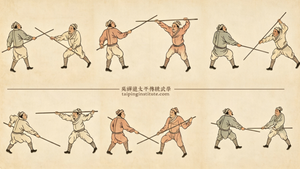
Zuo Family Fist has rich content, which can be divided into two main parts: fist techniques and weapons. Fist techniques include 弹腿 Springing Leg, 面掌 Face Palm, Large and Small Flowing Style 大小流式, Large and Small Forked Fist 大小叉拳, Peach Blossom Palm 桃花掌, etc.; weapons include double hooks 双钩, Six Harmony Spear 六合枪, Willow Knife 提柳刀, Chopping Knife 对劈刀, Five Tigers Breaking the Gate Spear 五虎断门枪, Swallow Wing Halberd 燕翅镗, Scholar’s Brush 状元笔, etc. There are also Zuo Family’s secret medicines for knife and spear wounds, bone-setting and massage techniques, etc.
Springing Leg. The Ten-Road Springing Leg is a fundamental skill in Zuo Family Fist. The main leg techniques include: kicking, stomping, hooking, stepping, stomping, swinging, slamming, pouncing, stomping, and hanging (踢、蹬、钩、踩、踺、踹、摆、扑、跺) ten types in total. The Ten Springing Leg Manual states: “Long Fist uses short-range striking techniques, walk the martial world. Unrivaled throughout the land, everyone knows the Springing Leg skill.” The ten springing leg techniques are: first, a continuous kick; second, a cross kick; third, a chopping kick; fourth, a supporting and grinding kick; fifth, a forked kick; sixth, a grabbing and striking kick; seventh, a grabbing and chopping kick; eighth, a thousand-hand kick; ninth, an iron-embracing kick; and tenth, a swaying kick. [长拳用的短打手,江湖路上走一走。打遍天下无敌手,人人才知弹腿功”。头弹起连腿,二弹十字腿,三弹劈砸腿,四弹撑磨腿,五弹叉权腿,六弹搂打腿,七弹搂砍腿,八弹千手腿,九弹拥铁腿,十弹起踺腿]
Face Palm (面掌 also known as Mother and Child Fist 母子拳). This is the signature move of the Left Family Long Fist, practiced both solo and in pairs. The hand techniques primarily use the palm, flowing smoothly like cotton, with continuous, unbroken movements. The palm techniques form a circle, extending the user’s hand, softening and yielding to the opponent’s force. Left Family Fist techniques are basically derived from this style, divided into high, medium, and low stances. The opening and closing palm techniques are called the Face Palm. The Face Palm is divided into four folds, eight hands, and thirty-six moves. It is compiled according to the essentials of grappling and fighting, with rich techniques, body movements, and footwork, which can be evolved into many free-fighting moves. Peach Blossom Palm is one example, and it is the most prominent style in Zuo Family Boxing.
Weapons. Zuo Family Boxing uses eighteen kinds of weapons. Commonly used ones include the Five Tigers Breaking the Gate Spear, Tiger Arm Spear, Single Saber, Willow Knife, Swallow Wing Halberd, Scholar’s Brush, and Zuo Family Double Hooks. The Zuo Family Double Hooks and Swallow Wing Halberd are the most prominent. Each weapon has its own unique characteristics and its own set of rules.
Take the Scholar’s Brush as an example. It is a double-edged, pen-shaped weapon, used as a concealed weapon. It is specifically designed to strike vital points and is generally used for self-defense. Its characteristics are: the body and the brush move in unison, flying up and down, defending in all directions, responding to all directions, moving like flowing water, moving like a swimming dragon, still as a mountain, and stable as a rock.
Main footwork includes: Bow, Horse, Empty, Pounce, Leap, Independent Step, Rest, and Continuous Step.
The footwork includes: discerning, hooking, swinging, walking, and turning steps. The main brushstrokes include: winding, pointing, piercing, thrusting, lifting, hanging, hooking, scissing, pulling, locking, and picking.
The boxing manual states: one point for the throat, two points for the heart, three points for the temples, four points for piercing the tendons, five points for the ribs, and six points for the groin. The reverse hand uses the Golden Scissors, cutting back to the original position after two points. If you ask my name and surname, the top scholar’s pen will show no mercy.
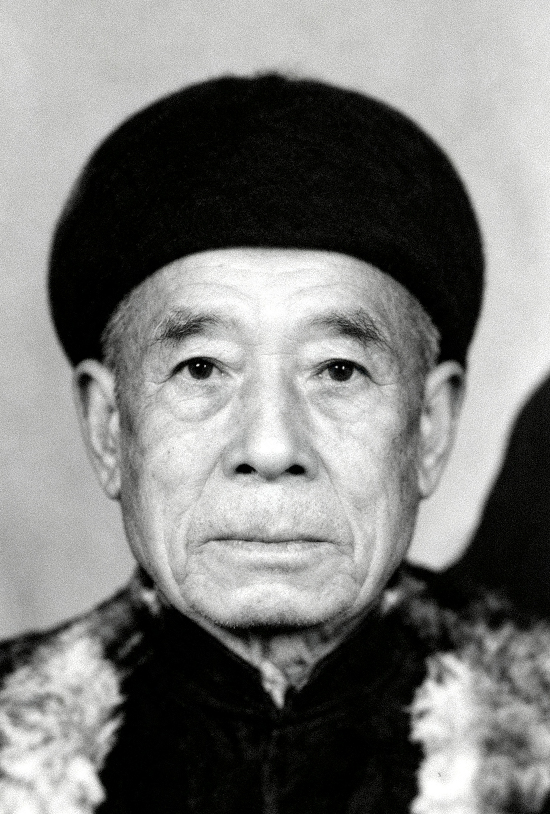
After retiring in his old age, Zuo Changde returned to his hometown and passed on the Zuo Family Boxing to his descendants, thus beginning the spread of this martial arts masterpiece in Wenshui County. Li Yuxiu (李毓秀, 1900-1984, 李育明), a disciple of Zuo Bingxin and Zuo Bingsheng, deeply mastered the essence of Zuo Family Boxing and received meticulous instruction from Tai Chi master Wang Xinwu, elevating it to a new level. Starting in 1929, Li Yuxiu and his disciples participated in numerous national, provincial, and county-level martial arts competitions and performances, winning many awards. Li Yuxiu famously defeated 13 martial arts masters with his Zuo Family Springing Leg technique, winning the championship and earning the nickname “Flying Leg. 飞毛腿 ” The fame of Zuo Family Boxing spread far and wide.
To this day, over 90% of the martial arts community in Wenshui still practices Zuo Family Boxing, with Zuo Liantong, Kong Zhaoyun, Wang Baoping, and Su Zhiyong among the most outstanding practitioners.
Zuo Family Boxing boasts a long history and profound depth, embodying the wisdom of generations of martial artists. It is a product of the rich accumulation of Wenshui’s sports culture. It remains widely practiced in Shanxi, Shaanxi, Beijing, Jiangsu, and other regions, with numerous practitioners, making it a rare treasure in the treasury of Chinese martial arts. It has witnessed historical changes, quelled conflicts in the martial arts world, created a new era for local physical exercise, and shaped a local folk custom that values martial arts and courage. Looking at Zuo Family martial arts as a whole, it has been created and refined by generations of Zuo family descendants, possessing extremely important value in many aspects, including fitness and health preservation, artistic appreciation, historical research, and literary creation.
The Fitness and Health Preservation Functions of Zuo Family Boxing: Through a long period of development, Zuo Family Boxing has continuously refined its techniques, and the surviving routines are invaluable essences, allowing for the high development of human potential and representing a relatively objective and optimized way of exercising. Like other martial arts styles, the internal energy cultivation methods of Zuo Family Boxing are themselves part of the health preservation culture; therefore, its formation and development have further enriched the connotation of Chinese health preservation culture.
The Profound Historical Value of Zuo Family Boxing: Zuo Family Boxing is a highlight of sports culture, embodying the wisdom of martial artists throughout history. It is a product of the rich and profound history and civilization of Wenshui, and therefore, to a certain extent, it has influenced the development of local customs, folkways, and culture. The Zuo family still possesses a series of well-preserved and precious historical documents, recording many legendary stories related to it. These documents provide the most original and authentic materials for studying the history of escort services, economy and culture, folk literature, and boxing manuals and regulations during the Qing Dynasty, thus possessing high historical and academic research value.
The literary value of Zuo Family Boxing: In its formation, Zuo Family Boxing not only inherited the essence of Chinese martial arts but also reflected the development trajectory of competitive sports. It also witnessed the chaos of jianghu (the martial arts world) conflicts and the social background of the rise and fall of commerce. Most importantly, it records many folk legends and customs of Wenshui at that time. As a branch of Zuo Family Boxing…