At the end of the Sui Dynasty (隋朝), the world was in chaos, and warlords divided the land. Li Yuan (李渊) raised an army in Taiyuan (太原), while Li Shimin (李世民) swept across the Central Plains. Wang Shichong (王世充) declared himself emperor in Luoyang (洛阳). Meanwhile, Shaolin Temple (少林寺) already owned over a hundred qing (顷, a unit of area) of land. The largest plot, located in Bai Gu Yu (柏谷坞), was bestowed by Emperor Wen of Sui (隋文帝).
Bai Gu Yu was strategically important, controlling the vital route to Luoyang. Wang Shichong’s nephew, Wang Renze (王仁则), led troops to occupy the area. He expanded the fortifications there and established the military stronghold of “Huan Zhou City” (轘州城), which was built on Shaolin Temple’s land. The temple received no compensation for the seized fields. Wang Renze not only took the land but also stationed soldiers in the temple, behaving arbitrarily and tyrannically.
According to the Annals of Shaolin Temple (少林寺志): “During the Kai Huang era of the Sui Dynasty, Emperor Wen (高祖文皇帝) bestowed Bai Gu Yu, a hundred qing of land, to Shaolin Temple. By the end of the Daye era, Wang Shichong (王世充) usurped the throne and, claiming the land belonged to Huan Zhou, seized it.” The temple sent people to negotiate, but they were driven away. The monks’ resentment toward Wang Renze began with the grievance: “You took my land to build your city.”
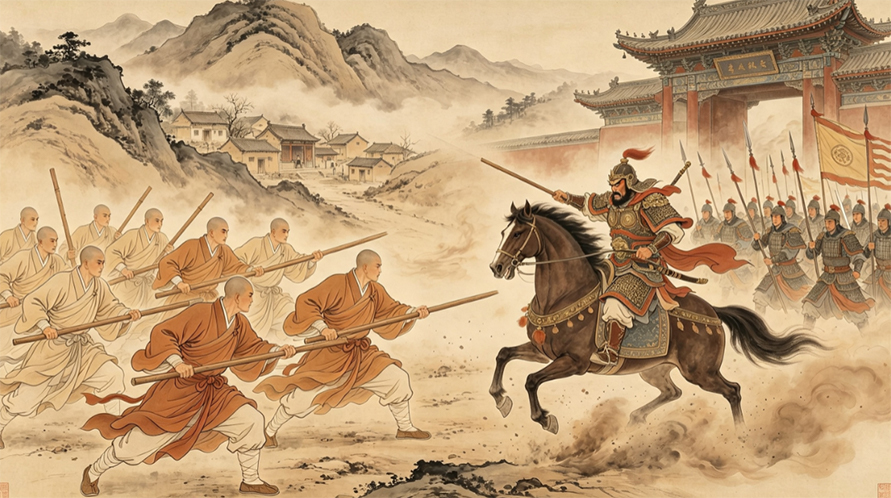
In March of the fourth year of the Wu De era (621 AD), the Tang army besieged Luoyang. Li Shimin wanted to remove Wang Renze, but Huan Zhou City was heavily fortified and difficult to capture. The monks of Shaolin Temple made a decision: rather than wait passively for the city’s fall and the temple’s destruction, they would take action. Abbot Zhi Cao (志操), the temple’s supervisor Hui Yuan (惠瑒), and others assessed the situation: the Tang Dynasty (李唐) was the legitimate regime, and the world would surely unify under Tang; Wang Shichong was a usurper doomed to fail. They contacted Zhao Xiao Zai (赵孝宰), the Sima (司马, a local official) of Huan Zhou under Wang Renze’s command. Zhao, a local man, had long been dissatisfied with Wang Renze’s rule. Together, they planned an inside-outside cooperation.
Zhao Xiao Zai would open the city gates, while the Shaolin monks would capture Wang Renze alive. Thirteen warrior monks, led by Tan Zong (昙宗), infiltrated Huan Zhou City under the cover of night. Tan Zong and his men captured Wang Renze alive (note: not killing him, as depicted in movies), but taking him prisoner. The other monks secured the city gates and coordinated with Zhao to open the defenses.
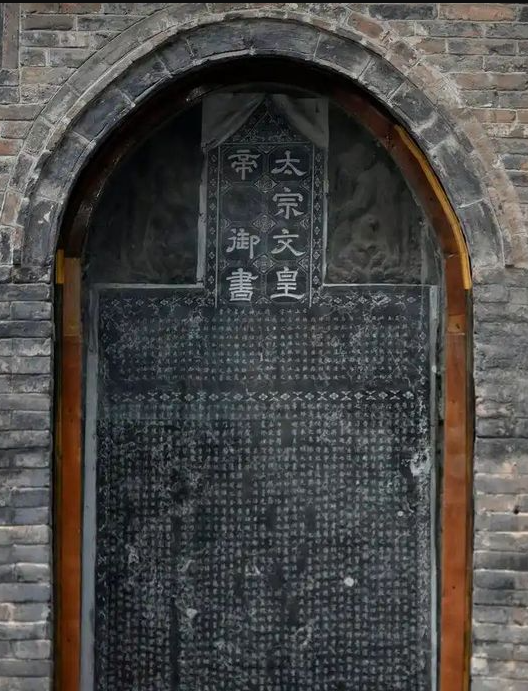
With Huan Zhou City in their hands, Li Shimin’s army advanced smoothly. Three days later, Li Shimin sent Shang Zhuguo (上柱国, a high-ranking official) Li An Yuan (李安远) to the temple to express his gratitude. Li Shimin’s letter to Shaolin Temple was later inscribed on a stele, which still stands in the temple today. The stele bears thirteen names: Senior Monk Shan Hu (善护), Abbot Zhi Cao (志操), Supervisor Hui Yuan (惠瑒), General Monk Tan Zong (昙宗), as well as Pu Hui (普惠), Ming Song (明嵩), Ling Xian (灵宪), Pu Sheng (普胜), Zhi Shou (智守), Dao Guang (道广), Zhi Xing (智兴), Seng Man (僧满), and Seng Feng (僧丰). These thirteen names have been carved in stone for 1,300 years.
Li Shimin wanted to grant official titles to the thirteen monks. Among them, only one accepted: Tan Zong, who was titled General Monk (大将军僧). A monk holding the title of a general: two identities in one person. The other twelve monks declined with eight words: “We only wish to renounce the world, practice the Dharma, and repay the country’s kindness. We do not seek official positions.” They refused titles but accepted Li Shimin’s gift of forty qing of land and a water-powered mill to Shaolin Temple. Each of the twelve monks was also granted a purple kasaya (袈裟, a Buddhist robe).
At that time, Li Shimin was not yet emperor, he was the Prince of Qin (秦王). When he wrote this letter, the Xuan Wu Gate Incident (玄武门之变) was still five years away. A 26-year-old general wrote these words outside Luoyang: “The masters have deeply understood the changing times, recognized the right path early, established meritorious deeds, and returned to the blessed land.”
As for the legend of “The Thirteen Staff-Wielding Monks Saving the Tang Prince” (十三棍僧救唐王), the story of the thirteen monks aiding the Tang had been inscribed on the Shaolin Temple stele for over a thousand years. However, during the early Republic of China era, Liang Qi Chao (梁启超) embellished the story in the preface to The New Chinese Martial Arts Staff Techniques (中华新武术棍术科), turning it into “The Thirteen Staff-Wielding Monks Saving the Tang Prince.” Later, Jiang Rongqiao (姜容樵) in Shaolin Staff Methods (少林棍法) and Han Mu Xia (韩慕侠) in their respective works further popularized this version. Additionally, a Qing Dynasty mural in Shaolin Temple’s White Robe Hall (白衣殿), titled The Thirteen Staff-Wielding Monks Saving the Tang Prince, and the 1982 film of the same name amplified the legend, completely overshadowing the historical truth.
A Shaolin Temple researcher said: “The thirteen monks aiding the Tang is a real historical event, but ‘The Thirteen Staff-Wielding Monks Saving the Tang Prince’ is a romanticized version.” The researcher pointed out that the stele does not directly mention phrases like “Tang Prince,” “staff-wielding monks,” or “saving the Tang Prince.” What is written on the stele is “The monks assisted the Tang in pacifying Wang Shichong”, not “saving,” but “assisting.”
So in summary, Li Yuan was not rescued, nor was Li Shimin trapped. The one who actually fought the Shaolin monks was Wang Shichong’s nephew, Wang Renzhe. The Shaolin monks did participate in the battle, but the story of rescuing the Tang emperor is a legend embellished by later generations based on historical facts.
The Stele of the Imperial Tang Songshan Shaolin Temple (皇唐嵩岳少林寺碑) still stands before the Bell Tower of Shaolin Temple. The stele’s top is carved with a coiled dragon, and its forehead bears seven large characters written by Emperor Xuanzong of Tang (唐玄宗): “The Calligraphy of Emperor Taizong” (太宗文皇帝 御书). The thirteen names are carved on it, not as legend, but in stone. The thirteen monks did not save Li Shimin; they captured Wang Renze alive. It was not a lone hero scaling walls but a coordinated effort from within and without. It was not “saving the Tang Prince” but “assisting the Tang Prince.” The stele remains, the people remain, and the names remain. The word “assist” (助) carved on the stele also remains.
References:
- Stele of the Imperial Tang Songshan Shaolin Temple (皇唐嵩岳少林寺碑) — Physical stele, currently located before the Bell Tower of Shaolin Temple
- Annals of Shaolin Temple (少林寺志)
- Old Book of Tang · Biography of Wang Shichong (旧唐书·王世充传)
- History of Chinese Martial Arts (中国武术史) — Published by People’s Sports Publishing House