In China it is said that there a great many swords but the three most renowned are Qimen Sword (from the Hebei area taught in the western parts of the province Hengshui, Baoding), Wudang Sword (from General Li Jinglin taught in Hebei and Tianjin not Wudang Mountain) and Qingping Sword (from the Hebei area taught in the Eastern parts of the province such as Cangzhou and Huanghua).
Whilst all are great, it is the Qingping Sword system which is held in the highest regard. Qingping sword after the 5th generation was stylized into a few different variations these are known as Old Yang (Enlin) Qingping Sword, Jia Family Qingping Sword, Yuan Family Qingping Sword and New Yang Family Qingping Sword. The fact that almost every inheritor of Qingping sword was already an expert of martial arts, explains the amount of foundation and skills necessary to acquire its skills.
History of the Qingping Sword
Within the Daoist circles, the sword originally a ceremonial tool was often carried by wandering Daoists. Over time techniques with the sword started to become develop through experiences. The Qingping (Water Lily) sword was mentioned within poetry since ancient times such as the Eastern Han Dynasty (25-220). However it was said to have been developed into the system we know today by a Daoist from the Dragon Tiger Mountain (Longhu Mt in Jiangxi Province which became the home of Zhengyi Daoism in the past).
The naming of Qingping sword technique is based on its characteristics: First, “Qingping” is a kind of duckweed, which lives on the sparkling blue waves and ripples in the breeze. It comes and goes erratically, ups and downs, unrestrained, free and unrestrained, giving people a sense of nobleness and unworldliness. Secondly, the “Qingping sword” is an ancient weapon, which is said to be able to cut gold and jade, cut hair, and is extremely sharp. The Qingping sword technique is light and flexible when practiced, and it seems to advance and retreat. It has the chic shape of “Qingping”. In actual combat, the attack and defense are alternating, and the moves are not in vain. It also has the sharpness of the “Qingping sword”, so it got the name.
Daoist Pan Zhenren had studied sword methods with his predecessors. Later through his experiences in combat and through his opponents collected various methods and compiled them as Qingping Sword. Pan was said to have passed to Meng Jiaohua (孟教华) who was from Yishui county in Shandong province. Meng then taught his skills to Feng Xiyang who was from Linyi, Dezhou county (which is far in the west of Shandong, close to Hebei Cangzhou). Feng Xiyang taught Yang En’lin who was from Wuding Mansion (today Shandong Binzhou Huimin County).
Jia Style Qingping Sword
Jia Yunhe (贾云鹤1831-1888) was from Shandong Yanshan County Dahancun village (today it is a part of Hebei Cangzhou Huanghua county). Yanshan is home to the Tongbi, Pigua and Erlang Quan styles of martial arts. Jia was born into a martial arts family who practised the Tongbi Pigua system for generations. Jia’s spear methods were said to be talented and he practised the reverse hold spear. Upon encountering Yang En’lin, Jia Yunhe wanted to really learn but unfortunately was unable to gain Jia’s preference.
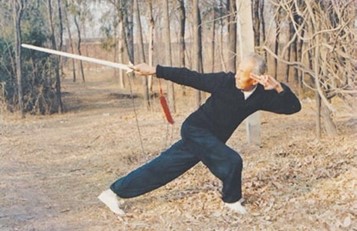
Later it was through Yang Sijie (Yang En’lin’s brother) that he was able to gain the support to study with Yang En’lin spending over 3 years together to study Qingping Sword. Jia Yunhe had obtained the sword system but later when he wanted to teach Yang En’lin did not agree, Jia continued his practise to mastery and through experiences enhanced the sword system further to develop the 365 methods in six sequences. Jia Yunpeng taught his Qingping sword to his son Jia Lingquan 贾灵泉 and his younger cousin Liu Wenshi (Liu Jiuru)。
Jia Family Qingping Sword
The Jia family retained the Sword system for generations. Jia Lingquan 贾灵泉 passed it on to his son, Jia Yaoting 贾耀亭 (1877-1963). Jia Yaoting was open in teaching students and therefore passed on his family sword methods more openly. Jia Yaoting was also associated with the Nanjing Guoshu Academy. He taught around the Hebei, Tianjin, Jiangsu, Anhui and Henan areas.
It also said that Jia Yaoting exchanged sword skills with Ma Zhenxiang (Liu Wenshi’s disciple) and together they added additional methods so that the Jia Family sword became 373 methods. Jia Yaoting taught many but his main disciples Liu Qingfeng, Fan Zhenlin, Zhang Shusen, Ning Ziguang, Liu Zimao and two grandsons Jia Bosheng (1927-2015) and Jia Zhaoshan (1944-) whom represent the 8th generation. Liu Zimao taught Uncle Zhao Guangdi (1946- ) in Cangzhou, Jia Zhaoshan taught elder brother Chi Jianxu from Suning.
Yang Style Qingping Sword : Yang Yunqiao 杨云桥 also studied Qingping sword with Yang En’lin. his sword consisted of 4 sections with 208 methods. This sword method was from Yang Yunqiao’s disciple, Sun Wenbo (孙文渤, 1881 – 1960) who studied with Yang Yunqiao in 1895 for six years. This is was then taught to further generations such as Wang Qingzhai (王庆斋), a well known Praying mantis practitioner in Shenyang.
Yuan Style Qingping Sword : Yuan Xizhen 袁希振 studied with Yang Yunqiao’s son, Yang Ziheng 杨紫恒. Yuan’s sword consists 254 methods.
Yanqing Men/Mizong Quan Style Qingping Sword
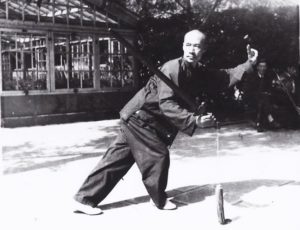
A key figure in introducing the Qingping Sword (青萍剑) into the Yanqing Men (燕青门) system was Liu Wenshi (刘文石), also known as Liu Jiuru (刘九如). Liu Wenshi was the cousin of Jia Yunhe (贾云鹤, courtesy name Feixian), a pivotal 5th-generation master who significantly organized and propagated the Qingping Sword.Jia Yunhe passed the sword method to his younger brother, Jia Lingquan (贾灵泉), and his cousin, Liu Wenshi. Liu Wenshi then taught many within the Yanqing Men, thereby establishing the Qingping Sword as a core component of the style. Historical records indicate that Liu Wenshi’s students included Yang Kunshan (杨昆山), Zhang Xianhe (张仙岛), Ma Zhenxiang (马振祥), and Mi Lianke (米连科).
Zhang Xianhe, a disciple of Liu Wenshi, later taught the sword method to Li Linchun.Additionally, there is a significant exchange of martial arts between Li Linchun and Zhang Xianhe. Li Linchun was himself an expert in the “Taishi Bian” (太师鞭, or “Hard Whip”) method.When Zhang Xianhe visited Li Linchun in Cangzhou, the two discussed martial arts and found great mutual respect. Zhang Xianhe then taught Li Linchun the complete Taishi Bian method. Through this exchange, both the Qingping Sword and the Taishi Bian became integrated into the Yanqing Men system. Li Linchun was a 4th generation Yanqing Men practitioner whom had studied under Yu Tongbo (余桐波 1858-1935) who in turn was Chen Shan’s disciple. (Yu Tonbo is known for taking Yanqing Quan to Chongqing, where he established a school and medical clinic (known today as 燕青门正骨疗法).
In the subsequent generation, Yang Kunshan taught a number of students, including Liu Zhenshan (刘振山), Yang Liansheng (杨连生), Lu Zhenduo (卢振铎), Guo Yufen (郭玉芬), Guo Jingchun (郭景春), Liu Enhua (刘恩华), and Liu Yanzhao (刘延照). Meanwhile, Li Linchun (Li Yusan), the student of Zhang Xianhe, became a crucial link connecting the Qingping Sword to a wider circle of Yanqing Men martial artists. He passed on what he learned to numerous practitioners, including Jiang Rongqiao (姜容樵), Chen Fengkui (陈凤魁), Chen Fengyi (陈凤仪), Chen Fengqi (陈凤岐), Sun Yunming (孙云明), Li Yuanzhi (李元志), Zhao Shoushan (赵寿山), Zhang Shulin (张树林), Liu Junling (刘俊岭), and Li Jianwu (李建武).
Within Yanqing Men there are distinct methods which are now sometimes referred to as Liu Family, Chen Family and Lu Family Qingping Sword. The variations amongst these are stylistic as they share the same sword manuscripts and techniques.
Taizu Men Qingping Sword
It was Liu Wenshi’s disciple Mi Lianke who opened Qingping sword to public eye when he became a part of the Nanjing Guoshu Academy. From there the Qingping sword was taught to a myriad of experts from different styles especially those around the Cangzhou region. Within the Taizu Men style, from Mi Lianke it was taught to the Zhang Guoxiang (Taizu Men), Dai Chaoxun (Taizu Men), Huang Jinshan, Liu Lanxia, Guo Xisan (郭錫三) and Guo Shouchen.
Nanjing Guoshu Academy Qingping Sword
Some of the techniques trickled down via the Nanjing Guoshu Academy, where Guo Xisan taught there but usually only 1-2 roads and privately up to 4 roads. One of his students included Fan Zhixiao (范之孝), whom later moved to Taipei area in 1950.
(There is another issue in the Han family tradition because Han Qintang, as talented as he may have been, only reconstructed his qingping sword from a handwritten 青萍劍全譜, then reconstructed the 六路 from the written material and taught selected students, of whom almost none learnt all six as he did not complete the reconstruction, and by any case were not correct. Exchanges with Fan Zhixiao corrected some of this in some of the transmissions only partially)
Da Liuhe Men Qingping Sword
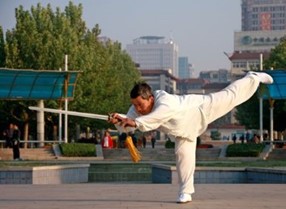
Li Guanming (~1783-1863) was from Cangzhou, the head of the Chengxing Biaoju (Chengxing Security Logistics), expert of Tantui, liuhequan and other boxing systems. The founder of the Cangzhou Da Liuhe Men system.
Li was a righteous hero of the Hui Minority, renowned for his superb martial skills he was not only undefeated throughout life but also the Master responsible for Cangzhou receiving its renowned ‘do not raise your flags’ (镖不喊沧) rule when passing Cangzhou. The Chengxing Security Logistics Bureau, had many martial arts experts within their rank and trained daily as part of their work, leading to an immense heritage of skills.
Li’s reputation with the Liuhe Spear and the broadsword were renowned. After helping Yang En’lin with some bandits in his old age, Yang En’lin taught Li the complete Qingping system including the Qingping Sword, Zixu Spear and Chunyang Dual Sword. Yang’s hand written manual (dated 1856) was also passed onto the Li family. Li and his students learnt the old Qingping sword which consists of 175 methods in Six Sequences.
Sometimes this is referred to Yang (En’lin) Style Qingping sword, or Old Yang Style Qingping Sword, but normally it is just Qingping Sword. This Qingping sword was passed down in the Cangzhou Li Family: Li Shuting and his son, Li Zhiyun. Li Zhiyun taught his son Li Junde (李俊德), grand-nephew Li Baosheng (李宝生) and disciples Zhang Shaofu (張少甫), Hu Jingtao (胡景濤), Zhang Yingjie (張英傑), Ma Honglin (馬洪林), Li Jinrong (李金榮), Wang Junxiang (王俊祥), Zhao Guangdi (赵广第), Yin Guangpu (尹廣普), and Zhang Wensheng (張文升). The current 9th generation keeper of the sword system, his son M Li Junde in turn taught disciples of the 10th generation of Qingping Sword, including Li Jianming, Ma Aijun, Ding Canglong, Xu Yunfei, Jiang Rongxiang, Zhang Hongjin and Wu Chanlong.
Methods of Qingping Sword
When discussing swordsmanship, many focus on so called sabers (Single edged) such as the Japanese Katana or the Chinese Da Dao and Saber. Further, when looking into usage, many discuss the fundamental cutting or sword techniques. However when it comes to the Qingping sword whilst the basic methods are relevant they are nothing but the tip of the real sword method. With Qingping sword after achieving the foundation, it is all about tactics and strategies, the essence of the sword in which it is important to link the body, the footwork and the sword (hands) as a complete unit. Requiring a very succinct mind, alert and agile with a focused and enduring spirit.
Taiping Qingping Sword System
Over the last 20 years or so, we have researched deeply into the Qingping sword systems across many family styles travelling regularly to Shanghai, Tianjin, Cangzhou, Huanghua and Baoding, training the different systems of Qingping sword. The three key systems are the Daliuhe Qingping Sword (Old Yang Style Qingping Sword), the Yanqing Men Qingping Sword (Jia Family Qingping Sword) and Tongbi Pigua Men Qingping Sword (Jia Family Qingping Sword) which were the most complete systems today, they include not just sword systems but also additional advanced practices. The Jia Family Qingping sword is again branched according to the Inner Jia Family and the Outer Jia Family, best known by the styles from which it is practiced such as Yanqing Men Qingping Sword.
Over the last decade roaming around especially studying further with different masters across Hebei, we have managed to not only learn the Qingping sword methods but also many of its other methods that are seldom disclosed or taught, in fact in many cases they are unknown (even almost extinct). The Jia family in Huanghua practise a type of martial arts system known as Tongbi Pigua (although it differs from the more commonly known style of the same name from Yanshan areas) and anyone who has studied directly also has some elements of this system. In addition Liu Zimao taught the Jia family Qingping sword taught by M Zhao Guangdi also in Cangzhou. The Old Yang family sword was kept within the Li Family from the Cangzhou Da Liuhe Men school, whilst the Yanqing Men sword came by way of Shanghai (Lu Family) and Cangzhou (Chen Family) lines of Yanqing Men. By studying the variations we have now structured the Qingping Sword system and its additional elements completely.
Qingping 36 Sword Foundations
Whilst there are many abridged versions of the fundamental sword (i.e. 13 methods, 16 methods, 24 methods), the complete Qingping sword foundations consist of 36 sword foundations (cuts/movements). The 16 keys of Qingping sword in publications are noted as : Dian 点 (point), Beng 崩(bounce), Ci 刺 (stab), Yun 云 (cloud circle), Mo 抹(wipe), Gua 挂(circle parry), Tiao 挑(pick upwards), Liao 撩 (glide up), Pi 劈(chop), Ti 提(raise), Bo 拨(poke aside), Chan 缠 (entangle), Jei 截(ambush), Lan 拦 (block), Chao 抄(seize circle), Sao 扫(sweep horizontal).
However there are a total of 36 Foundations within the system. In the traditional Qingping sword these are taught before learning techniques, which are learnt before any forms. Each of the keys and their associated cuts or methods are practiced, initially for structure and then later against objects. Once the basics are grasped they are combined into techniques and initial partner drills are undertaken.
Qingping Sword System
The main system consists of Spear (long distance) and Sword (short distance) methods, with the sword being very conservative but the spear being almost never taught. Today there are but a handful of practitioners that know the complete qingping methods of spear and sword as noted below:
- Yang Shi Qingping Jian (楊氏青萍劍 6 Sequences of Yang En’lin Qingping Sword)
- Jin Qiang (金槍 Golden Spear,絕戶槍)
- Yanqing Qingping Jian (燕青门青萍剑 6 Sequences of Yanqing Qingping Sword)*
- Zixu Qiang (子婿槍 6 Sequences of General Wu Zixu Spear)*
- Jia Shi Qingping Jian (賈氏青萍劍 (6 Sequences of Jia Family Qingping Sword)
- Chunyang Jian Fa (純陽劍法 12 Sequences of Chunyang dual combat Sword)
- Sanshiliu Da Qiang (三十六路大槍 36 roads of Long Spear)
- Duizha Qiang (對扎槍 6 Sequences of dual combat Spear)
*Only if practitioners have a solid foundation in Yanqing Men, Erlang Men, Chahua Men or Da Liuhe Men. Others can skip this and continue to the Jia Family Qingping Sword.
Jia family Baiyuan Tongbei Quan
Other materials from the Jia family Fist (Huanghua Baiyuan Tongbi) – in case there is no martial foundation, the following from the Jia family Baiyuan Tongbi Quan may be required:
- Baiyuan Tongbi Quan 白猿通臂拳
- Si Men Quan 四門拳
- Erlang Quan 二郎拳
- Da Hong Quan 大紅拳
- Hei Long Quan 黑龍拳
- Taishi Bian 太師鞭
- Chunqiu Da Dao 春秋大刀
Additionally, since Liu Zimao practised Mizong Quan, elements from that style may also included. Check the link on Mizong Quan for further details.