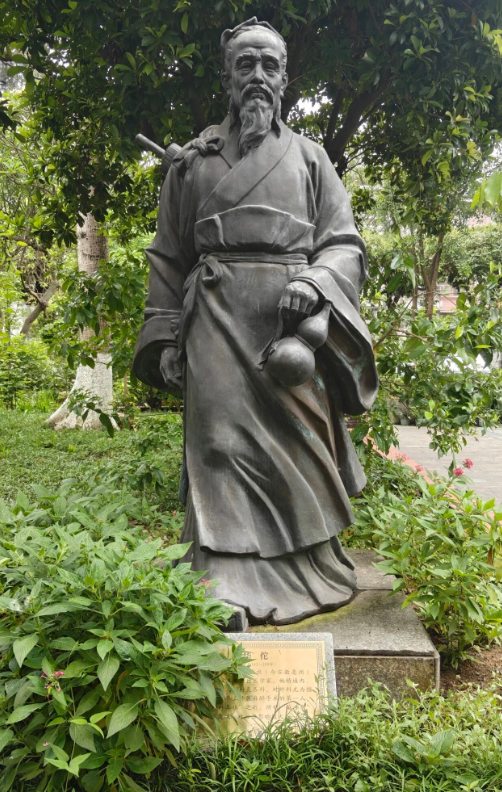
Hua Tuo (华佗), known as the “Divine Doctor” of the Eastern Han Dynasty, remains a figure of much debate regarding his birth and death years. While some claim he lived to be 64 or was executed by Cao Cao, as depicted in The Romance of the Three Kingdoms, official historical records such as The Chronicles of the Three Kingdoms (San Guo Zhi 《三国志》) and The Book of Later Han: Biography of Hua Tuo (Hou Han Shu·Hua Tuo Zhuan 《后汉书·华佗传》) state that he was considered immortal by his contemporaries, living to be over 100 years old while maintaining the appearance and vigor of a young man. These official accounts are more reliable.
Hua Tuo’s longevity and vigor in old age were not only due to his medical skills but also his focus on health preservation. He was one of China’s earliest advocates of physical exercise for health and a pioneer of the concept of “treating before illness.” His creation, the Wu Qin Xi (五禽戏, Five Animal Frolics), is a valuable legacy for preventing disease. Historical records describe Hua Tuo as sharp-minded and agile even in his later years.
One day, his student Wu Pu (吴普) visited him to seek advice on fitness. Hua Tuo explained that the key to fitness lies in the word “movement.” The human body thrives on movement, the more active, the stronger and more agile it becomes. Without movement, the body weakens and degenerates. If the body maintains good movement, nutrients can be absorbed, blood flow remains unobstructed, and diseases can be prevented. He likened the human body to a door hinge: the more it moves, the more flexible it becomes; if left idle, it rusts and decays.
Wu Pu agreed with his teacher’s wisdom. Hua Tuo continued, “Understanding the principle of movement is not enough; one must also know how to move.” He then introduced Wu Pu to the Wu Qin Xi method. With a sigh, Hua Tuo added, “Many people have asked me about fitness methods, and I have taught them wholeheartedly. However, most fail to persist. Why? Not because they don’t understand the principles or haven’t learned the movements, but because they lack perseverance. Understanding without application is the same as ignorance.” Wu Pu promised his teacher he would persist in practicing this method. From then on, he kept his teacher’s teachings and his own promise in mind, practicing Wu Qin Xi for the rest of his life. Even at the age of 100, he could still practice medicine, with clear vision, firm teeth, and no illness, passing away peacefully at the end of his natural lifespan.
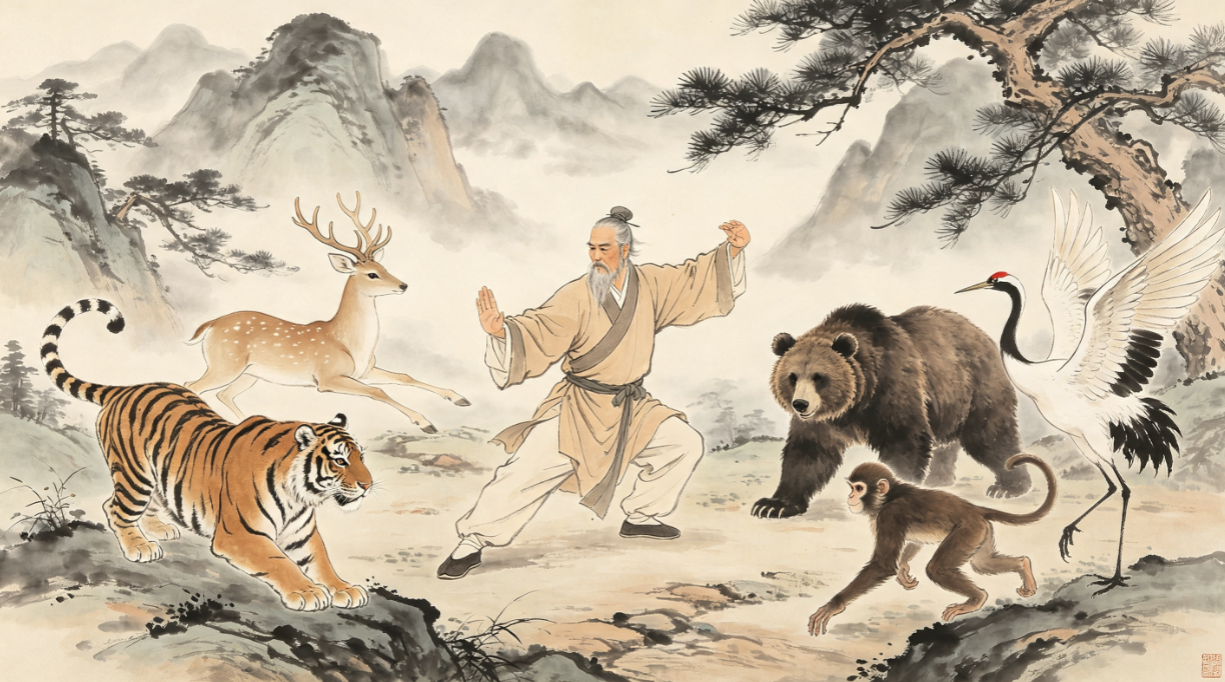
According to records, Wu Qin Xi was created by Hua Tuo at the end of the Eastern Han Dynasty. Hua Tuo’s contributions to physical fitness and health preservation were outstanding. Based on the theory of the “Inner Classic” (Nei Jing) of traditional Chinese medicine, the theory of Yin-Yang and the Five Elements, and the movement patterns of the body’s organs, meridians, Qi, and blood, Hua Tuo observed the habits and postures of various birds and beasts. He selected the characteristics of the tiger (fierce), deer (agile), ape (intelligent), bear (steady), and bird (harmonious) to form the Wu Qin Xi routine. This is a health-preserving Qigong that combines internal and external cultivation, perfecting the ancient (导引) and Tu Na (吐纳) breathing exercises, to create the Wu Qin Xi routine, which has been passed down through the ages. It has profoundly influenced the formation and development of later martial arts routines and mimicry boxing, with the effects of eliminating disease, preventing illness, and prolonging life. It is said that Hua Tuo’s disciples Wu Pu and Fan A practiced Wu Qin Xi and lived to be over 100 years old, with clear vision and strong teeth
Over nearly 2,000 years, the Wu Qin Xi has proven its remarkable health benefits. Regular practice can improve bone density, strengthen muscles and tendons, enhance joint flexibility, promote blood circulation, and delay physical aging. In particular, learning to control breathing can not only relieve psychological stress and improve mental health but also enhance the Qi in the Dantian, ensuring smooth flow through the Ren, Du, and Chong meridians, activating the body’s self-repair and regeneration capabilities, and keeping the tree of life evergreen.
Lineage of Transmission: Wu Ju (武举) → Wang Yi (王译) → Tan Ji Lin (谭继林) → Liu Shi Rong (刘时荣) & Dong Wen Huan (董文焕)
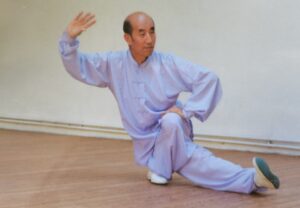
Note: M. Liu’s practice comprises 44 methods (8 for the Tiger, 8 for the Deer, 8 for the Bear, 10 for the Ape, and 10 for the Bird) and his development, the Hua Tuo Five-Animal Sword. M. Dong emphasized 54 methods (13 for the Tiger, 9 for Deer, 9 for Bear, 10 for Ape, and 13 for Bird). Most students have learnt at different points from both of them and collectively practice the Hua Tuo – Wu Qinxi system. There are also the “Mutual Generation” and “Mutual Overcoming” practice methods, the “Agile Ape Plays with Clumsy Bear” drill, the Crane-style sparring routine. Although both Dong Wenhuan and Liu Shirong studied under the renowned martial arts master Tan Jilin in Bozhou, Anhui, their respective lineages diverged, not only in the ways mentioned above but also in specific hand techniques. For instance, in the Deer routine, Liu Shirong’s lineage uses a hand gesture with the index and ring fingers bent, whereas Dong Wenhuan’s lineage uses a gesture with the middle and ring fingers bent.
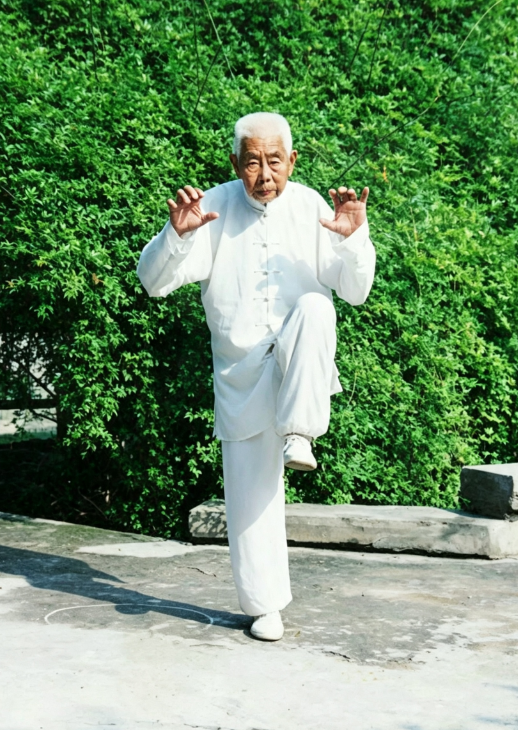
Dong Wen Huan (董文焕, 1920–2012) was a Han Chinese from Shi Ba Li Town, Bo Zhou City, Anhui Province. At the age of 15, he began studying martial arts under the local martial arts master Tan Ji Lin (谭继林, 1896–1975, from Tan Lou, Wei Gang Town). He studied under Tan Ji Lin for ten years. Over more than 60 years of practising and teaching martial arts, he established over 60 martial arts training grounds, trained thousands of disciples across Anhui and beyond, and cultivated more than 30 students who became martial arts coaches, including Sun Qian Kun (孙乾坤), Tian Qing Hua (田青华), and Shi Wan Ying (石万英).
Dong Wen Huan was the 57th-generation inheritor of Wu Qin Xi and a representative inheritor of the fourth batch of national intangible cultural heritage projects. He authored the book Hua Tuo Wu Qin Xi and received awards such as the “Hero Teacher Award” from the State Sports Commission. His achievements were recorded in the Dictionary of Chinese Folk Martial Artists, and he appeared in the CCTV documentary Hua Tuo Wu Qin Xi.
From 1979 to 1988, he used the summer vacations to run martial arts short-term training classes. Every spring, the Municipal Sports Commission organized martial arts short-term training class members to perform at the Sports Commission. In 1982, the Fifth Anhui Provincial Games were held in Gu Zhen County, and he was invited by the organizing committee to attend the opening ceremony, where he performed Hua Tuo Wu Qin Xi. He also participated in the National Sports Commission’s conference for old martial arts masters. In 1983, representing Fuyang District, he attended the First Anhui Provincial Martial Arts Conference held in Chu Zhou. In 1984, the National Construction Literature Conference was held in Bo Zhou, and he led his students to perform Hua Tuo Wu Qin Xi, attracting the attention of experts and scholars at the conference. In May 1986, as a representative of the province’s old martial arts masters, he attended the “National Martial Arts Observation and Exchange Conference” held in Xu Zhou, where he performed Hua Tuo Wu Qin Xi and was awarded the “Heroic Lion Medal” by the National Sports Commission.
At 87, Dong Wen Huan performed a Wu Qin Xi stance. As he slightly focused his Qi, a crackling sound emerged from his bones, as if they were growing. “This is the sound of my internal Qi rushing through my bones,” he explained. “It’s the result of my years of quiet cultivation.” He had practiced for over 60 years to reach this level. With skill comes natural achievement. At a certain stage, the scattered Qi in the body gathers in the Dantian, moving like a rolling pearl through the bones, allowing Qi to be freely controlled.
In his eighties, Dong Wen Huan had white hair and a face lined with wrinkles, but apart from slight hearing loss, his teeth were strong, his vision was clear, and he could read and remember things well. His body remained sturdy. Every morning at 4 or 5 AM, he would get up, put on his silver-white practice clothes, and practice martial arts for an hour. Then, he would ride his electric bike (originally a bicycle) from his hometown of Shi Ba Li Town, 20 kilometers away to Bo Zhou City, where he would teach Wu Qin Xi for free in designated squares and parks. His students included many foreigners from Germany, Denmark, Singapore, Australia Japan, and Hong Kong. Almost everyone in Bo Zhou knew Dong Wen Huan and Wu Qin Xi. Every morning, as soon as he appeared, many familiar faces would greet him: “Hello, Teacher Dong!” He would nod, unclasp his hands from behind his slightly hunched back, step into the center of the field, and begin performing each movement. After finishing a set of Wu Qin Xi, his face would not be red, and his breathing would be steady.
How did Dong Wen Huan learn Wu Qin Xi? Was his Wu Qin Xi the same as Hua Tuo’s creation? What was so magical about Wu Qin Xi? Over the decades, countless martial arts enthusiasts and people from all walks of life, driven by curiosity, have come to Bo Zhou to visit, observe, and seek teachings from Dong Wen Huan. “I am a direct inheritor of Hua Tuo’s Wu Qin Xi, and it was passed down locally,” Dong Wen Huan said. He had loved martial arts since he was a child. In his hometown of Shi Ba Li Town, practicing martial arts was a tradition. Dong Wen Huan had studied at a private school for nine years, but due to poverty, he dropped out at 15 to do business. In his spare time, he practiced martial arts. He started with Chang Quan (Long Fist), then learned Nei Jia Quan (Internal Family Fist), practicing Xing Yi Quan (Form-Intent Fist) and Ba Gua Zhang (Eight Trigram Palm). Dong Wen Huan’s eventual success in martial arts was largely due to his teacher, Tan Ji Lin.
Tan Ji Lin was highly skilled in martial arts and known for his chivalry and justice, earning him the nickname “Tan the Hero” in the Huai Bei region. Tan Ji Lin was also from Bo Zhou. As a child, his health was poor, but later he studied martial arts with his relative, Wang Nai Pu. Wang Nai Pu inherited the teachings of Wang Ze, the 54th-generation inheritor of Hua Tuo’s Wu Qin Xi and a martial arts Jinshi (进士) of the Qing Dynasty. Wang Ze’s home was near Hua Tuo’s Temple in Bo Zhou. As the 55th-generation inheritor of Wu Qin Xi, Wang Nai Pu saw Tan Ji Lin’s intelligence and taught him all he knew about Wu Qin Xi. Tan Ji Lin became the 56th-generation inheritor. Wang Nai Pu was the commander of the Yi Army’s Five Camps during the late Qing and early Republic of China. Tan Ji Lin served under him in the army, becoming a member of the martial arts team and learning Shaolin martial arts and weapons from the army’s martial arts instructor, Ma Deng Yun.
Ma Deng Yun, from Hejian, Hebei, was known as the “Cover of the South of Beijing” and was a disciple of the famous Xing Yi Quan master Zhang Zhao Dong (Zhan Kui). Ma Deng Yun was highly skilled in Xing Yi Quan. Tan Ji Lin also studied under Fang Chao Zheng, mastering the “Five Sounds and Eight Trigrams Fist” and other styles. Additionally, Tan Ji Lin was the 8th-generation inheritor of Xing Yi Quan. In 1923, he resolutely left the army and returned to his hometown to teach martial arts. At that time, he went to Shi Ba Li Town and lived near Dong Wen Huan’s home. The Dong family then ran a dye shop. In addition to learning martial arts from Tan Ji Lin, Dong Wen Huan also partnered with him to run a cloth business. Dong Wen Huan followed Tan Ji Lin for 10 years, not only mastering Wu Qin Xi but also systematically studying Xing Yi Quan, Ba Gua Zhang, Wudang, Tai Ji Quan, and more than 30 types of weapons such as knives, spears, staffs, and clubs. Since he was young, Dong Wen Huan maintained a habit: he did not smoke, believing that smoking harms Qi, and practicing martial arts is about cultivating Qi. He also did not drink alcohol, fearing it could cause trouble. His teacher, Tan Ji Lin, also did not smoke or even drink tea, only plain boiled water, believing that drinking plain boiled water could detoxify the body.
Dong Wen Huan continued to practice martial arts and do business until after the founding of the People’s Republic of China. In the early days of liberation, his family was allocated land, and he stopped doing the cloth business, turning to farming. In his spare time, he started a martial arts team to teach Wu Qin Xi and other styles. In the late 1960s, he founded the Hua Tuo Wu Qin Xi Research Association, opening more than 60 martial arts training grounds and training thousands of disciples, many of whom became martial arts coaches. His direct disciple, Sun Qian Kun, is now the 58th-generation inheritor of Wu Qin Xi. Sun Qian Kun and Dong Wen Huan said that Wu Qin Xi is not magical; as long as one has perseverance and persists in practice, their physical condition can be strengthened, and diseases can be prevented.
“From the Eastern Han Dynasty to the present, the basic routines and practice methods of Hua Tuo’s Wu Qin Xi have not changed much,” Dong Wen Huan said. After inheriting Wu Qin Xi, he made slight adjustments to the practice methods, carefully arranging the combat techniques of Wu Qin Xi into three confrontational routines, which he published to the world.
Dong Wen Huan also had the title of “Huai Bei Big Knife King,” related to his use of a 137-jin (about 82 kg) Spring and Autumn Big Knife. He wielded the big knife and performed flower patterns with ease, amazing onlookers. Later, when presenting the knife routine and the actual object, the big knife was handed over. In 1982, Dong Wen Huan, as a special invited representative, attended the Anhui Province Martial Arts Exchange Conference. After that, he traveled around to excavate and organize folk traditional martial arts, and made efforts to find and restore the lost Chen Tuan’s “Liu He Quan” (Six Harmony Fist) in Bo Zhou, reviving this martial art locally. Unfortunately, once while practicing in the park, his handbag was stolen by a ragpicker, containing many materials he had collected from the folk. In May 1986, Dong Wen Huan, as a representative of Anhui’s old martial artists, went to Xuzhou to participate in the National Martial Arts Observation and Exchange Conference. His performances of Wu Qin Xi and Xing Yi Mixed Hammer won gold awards. Later, at the National Martial Arts Observation and Exchange Conference held in Cangzhou, Hebei, he won another major award.
In his later years, Dong Wen Huan enjoyed practicing standing meditation. He said that practicing martial arts without standing meditation is like eating without a stomach, it’s like having a bad stomach and indigestion. During an hour of standing meditation, he often practiced both static and dynamic stances. “Practicing this skill can warm the body and eliminate fatigue,” Dong Wen Huan said. Interestingly, he also composed a rhyme about Wu Qin Xi and its influence:
Hua Tuo’s Wu Qin, passed down through ages, Bo Zhou, Anhui, is its place of origin.
Hua Tuo Town, where ancestors dwelled, Er Li Hua Zhuang, their home and kin.
Respected worldwide, Wu Qin endures, Medicine and Wu Qin, a legacy pure.
Practice Wu Qin, better than fine pills, Aging gracefully, its power fulfills.
Bo Zhou’s Wu Qin, with inheritors true, Inherit, innovate, lead the way anew.
Wu Qin’s five forms, forty-five moves, Combat and defense, routines to improve.
Ape and bear in combat stance, Five elements, generation’s dance.
Central TV and reporters came, Praised Wu Qin, its fame they proclaimed.
Foreigners came to see and learn, Reporters and cameras, its story to affirm.
Radio stations often broadcast, Promoting Wu Qin, its fame alight.
Leaders at all levels came to observe, Wu Qin’s praise, they all preserve.
Liu Shi Rong (刘时荣, 1924–2009) was a native of Hua Tuo’s (华佗) hometown, Bo Zhou. From a young age, he was influenced by his maternal grandfather, an old traditional Chinese medicine practitioner, and developed a love for reading medical books and martial arts. At the age of 7, he entered the Han family martial arts school in Er Lang Temple, Bo County, and studied under Tan Ji Lin (谭继林, a martial arts master and escort from the late Qing Dynasty Yi Army). He learned Wu Qin Xi (五禽戏), Xing Yi Quan (形意拳), Tai Ji Quan (太极拳), and various long and short weapons. Between 1933 and 1937, he participated in numerous martial arts performances and competitions organized by the province and county, winning awards. After the founding of the People’s Republic of China, Liu Shi Rong worked in various units such as the Bo County Newspaper Office, Printing Factory, and Tax Bureau. After retiring, he taught physical education classes at the Municipal Senior Citizens University, serving as a volunteer teacher. No matter where he was, practicing Wu Qin Xi was a daily necessity for him, and he never missed a day.
Liu Shi Rong believed that Hua Tuo’s hometown was the birthplace of Wu Qin Xi, and for thousands of years, there had been no written records of Wu Qin Xi, everything was passed down orally. He felt it was urgent to revise and preserve the art, or it would face the risk of being lost. During the Cultural Revolution, he began planning the compilation of Wu Qin Xi and Wu Qin Jian (五禽剑). He extensively collected various versions and materials related to Wu Qin Xi, summarized his lifelong experiences and insights from practicing Wu Qin Xi, visited experts and scholars, absorbed the essence of various schools, and followed the original principles and forms of the ancient Wu Qin Xi. After years of meticulous and careful efforts, he finally created two fitness books: Wu Qin Jian and Ancient Classic New Exploration: Hua Tuo’s Wu Qin Xi.
Since the publication of Ancient Classic New Exploration: Hua Tuo’s Wu Qin Xi, it has attracted the attention of sports, martial arts, and medical professionals from various provinces and cities. Many people have come from both across China and overseas to Bo Zhou to learn, and Liu Shi Rong has been too busy to handle all the requests. From 2003 to 2005, Overseas students from countries such as France, South Korea, United States, Singapore and Australia also studied with Liu Shi Rong. They would spend a few months in Bo Zhou learning Wu Qin Xi and Wu Qin Jian.
In June 2004, Liu Shi Rong led several disciples to perform Wu Qin Xi on the “Martial Arts Wind” program of Henan Television, receiving high praise from the audience and having a significant impact in the Central Plains region. At the invitation of the Shengli Oilfield Veteran Cadre Management Office, Liu Shi Rong and two of his disciples held a Wu Qin Xi learning class in Dongying City, Shandong Province, where they taught and passed on Wu Qin Xi, training hundreds of participants. Liu Shi Rong taught Wu Qin Xi at the Bo Zhou Senior Citizens University for 20 years. He held 25 sessions of Wu Qin Xi and Tai Ji Quan training classes and two sessions of Wu Qin Xi theoretical study classes at the Senior Citizens University. Everyone spoke highly of him as a morally respectful, hardworking, and selfless volunteer teacher. Whether in the cold winter or the hot summer, he patiently and enthusiastically led everyone in practicing Wu Qin Xi, Wu Qin Jian, and Shi Duan Jin (十段锦) to strengthen their bodies.
Not only did participants learn the essentials of the movements, but more importantly, through practice, they improved their physical fitness, recovered from illnesses, and gained strength. He also enthusiastically taught visitors from various places who came to seek knowledge, free of charge, until they mastered the routines. He never accepted any fees or rewards. Some beneficiaries sent gifts to express their gratitude, but he politely declined. In 2008, with the approval of the Anhui Provincial Department of Culture, Liu Shi Rong became a provincial intangible cultural heritage inheritor. Despite his advanced age, his enthusiasm did not diminish. He continued to work for the development of national fitness activities and the need to improve people’s physical fitness, compiling books such as Acupressure Massage Health Exercise, Wu Qin Xi Fitness Exercise, Simplified Wu Qin Xi, and Eight Clapping Palms, as well as many martial arts and fitness papers, which were published in the Proceedings of the 1998 International Hua Tuo Academic Symposium and related magazines. In January 2009, Liu Shi Rong passed away due to illness at the age of 85. He dedicated his life to the inheritance and promotion of Wu Qin Xi, and we will always remember him.
1. Tiger Play (虎戏)
The Tiger Frolics exercise the kidneys, which correspond to the water element in the Five Elements theory, as well as the bladder, bones, and ears in the body. Practicing Tiger Frolics strengthens bones, supplements marrow, enhances immunity, regulates bowel movements, treats ear diseases, and benefits the reproductive system, bone diseases, ear conditions, and hair loss. It also strengthens willpower. The kidneys are the foundation of innate vitality, and strong kidney Qi enhances immunity and resistance. Weak kidney Qi leads to weakened immunity and resistance, making the body susceptible to various diseases.
虎戏
坐洞运爪, 黑虎出洞, 饿虎下山(左右), 猛虎跳涧(左右), 猛虎觅食(左右), 猛虎抓食(左右), 翻身虎扑(左), 摇头摆尾(左), 跃步虎扑(左), 翻身虎扑(右), 摇头摆尾(右), 跃步虎扑(右), 猛虎撕食, 饱虎上山(左右), 老虎崴窝(左右), 虎卧山洞(左右), 调息收式
2. Deer Frolics (鹿戏)
The Deer Frolics exercise the liver, which corresponds to the wood element in the Five Elements theory, as well as the gallbladder, tendons, and eyes in the body. Practicing Deer Frolics stretches the tendons and meridians, soothes the liver, regulates Qi, reduces liver fire, strengthens the body, and clears the liver to improve vision. The liver stores blood, governs the eyes, and controls the tendons. Practicing Deer Frolics can unblock the meridians, reduce internal heat, and improve vision.
梅鹿伸腰 (左右), 转颈运闾 (左), 驼鹿欢跳 (左), 轻颈运闾(右), 驼鹿欢跳(右), 成鹿亮角(左), 回首观足(左), 翘首远望(左), 成鹿亮角(右), 回首观足(右), 翘首远望(右), 返回鹿巢(左), 返回鹿巢(右), 觅巢扒草(左), 觅巢扒草(右), 安卧鹿巢(左), 安卧鹿巢(右), 调息收式
3. Bear Frolics (熊戏)
The Bear Frolics exercise the spleen, which corresponds to the earth element in the Five Elements theory, as well as the stomach, muscles, and lips in the body. Practicing Bear Frolics strengthens the body, supplements the spleen, transforms liver wind, and prevents the generation of internal heat. It enhances spleen and stomach functions, strengthens the middle, benefits Qi, eliminates stagnation, and improves sleep. The spleen is the foundation of acquired constitution, which can in turn nourish the innate constitution. Practicing Bear Frolics is particularly beneficial for diseases related to digestion and absorption in the stomach and intestines. The spleen governs the muscles, and practicing Bear Frolics also strengthens Qi.
坐洞添爪(左), 黑熊探爪(左), 黑熊坏八(右), 笨熊游走(左), 笨熊猛击(左), 笨熊游走(右), 笨熊猛击(右), 笨熊晃体(左), 笨熊推掌(左), 笨熊抗臂(左), 笨熊晃体(右), 笨熊推掌(右), 笨熊抗臀(右), 贪熊攀树(左), 食熊学树(右), 怒熊拔树(左), 怒熊拔树(右), 坐洞添爪(右), 调息收式
4. Ape Frolics (猿戏)
The Ape Frolics exercise the heart, which corresponds to the fire element in the Five Elements theory, as well as the small intestine, blood vessels, and tongue in the body. Practicing Ape Frolics enhances the mind’s command and control over the body’s form and Qi. It has excellent preventive and therapeutic effects on cardiovascular diseases, arthritis, and a series of diseases caused by excessive heart fire.
白猿欢跳(左右), 白猿欢跳(左), 白猿转身, 亮穹远望, 白猿欢纵(左), 白猿跪地(左), 白猿攀枝(左), 白猿摘果(左), 白猿托桃(左), 白猿献果(左), 白猿跪地(右), 白猿攀枝(右), 白猿摘果(右), 白猿托桃(右), 白猿献果(右), 白猿欢纵(右), 白猿抓痒(左), 白猿抓痒(右), 调息收式
5. Bird Frolics (鸟戏)
The Bird Frolics exercise the lungs, which correspond to the metal element in the Five Elements theory, as well as the large intestine, skin, and nose in the body. Practicing Bird Frolics can clear heat, relieve superficial symptoms, stop sweating, and nourish Yin to moisten the lungs. Long-term practice can open the chest, regulate Qi, and benefit lung diseases, nasal conditions, intestinal diseases, and skin diseases
仙鹤跳枝(左), 仙鹤跳枝(右), 白鹤飞翔(左), 群鹤落滩(左), 白鹤扑地(左), 白鹤飞翔(右), 群鹤落滩(右), 白鹤扑地(右), 转颈左顾(左), 单腿鹤栖(左), 飞鹤展翅(左), 转颈右仰, 单腿鹤栖(右), 飞鹤展翅(右), 群鹤净身(左), 摇身抖水(左), 群鹤净身(右), 摇身抖水(右), 抖翎飞翔(左), 降落岩石(左),抖翎飞翔(右), 降落岩石(右),飞鹤盘旋(左), 飞鹤盘旋(右), 白鹤宿巢(左), 白鹤宿巢(右), 调息收式