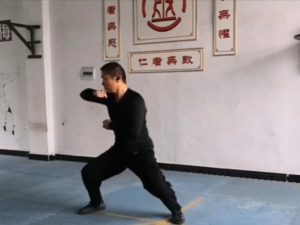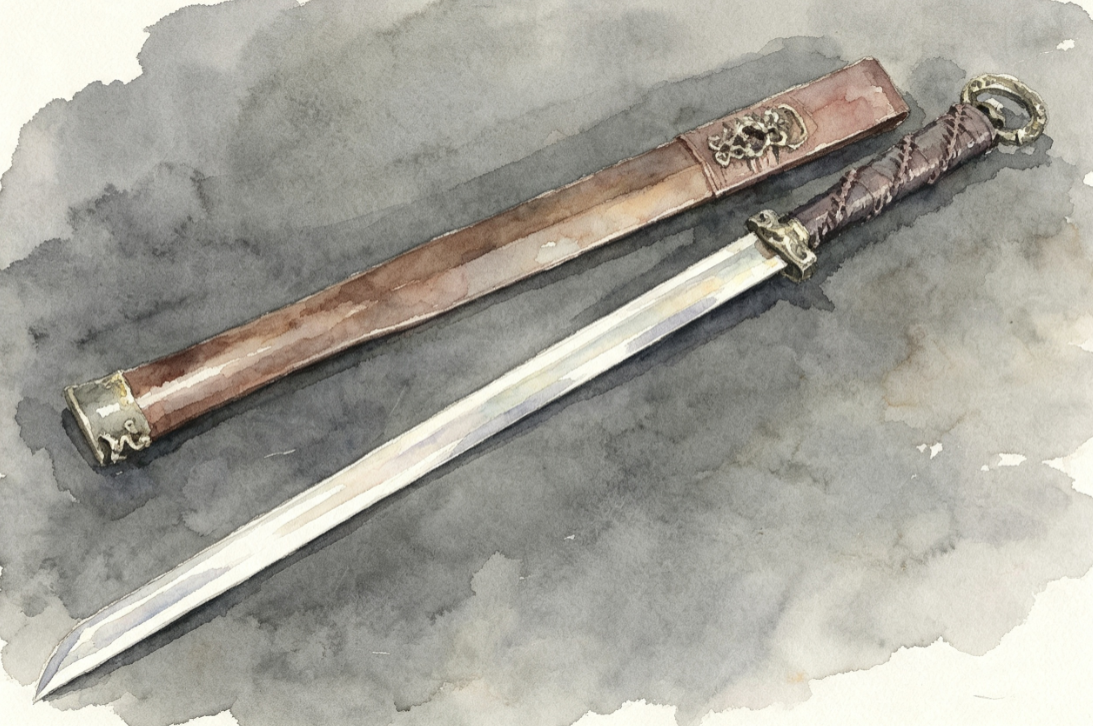
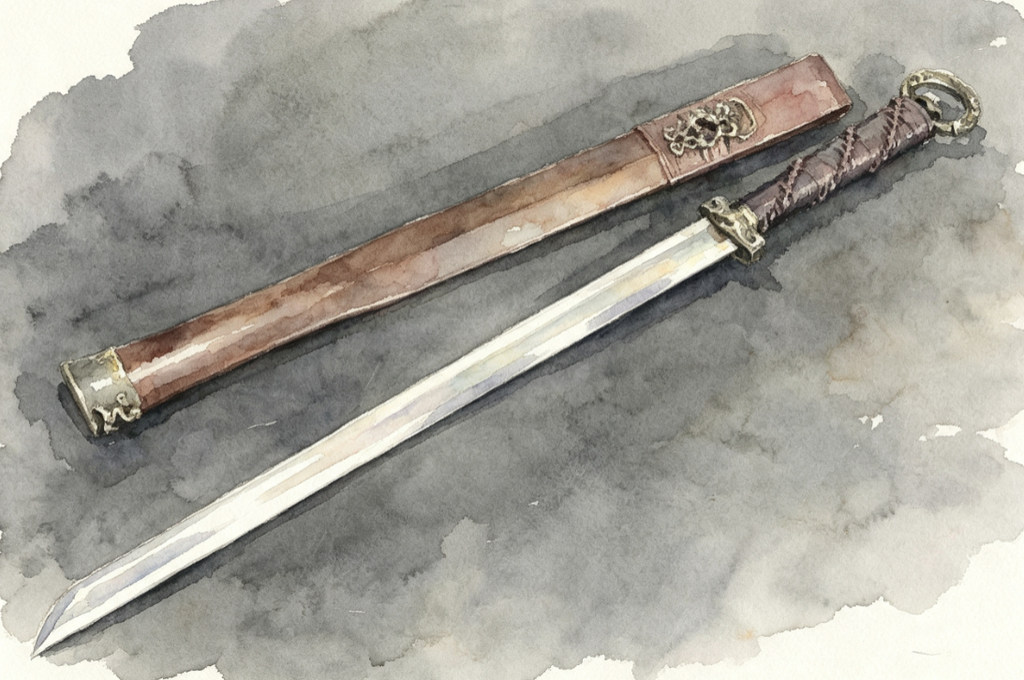
The history of the sword is a testament to humanity’s ingenuity in metallurgy, warfare, and cultural expression, with each civilization developing unique methods of swordsmanship shaped by their resources, enemies, and societal values. From the earliest bronze weapons to the sophisticated steel blades of later eras, the sword evolved not only as a tool of combat but also as a symbol of power, honor, and identity. The development of sword methods was deeply intertwined with advancements in metallurgy, such as the introduction of iron and steel, which allowed for stronger, more durable blades. In China, the transition from bronze jian (劍) to iron and steel weapons marked a significant shift in warfare, with the jian serving as a double-edged straight sword used by nobles and infantry alike.
The Jian (Straight sword) historically had moved into a different role. By the Tang Dynasty, the jian was already a regulated status symbol for officials, and this cultural prestige ensured its survival. It became the “Gentleman of Weapons,” an emblem of moral and scholarly virtue. It was more of a personal weapon rather than for the battlefield, requiring a higher level of skill to wield compared to the battle driven dao (saber). In the late Qing Dynasty and Republican era, the jian experienced a significant resurgence, championed by figures who bridged the military, scholarly, and martial arts worlds. General Li Jinglin (李景林) is a prime example. He was a high-ranking military commander in the Beiyang Army (北洋军阀) and later a founder of the Central Guoshu Institute (中央国术馆). The Qingping Jian (青萍剑) by the mid-to-late Qing period, had become associated with the security escort trade and it was during this era that it was taught to and used by martial artists working as bodyguards for Biaoju (镖局 Logistics Security Bureau), even though also used dao and many other weapons.
The dao (刀), however was deployed in the battlefield for last-resort short-distance combat. The Han Dynasty (206 BCE – 220 CE) saw the rise of the Huán shǒu dāo (环首刀), a single-edged, straight (or sometimes slightly curved) blade with a ring pommel, which became the standard weapon for cavalry, reflecting the growing importance of mounted combat. The Tang Dynasty (618–907) introduced the liuyedao (柳葉刀 “willow-leaf saber”), a curved, single-edged saber optimized for slashing from horseback. This period also saw Chinese sword-making techniques spread to neighboring regions; however, while the liuyedao influenced Asian saber design, the Japanese tachi (太刀) evolved primarily from the earlier Tang heng dao (横刀, a straight single-edged sword) and was heavily shaped by Tang metallurgy and forging methods.
The Song Dynasty (960–1279) further refined blade designs with the yanmaodao (雁毛刀/雁翎刀 “goose-feather saber”), a less curved blade with a broader tip, which infantry found effective for countering cavalry charges. During the Ming Dynasty (1368–1644), swordsmiths developed a long, two-handed saber to counter both northern Mongol horsemen and Japanese pirates (wokou). Importantly, this weapon was not called the Miao Dao in its own time; in the Ming period, it was known as the cháng dāo (长刀 “long saber”) or simply dān dāo (单刀 “single saber”). It was famously refined by the general Qi Jiguang, who adapted elements of Japanese kenjutsu to create a new infantry discipline. It was only during the Republic of China period (circa 1921) that this long, slender saber was renamed the miáo dāo (苗刀 “seedling saber”), a name derived from its narrow, elongated blade that resembles a young rice shoot, not from any association with the Miao ethnic minority.
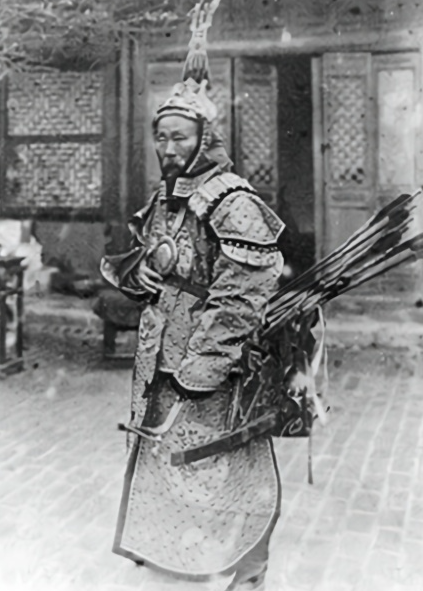
The Qing Dynasty (1644–1912) standardized the pèi dāo (佩刀), a short saber worn by officers, and mass-produced military sabers for cavalry using local iron, though elite units often wielded wootz steel (high-carbon crucible steel imported from India). In the mid-to-late Qing period, a new design emerged: the niú wěi dāo (牛尾刀 “oxtail saber”), which featured a wide, flaring tip and a heavier, thicker spine. This blade, a hybrid of the earlier yanmaodao and liuyedao, became the standard sidearm for constables, bailiffs, and civilian militias, prized for its devastating cleaving power in close-quarters combat.
Finally, during the Second Sino-Japanese War (1937–1945), the dà dāo (大刀 “big knife/saber”) rose to iconic status. This was a long-handled, broad-bladed weapon reminiscent of ancient Chinese two-handed swords. It gained legendary fame during the 1933 Battle of Xifengkou, where the 29th Army’s “Big Sword Brigade” famously ambushed Japanese troops in a nighttime raid. The dà dāo became an enduring symbol of Chinese resistance and martial courage, immortalized in the patriotic anthem “The Broadsword March” (大刀进行曲), which rallied the nation against invasion.
“The sword is the extension of the warrior’s spirit. In battle, the jian must be wielded with precision, for a single thrust can decide the fate of a kingdom.” – The Art of War (孙子兵法, Sūnzǐ Bīngfǎ, 5th century BCE)
Battle of Red Cliffs (赤壁之战, 208 CE)
“The men of Wu, mounted on swift horses, wielded their dao with terrible effect, cutting down the enemy like wheat before the scythe.” – Records of the Three Kingdoms (三國志, Sānguó Zhì, 3rd century CE) by Chen Shou (陳壽)“The liuyedao shall be the weapon of the imperial cavalry. Its curve is as the willow’s grace, its edge as the dragon’s breath.” – Tang Military Manuals (Tang Liu Dian 唐六典, 7th century CE)
Battle of Talas (怛羅斯之戰, 751 CE)
“The Chinese horsemen, with their curved blades, moved like the wind, and their swords cut through our ranks as if we were but reeds.” – Arab chronicles (e.g., Kitab al-Futuh by Ibn A’tham, 9th century CE)“The Jin horsemen charged, but our men, with their yanmaodao, cut down horse and rider alike, and the field was littered with the fallen.” – Song History (宋史, Sòng Shǐ, 14th century CE)
“The yanmaodao is to be wielded with both hands, its blade descending like the goose’s wing to cleave the enemy’s horse and rider as one.” – Song Military Treatise (Wujing Zongyao 武经总要, 1044 CE)
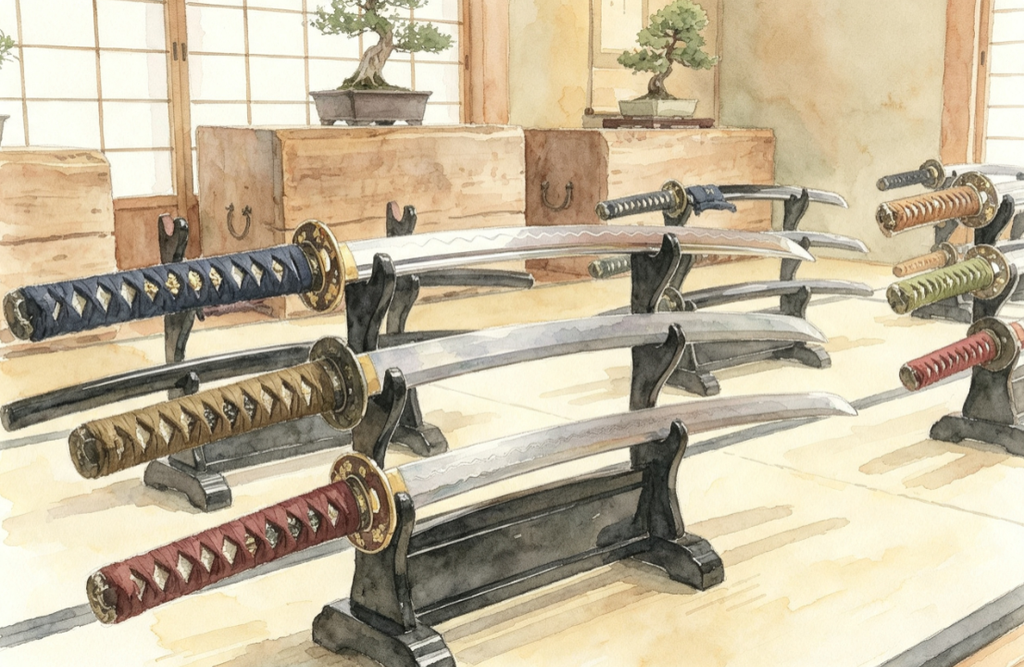
In Japan, whilst the Samurai were predominantly archers, the evolution of the sword was marked by the transition from the tachi, a cavalry weapon worn edge-down, to the katana (刀), a slightly less curved blade worn edge-up in the obi (帯). This shift reflected the growing importance of infantry combat during the Kamakura (鎌倉) and Muromachi (室町) periods. The katana’s reputation was further enhanced by the development of differential hardening (yaki-ire 焼入れ), a process involving the application of clay (yakibatsuchi 焼刃土) to the blade before heating and quenching, which created a hard edge (martensite) and a tough spine (pearlite), resulting in the characteristic hamon (刃文), or visible hardening line. This innovation allowed the katana to combine sharpness with durability, making it one of the most effective and revered swords in history. The Sengoku period (戦国時代) saw the katana used extensively in battles such as Sekigahara (関ヶ原の戦い), where Tokugawa Ieyasu’s (徳川家康) ashigaru (足軽) foot soldiers wielded katana in mass infantry combat, demonstrating the sword’s role in shaping the outcome of large-scale conflicts. Notable swordsmen like Miyamoto Musashi (宮本 武蔵) authored texts such as The Book of Five Rings (五輪書), which detailed the philosophy and techniques of swordsmanship.
“The tachi of Minamoto no Yoshitsune flashed like lightning as he cut down his foes at the Battle of Dan-no-ura. The blade, forged in the fires of the tatara, sang as it drank the blood of the Taira.” – The Tale of the Heike (平家物語, ~1220 CE)
“The katana is the soul of the samurai. Even in peace, it must be kept sharp, for a warrior’s death is always near.” – Hagakure (葉隠, 1716 CE) by Yamamoto Tsunetomo
In India, the khanda (खंडा), a double-edged straight sword, was a primary weapon for infantry and cavalry from ancient times through the medieval period. The development of wootz steel, a high-carbon crucible steel produced in South India, revolutionized sword-making by providing blades with exceptional hardness and a distinctive watered pattern. This steel was widely traded, influencing sword production in Persia, Arabia, and Damascus, where it became known as Damascus steel. The talwar (तलवार), a curved, single-edged saber, became prominent during the Maratha Wars (मराठा युद्ध), where it was wielded by cavalry in slashing attacks. The pata (पाता), a gauntlet sword with a blade extending from the knuckle guard, was another unique Indian weapon used in close-quarters combat, particularly by Maratha warriors in battles such as Sinhagad (सिंहगड). Shivaji Maharaj (छत्रपती शिवाजी) and Rana Pratap (राणा प्रताप) were renowned for their use of these weapons in battles against the Mughal Empire.
“Shivaji’s men, with their talwar flashing, struck like lightning from the hills. The Mughals could not match their speed or ferocity.” – Sabhasad Bakhar (सभासद बखर, 17th century CE)
“A soldier’s khanda must be as straight as his duty and as sharp as his resolve. In battle, it is the extension of his arm and the guardian of his life.” – Arthashastra (अर्थशास्त्र, 4th century BCE)
“The swords of my men, forged in the fires of Hind, cut through the armor of the Rajputs as if it were paper.” – Baburnama (بابر نامہ, 16th century CE)
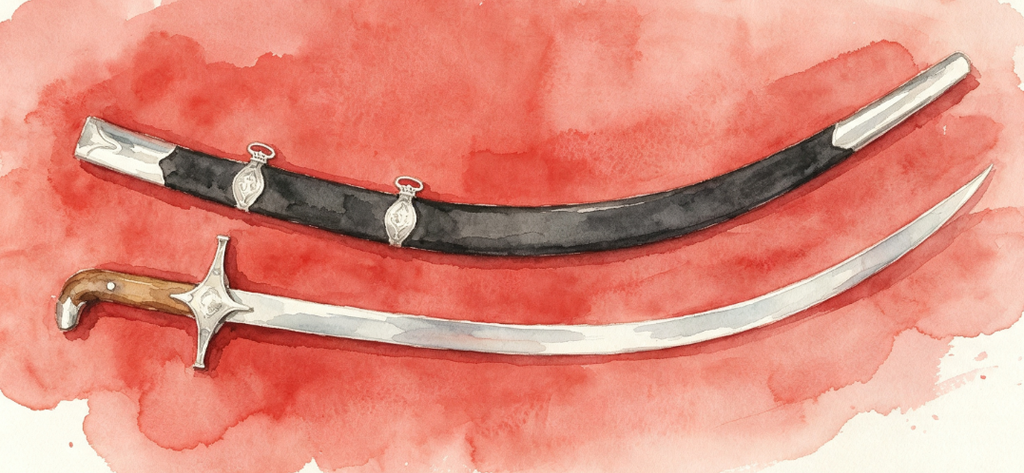
In Persia, the shamshir (شمشیر) emerged as a curved, single-edged saber optimized for cavalry warfare. The Safavid Empire (صفویان) standardized the shamshir for its cavalry, and its use was documented in battles such as Chaldiran (چالدران), where Safavid forces clashed with the Ottoman Empire. The shamshir’s design allowed for effective slashing attacks from horseback, making it a formidable weapon in the hands of Persian horsemen. The Qajar Era (قاجاریان) saw the shamshir become more decorative, though it remained a symbol of Persian martial tradition. Notable figures like Nader Shah (نادر شاه) were known for their use of the shamshir in battles against the Mughals and Ottomans.
“The shamshir of the Persian horseman is as the scythe of death. None can stand before its sweep.” – Jame al-Tawarikh (جامع التواریخ, 14th century CE)
In the Arab and Islamic worlds, the saif (سيف) was a straight, double-edged sword used extensively in early battles such as Qadisiyyah (القادسية), where Arab cavalry demonstrated the effectiveness of the sword in mounted combat. The scimitar (saif al-muqawwar سيف المقور), a curved, single-edged sword, became prominent during the time of the Mamluks (مماليك), who used it to great effect in battles such as Ain Jalut (عين جالوت), where Mamluk cavalry defeated the Mongols. The scimitar’s design allowed for powerful slashing attacks, making it a favored weapon among Islamic warriors. Saladin (صلاح الدين) and Baibars (بيبرس) were renowned for their use of the scimitar in battles against the Crusaders and Mongols.
“The Mamluks, with their scimitars flashing, charged the Mongols like lions upon a herd of gazelles. The earth trembled, and the Mongols fled.” – Tarikh al-Mamluk (تاريخ المماليك, 15th century CE)
The Mongols primarily wielded a curved, single-edged saber known as the Turko-Mongol saber, which was lightweight and designed for slashing attacks from horseback, complementing their renowned mounted archery. This sword, typically measuring between 70 to 90 centimeters in length, featured a simple hilt and was often crafted from high-carbon steel, sometimes incorporating pattern-welding techniques influenced by Central Asian and Middle Eastern traditions. While the Mongols were most famous for their archery, their sabers were essential in close-quarters combat, particularly after disrupting enemy formations with arrows. The design of the Mongol saber was influenced by Turkic and Persian sword designs, such as the shamshir (شمشیر), reflecting the cultural exchanges that occurred as the Mongols expanded their empire. The Mongol Yuan Dynasty (元朝, 1271–1368) adopted Chinese sword designs, such as the liuyedao (柳葉刀), for use by their Han Chinese and Mongol troops. Figures like Genghis Khan (成吉思汗) and Subutai (速不台) led armies where these sabers were used effectively alongside bows, ensuring the Mongols’ dominance in both ranged and melee combat.
“The warriors of Genghis Khan, with their curved blades and swift horses, were as the wind that scatters the leaves. No enemy could stand before them, whether they struck from afar with arrows or from near with the sword.” The Secret History of the Mongols (蒙古秘史, Měnggǔ Mìshǐ, 13th century)
“The Mongols, having loosed their arrows like a storm, drew their curved swords and fell upon the Jin soldiers, cutting them down as they fled.” History of the Jin Dynasty (金史, Jīn Shǐ)
Battle of Legnica (1241 CE)
“The Mongols, with their small but swift horses and curved blades, cut through the ranks of the European knights like a scythe through wheat.” – Chronicle of Teutonic Knights (13th Century)
In Europe, the longsword, a double-edged, straight blade, was a versatile weapon used for cutting, thrusting, and grappling during the medieval period. The I.33 manuscript, the oldest known European fencing manual, provides detailed instructions on longsword techniques, reflecting the importance of the weapon in knightly combat. The rapier, a straight, double-edged sword with a complex hilt, emerged during the Renaissance as a dueling weapon optimized for thrusting. The Italian and Spanish schools of fencing, as documented in works such as Achille Marozzo’s Opera Nova and Jerónimo Sánchez de Carranza’s Of the Philosophy of the Arms, emphasized precision and geometry in rapier combat. The saber, a curved, single-edged sword, became prominent in Europe during the 17th to 19th centuries, particularly among cavalry units such as the Polish Winged Hussars and French cavalry, who used it in charges against infantry squares. William Marshal (Guillaume le Maréchal) and Joan of Arc (Jeanne d’Arc) were renowned for their use of swords in battles such as Lincoln and Orléans.
“The English knights, with their longswords, hewed down the French as a reaper cuts his grain. The field was a slaughterhouse, and the French nobility lay in heaps.” – Chronicle of Enguerrand de Monstrelet (15th century CE)
“The rapier is the gentleman’s weapon, for with it he may defend his honor as he defends his life. Let his thrust be true, his parry sure, and his footwork light as a dancer’s.” – Opera Nova (1536 CE)
“The rapier is not merely a weapon but an extension of the soul. Its geometry is as precise as the movements of the heavens.” – Philosophy of the Arms (1569 CE)
The Philippines and Indonesian Archipelago developed rich sword traditions that reflected their cultural, spiritual, and martial practices, with indigenous blades such as the kampilan, kris (keris), ginunting, golok, mandau, and rencong serving as both practical weapons and symbols of identity, authority, and heritage. In the Philippines, the kampilan was a large, single-edged sword used by Moros in Mindanao, Sulu, and Palawan, while the kris and ginunting were employed in warfare and rituals, with the ginunting particularly effective in jungle combat. The itak or tabak-toyok served as a utility knife and secondary weapon among commoners and warriors. In Indonesia, the keris held deep spiritual significance, often featuring a wavy, double-edged blade crafted from pamor (pattern-welded steel), and was used in both combat and ceremonial contexts, while the golok and mandau were practical tools and weapons, with the mandau symbolizing masculinity and bravery among the Dayak people of Borneo. The rencong, a short, double-edged dagger, was a symbol of Acehnese identity.
In the Americas, the gauchos of Uruguay and Argentina became renowned for their skill with the saber and facón (facón) during the Cisplatine Wars (Guerra Cisplatina). The gauchos, nomadic horsemen of the Pampas, used their mobility and knowledge of the terrain to great effect in battles such as Sarandí and Ituzaingó, where their cavalry charges with sabers and lances broke Brazilian infantry squares. The facón, a large knife or short sword, was used in close-quarters combat, while the boleadoras, leather balls with weights, were employed to tangle horses and opponents. The gauchos’ tactics, which included hit-and-run attacks and psychological warfare, demonstrated their adaptability and effectiveness as irregular forces. Juan Antonio Lavalleja (Juan Antonio Lavalleja) and Fructuoso Rivera (Fructuoso Rivera) were renowned for their leadership and use of these weapons in battles against Brazilian forces.
“The gauchos of Lavalleja, with their sabers flashing in the sun, fell upon the Brazilians like a storm. The enemy, unaccustomed to such ferocity, broke and fled. The field was ours, and the blood of tyrants watered the earth of liberty.” – Diario de la Guerra de Cisplatina (1825)
“The gauchos, with their lances couched and sabers drawn, swept around the Brazilian lines like a whirlwind. The enemy, though numerous, could not match their speed or their courage. By nightfall, the field was strewn with the dead, and the road to Montevideo was open.” – Historia de la Guerra Cisplatina (1830)
“The Uruguayan gauchos, their sabers red with Paraguayan blood, charged again and again into the fray. Their cries of ‘¡Viva la libertad!’ echoed across the battlefield, and the enemy, though brave, could not withstand their onslaught.” – La Guerra de la Triple Alianza (1870)
The evolution of sword methods across cultures and time reflects the interplay between technological innovation, tactical adaptation, and cultural symbolism. Advances in metallurgy, such as the development of steel and the introduction of techniques like differential hardening, allowed for the creation of stronger, more effective blades. The sword’s role in warfare evolved in response to changes in enemy tactics and armor, with cavalry sabers and infantry swords developing distinct characteristics to meet the demands of their respective combat roles. Beyond their practical use, swords held deep cultural significance, serving as symbols of power, honor, and identity in societies around the world. From the jian of China to the katana of Japan, the khanda of India to the shamshir of Persia, and the rapier of Europe to the saber of the gauchos, the sword remains a enduring testament to humanity’s martial past and the relentless pursuit of mastery over steel and spirit.