Fu Shan (傅山), courtesy name Qingzhu (青主), alternative sobriquet Qiaohan (侨寒), was a native of Yangqu County, Taiyuan. He was born in the thirty‑fourth year of the Wanli reign of the Ming dynasty (1606) and died in the twenty‑third year of the Kangxi reign of the Qing dynasty (1684), aged seventy‑nine. He once took ordination at the Longchi Daoist Temple on Wufeng Mountain in Shouyang County, Shanxi, with the Daoist name Zhenshan (真山), becoming a sixth‑generation disciple of the Daoist Longmen sect.
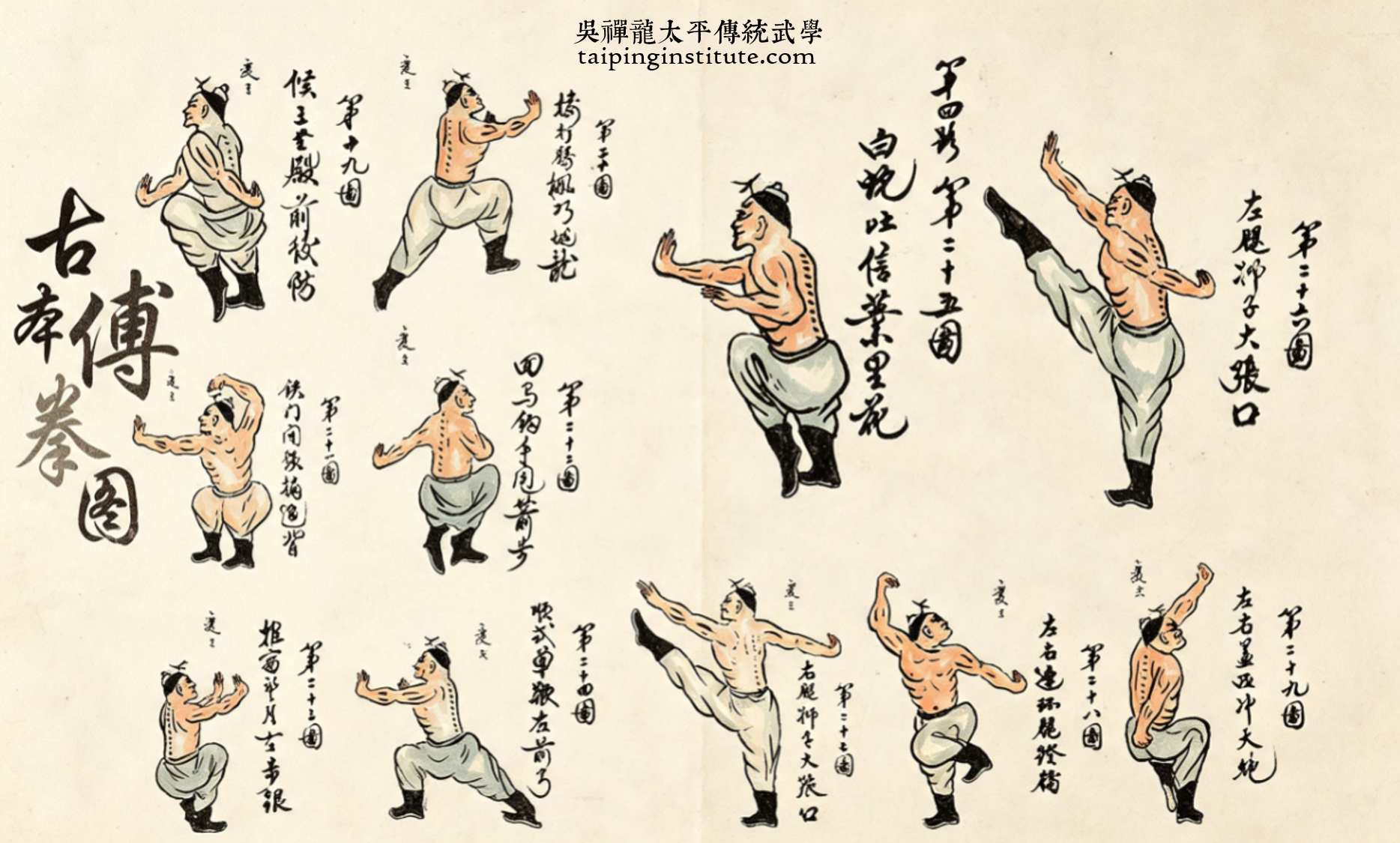
Mr Fu Shan was born into a martial arts family. He was a social activist of lofty national integrity in the late Ming and early Qing, and also a scholar, poet, calligrapher, painter, physician, outstanding martial artist, and politician of broad learning and many talents. Fu Shan was skilled in martial arts, and the Fu Qingzhu (傅青主) in the celebrated Seven Swords Down the Tianshan Mountains (七剑下天山) is none other than Mr Fu Shan. Fu Shan’s boxing method predates Wang Zongyue’s (王宗岳) Treatise on Taiji Quan (太极拳论) by more than a century, and predates the Chen Family Boxing Manual (陈氏拳谱) written by Chen Wangting (陈王廷) by more than half a century. Fu Shan was a political activist. After the failure of the anti‑Qing resistance in the south in the late Ming and early Qing, he returned and lived in seclusion in a south‑facing cave on Mount Jinci, where he created a set of Taiji Quan called Chaoyang Quan (朝阳拳), also known as Zi Wu Taiji Quan (子午太极拳). During his years of seclusion, Mr Fu Shan was often active at Lingkong Mountain in Qinyuan, at Shigao Mountain and Shenlin Temple in Lingshi, and at Mian Mountain in Jiexiu, where he preached, lectured, practised medicine, and also taught martial arts. During this time, he was employed by the prominent He family of Liangdu Village in Lingshi, one of the four great families of Lingshi, to teach the He children literature and martial arts, from which he benefited greatly. When a young woman of the He family married into the Cai family of Caijia Gully in Shuangchi, she carried with her a handwritten copy of the Fu Boxing Illustrations (傅拳图). After the old lady passed away, it was treasured by her sixth grandson, Cai Laoliu (蔡老六). In 1985, Cai Laoliu’s brother‑in‑law Ren Zhongyuan (任重远), a native of southern Shanxi and an intellectual who was then a full‑time standing committee member of the Lingshi County Political Consultative Conference, went to Xiamen to visit his wife’s brother. Cai Laoliu said, “My grandmother left me a copy of the Fu Boxing Illustrations on her deathbed.” Ren saw it and knew the book was precious. He immediately took it back to Lingshi and showed it to Zhang Yaolong (张耀龙), then director of the Lingshi County Sports Commission and chairman of the Wushu Association. Zhang said, “I have never heard that Fu Shan knew martial arts. This book is too precious.” The two then took the Fu Boxing Illustrations directly to the National Sports Commission in Beijing. When they produced the Fu Boxing Illustrations there, the leaders and experts of the Sports Commission also said they had never heard that Fu Shan knew martial arts, and then went outdoors to imitate the postures according to the illustrations. They were seen by a disciple of Li Siyuan (李思元), who went back and told his master, saying, “The boxing they are imitating is the same as the boxing we practise.” Li Siyuan was the former director of the Political Department of the Railway Corps Court, of general rank. Master Li immediately took a car to the National Sports Commission, looked at it, and said, “This is the Zi Wu Taiji Quan we practise. We did not know its origin before. Only now do we know that it was created by Mr Fu Shan.” Zhang Yaolong then stayed, became a disciple of Master Li, and learned Fu Boxing from him. After mastering it, he returned to Lingshi to teach it and trained a group of disciples. At that time I, as vice chairman of the Wushu Association and senior fellow disciple of Zhang Yaolong, also participated in the learning. At the same time, with Zhang Yaolong as the principal writer, based on the Fu Boxing Illustrations and the movements taught by Li Siyuan, and with the help of Li Youfu (李有甫), a martial arts professor at Shanxi University, the book Fu Shan’s Boxing Method (傅山拳法) was compiled and published by Shanxi People’s Publishing House in October 1988, with a print run of 5,500 copies.
Fu Shan’s boxing method uses Daoist qigong breathing as its guide, takes the meridians of medical science as its pathways, and combines the martial arts essentials of Yijin Jing (易筋经), Baduanjin (八段锦), and Ziwei Bagua (紫微八卦). Fu Shan’s boxing method places great emphasis on cultivating essence, energy, and spirit. Its characteristics are: leading the breath with the mind, moving the body with the breath, one stillness and one movement, one yin and one yang, clear distinction between emptiness and solidity, mutual complement of hardness and softness, free attack and defence, self‑defence and health preservation. In motion, the postures have height and lowness, speed and slowness, with high and low responding to each other, fast and slow alternating, first literary then martial, first slow then fast, beginning with literary and ending with martial, continuous and unbroken. Regular practice can make the lower abdomen warm and allow one to focus the mind on the dantian. It has both beautiful观赏性 and strong practical value for attack and defence as well as health preservation. Fu Shan’s boxing originally had eighty‑one movements, and performing one round took about fifteen minutes. In order to facilitate learning, popularisation, promotion, and participation in competitions, I asked coach Liang Rongfen (梁蓉芬), a native of Taiyuan and a sent‑down educated youth, a first‑class referee of Shanxi, a first‑class coach of Lingshi, and a national third‑class coach, to trim the movements to competition time, remove repetitions, and extract the essence, compiling a simplified Forty‑Two Form Fu Shan Boxing Method (42式傅山拳法), which takes a little over five minutes to perform. It was promoted and popularised at fitness stations throughout the county and entered competitions in mainland China and Hong Kong, achieving excellent results and receiving favourable responses in the martial arts community.
In the autumn of 1989, Zhang Yaolong told me that the province wanted to hold the second martial arts competition in Lingshi and asked whether Lingshi would host it. It would require about eight thousand yuan. After requesting instructions, the county provided two thousand yuan. I said I would raise the rest, and told him to telephone the province and accept. The competition was then held in September. Mr Li Siyuan, the inheritor of Fu Boxing in Beijing, was specially invited to attend. Master Li performed Fu Shan Boxing and Fu Shan Sword at the event. We asked Lingshi Television to record it. The original boxing had a manual, but the sword had left no sword manual. Later I asked Liang Rongfen to write a Fifty‑One Form Fu Shan Sword (51式傅山剑) manual with reference to the manuals of Wudang Sword (武当剑) and Yangmei Sword (扬眉剑), which takes about four minutes to perform. The structural routine of the Fu Shan Sword is rigorous, with movements rising, bearing, turning, and transitioning naturally and smoothly. It has softness and hardness, with hardness and softness complementing each other, like a dragon flying and a phoenix dancing, like a tiger stepping and a bear walking. Every sword stroke has spirit, every step is firmly planted. Advancing and retreating, turning and shifting, leaping and traversing, it is ingenious and inspired, with a calm mind and sufficient breath, strong hands and light feet. The Fu Shan Sword is a fine sword technique for the broad masses of martial arts enthusiasts to strengthen the body and build health.
Appendix – Notes by M. Li Siyuan (李思元):
Fu Shan’s Boxing Method (傅山拳法), also known as Zi Wu Taiji Quan (子午太极拳), is an extremely precious boxing method. I have studied Fu Boxing since my youth, and it has been over fifty years now. In the early 1930s, because I was frail and exhausted, weak enough to be blown over by the wind, my father had me learn martial arts to strengthen my body. I became a disciple of Hao Zhongtao (郝仲套) and studied Fu Boxing. For over fifty years, whether in the wartime years of moving between north and south, or in the comfortable and peaceful environment of peacetime, I have risen at the crow of the rooster to practise, never once interrupting. Fu Boxing not only made my body go from weak to strong, from deficient to solid, but also kept me from declining in old age, benefiting me enormously. I am now seventy years old, yet my ears are not deaf and my eyes are not dim. Everyone says I look about sixty, and I myself feel full of energy, not inferior to a man in his prime.
Fu Shan’s Boxing Method was originally a skill transmitted singly from master to disciple, a secret boxing method, passed down to its inheritors here. My teacher Hao Zhongtao was a disciple of Ge Shuyuan (葛书元). Mr Ge had learned it from a seated physician at the health clinic opened by Mr Fu Shan, which is now the Daning Tang (大宁堂) in Taiyuan. I spent great effort, time, and heart’s blood to learn it, so I cannot bear to forget it. I practise it daily and have experienced many of its profound and subtle points. During the War of Resistance against Japan, in the battles against the Japanese invaders and traitors, when I was several times in critical danger, I always employed the secret combat methods of Fu Boxing to destroy the enemy and preserve myself. During the ten years of sectarian disaster, I suffered inhuman torture, which caused concussion and a severe decline in my constitution. After enduring that inhuman torment, it was again Fu Boxing that saved me, brought me back from the brink of death to live until now, and made me stronger and stronger. I deeply feel that Fu Boxing, whether for health or self‑defence, has high value. It is a unique gem among the treasures of Chinese martial arts. I have practised this boxing method tirelessly for many years and am extremely fond of it. Mr Cui Yishi (崔一士), Yang Yuting (杨禹廷), and Hou Zhixuan (候志宣) of Beijing, the Zi Wu Taiji Quan master Zheng Wuqing (郑吾卿) of Xi’an, Professor Chen Shengfu (陈盛甫), chairman of the Shanxi Wushu Association, and Mr Li Tianji (李天骥) of the Wushu Division of the National Sports Commission have all seen performances. They believe this is an ancient Daoist boxing method, from which the later Taiji Quan evolved. It seems this boxing can be regarded as the ancestor of Taiji Quan.
Fu Shan’s Boxing Method is divided into fixed postures and living postures. The routine illustrations in this book are all fixed postures. Fixed postures are the stage for learning the routine, correcting postures, training body and mind, strengthening the constitution, and cultivating willpower, laying the foundation and building skill. This stage is very important and requires a longer time, generally more than two or three years. Only when the skill has advanced and the above requirements have been met can one proceed to practise living postures. Living postures are the sublimation and evolution on the basis of fixed postures, focusing on the application of attack and defence techniques, studying the flexible and changeable use of techniques without being bound to fixed patterns. Doing as one pleases is the advanced stage adapted to the ever‑changing situations of attack and defence combat.
The entire routine of Fu Shan’s Boxing Method has a rigorous structure. The movements rise, bear, turn, and transition naturally and smoothly, light, agile, soft, and lively, yet steady and solid. The movements are hard within soft, using softness to overcome hardness, hardness and softness complementing each other, with free attack and defence. The postures have height and lowness, the movements have speed and slowness, with high and low responding to each other, fast and slow alternating, first literary then martial, that is, first slow then fast, beginning with literary and ending with martial. When performing, one requires the crown to be suspended, the chest hollowed and back extended, shoulders sunk and elbows dropped, the anus lifted and the crotch rounded, advancing and retreating steadily, with clear distinction between emptiness and solidity. When sinking, it is solid; when empty, it is agile. The chest follows the waist in turning. The hands move and the heels follow, with heat released outward. “When the shoulder and elbow bones are opened, breath reaches both hands and power is sufficient.” Moving yet still, still yet moving. When in motion, it is hard; when still, it is soft. To be hard, first be soft; use softness to achieve hardness. Through softness, dissolve and neutralise, using softness to overcome hardness. Advance with hardness, using hardness to overcome softness. Hardness and softness complement each other, with free attack and defence, displaying a momentum like rivers and seas in motion and mountains in stillness.
Fu Shan’s Boxing Method places great emphasis on cultivating essence, energy, and spirit. Essence, energy, and spirit are the basis of human life, the manifestation of nature and life. They can be called the three treasures of a person, none of which can be missing. Mr Fu Shan, in creating this boxing method, arranged the martial arts movements of breathing and guidance, circulating breath to nourish essence, and moving to invigorate spirit in a reasonable manner, forming a martial arts routine in which breathing, movement, and intention are coordinated. It regulates essence, energy, and spirit, strengthens the root and flourishes the branches, and prolongs life.
The characteristics of Fu Shan’s Boxing Method are: leading the breath with the mind, moving the body with the breath, practising breathing and guidance, circulating breath through the meridians, neither forcing nor tiring, passing naturally, neither leaning nor tilting, seeking softness and attaining the centre, focusing the mind on the dantian, about an inch below the navel. When first learning this boxing, generally after about half a year of practice, one will experience heat in the palms and soles, slight numbness in the fingers, a prickling sensation, and even abdominal rumbling and belching, which are qi phenomena. Do not be afraid; they are normal phenomena. Let them be natural. After the practice ends, one will feel the whole body comfortable. After the movements are proficient, one can coordinate with breathing guidance. From the preparatory posture, the mind leads the breath from the Yongquan point on the sole of the foot, ascending along the meridian, passing Changqiang, ascending along the Governing Vessel, passing Mingmen, Dazhui, and reaching the Baihui point. Then it circulates forward and downward, passing Yintang, Yinjiao, crossing the Magpie Bridge into the Conception Vessel at Chengjiang point, descending through Shanzhong to the dantian, and pausing briefly. Then, the mind leads the breath from the dantian downward, passing Huiyin, crossing the gap to Changqiang on the Governing Vessel, and ascending. After circulating three times, the breath returns to the dantian, and the routine practice begins. Leading the breath along the Governing and Conception Vessels, although it is a method of entering stillness from a high level, during the practice the movements govern the breathing. The principle is “inhale when rising, exhale when falling,” “exhale when opening, inhale when closing,” paying attention to depth, length, fineness, and evenness, coordinating naturally. Coordinating movements and breathing as guidance exercises trains the Governing and Conception Vessels, strengthens the connection between the peripheral system and the brain, keeps various physiological functions vigorous, makes neural transmission and control functions respond sensitively, regulates the functions of various organs, and especially enables the excitement and inhibition of the nervous system to be well regulated, maintaining balance, strengthening the brain’s anti‑interference ability. One can calmly cope with and correctly handle various adverse external stimuli. After long practice, one can have stable adaptability. This is a characteristic of Zi Wu Taiji Quan practice.
Because this boxing method is an exercise of both internal and external cultivation, it emphasises guiding the external through the internal, with external movement of the body and internal traction and massage. When the upper moves, the lower follows; when the lower moves, the upper leads. When upper and lower move together, the middle follows and responds. When the middle wishes to move, upper and lower harmonise and follow, internal and external are continuous, front and back mutually require. Lead the breath with the mind, follow nature, move gently, continuously and unbroken, with the posture stopping but the intention not stopping, the spirit not breaking. Head, eyes, heart, ears, hands, feet, waist, and crotch, these eight bodies are interrelated. When one branch moves, a hundred branches shake. When one moves, nothing does not move. The five viscera and six bowels, sinews, meridians, skin, flesh, the four limbs and hundred bones, are all connected and follow one another. Every posture is interrelated, making the organism coordinated and unified, internal and external harmonised as one, beneficial to physical and mental health.
Cultivating essence, energy, and spirit. During practice periods, one requires a life of clear mind and few desires, moderation in sexual activity, and less smoking. During practice, the mind should be calm, the breath smooth, the body relaxed. In daily life, one should pay attention to the stability of thoughts and emotions. The Chinese medical text Youyu Studio Medical Talks (友渔斋医话) says: “The seven emotions are unavoidable for humans; only they must not be excessive. When excessive, they cause harm.” The so‑called seven emotions are joy, anger, sorrow, fear, thought, shock, and grief. Different emotions, when excessive, harm the organs. For example, excessive joy harms the heart; when the heart is harmed, the breath becomes short. Excessive grief harms the liver and gallbladder; when the liver is harmed, fire flares and kidney water dries up, blood congeals and qi stagnates, making one prone to heart and brain diseases. Excessive fear harms the gallbladder; when the gallbladder is harmed, qi becomes chaotic and the heart is restless. Excessive worry and thought harm the spleen and stomach, causing loss of appetite and poor nutrition. In short, disharmony of the seven emotions is a great harm to boxing practice. In practising Fu Shan’s Boxing Method, as long as one grasps the essentials and follows the precautions, one can regulate the nerves, balance the nutritive and defensive qi, prevent pathological changes caused by adverse emotions, and improve physical and mental health. From my decades of experience, Fu Boxing is suitable for young men and women to exercise, and also suitable for the health activities of middle‑aged and elderly people. I was frail in my early years and even had tuberculosis. Due to years of practising this boxing, my constitution has clearly strengthened. Later, unfortunately, I fell and suffered concussion, with injuries to the lumbar and cervical spine, blurred memory, and malfunctioning hands and feet, in a state of semi‑paralysis. After hospitalisation, I actively cooperated with the doctor’s treatment and practised boxing three times a day, morning, noon, and evening. Within half a year I recovered my health. Now, over seventy, I walk with vigour, think quickly, write articles, perform martial arts, and teach skills without feeling tired. The disease‑preventing and disease‑treating effects of Fu Shan Boxing can be illustrated with a few examples.
The combat function of Fu Shan Boxing. Because this boxing has combat techniques such as roll‑back, ward‑off, press, push, pluck, split, and elbow, as well as kicking, striking, throwing, holding, and seizing skills, it is a routine with strong practical attack and defence. The combination of Fu Shan’s combat movements conforms to the changing laws of attack and defence. It has practical value in battlefield capture, hand‑to‑hand combat, reconnaissance, peacetime self‑defence, and public security. The stillness and movement, emptiness and solidity, opening and closing, extension and contraction, straightness and curvature, density, odd and even, literary and martial, lightness and elegance of Fu Boxing postures have a rich flavour. In stillness there is hidden danger, and in danger one seeks stillness. Its movements are like a crane flying and an eagle soaring, a nimble cat catching a mouse, a dragon rising and a tiger leaping, forming a combination of style, expression, and temperament. It is a beneficial physical activity, delighting the heart and eyes, cultivating character, and giving the enjoyment of interest, harmony, and artistic beauty.
12 December 1987, in Beijing. Excerpt from Fu Shan’s Boxing Method.
According to Mr Cai Chenglie (蔡承烈): the Fu Boxing Illustrations (傅拳图) is a relic brought by his grandmother née He from the He family. The He family was a historically famous family in Liangdu Town, Lingshi, and also a famous martial arts family, producing many military officers over the generations. This boxing was taught by Fu Shan when He Ji (何基), an ancestor of the He family, invited him to lecture in Liangdu during the Kangxi reign of the Qing dynasty. Because He Ji also loved martial arts, someone in the family copied a copy, which was taken to the Cai family upon marriage and kept at the bottom of a chest for generations as a family treasure, preserved to this day. In order to verify whether Fu Shan had come to Lingshi to lecture, we visited relevant people and consulted historical records.
It is proven that Fu Shan came to Lingshi four times in the early Qing. The Lingshi County Gazetteer (灵石县志) indeed contains a record of He Shiji inviting Fu Shan to lecture. The He Family Genealogy (何氏家谱) also records: “Shiji heard that Qingzhu was at leisure in the Jie Temple, so he personally went to invite him. Qingzhu knew his character and gladly agreed. Those who studied were Shiji’s sons and nephews. Qingzhu also performed boxing for health, and his sons and nephews loved it.” From this it can be inferred that the Fu Boxing Illustrations is indeed a martial arts routine transmitted by Fu Shan. Fu Shan came to Lingshi four times. Lingshi is strategically located and has been a contested place for military strategists since ancient times. In the late Ming and early Qing, the people’s anti‑Qing tide was extremely high. In the fifth month of the fourth year of Shunzhi, Hou Jiudu (侯九读), courtesy name Yinglong, of Houjiazhuang in Yicheng, Shanxi, and his three brothers, after the failure of their anti‑Qing and Ming‑restoration uprising, saw Jiuxi and Jiuxun killed. Jiudu fled alone to Baofu Cliff in Lingshi, shaved his head and became a monk, and under the pretext of taking disciples and teaching boxing, widely befriended anti‑Qing patriots.
It was under these circumstances that Fu Shan came to Lingshi, stayed at the Zitui Temple, and discussed anti‑Qing plans with Hou Jiudu. According to the Laiyang Prefecture Gazetteer, Events Examination Volume: “In the sixth year of Shunzhi of the present dynasty, there was a certain Hou of Lingshi, fierce and lawless, who occupied Baofu Cliff with over fifty men, plundered the eastern mountain forts, and gathered thousands of followers.” The Qing History: Record of Events states: “Yinglong, together with Zhang Guoke, Wang Guoshi, and others, had over ten thousand followers, attacked cities and forts, killed garrison commanders, and pressed directly on Pingyang.” According to the first archive of the government, Liu Hongyu, vice minister of the Ministry of War and censor of the Censorate, reported: “Zhang Shishou, magistrate of Lingshi, was attacked from outside and betrayed from within. Wang Laiqin of Huozhou lightly left the prefectural seat and was killed on the road.
Zhao Cheng, Zhao Xiangxing of Hongtong, and Li Chenglong of Hongtong fled upon hearing the alarm. Liu Huangyu of Yueyang (present‑day Anze County) fled to another province when the city fell.” It can be seen that the uprising of Monk Hou was very powerful at the time. Later, the county magistrate Zhao Pu, a native of Fengtian, secretly came to Lingshi and ordered Liu Guoying, the martial arts instructor at the county training ground, to use the tactic of “Sun Wukong drilling into Princess Iron Fan’s belly,” recruiting local braves under the false pretence of partnership, persuading Hou’s followers, and causing internal strife. After external attack and internal betrayal, they finally retreated to General Fort, Qumo, and Baofu Cliff. Liu bribed Hou’s followers to assassinate Monk Hou. Monk Hou’s soldiers each carried a bag of earth and built a small hill‑like tomb, which later generations called the Wang Hong Tomb, actually meaning “Gazing for Hong,” hoping for the restoration of the Ming. To this day, the deeds of Monk Hou’s anti‑Qing and Ming‑restoration activities are praised endlessly in the eastern mountains of Lingshi. After Liu Guoying assassinated Monk Hou, he also tricked and killed Hou’s followers at General Fort. Liu, for his merit in the rebellion, was reappointed magistrate of Zhenyuan.
During the sixteenth year of Shunzhi, Fu Shan, with his son Fu Mei (傅眉), went south to Jianghuai to observe Zheng Chenggong and Zhang Huangyan fighting in the Jiangsu, Zhejiang, and Anhui areas and besieging Nanjing. On his return to Shanxi, he passed through Qinyuan and Shigao Mountain’s Tianzhu Temple, and was active in the Xixu Township area of Lingshi. During his stay, he taught the temple monks the Five Animal Frolics and Eight Brocades, and wrote the four characters “Shan Lin Lin Qu” (山林林趣, “Delight of Mountain Forests”), which the monks later carved on the gate tower of the Tianzhu Temple in Zhongyan to commemorate. It is still preserved intact. At the same time, at the back fort of Shigao Mountain, he was stung by wasps and left the poem Righteous Bees (义蜂) to record it: “The swarm has lost its master, flying wildly to and fro. Bitterly stinging and provoking people to strike, willingly returning in death. Piercing flowers, red suddenly falls; entering trees, green all withers. Burning the eyelashes, the tears of ruler and minister, no way to wet the Daoist robe.” Fu Mei’s painting is in the temple and is now preserved by the Lingshi County Government.
In the same year, Fu Shan came to Lingshi for the third time and lived in seclusion at the Jie Temple, as evidenced by a stele. The stele inscription says: “In the Dinghai year there was this chapter; in the Jihai year I came again to supplement and leave it. The six lines are inscribed at the top.” The Fu Boxing Illustrations was exhibited twice, in Chengde and Beijing, and received much attention. In particular, Comrade Li Siyuan (李思元), former president of the Military Court of the Railway Corps in Beijing, and Comrade Cheng Yuhuai (程玉怀), a retiree of the Beijing Cleaning Vehicle Factory, paid special attention to the illustrations. They said happily that Fu Boxing was the same as the routine they practised. Comrade Li Siyuan said, “Now we have found the source.” The name of the Zi Wu Taiji Quan he practised was the same as the Fu Shan illustrations, further proving that Taiji Quan was transmitted by Fu Shan. Comrade Cheng Yuhuai said: “They call this boxing Mian Mountain Taiji Quan. The founder is Meng Taizhen (孟太真), the ninth‑generation Tai‑character disciple of the Longmen sect. Meng Taizhen was a native of Lingshi, Shanxi, and it is said that Meng Taizhen transmitted it to Wang Zongyue (王宗岳) of Jiangzhou, Shanxi.” This raises the question of the relationship between Fu Boxing and Taiji Quan, which awaits further verification.
Regarding Zi Wu Taiji Quan, we visited Comrade Li Siyuan. Li Siyuan, originally named Shiyuan, was a native of Nizhuang Village, Hujia Ya Township, Shouyang County, Shanxi, born in 1913. In 1935, while studying in Shouyang County, he admired Fu Shan Boxing. He heard from his father Li Weiguo (李维国) that Fu Shan’s Boxing Method was very famous in Shouyang. The Daoists of Wufeng Mountain knew it but would not transmit it to outsiders. For this reason, Li’s father became a Daoist, but the boxing was already lost at Wufeng Mountain. Li studied as an apprentice at the Daning Tang in Taiyuan and said that Ge Suyuan (葛苏元) also knew it. Ge Suyuan, courtesy name Qingshan, was from Yangshao Village, Jishan County, Shanxi. At sixteen he became a disciple of Liu Donghan (刘东汉) to study Yang‑style Taiji Quan. In 1931 he was Yan Xishan’s martial arts instructor. In 1934 he was a coach at the Hebian Martial Arts Institute. In 1937, when the Japanese invaded Taiyuan, Ge Suyuan made a living by carving characters until his death. After learning Yang‑style Taiji Quan, Ge came into contact with the gentleman at the Daning Tang, who taught Fu Shan Taiji Quan. Ge Suyuan, in memory of Fu Shan and not forgetting his master, took the courtesy name Qingshan. Li Siyuan, in order to learn Fu Shan Boxing, made a special trip to Taiyuan to become a disciple, receiving careful instruction from Ge Suyuan and Hao Zhongkui (郝仲奎), a native of Shouyang and disciple of Ge Shuyuan, and also learned the living postures and moving frame.
According to the introduction of the boxing master Ge Shuyuan at the time: Fu Shan Boxing was originally called Chaoyang Quan (朝阳拳), created by Mr Fu Shan when he was studying in the Chaoyang Cave at Jinci. The Chaoyang Cave is a naturally formed cave on the Xuanyong Mountain behind the Holy Mother Hall. The front cave is a zhang square, spacious and bright; the back cave is narrow and small, unfathomably deep. It is said that a Chaoyang Zhenren once lived in this cave and later cultivated to immortality, hence the name. Fu Shan extensively read books on Buddhist and Daoist health preservation and was also fond of studying Huang‑Qi medical classics. Using Daoist breathing and guidance, medical meridian pathways, and combining the movements of Yijin Jing, Baduanjin, and Ziwei Bagua dance, he created Fu’s Chaoyang Quan to transmit to later generations. Later, due to the Song Qian uprising, Fu Shan was implicated and imprisoned. Afterwards, Fu Shan was especially cautious about transmitting martial arts and warned his disciples: “I would rather let the unique skill end than let the true transmission fall into heterodox hands.” Over the long years, Fu Shan treated the suffering. He combined qigong with medicine, and Chaoyang Quan also evolved into Zi Wu Taiji Quan.