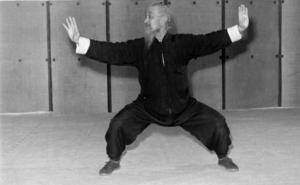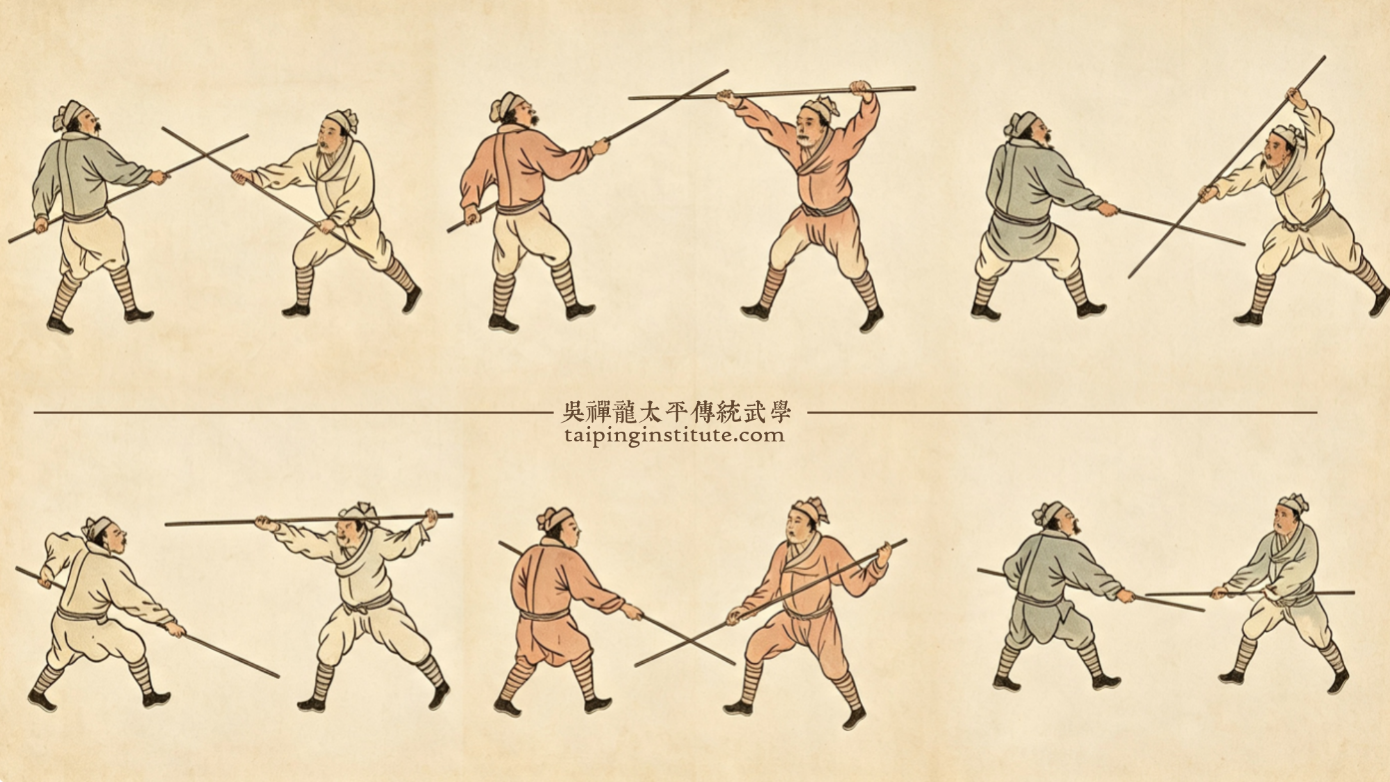
The Jian Jing (剑经) manual is not a collection of techniques, rather it is a method of controlling distance, line, rhythm, and force so that the staff becomes an extension of the whole body, and the body becomes a formation. One of the main problems with those that have not studied the staff, is that they often wiggle around the staff without attention of the body, and in chinese martial arts, and in the Jian Jing, significant focus is on distance, stepping, as well as the lines of forces.
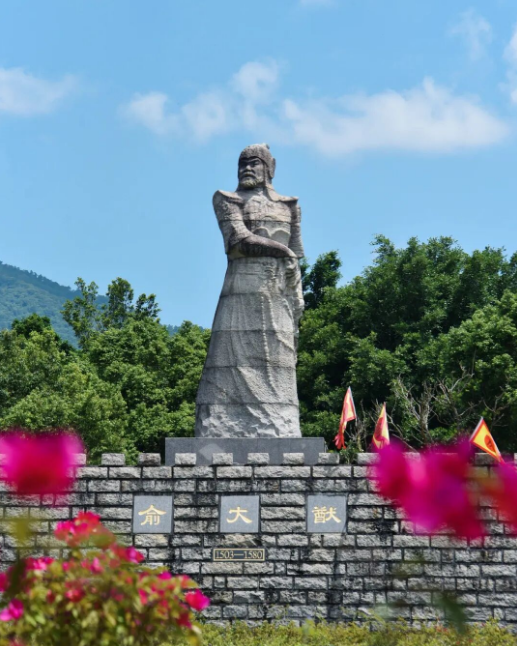
Yu Dayou (俞大猷, 1503-1580), styled Zhi Fu (志辅) and nicknamed Xu Jiang (虚江), was born in Hou Ge Tou Village (濠格头村), Jinjiang County (晋江县), Quanzhou Prefecture (泉州府), Fujian (now part of Luojiang District, Quanzhou City). His ancestral home was in Ho Qiu County (霍丘县), Feng Yang Prefecture (凤阳府), Southern Zhili (now part of Liu An, Anhui). Yu Dayou was a prominent Ming Dynasty military strategist, martial artist, and renowned general known for his campaigns against Japanese pirates (Wokou). Born in Jinjiang (modern-day Quanzhou), Fujian, he studied Jingchu Longsword (荆楚长剑) under Li Liangqin (李良钦). He authored several works, including She Fa (《射法》), Jian Jing (《剑经》), and Zheng Qi Tang Ji (《正气堂集》). It is said that, Yu Dayou (俞大猷) taught staff techniques to Shaolin disciples Zong Qiao (宗擎) and Pu Cong (普从), making significant contributions to the development and inheritance of Shaolin martial arts, particularly Shaolin staff methods. During the anti-Wokou campaigns, his “Yu Family Army” (俞家军) struck fear into the hearts of the pirates. He and Qi Jiguang (戚继光) were known as “Yu Long and Qi Hu” (俞龙戚虎), with Yu being the “Dragon” and Qi the “Tiger.”
Yu Dayou conducted in-depth research into both traditional military martial arts and folk martial arts, making unique and significant contributions to the field. Through years of diligent study, broad inquiry, and the synthesis and refinement of various traditions, he authored Jian Jing (The Sword Classic, 剑经) in the 36th year of the Jiajing reign (1557). This work stands as the first comprehensive, systematic, and practical treatise on martial arts combat theory in Chinese history. Due to its immense value for historical research and practical combat application, Jian Jing presents strategic and tactical principles of universal significance, representing the quintessence of ancient martial arts theory and showcasing Yu Dayou’s profound mastery of the discipline.
Yu Dayou’s purpose in writing Jian Jing was threefold: first, to elucidate the theory of martial combat; second, to establish systematic, rational, scientific, and practical strategic and tactical guidelines to direct actual combat; and third, to introduce his self-created “Yu Family Staff Method” (Yu Gong Gun Fa, 俞公棍法), a system that synthesized the achievements of his predecessors, thereby providing a concrete model for the future development of martial arts and combat sports. This ensured that subsequent generations had established principles, methods, and techniques to follow and apply, enabling them to understand the underlying logic, master practical application, and achieve the unity of knowledge and action. He consistently advocated the philosophy that “learning must seek practical utility, and strategy values tangible results.”
1. Preface
剑经并序
猷学荆楚长剑,颇得其要法。吾师虚舟赵先生,见而笑曰:若知敌一人之法矣,讵知敌百万人之法本于是乎?猷退而思,思而学,学而又思,思而又学,乃知天下之理原于约者,未尝不散于繁。散于繁者,未尝不原于约。复以质之,先师曰:得之矣。夫首之大, 嘴牙之小,不相称焉,两不相为用也。手足之大,指爪之小,不相称焉,两不相为用也。凫以掌大而不能栖,鹜以嘴大而不能啄,鸢以翼大而不能击,狼以尾大而不能掉,鹿以角长而困,豕以肉多而喘,驽以鬣浓而钝,虎以项短而力,兔以前短而狡,鸡以爪细肩广而善斗,犬以毛浅尾锐而善猎。疾病之人,手足鞅掌者懒,脐腹彭亨者倦,头项瘿瘤者偏,腰膂薄弱者痿,前急后曳者踬:无不有势存焉。
Translation:
I, You, studied the long staff of Jing-Chu and rather obtained its essential methods. My teacher, Mr. Zhao Xuzhou, saw it and laughed: “You know the method for opposing one man; how do you know that the method for opposing a million men is rooted in this?” I withdrew and thought; I thought and studied; I studied and thought again; I thought and studied again. Then I knew: the principles of the world that originate in the simple never fail to spread into the complex; those that spread into the complex never fail to originate in the simple. I again asked my late teacher. He said: “You have got it.”
Now, the head is large and the mouth and teeth are small: they do not match, so the two cannot be used together. Hands and feet are large and fingers and claws are small: they do not match, so the two cannot be used together. The wild duck cannot perch because its feet are too large; the duck cannot peck because its bill is too large; the kite cannot strike because its wings are too large; the wolf cannot wag because its tail is too large; the deer is trapped by its long horns; the pig pants because it has too much flesh; the nag is dull because its mane is thick; the tiger has strength because its neck is short; the rabbit is cunning because its front legs are short; the chicken fights well because its claws are fine and its shoulders broad; the dog hunts well because its hair is shallow and its tail sharp.
In sick people: those with swollen hands and feet are lazy; those with bloated bellies are tired; those with goiter on the neck are crooked; those with weak lower back are limp; those who are tense in front and drag behind stumble. In all of these, a posture/force is present.
Analysis:
This opening is metaphysical and military at once. Yu Dayou’s teacher challenges him: one-man combat and million-man war are not separate sciences. The same principles scale up and down. The animal and sick-body examples show that structure determines function: if proportions, leverage, and posture are wrong, power cannot issue. This is the foundation of the staff method: do not seek isolated tricks; seek the root principles of body alignment, distance, timing, and force. “Simple” and “complex” are two directions of the same law.
2. Body as Formation
圣人制兵师之阵,必有奇有正,必有从有伏,必有扬有备,必有前后、有中央、有左右,必有握奇,必有游阙。其阵不一,各有轻重、饶减、盈缩、远近、疏数之权。度大以称小,小以称大,人以称地,地以称人,无不胜也。然则舍万 物之情,以求行阵之法者,远矣。一人之斗,有五体焉:一身居中,二手二足,为之前后左右,有防有击,有立有踢,一体偏废,不能为也。唯伍法具于一人,故起伍之数,必五人两之数,必五伍队之数,必五十卒之数;必四两一车,车之数必五乘,偏之数必五队,军之数必五偏,阵之数必五军,自一人以至百千万人,同一法也。一人之斗,身体手足,皆有屈伸之节。屈于后者,伸之于前;屈于右者,伸之于左。使皆屈而无伸,与皆伸而无屈,僵人而已耳!虽具五体,不能为也。故伍必以三人为正,二为奇;什必七人为正,三为奇;八阵必四隅为正,四方为奇;自一人以至百千万人,同一法也。人之善斗者,一身四肢屈伸变化,有无穷尽之形,故前正而后奇,忽焉正后而奇前,正聚而奇散;忽焉正散而奇聚,车正而骑奇;忽焉骑正而车奇;自一人以至百千万人,同一法也。万人之变化,犹一人之伸缩;万人之从令,犹五体之从心,无不胜也。然则舍一人之身,以求行阵之法者,远矣。上古圣人观之于天,察之于数,验之于易,推之于度,取之于身,证之于物,曲尽其理,而立为伍,法以教人,可谓明且尽矣。忠臣义士,志可以矢,效公忠而学,必求乎实用。气可以运,量宇宙而谋,又贵于有成,彼览影偶质,岂能改?独指迹慕远,何救于迟也耶?猷谨将所得要法,著为《剑经》,以告后人,世有真丈夫,当亮予志。
Translation:
When sages established military formations, they always had the unorthodox and the orthodox, pursuit and ambush, feint and reserve, front and rear, center, left and right, a gripping wonder, and roaming gaps. Formations are not uniform; each has its weighting, reduction, expansion and contraction, distance, and density. Measure the large to match the small, the small to match the large, men to match ground, ground to match men, then none is not victorious. Therefore, to abandon the nature of all things and seek formation methods is far off.
In one man’s fight there are five bodies: the torso is centered; the two hands and two feet are front, back, left, and right. There is defense and attack, standing and kicking. If one part is crippled, one cannot act. Only squad method is complete in one person. Thus the starting number of a squad must be five men; the number of pairs must be five squads; the number of files must be fifty soldiers; four pairs make a chariot; chariots number five; wings number five files; armies number five wings; formations number five armies. From one man to hundreds, thousands, ten thousands, it is the same method.
In one man’s fight, the body, hands, and feet all have joints of bending and extending. Bend at the rear to extend at the front; bend on the right to extend on the left. If all bend with no extension, or all extend with no bending, it is only a stiff corpse. Though it has five parts, it cannot act. Thus a five-man squad must have three as orthodox and two as unorthodox; a ten-man squad must have seven orthodox and three unorthodox; the eight formation must have the four corners as orthodox and the four sides as unorthodox. From one man to millions, it is the same method.
A skilled fighter’s one body and four limbs bend, extend, and transform into inexhaustible shapes. Thus front is orthodox and rear unorthodox; suddenly rear is orthodox and front unorthodox. Orthodox gathers while unorthodox scatters; suddenly orthodox scatters while unorthodox gathers. Chariots are orthodox and cavalry unorthodox; suddenly cavalry is orthodox and chariots unorthodox. From one man to millions, it is the same method. The transformations of ten thousand men are like the extension and contraction of one man; ten thousand men obeying orders are like the five limbs obeying the heart—none is not victorious. Therefore, to abandon one man’s body and seek formation methods is far off.
The ancient sages observed Heaven, examined number, verified it in the Yi, deduced measure, took it from the body, proved it with things, exhaustively reached the principle, established the squad, and taught the method. This may be called clear and complete. Loyal ministers and righteous men, whose will can be sworn, learn for public loyalty and must seek practical use. Their qi can be moved, they plan for the cosmos, and they value success. Those who look at shadows and match appearances—how can they change? Those who alone point at footprints and long for distant places—what saves them from lateness? I, You, respectfully take the essential methods I obtained and write them as the Jian Jing to tell later generations. If there are true men in the world, they should understand my aim.
Analysis:
This is the core military-philosophical thesis. A single body already contains a formation: center, flanks, front, rear, reserve, feint, and attack. The staff is not merely a weapon; it is a laboratory for orthodox/unorthodox (正/奇) deployment. The same logic governs five men, fifty, five armies. The key practical lesson for staff study: every technique must have a supporting structure, one part bends so another extends; one line feints so another kills. Power is not local; it is distributed through the whole body and then through the unit.
3. Foundation: Staff as the Root Weapon
中文原文:
用棍如读《四书》,钩、刀、枪、钯,如各习一经。《四书》既明,六经之理亦明矣。 若能棍,则各利器之法,从此得矣。
Translation:
Using the staff is like reading the Four Books; hook, saber, spear, and fork are like each studying one classic. Once the Four Books are clear, the principles of the Six Classics are also clear. If one can use the staff, then the methods of all sharp weapons are obtained from this.
Analysis:
The staff is the foundational weapon. It teaches distance, line, force, sticking, deflection, and timing without the distraction of an edge. Once the root is understood, other weapons become variations. This is why the manual keeps returning to staff (棍) even when discussing Fork/Rake(钯),Sabre(刀), Spear(枪).
4. First Stanza
中文原文:
总诀歌,
中直八刚十二柔,
上剃下滚分左右;
打杀高低左右接,
手动足进参互就。
Translation:
General formula:
Center straight; eight hard, twelve soft.
Above, shave; below, roll; distinguish left and right.
Strike and kill high and low, left and right, connecting.
Hands move, feet advance, mutually completing each other.
Analysis:
The staff must stay centered and straight. Hard and soft are proportioned: not brute force alone. “Shave” is a downward slicing deflection; “roll” is a rolling deflection along the opponent’s shaft. The last line is crucial: hand techniques and footwork must complete each other. A staff technique without stepping is incomplete.
5. Second Stanza
中文原文:
总诀歌,
却在他力前,
柔乘他力后。
彼忙我静待,
知拍任君斗。
Translation:
General formula:
Yield before his force;
softness rides after his force.
When he is busy, I wait quietly;
knowing the beat, you may fight as you please.
Analysis:
This is timing. Do not meet force head-on. Let the opponent’s force pass, then ride it. “Knowing the beat” is 知拍; the later summary calls this 拍位. It means perceiving the exact instant between the old force spending and the new force not yet issuing.
6. Third Stanza
中文原文:
总诀歌,
阴阳要转,两手要直;
前脚要曲,后脚要直。
一打一揭,遍身着力;
步步进前 ,天下无敌。
Translation:
General formula:
Yin and yang must turn; both hands must be straight.
The front foot must be bent; the rear foot must be straight.
One strike, one lift: the whole body exerts force.
Step by step advance: invincible under Heaven.
Analysis:
Stance and power. The hands are not limp; they are structurally straight. The front leg bends for mobility and spring; the rear leg straightens for drive. Every strike and lift uses the whole body, not the arms alone. The forward pressure is relentless.
7. Fork Practice Step Method (1)
中文原文:
钯习步法
习钯简步十进,足如环无端。进一足中平当大压;又进一足,压死;又进一足,小压;又进一步,压死;又进一步,高大当;又进一足,大压死;又进一步,高小当;又进一足,小压死;又进一足,高大当;又进一足,大压死。
Translation:
Fork practice step method:
Practice the fork with simple steps, ten advances, the feet like a ring without end. Advance one foot: center-level block with big press. Advance another: press dead. Advance another: small press. Advance another: press dead. Advance another: high big block. Advance another: big press dead. Advance another: high small block. Advance another: small press dead. Advance another: high big block. Advance another: big press dead.
Analysis:
This is a drilling pattern. “Press dead” means to pin or suppress the opponent’s weapon so it cannot issue. The pattern alternates center/high, big/small, and press/block while continuously stepping. The “ring without end” means the steps recycle seamlessly.
8. Fork Practice Step Method (2)
中文原文:
钯习步法 中平起,大斜压。他大飞天,我转角赶上压。他再大飞高,我小高直,当即小压下。他小飞高,我小高直,当直小压下。他再小飞高,我大高直,当即大压下过小。他抽直杀来,我再大压过小。他入我大上角,我用身力转角赶上,略收低。他再入我大上角,我转角对手直杀去,跳回一步。他打来,我伏回即赶上大起,一扫下,再跳回中栏止。大压小压,已粘他杆,即大进上,斩死他。
小直当,小斜压;大直当,大斜压。
Translation:
Fork practice step method: start from center-level, big diagonal press. If he flies up big, I turn the corner and catch up with a press. If he again flies high big, I go small-high straight and immediately press down small. If he flies high small, I go small-high straight and immediately press down straight small. If he again flies high small, I go big-high straight and immediately press down big, passing over small. If he draws back and kills straight, I again big-press over small. If he enters my big upper corner, I use body force, turn the corner, catch up, and slightly withdraw low. If he again enters my big upper corner, I turn the corner and kill straight at the opponent, then jump back one step. If he strikes, I lie back, then catch up with a big rise, sweep down once, then jump back to middle bar and stop. When big press or small press has already stuck to his shaft, immediately big-advance and chop him dead.
Small straight block, small diagonal press; big straight block, big diagonal press.
Analysis:
This section trains angular responses. The fork is not used like a simple club; it turns corners, presses diagonally, and sticks. “Jump back” is a reset, not retreat in fear. The finish comes only after the opponent’s shaft is controlled.
9. Skill, Rear Hand, Timing
中文原文:
总诀歌
视不能如能,生疏莫临敌。
后手须用功,遍身俱有力。
动时把得固,一发未深入。
打剪急进凿,后发胜先实。
步步俱要进,时时俱取直。
更有阴阳诀,请君要熟识。
Translation:
General formula:
Seeing is not equal to being able; if unskilled, do not face the enemy.
The rear hand must work; the whole body must have strength.
When moving, grip firmly; once issued, do not penetrate too deep.
Strike, scissor, urgently advance and chisel; later issuing beats earlier solidity.
Every step must advance; at all times seek straightness.
There is also the yin-yang formula; please know it thoroughly.
Analysis:
This warns against mistaking theory for skill. The rear hand is the power hand. “Once issued, do not penetrate too deep” means keep a reserve; do not overcommit. “Later issuing beats earlier solidity” is the 后人发先人至 principle: let the opponent commit, then arrive first.
10. Practice Step Sequence
中文原文:
习步法
起中平,推牵,扁身杀,丁字回杀,旋手进五步杀,跳进三步原位,直打直挑进五步杀,腰力挑打,滴水献花,杀,跳进三步原位进打,穿后手马前鸡啄进三步杀,马前斩草进三步杀,跳进原位,打沉让他先起穿后手,抽回,吊前抽回,三脚并进五步,大门趁棍走,进杀,小门趁棍走进直符杀,洗,倒头,直打,直起磕,打杀摆腰进三步,剪,杀,跳退原位。
Translation:
Practice step method:
Start center-level; push-pull; flat-body kill; T-step return kill; whirl hand advance five steps kill; jump advance three steps to original position; straight strike, straight lift, advance five steps kill; waist-power lift-strike; dripping water offers flower; kill; jump advance three steps to original position, advance strike; pierce rear hand, horse-front chicken peck, advance three steps kill; horse-front cut grass, advance three steps kill; jump advance to original position; strike sink, let him rise first, pierce rear hand; draw back; hang front, draw back; three feet together advance five steps; outer gate follow staff walk; advance kill; inner gate follow staff walk, advance straight-talisman kill; wash; inverted head; straight strike; straight rise knock; strike kill, swing waist advance three steps; scissor; kill; jump retreat to original position.
Analysis:
This is a solo form. The names are mnemonic labels for techniques. Notice the frequent “advance five steps,” “jump back to original position,” and “kill.” The form trains continuous forward pressure punctuated by resets. It also links outer gate and inner gate entries.
11. General Step Catalogue
中文原文:
总步目
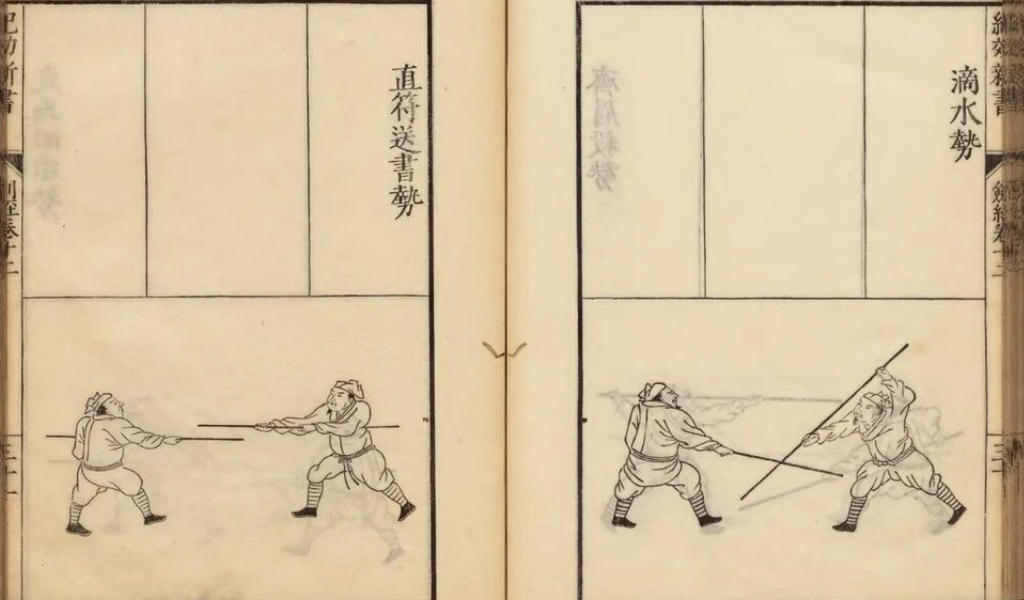
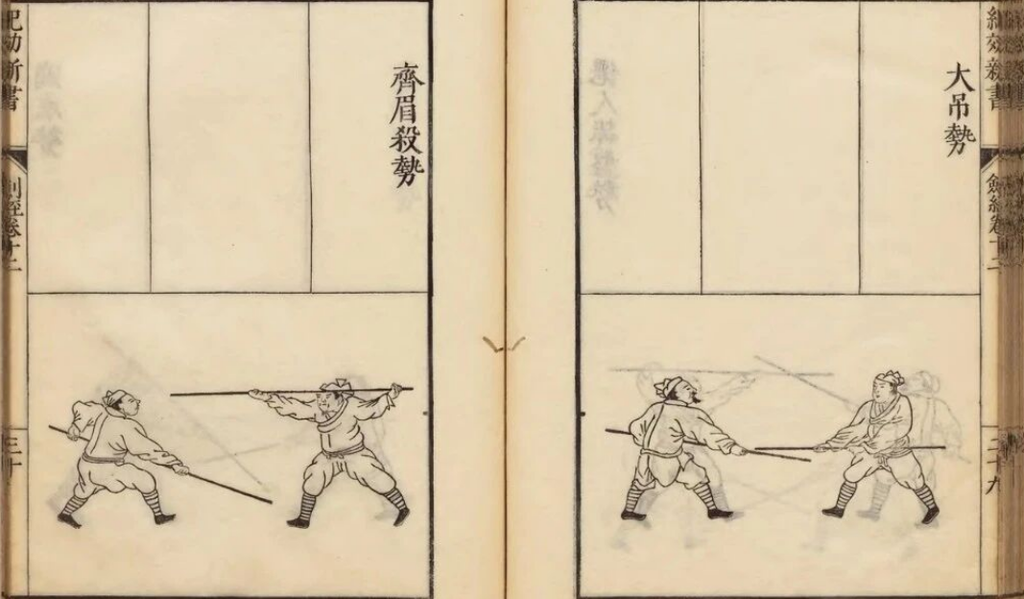
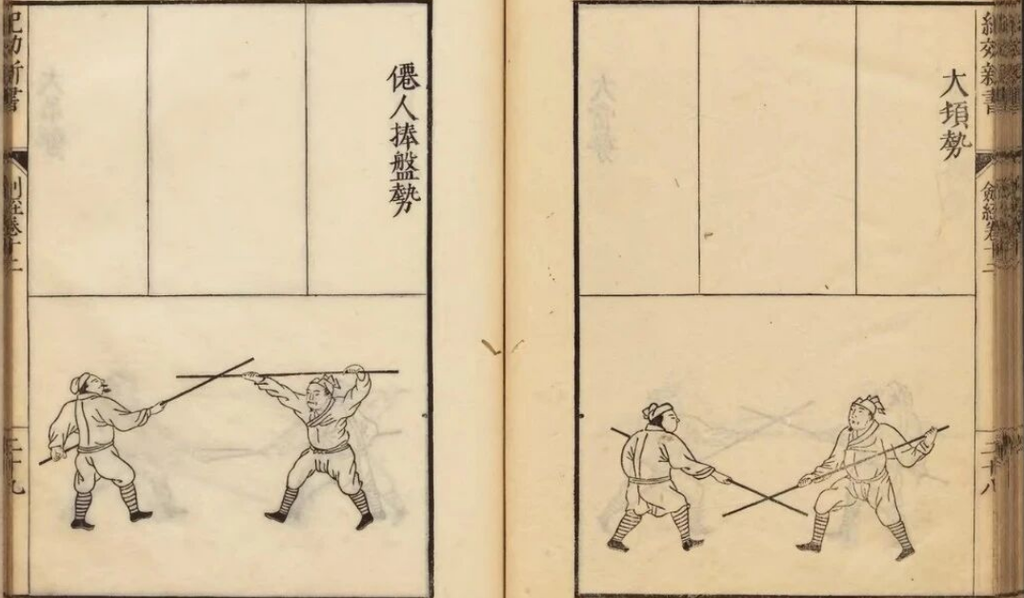
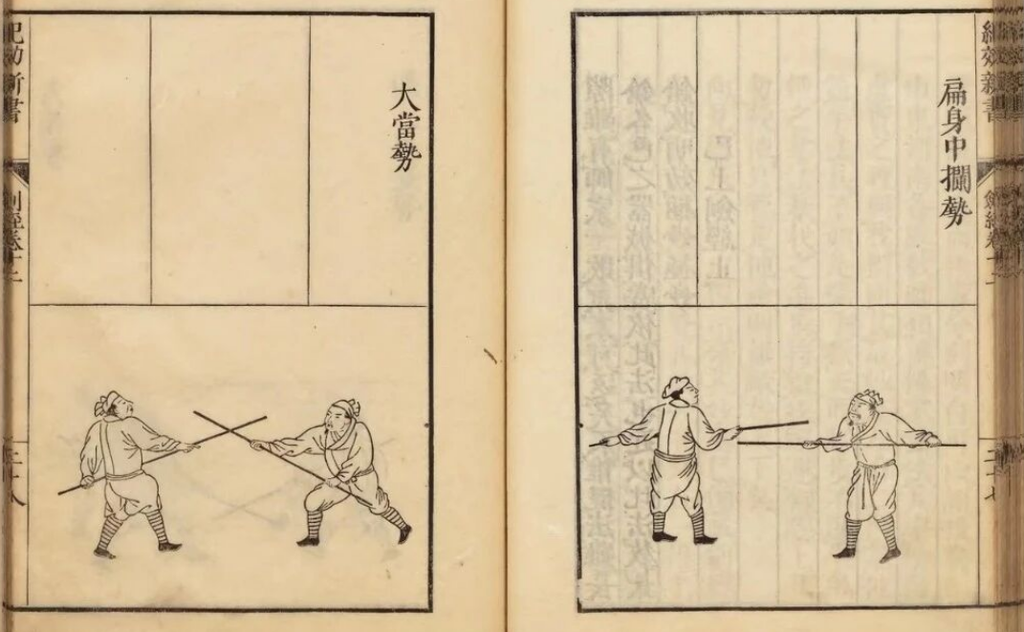
直破打剃大剪,小剪,揭(用手力),上扁身,滴水献花,吊剪,下起接,让高低俱有大单鞭压,子午,阴阳,下起穿手上,喜鹊过枝,趁棍走,走马回头丁字步(大僻),鸡啄谷,高栏凶棍,直凿,闪腰剪,三脚峙,倒头,马前斩草,上捧凿,小剪下小起,小单鞭压就手凿,下扁身,二龙争珠,直符送书杀,齐眉杀(后手高妙),顺势打盘山托,定四步行,固。
Translation:
General step catalogue:
Straight break strike shave, big scissor, small scissor, lift (using hand power), upper flat-body, dripping water offers flower, hanging scissor, lower rise connect, yield high and low both have big single-whip press, zi-wu, yin-yang, lower rise pierce hand upward, magpie crosses branch, follow staff walk, walking horse turns head T-step (big side), chicken pecks grain, high bar fierce staff, straight chisel, flashing waist scissor, three-foot stand, inverted head, horse-front cut grass, upper scoop chisel, small scissor lower small rise, small single-whip press then hand chisel, lower flat-body, two dragons contend for the pearl, straight talisman delivers the letter kill, eyebrow-level kill (rear hand high and marvelous), following momentum strike coil-mountain lift, settle four-step walk, solid.
Analysis:
This is a lexicon. It shows the manual’s method: name the technique, then combine. Many later paragraphs are recombinations of these names. A student should not memorize names as dead forms but understand their functions: break, shave, scissor, lift, roll, stick, press, chisel, kill.
12. Engagement Tactics: Invasion and Distance
中文原文:
侵他一尺(如上拦杀状),直破打他棍(打下作败状亦可),就进步侵四五尺小门一揭(或流水小剪,他起我揭),大进步对手凿,或再大进步,倚他棍尾,直剃下打他手,或头急变扁身中拦杀。
侵他一尺,直破他棍,就进侵四五尺,小门,一揭一小剪(近他手一尺为妙),走脚过一大剪(近他手五寸为妙),急变扁身中拦杀。
侵他三尺,直破打他棍。他过枝向小门来伤我,我急变滴水,大进步捧他棍。若他棍不起,我就小门进步(若钩刀,就将他割来),扁身中拦凿结尾。若他棍起,我棍粘他,献花直破打落,急变二龙争珠,大门手兜杀。
Translation:
Invade one foot—like an upper-bar kill posture—directly break and strike his staff (striking down and feigning defeat is also possible). Then advance, invading four or five feet, inner gate one lift (or flowing small scissor; if he rises, I lift). Big advance, facing opponent, chisel; or again big advance, lean on his staff tail, straight shave down and strike his hand; or suddenly change to flat-body middle-bar kill.
Invade one foot, directly break his staff, then advance invading four or five feet, inner gate: one lift, one small scissor (best when one foot from his hand); walk the foot over one big scissor (best when five inches from his hand); suddenly change to flat-body middle-bar kill.
Invade three feet, directly break-strike his staff. If he crosses branch toward the inner gate to hurt me, I suddenly change to dripping-water, big advance, scoop his staff. If his staff does not rise, I advance into the inner gate (if hook saber, cut him over), flat-body middle-bar chisel to finish. If his staff rises, my staff sticks to his, present-flower directly breaks and strikes it down, suddenly change to two dragons contend for the pearl, outer-gate hand兜 kill.
Analysis:
This is a distance-management lesson. One foot is a probe. Four or five feet is commitment range. The targets are the opponent’s hand and staff tail, not his weapon’s tip. “Near his hand one foot/five inches” is the crucial control zone. If he crosses to the inner gate, switch to dripping-water and stick. The finish is always preceded by controlling the staff.
13. Engagement Tactics: Two-Foot Invasion and T-Step Return
中文原文:
侵他二尺,低打低揭连几下,待他忙时,径进步大起棍,从小门去打他手,不论中不中,须急退丁字回。他决进我小门来伤我,此时我一揭一进,压剃落,打他手,决中矣。
侵他二尺,低打抵揭,连几下,待他忙时,急退丁字一步,急大进步,吊剪他手。急收回原势立,他进来打我,我就大门下起接。他一大剪,急变扁身,中拦杀。
Translation:
Invade two feet: low strike, low lift, several times. When he becomes busy, directly advance, raise the staff big, and from the inner gate strike his hand. Whether it hits or not, you must quickly retreat into a T-step return. He will certainly enter my inner gate to hurt me. At this moment I one-lift one-advance, press-shave down, strike his hand, certainly hit.
Invade two feet: low strike, resist-lift, several times. When he becomes busy, quickly retreat one T-step, then quickly big-advance, hanging-scissor his hand. Quickly withdraw to original posture and stand. If he enters to strike me, I rise from the outer gate to connect. If he big-scissors, suddenly change to flat-body, middle-bar kill.
Analysis:
The T-step return is a trap. You provoke with low strikes, then withdraw. The opponent follows; you meet him with lift-press-shave or hanging scissor. The pattern is provoke-reset-counter-finish.
14. Engagement Tactics: Inner and Outer Gate Facing
中文原文:
两人小门,对打对揭,须急变(急变时,勿使他揭着,揭着则不及矣),大门下起接大剪(或顺势打),中拦杀,或于揭时即用小剪变大剪,中拦杀。
两人大门对打,不进前脚,不折后脚,不能胜(须知有顺势折脚,是逃闪之法)。
两人大门齐对打,我且将棍提在高(连脚抽回些),迟斯须进步压打下,即进变扁身中拦。若我打去,他棍提回让我,我须勿将棍尾打下,只进步对他胸喉,直杀去。
Translation:
When both are in the inner gate, striking and lifting against each other, you must change quickly. When changing quickly, do not let him lift you; if he lifts you, it is too late. From the outer gate rise to connect with a big scissor (or following-momentum strike), middle-bar kill; or at the moment of lifting, use small scissor and change to big scissor, middle-bar kill.
When both are in the outer gate striking against each other, if you do not advance the front foot and do not fold the rear foot, you cannot win. Know that there is a following-momentum folded foot; it is a method of escaping and flashing.
When both are in the outer gate striking evenly, I first lift my staff high (drawing the foot back a little). After a moment, advance, press down and strike, then advance and change to flat-body middle-bar. If I strike and he lifts his staff back to let me pass, I must not strike down with the staff tail; only advance and kill straight at his chest and throat.
Analysis:
This stresses initiative in the exchange. If both are in the same gate, whoever changes first and controls the beat wins. The feet must not be frozen. But when the opponent yields, do not chase his weapon; go to the body.
15. Engagement Tactics: Magpie Crosses Branch
中文原文:
喜鹊过枝有四:他直高打来,我将棍抽过,大门让他,下随用大剪,一也;他直高打来,我将棍抽过小门,让他下,对胸杀去,二也;他直平打来,我坐脚,过枝进步,小门杀他,三也;他平直杀,或打来,我折后腿(即顺势),大门剪杀,四也。以上过枝,俱在下面,过入他棍,二尺即过。
Translation:
Magpie crosses branch has four [variations]:
- He strikes straight and high; I draw my staff over, yield the outer gate, then follow below with a big scissor.
- He strikes straight and high; I draw my staff over to the inner gate, yield below, and kill straight at his chest.
- He strikes straight and level; I sit the foot, cross branch and advance, and kill him in the inner gate.
- He kills straight and level, or strikes; I fold the rear leg (that is, following momentum), and outer-gate scissor-kill.
In all the above crossing-branch, it is below; cross into his staff about two feet and then cross.
Analysis:
“Magpie crosses branch” is a family of counters to straight high or level attacks. The key is to pass under or across the opponent’s staff line at about two feet, then attack either the inner gate or chest. It is not a block; it is an angle-change and entry.
16. Engagement Tactics: Controlling Low and Ambush Staffs
中文原文:
治伏棍、低棍,须用小剪,离他手前,一尺之间,他急过大门,我或揭进打亦可(飞风箭亦可);急变大剪杀亦可(又我小剪他,他抽走,我急进步,起高棍打他,须二步折过小门)。
他打来临身,在小门则趁棍走一打。在大门则走马回头,丁字步一打,顺棍上一杀。又一大剪,扁身中拦杀。
大门接凶棍有五:扁身中拦接,一也;高捧接,二也;下起磕,三也;我棍略横,离前手一尺受他,打一下,四也;待他打将到身,用手前一尺,磕他一下,五也。各接后,须用大剪,继之以杀。
Translation:
To control a lying staff or low staff, you must use a small scissor about one foot in front of his hand. If he quickly crosses to the outer gate, I may lift-advance and strike (flying wind arrow is also possible); or quickly change to big scissor kill. Also, if I small-scissor him and he draws away, I quickly advance, raise a high staff and strike him; must use two steps and fold over to the inner gate.
If he strikes coming to my body: in the inner gate, follow the staff and walk one strike. In the outer gate, use walking-horse-turns-head, T-step one strike, following the staff upward with one kill. Then one big scissor, flat-body middle-bar kill.
There are five ways to receive a fierce staff at the outer gate: 1. flat-body middle-bar receive; 2. high scoop receive; 3. lower rise knock; 4. my staff slightly horizontal, one foot from the front hand, receive him and strike once; 5. wait until his strike is about to reach the body, use one foot in front of the hand and knock him once. After each receive, you must use big scissor, then follow with kill.
Analysis:
Low and lying staffs are dangerous because they are already beneath your line. The answer is small scissor near the hand, then either lift-strike or big scissor. Receiving a fierce staff is not one technique but five, all of which must end with big scissor and kill.
17. Engagement Tactics: Chicken Peck and Straight Kill
中文原文:
他鸡啄我,须起凶棍,入剪他手前二尺之间。他连起,我连剪;我鸡啄,他起凶棍;我让他先起,穿他小门手上(我接凶棍步亦可)。
他直杀来,须进脚向小门剪,或向他棍尾,小门起变大剪,或端的直破,闪腰剪几剪后,须用进杀,都不如定四步,坐直赶上。
Translation:
If he chicken-pecks me, I must raise a fierce staff and enter to scissor within two feet of his hand. If he rises repeatedly, I scissor repeatedly. If I chicken-peck and he raises a fierce staff, I let him rise first, then pierce his inner-gate hand (my receive-fierce-staff step is also possible).
If he kills straight at me, I must advance the foot toward the inner gate and scissor, or go to his staff tail and from the inner gate rise into a big scissor, or truly straight-break. After several flashing-waist scissors, you must use advance-kill. But none is as good as settling the four-step and sitting straight to catch up.
Analysis:
Chicken peck is a quick probing attack. The counter is to enter the space near the hand and scissor. Against straight kill, the manual prefers a settled four-step and straight catch-up, i.e., don’t overcomplicate; control the line and advance.
18. Engagement Tactics: Openings and the Principle of Later Arrival
中文原文:
凡小门一揭一打,一打又一揭,终无结尾,必须乘揭用小剪(如铁门),过大门结尾。或将身抽退,他打来,我就大门下,起接剪打杀,结尾。
凡起手要打要杀,俱要在他门内,一尺之间,未可将手势发尽,待他赶来伤我,他手势已尽。此时或大或小,或剪或接,或自大下起接,各将他棍死了。然后进步,扁身中拦,结尾无不胜也。法曰:后人发,先人至。知此决不可一发便要伤人,徒使自势发尽,为他人反伤,戒之,戒之。棍初交则下起者,有势;棍深入则上压者,取嬴。我单鞭,他变马前斩草,我且大进一步,硬用手力,他棍自输。小剪,是棍中至要,人所不疑者。
Translation:
In general, in the inner gate, one lift one strike, one strike another lift, ultimately has no ending. You must take advantage of the lift to use a small scissor (like iron gate), cross to the outer gate and finish. Or draw the body back; when he strikes, I go from the outer gate, rise to connect, scissor, strike, kill—finish.
Whenever you begin a strike or kill, it must be within one foot inside his gate. Do not issue your posture to the full. Wait for him to come to hurt me; his posture is already spent. At this moment, whether big or small, scissor or receive, or rising from below the outer gate to connect, each will kill his staff. Then advance, flat-body middle-bar, and finish—none not victorious. The method says: “Others issue later, I arrive first.” Knowing this, you must never issue once and immediately want to hurt him, merely spending your own posture and being counter-hurt by another. Beware, beware.
When the staffs first cross, the one who rises from below has the advantage. When the staffs have entered deep, the one who presses from above wins. If I use single-whip and he changes to horse-front cut grass, I simply big-advance one step, use hard hand force, and his staff will lose by itself. Small scissor is the most essential in staff; people do not doubt it.
Analysis:
This is one of the most important passages. Do not overcommit at first contact. Keep your posture within one foot of his gate. Let him spend his force. Then scissor, receive, or rise, kill his staff, and finish. “Later issue, first arrive” is the essence. Small scissor is singled out as essential.
19. Engagement Tactics: Daily Training, Hand Power, and Body Method
中文原文:
凡棍动时,须要把极坚固,方有力。凡大小门直破打,不分粘他棍不粘他棍,务对他手,直起直落,任他揭打。或我揭打他,我棍亦不离他身五寸,即离亦须即直。凡日间将棍一打一揭,自习打揭,俱要自声,久则自有力,高不过目,低不过膝。凡小门杀,须在他手上,方无后患,大门亦然。三脚峙打,须要习(有大僻),又定四打要习。彼抽退,勿急追;彼急进,勿遽离。腰力为上,后手力次之,前手力又次之。棍提起手,阳杀去,及打去俱手阴。阴阳俱要识透。他棍头略起,我不意向大门二尺位坐脚,一破剪进杀,又或不意用献花破进。
Translation:
Whenever the staff moves, the grip must be extremely firm, then there is power. In all outer/inner gate direct break-strikes, whether sticking to his staff or not, you must aim at his hand, rising and falling straight, letting him lift or strike. Or if I lift-strike him, my staff also does not leave his body by five inches; even if it leaves, it must immediately straighten.
In daily practice, take the staff and one strike, one lift; practice striking and lifting by yourself. All must make their own sound; after a long time, power will come naturally. High not above the eyes, low not below the knees.
In all inner-gate kills, you must be on his hand, then there is no later trouble. Outer gate is the same. Three-foot stand strike must be practiced (there is big side); also settle four-strike and practice. If he draws back, do not chase hastily. If he advances quickly, do not suddenly leave. Waist power is superior; rear-hand power is next; front-hand power is next again. When the staff raises the hand, yang kill; when striking down, both hands are yin. Yin and yang must both be understood thoroughly.
If his staff head slightly rises, unexpectedly I sit the foot at the outer gate two-foot position, one break-scissor advance kill; or unexpectedly use present-flower to break and enter.
Analysis:
This is training methodology. The grip must be firm but not stiff. The staff should not stray from the opponent’s body line; five inches is the control distance. Daily solo practice of one strike one lift builds sound and power. Targets: eyes to knees. Waist power > rear hand > front hand. Yin-yang refers to the turning of the hands and the issuing/receiving of force.
20. Foot Kill
中文原文:
脚杀
他起高拦若迫进,赶上对胸杀。他起高拦,我径赶上迫他(如杀状),打下前五步,大门接,随时用俱可,抽让亦可(有抽让,有不抽让,须知之)。急折脚,顺势剪一步,更妙。他小门打来,或低杀来,急折进前脚,横压他棍尾,然后二步折打他。他闭大门,我折后脚,就下起,径杀他大门(略剪意)。他闭小门,我进前脚,就下揭起,径凿他小门。他起流水进,我后手略高牵,就进步杀,大小门皆然。直符送书杀。我大门压,他坐身退,欲过枝小门。我就进前脚,对棍直杀去;须后手高,前手低,直符送书步用。他起高棍,我略进入,待他落大折过大门,打他半棍一下,就进杀(丁字回头亦可,须知有顺势),不论他棍打落,打不落(我都是如此)。两人揭打,我因手避之,顺侵打(打时不可沉自棍),不使他揭得,须后手出在前手胁下去打,则他揭不得。直符送书,杀难揭。用流水打他棍,他棍起,我就揭进剪打。大门连打连揭忙时,将棍变流水打他棍;他棍起,我就揭进剪打。 将棍出,长挂膝上,鸡啄打。铁门打慢慢进(回头),又如铁门势,大进步困打。他尽手杀来,我径折进,前脚过大门,对手杀去,不与他棍相粘,或折过小门,亦此法。大门哄杀,他压我,我过小门,假作败状。他决杀来,我一揭,折进杀或打。我初起高小门,杀一尺,他进来,我即过大门,高拦打下,收下拦,杀上(或再待亦可)。凡小门杀来,待来将到手,丁字回,一揭折进杀,则中矣。下哄,待他剪向上,直符送书杀,上大门哄(或打他手、折脚),伏下小门杀,或伏下待他来,一揭杀,更妙。我将棍略高,略侵入,他来接,我即丁字步滚下杀。他起高拦打,我折进大门,将他棍尾,或半棍敲下,进齐眉杀(须知有顺势,敲时切不可沉自棍)。凡进杀,须急丁字回头退,方稳。大门高哄杀去四五尺,待他来抵剪,就剪他;大进杀小门,亦然(须知有顺势,丁字回头亦可)。侵他三四尺,低打低揭,连几下,待他忙时,大进趁棍进杀。梗直哄杀去四五尺,任他打或揭;我就寻他虚处,大进杀去。凡他棍来,我避他抽退,我急随杀,极妙。不急,则不可去。我大门高进,入丁字牵伏下,他赶来,我一牵揭,进凿。
Translation:
Foot kill:
If he raises a high bar and presses in, catch up and kill at his chest. If he raises a high bar, I directly catch up and press him (as if killing); strike down front five steps, outer-gate receive; use at any time, or draw back and yield (there is draw-back-yield and not-draw-back-yield; you must know them). Quickly fold the foot; following momentum scissor one step is even better. If he strikes from the inner gate, or kills low, quickly fold and advance the front foot, horizontally press his staff tail, then two steps fold and strike him.
If he closes the outer gate, I fold the rear foot, rise from below, and directly kill his outer gate (slight scissor intent). If he closes the inner gate, I advance the front foot, rise from below with a lift, and directly chisel his inner gate. If he rises with flowing water and advances, my rear hand slightly high pulls, then advance and kill; outer and inner gate both so. Straight talisman delivers the letter kill.
If I press at the outer gate and he sits back to withdraw, wanting to cross branch to the inner gate, I advance the front foot and kill straight facing his staff; the rear hand must be high, front hand low—this is the straight-talisman-delivers-letter step. If he raises a high staff, I slightly enter, wait for him to fall, big-fold over the outer gate, strike his staff halfway once, then advance kill (T-step return also possible; know there is following momentum). Whether his staff is struck down or not, I always do thus.
When both lift and strike, I avoid with the hand and follow-invade strike (when striking, do not sink your own staff). Do not let him lift you. The rear hand must come out from below the front hand’s ribs to strike; then he cannot lift. Straight talisman delivers the letter is hard to lift. Use flowing water to strike his staff; if his staff rises, I lift-advance scissor-strike. When outer gate is busy with continuous strike and lift, change the staff to flowing water and strike his staff; if his staff rises, I lift-advance scissor-strike.
Put the staff out, hang it long on the knee, chicken-peck strike. Iron gate strike slowly advances (turn head); again like iron-gate posture, big advance trap-strike. If he kills with full hand, I directly fold-advance, front foot passes outer gate, face opponent and kill, not sticking to his staff; or fold over inner gate—same method. Outer-gate feint kill, he presses me; I pass to inner gate, feign defeat. He will certainly kill; I one-lift, fold-advance kill or strike.
I first rise high inner gate, kill one foot; he enters; I immediately pass outer gate, high bar strike down,收下拦, kill upward (or wait again). In all inner-gate kills, wait until his hand is about to arrive, T-step return, one lift fold-advance kill—then hit. Lower feint: wait for him to scissor upward, straight talisman delivers letter kill. Upper outer-gate feint (or strike his hand, fold foot), lie low inner-gate kill, or lie low and wait for him to come, one lift kill—even better.
I hold staff slightly high, slightly invade; he comes to receive; I immediately T-step roll down kill. He raises high bar and strikes; I fold-advance outer gate, knock down his staff tail, or half the staff, enter eyebrow-level kill (know there is following momentum; when knocking, never sink your own staff). In all advance kills, you must quickly T-step turn head and retreat to be stable.
Outer-gate high feint kill four or five feet; wait for him to come resist-scissor, then scissor him; big advance kill inner gate likewise (know following momentum; T-step return also possible). Invade three or four feet, low strike low lift several times; when he is busy, big advance following staff advance kill. Straight feint kill four or five feet; let him strike or lift; I seek his empty place and big-advance kill.
Whenever his staff comes and I avoid, he draws back; I urgently follow and kill—excellent. If not urgent, do not go. I outer-gate high advance, enter T-step pull and lie low; he catches up; I one-pull one-lift, advance chisel.
Analysis:
“Foot kill” is about using the feet to create the killing angle. It includes folding, advancing, T-step returns, and feints. The recurring idea: do not chase his weapon; use footwork to occupy his gate, press his staff tail, then kill. Feints set up the real entry. T-step return stabilizes after commitment.
21. Breaking Kills
中文原文:
破杀
破直杀有七:一步、闪腰打、二步、折脚、二步滚、二步、流水。 我扁身入深,此时不顾性命了,只两目认他胸前。棍上空,急穿上;棍下空,急穿上。他大过枝小,直符指去一步;他小过枝大,我亦直符指去一步。 凡直符杀,不碍他棍尾。 我过枝小门,用盘山托亦可,用直符步亦可。 大哄过小,待他来小压,急过大剪杀,盖哄多则容易也。剪而后杀,则无后患也。中有顺势,须知之。 凡进杀,先软后硬,今后勿用打。 破高拦,务先顺牵,后剪杀(杀去待他,落即转),要知顺牵与剪不同。 杀在小门,待他来,即过大门,剪后杀,如小门先牵后杀之理。但须防他回头,牵他回牵,我又过去小门。 又曰盘山托、大折、过小。 直入打剪,他临手一杀;待他剪,然后过小门容易。 对棍,低入小门,一小揭小剪杀,或待变。 他累打揭,我对打,二步对手杀,大进待他打下,大剪或杀。 我大入,他过小门,我就坐进前脚,就他棍中滚入,然后大打进杀。 他滴水,我对他手慢慢指去,待他动,即坐脚,剪下进凿。 小门有揭,亦有大揭,与献花不同。 他坐低,我正好折过小门打。 凡将棍直指,慢慢侵入,待他动,欲打我,我就杀他;他欲杀我,我就进打他手。 何尝叫人勿打,要哄他,棍来就我打;或打他棍,着响一声,便可进杀。 何尝叫人勿杀,要哄他,棍开杀去,勿使他打着,方可杀深杀后,在大门即洗,小门即揭牵。 但凡接高棍,须防他盘山托,就坐下小剪。 他大门单鞭坐脚,直滚入杀;我折进前脚,过大门,直符杀他。 俯身揭,顺势剃,急接打,未知俱要习熟。 钯对刀,他入我四角,我四下不相粘,后手起,高杀(自思出),扁身中拦兼大僻(丁字步,要大僻);他起高,我就赶上剃(扁身中拦杀,要后手高,平胸去)。 他打来,我打去,他起我揭,务要小剃,又要累累押去,大亦然。手动时,即下定四步,门户方密。 他打来,我打去,他起我对,手穿入小门,随将两手捧高,手动时即落定,四步寸寸打上,随他小门杀、小门压、大门杀、大门压。他起大,高赶上剃,要就杀,或先接后杀;他起小,高赶上大接,或接小剃。 上此一步,乃棍中之正兵,不能离此以取胜者,也不能胜,亦不能败。 打时须记得进杀,千万千万。 大门迫他压低,我抽下过小门,如杀状;他决尽力来小压,急急抽过,大门剪杀,此步极妙。 右此一步,高打来,亦要如此哄,急翻剪杀。且铁牛入石,我揭起打下,他方揭起,我就由他手边过,大剃打亦可。 双人大门对打,他力雄,我急变丁字步打,用身压之,然后变。 他小门杀来急,我坐进前脚,就他棍中滚入,连剪二三下,然后杀。 钯大门空起勾下,勾步绝妙;又有下流水勾,不叉他。 对手直起对他身打落,如是走,离大并直赶为上好。 他刀下来,我或大门流水勾迫,或小门流水,俱不叉他。刀如棍用,须继以对手大请起(又起势时,就丢大门,流水去亦可)。 大门扇出他刀尾,伏回待他来,不拘他刀高下,俱对他身直起。他不来,若近或他刀不高,亦请得起,若不出他刀尾,就将刀压下,对面直起,有闪身。 小门阳手扇下,阴手请起。凡请起如不着,即急对他身,他刀扇下,大小门皆然。 他刀中拦直来,我直就上压下。中拦有拔步,有顺势转角步。又有钯过他身,将他身勾来。 我出中拦钯,他直打下,我将钯抽,大门起上压落。如我用棍步,须勿 凡他起,我亦起,他落我亦落,俱要随他。 凡叉起,他逆对,须顺他势,或左或右,送落几下,叉起亦然。须知步步进脚。 凡被他刀入角,即便坐退,后脚撑起。 凡我伏回,他只中拦立不来,我就偷后脚进去,深闪入有哄。 他高拦打下,我就大门揭起,不用阴阳手。只直揭起,则我在上而彼在下矣。他若将棍如打下而不打下,当我揭起,则彼下则我输矣。总不外棍深入在上者取嬴。若我棍打沉了,他打来,我用别步皆不及,只直硬起妙。 将棍坚把住,用身势(棍头高)慢慢侵入。他大门来,我大门接,一下只离一寸;他小门来,我小门接,一下只离一寸:待他何门死,我尽身入。 铁牛入石,我打去,他揭起,我将棍尾勿坠,就将棍尾倒抹上一下,即大剪他手,或即打他手。他打来,我揭起,即入杀他小门,极妙,极妙。 凡接他大剪鸡啄,妙皆如此。 直磕一声就杀去,不用拔剃,亦甚紧矣。惜无困死人棍之法,大抵用拔剃为是。 凡左右门打来,俱用手前一尺,盖他棍尾。凡左右门杀来,俱用棍尾,在他手前一尺盖他,打来势重,必须吾手前一尺,方接揭得他住。他杀来手轻,又要过枝,必须用吾棍尾,盖他手前一尺。 学到上下、高低、硬软,直破打上下接,俱是一手法,方是有得,但直破顺势打是一套,去接是做二节去,初学未易语之。后手初曲,后直硬处须悟得;前手,须悟得。 我单鞭上,他过小门,若入深,即用直符送书杀。若他入浅则不过,恐他竭起,只用赶上直打。凡杀来大小门,皆如此例。 凡过小门杀来,我就行过小门,就他棍尾,对手直打下;若变过大门杀来,我就行过大门,就他棍尾,对手直打下,妙,妙。 总有三节 接高拦,一磕一拔,后手一尺剃,一进杀,接抵打来,亦然。 直破对打,磕带抽,后手剃,相连后,进杀。 入中拦,只用一磕,带略拔剃五寸,一进杀。若未侵入、他棍未死,亦用拔用手,一尺剃下,进杀。 踏过他小门进入,如前法,但自棍横势,送进。上中拦,皆然。 此当字,如曲中之拍位,妙不可言,故赞之曰:我他傍,前手直当,后直加拔,有神在中。学到此,一贯乎万矣。 千千万万步,俱有拍位。 一转阴阳,不可太早,临时一下,乃不费力,明之明之,折脚不如直入。 上李良钦之传,学到此,一贯乎万矣。 上刘邦协之传,中间有拍位,不用拔剃洗落,只撒手杀,则又紧矣。但无困死人棍之法,大抵前用拔剃为是,小门亦然。? 上在偏头关时,得之教师林琰者,其诗曰:壮士执金枪,只用九寸长;日月打一转,好将见阎王。
Translation:
Breaking kills:
There are seven ways to break a straight kill: one step; flashing-waist strike; two steps; folded foot; two-step roll; two steps; flowing water. When I flatten my body and enter deep, at this moment I disregard life and death; my two eyes only recognize his chest. If his staff is empty above, urgently pierce upward; if empty below, urgently pierce upward. If he crosses branch big to small, straight-talisman points forward one step; if he crosses branch small to big, I also straight-talisman point forward one step. In all straight-talisman kills, do not obstruct his staff tail.
When I cross branch to the inner gate, I may use coil-mountain lift, or use straight-talisman step. Great feint crosses to small: wait for him to small-press; quickly cross to big scissor kill—because many feints make it easy. Scissor and then kill: then no later trouble. Within it there is following momentum; you must know it.
In all advance kills, first soft then hard; from now on do not use strike. To break a high bar, first follow-pull, then scissor-kill (after killing, wait for him; when he falls, turn). Know that follow-pull and scissor are different. If killing in the inner gate, wait for him to come, then cross to outer gate, scissor then kill—like the principle of inner gate first pull then kill. But you must guard against his turning head; pull him back-pull, and I again cross to inner gate.
Also called coil-mountain lift, big fold, cross to small. Directly enter strike-scissor; if he kills at the hand, wait for him to scissor, then crossing to inner gate is easy. Facing staff, low-enter inner gate, one small lift small scissor kill, or wait to change. If he repeatedly strikes and lifts, I strike against him; two steps face-opponent kill; big advance wait for him to strike down, big scissor or kill.
If I enter big and he crosses to inner gate, I sit-advance the front foot, roll into his staff, then big-strike advance kill. If he uses dripping water, I slowly point at his hand; wait for him to move, then sit the foot, scissor down advance chisel. Inner gate has lift, also big lift, different from present-flower. If he sits low, I can just fold over the inner gate and strike.
In all, point the staff straight and slowly invade. Wait for him to move. If he wants to strike me, I kill him; if he wants to kill me, I advance and strike his hand. When have I ever told people not to strike? I want to lure him: when his staff comes to me, I strike; or strike his staff, make one sound, then advance kill. When have I told people not to kill? I want to lure him: when his staff opens, kill; do not let him hit you, then you may kill deep. After killing, at the outer gate wash; at the inner gate lift-pull.
Whenever receiving a high staff, guard against his coil-mountain lift; sit down small scissor. If he outer-gate single-whip sits the foot and rolls straight in to kill, I fold-advance the front foot, cross outer gate, straight-talisman kill him. Bend body lift, following momentum shave, urgently connect strike—all must be practiced until familiar.
Fork against saber: if he enters my four corners, my four downward [movements] do not stick; rear hand rises, high kill (think it out yourself), flat-body middle-bar plus big side (T-step, need big side). If he rises high, I catch up and shave (flat-body middle-bar kill: rear hand high, go level at chest). If he strikes, I strike; if he rises, I lift. You must small-shave, and repeatedly press away; big is also so. When the hand moves, immediately settle four steps; then the doors are dense.
If he strikes and I strike, he rises and I face; hand pierces into inner gate, then both hands scoop high. When the hand moves, immediately settle; four steps inch by inch strike upward, following his inner-gate kill, inner-gate press, outer-gate kill, outer-gate press. If he rises big, high catch up shave—want to kill immediately, or first connect then kill. If he rises small, high catch up big connect, or connect small shave.
This one step is the orthodox soldier in the staff. One cannot leave it to win; without it one cannot win, nor can one lose. When striking, remember advance kill—thousands, ten thousands.
If at the outer gate you press him down, I draw down and cross to inner gate like a kill; he will certainly use full strength to small-press. Quickly draw over, outer-gate scissor kill—this step is excellent. The above step: if he strikes high, also feint thus, quickly turn and scissor kill. Moreover, iron ox enters stone: I lift and strike down; just as he lifts, I pass by his hand and big-shave strike—also possible.
When two men outer-gate strike against each other and his strength is strong, I quickly change to T-step strike, use body to press him, then change. If he inner-gate kills quickly, I sit-advance the front foot, roll into his staff, scissor two or three times, then kill.
Fork outer gate empty rise hook down: hook step is excellent; there is also lower flowing-water hook, do not fork him. Face opponent straight rise and strike down at his body; if he walks, leaving big and straight catch-up is best. If his saber comes down, I either outer-gate flowing-water hook press, or inner-gate flowing water; both do not fork him. Saber used like staff must continue with facing-opponent big lift-up (also when rising posture, discard outer gate and go flowing water—also possible).
Outer gate fan out his saber tail, lie back and wait for him to come. Regardless of his saber high or low, always rise straight at his body. If he does not come, if close or his saber is not high, you can also lift him up. If you do not fan out his saber tail, press the saber down and rise straight facing him; there is flashing body. Inner gate yang hand fan down, yin hand lift up. In all lift-ups, if not hit, immediately face his body; if his saber fans down, outer and inner gate both so.
If his saber middle-bar comes straight, I directly press down from above. Middle-bar has拔步, following-momentum corner step. Also fork passes his body and hooks his body over. If I issue middle-bar fork and he strikes straight down, I draw the fork, outer gate rise press down. If I use staff step, must not…
Whenever he rises, I also rise; whenever he falls, I also fall—always follow him. Whenever forking rises and he opposes, must follow his momentum, left or right, send down several times; forking rise also so. Know to advance the foot step by step.
Whenever his saber enters your corner, immediately sit back, rear foot braces up. Whenever I lie back and he only stands at middle bar and does not come, I steal the rear foot in, deeply flash in with feint. If he high-bar strikes down, I outer-gate lift up, not using yin-yang hands. Only lift straight up, then I am above and he below. If he makes as if to strike down but does not, when I lift up, if he then comes down, I lose. In all, when the staff enters deep, the one above wins. If my staff is struck sinking and he strikes, using other steps is too late; only straight hard rise is excellent.
Grip the staff firmly, use body posture (staff head high) to slowly invade. If he comes outer gate, I outer-gate receive, each time only one inch away. If he comes inner gate, I inner-gate receive, each time only one inch away. Wait until whichever gate of his is dead; then I enter with full body.
Iron ox enters stone: I strike; he lifts. I do not let my staff tail drop; I reverse-wipe my staff tail upward once, then big-scissor his hand, or immediately strike his hand. If he strikes, I lift, then enter and kill his inner gate—excellent, excellent. In all receiving his big scissor or chicken peck, the wonder is like this.
Straight knock one sound and kill; no need to pull-shave—very tight. Unfortunately there is no method to trap the opponent’s staff to death; generally pull-shave is correct. In all left/right gate strikes, use one foot in front of the hand to cover his staff tail. In all left/right gate kills, use the staff tail to cover him one foot in front of his hand. If the strike comes heavy, you must use one foot in front of your hand; then you can receive and lift him. If his kill comes light, and he wants to cross branch, you must use your staff tail to cover one foot in front of his hand.
Learn up/down, high/low, hard/soft; direct break-strike, up/down connect—all are one hand method. Only then do you have attainment. But direct break following-momentum strike is one set; going to receive is a second section. It is not easy to explain to a beginner. The rear hand first bends, then straightens hard—you must awaken to this. The front hand—you must awaken.
If I single-whip up and he crosses to inner gate, if he enters deep, immediately use straight-talisman delivers-letter kill. If he enters shallow, do not cross; fear he may exhaust and rise; only catch up straight strike. In all kills coming to outer/inner gate, this example holds. In all inner-gate kills coming, I walk over inner gate, go to his staff tail, face opponent strike straight down. If he changes to outer-gate kill, I walk over outer gate, go to his staff tail, face opponent strike straight down—wonderful, wonderful.
There are always three sections: receiving high bar—one knock, one pull, rear hand one-foot shave, one advance kill. Receiving resist-strike coming is also so. Direct break facing-strike: knock with draw, rear hand shave, connected, advance kill. Enter middle bar: only one knock, with slight pull-shave five inches, one advance kill. If not yet invaded and his staff not dead, also use pull-hand, one-foot shave down, advance kill. Step over his inner gate and enter, as previous method, but your own staff horizontal, send in. Upper middle bar both so.
This “dang” character is like the beat in music—wonderful beyond words. Thus it is praised: “I and he side by side, front hand straight dang, rear straight add pull, there is spirit within.” When you learn this, one thread runs through ten thousand.
Thousands and ten thousands of steps all have a beat.
One turn of yin-yang must not be too early; one moment at the time—then it is effortless. Understand clearly, understand clearly. Folding the foot is not as good as direct entry.
Above is Li Liangqin’s transmission. When you learn this, one thread runs through ten thousand.
Above is Liu Bangxie’s transmission. In the middle there is a beat; do not use pull-shave-wash-drop, only release-hand kill—then it is tighter. But it lacks the method of trapping the opponent’s staff to death; generally previous use of pull-shave is correct. Inner gate likewise.
Above, when at Pianguan, I obtained this from teacher Lin Yan. His poem says: “The strong man holds the golden spear, only uses nine inches long; sun and moon strike one turn, ready to see the King of Hell.”
Analysis:
This long section is a compressed encyclopedia. The core themes:
- Break straight kill by footwork, waist-flash, roll, or flowing water.
- Enter deep with eyes on the chest, not the weapon.
- Feint, then scissor, then kill.
- “First soft, then hard” in advance kills.
- Use the opponent’s staff tail and hand as control points.
- The “beat” or 拍位 is the musical timing of technique.
- Different teachers transmitted variants: Li Liangqin emphasized urgent saves and second-intention counters; Liu Bangxie emphasized direct release-hand kill with beat; Lin Yan emphasized short, tight spear/staff.
- The key is not a fixed form but the ability to follow momentum and seize the instant.
22. Summary: The Three Teachers and the Eight-Character Secret
中文原文:
总结、分析
三教师,原来合一家。 千言万语不外乎致人而不致于人一句,李良钦之所以救得急者,都是前一下哄我去,然后转第二下来解救,故救得速,故能速也。 不外乎后人发先人至一句,不外乎不打他先一下只是打他第二一下。 俱是顺人之势,借人之力,只要快便,又要似进实退而后进,则大胜矣。 须要习:上拦大小门剃,下拦大小门剃。下拦小门剃颇难,须用功习之。 两人大门对打对迫,忽然变大僻,凶猛打下(甚妙,甚妙);两人对鸡啄,亦如此变。 二龙争珠杀,就采下,不用提起棍,此全是手法。前后手俱有法,如教师童琰父所谓:临时取之力也。我他傍,亦是临时取之力,须要悟他临时取力口诀。 但凡打敲采洗,俱用后手功,故棍不用提起高。今之欲用力打人者,惟恐棍起不高,打不重,盖只是有前手之力、无后手之功,故耳。 伏回之枪,俱是哄我杀去,他即起弹杀我也。记之,记之。 全书总要,只是乘他旧力略过、新力未发八字耳。至妙,至妙。此只是我他傍之秘旨,语到此,则不能复加一言矣。 凡此意味,体认得真,亦有七日不食,弹琴咏歌之趣也。 滚剃后,须再赶上,当剪死他棍,然后杀,记之记之,大小门皆然。滚是他低平直杀来,我棍在高,遂坐下,量离了手前一尺,与他棍尾相遇,顺滚至他手,杀他身。剃是他高打来,或高杀来,或他虽把定未动,但棍尾高,有十字。我用棍尾量一尺之处,与他棍尾或棍中相遇剃下。大小门皆有滚剃,顺至他手,杀他身,此滚剃之不同也。下起磕弹,何以不滚剃?磕既响一声,恐他棍开或沉,无桥可乘(故必打剪,然后杀)。 先侵二三尺,一打坐身沉棍头,他必进杀,我就下起磕一响,大进步打剪,或丁字回打剪。然后扁身杀他。乔教师曰:弹枪则在下面横捧,亦起磕之法。但在下面横,则不响之理矣。童教师曰:一声响处值千金,彼失提防我便嬴是也。依乔教师之说,乃知伏面之枪,俱是哄我杀去,他即起弹杀我也。记之记之。 剪打急起磕起,磕复剪打剪,打复急起磕,相连而进,彼从何处杀将来,微乎神哉!破金枪之第一法也。稳而能胜,习之习之。 他打下,我揭起,我哄他欲打下,而实不打下;待他尽力揭起,力使过了,即赶将他棍剃下。 问如何是顺人之势,借人之力?曰:明破此,则得其至妙至妙之诀矣。盖须知他出力在何处,我不于此处与他斗力;姑且忍之,待其旧力略过、新力未发,然后乘之,所以顺人之势、借人之力也。上乘落、下乘起,俱有之,难尽书。钩刀枪棍,千步万步,俱是乘人旧力略过、新力未发而急进压杀焉。我想出旧力略过、新力未发八个字,妙之至也,妙之至也!前言拍位,都是此理。 小门进对打,须斟酌用之,恐力大之人一挑灯,我走难离矣。大抵小门,只是哄他不真,要打或杀为稳。 与用左手人对在小门,须坐极低,在大门大折足过打。 他用极长软枪或竹枪,我须坐身,将棍头提高,慢慢迫上,待他下面杀来,即变一拦粘定,用黄龙转尾步赶,万无一失。 学至于此,则身手足应心,全不杆格矣。学至于此,学至于此,全不看见,他是枪是刀,只认定对他手前杀他身而已。若他打来乱时,必须忍,略退回,坐足下中平,待少顷,他来即用磕手法进自胜。总是以静待动、以逸待劳,道理微乎微乎!李良钦,每每如此。 大门大侵,入磕小门,不可大侵;入挑大门,大侵入磕,则彼必死无疑矣。小门若大侵入挑,恐彼力大,挑不起,则难救矣。若挑声一响,然后大侵,入打他又何妨? 他棍起,就进步,直当去,不待他打落,低拦亦然。 大剪下起手,要直平不曲。 但凡先一下打他棍,他自然提起,再赶上,直当大僻中,要有顺势。 剃后,待他起,进步直当。 齐打下,让他起,赶上直当如钯步。 小门更勿直凿,只哄他棍起,就过大门,直当剃打。 两人对鸡啄,大进步赶入对棍尾剃;又进起杀,待他起直当去。 他过我小门,我须将前脚入,将前手棍起,占了小门,大开大门,随他变不变,俱剃打下。 曲腰将棍尾略压他,他棍起,就他大门下起,直当去。 打忙时,须要认空处杀。 对手钻去,须在他棍上。 打到中间忙时,须记得收下再起。 我打他接我,须不与他接着,只是埋下,引他打下,我起接,则我为后发先至。 我打不与接着,即转小门,挑起进打,亦是后发先至之理。 打到中间,他打几下,我接起,我勿打下,他决再起,即急再直当去,则他自败也。 我入被他打,觉败,即急跳退,记之记之。 师父初假意杀来,或打来;我或接着或挑着,决不宜贪心就进去伤他,待他动,我再或接或挑,进去伤他。 打认棍,打认棍、剃认棍、剃入认棍、入挑认棍挑,凡举手俱要认他棍,若认人不认棍之说,是彼棍已败开了,只管认人坐去也。 寻枪头,就死求赢。 将棍头,低穿入他棍下,或左边一起一剃,或右边一起一剃,起要有响为度,总是一理。 是脚去手去,剃是脚去手回,顿是脚去手去,剪是脚去手回。 凡直当之后,打下不如进脚坐顿下。打下则自势尽,他反当我顿坐下,则有有余之势。如他再起,则再当之,大小门皆然。 凡钯与软杀之人,须照我原大,扇赶为气势,容易服人。凡遇硬进步起角入,须不离分寸,如今所制钯谐,入他为稳。大门轻打他棍一下,他用力来抵,即丁字步,大进打彼自屈矣。 大当大顿坐,小当小坐;他大压,我偷过小坐;他小压,我偷过大顿坐。千步万步,此段尽之。 今以后打步少,只是当死他棍,然后凿他。 千言万语,总是哄他旧力过去,新力未发而乘之。 钯所以终对不得枪刀者,枪刀有哄,钯哄不得人也。 响而后进,进而后响,分别明白,可以语技矣。 山东河南,各处教师相传杨家枪法,其中阴阳虚实之理,与我相同,其最妙是左右二门拿他枪手法,其不妙是撒手杀去,而脚步不进。今用彼之拿法兼我之进步,将枪收短,连脚赶上,且勿杀他,只管定他枪,则无敌于天下矣。
Translation:
Summary and analysis:
The three teachers originally combine into one family. A thousand words and ten thousand phrases are nothing more than “control others and do not be controlled by others.” The reason Li Liangqin could rescue urgently is that the first move lured me in, then he turned to the second move to rescue—so the rescue was fast, and therefore he could be fast. It is nothing more than “others issue later, I arrive first”; nothing more than not striking his first move, only striking his second move. All is following the opponent’s momentum and borrowing the opponent’s force. Only be fast and convenient, and also seem to advance while actually retreating, then advance—then great victory.
You must practice: upper bar outer/inner gate shave; lower bar outer/inner gate shave. Lower bar inner-gate shave is quite difficult; must work hard at it. When two men outer-gate strike and press, suddenly change to big side and fiercely strike down (very wonderful, very wonderful). When two men face chicken-peck, also change thus.
Two dragons contend for pearl kill: immediately pick down, do not lift the staff; this is entirely hand method. Front and rear hand both have method, as teacher Tong Yanfu said: “Take power at the moment.” “I and he side by side” is also taking power at the moment; you must awaken to his oral formula for taking power at the moment.
In all strike, knock, pick, wash, all use rear-hand work; therefore the staff need not be lifted high. Those today who want to use force to strike people fear only that the staff is not raised high enough or strikes not heavy enough; this is because they have only front-hand strength and no rear-hand work.
A lying-back spear is always luring me to kill; he then rises and springs to kill me. Remember, remember.
The whole book’s essential point is only the eight characters: “Take advantage when his old force is just passing and new force has not yet issued.” Most wonderful, most wonderful. This is only the secret meaning of “I and he side by side.” When words reach this, nothing more can be added.
If you truly understand this flavor, there is also the joy of not eating for seven days, playing the qin and singing.
After rolling-shaving, you must catch up again, scissor his staff to death, then kill. Remember, remember; outer and inner gate both so. Rolling: he kills low and level straight; my staff is high, so I sit down, measure one foot from my hand, meet his staff tail, roll along to his hand, kill his body. Shaving: he strikes high, or kills high, or though he holds still, his staff tail is high, with a cross. I use my staff tail to measure one foot and meet his staff tail or mid-staff and shave down. Outer and inner gate both have roll and shave, following to his hand, killing his body. This is the difference between roll and shave.
Why not roll-shave for lower rising knock-spring? Once the knock sounds, fear his staff opens or sinks, no bridge to ride (therefore must strike-scissor, then kill).
First invade two or three feet; one strike sits the body and sinks the staff head. He will certainly advance kill. I then lower-rise knock one sound, big advance strike-scissor, or T-step return strike-scissor. Then flat-body kill him. Teacher Qiao said: “Spring spear is then horizontally scooped below; it is also a rise-knock method. But if horizontal below, it will not sound.” Teacher Tong said: “One sound is worth a thousand gold; if he loses guard, I win.” According to Teacher Qiao, then know that a lying-face spear is always luring me to kill; he then rises and springs to kill me. Remember, remember.
Scissor-strike urgently rise-knock; knock again scissor-strike-scissor; strike again urgently rise-knock; linked and advancing—from where will he kill? Subtle and divine! This is the first method to break the golden spear. Stable and able to win; practice, practice.
If he strikes down, I lift up. I lure him to want to strike down but actually do not strike down; wait until he exerts full strength to lift, his force has passed, then catch and shave his staff down.
Question: What is following the opponent’s momentum and borrowing the opponent’s force? Answer: If you clearly break this open, you obtain the most wonderful, most wonderful formula. You must know where he exerts force. I do not fight force at that place; I endure for a while. Wait until his old force is just passing and new force has not yet issued, then ride it. This is following momentum and borrowing force. Above ride fall, below ride rise—both exist; hard to write fully. Hook, saber, spear, staff, a thousand steps, ten thousand steps—all are riding the moment his old force is just passing and new force has not yet issued, then urgently advancing, pressing, killing. I thought out the eight characters “old force just passing, new force not yet issued”—most wonderful, most wonderful! The previously spoken “beat” is all this principle.
Inner-gate advance facing-strike must be used with discretion; fear that a strong man may one挑灯, and I cannot leave. Generally the inner gate is only to feign him unreliable; to strike or kill is more stable.
Against a left-handed man in the inner gate, you must sit extremely low; at the outer gate, big-fold the foot over and strike.
If he uses an extremely long soft spear or bamboo spear, I must sit the body, raise the staff head high, slowly press up. Wait for him to kill from below; then change to one bar, stick and fix, use yellow dragon turns tail step to catch—ten thousand without one loss.
When learning reaches this, body, hands, and feet respond to the heart, completely without obstruction. When learning reaches this, when learning reaches this, you do not see at all whether he is spear or saber; you only recognize and kill his body in front of his hand. If he strikes wildly, you must endure, slightly withdraw, sit the foot below center-level. Wait a little; when he comes, use knock-hand method to advance and win. Always “use stillness to await movement, use ease to await exhaustion.” The principle is subtle, subtle! Li Liangqin was always like this.
Outer-gate big invasion: enter knock inner gate; do not big-invade. Enter lift outer gate: big-invade and enter knock, then he will certainly die without doubt. If inner gate big-invade and enter lift, fear he is strong and you cannot lift, then it is hard to save. If the lift makes a sound, then big-invade and enter strike—what harm?
If his staff rises, advance and straight-dang go; do not wait for him to strike down. Low bar likewise.
Big scissor lower rising hand must be straight and level, not bent.
In all, first strike his staff once; he will naturally lift. Then catch up, straight-dang into big side; there must be following momentum.
After shaving, wait for him to rise, advance straight-dang.
If he strikes level, let him rise, catch up straight-dang like fork step.
Inner gate even more do not straight chisel; only lure his staff up, then cross outer gate, straight-dang shave-strike.
When two men face chicken-peck, big advance catch in, face staff tail shave; again advance rise kill; wait for him to rise and straight-dang go.
If he crosses my inner gate, I must enter the front foot, raise the front-hand staff, occupy the inner gate, open the outer gate wide. Whether he changes or not, shave-strike down.
Bend waist and slightly press his staff tail; when his staff rises, from his outer gate lower rise, straight-dang go.
When striking busily, you must recognize the empty place and kill.
When facing opponent and drilling in, it must be on his staff.
When striking to the middle and busy, remember to收下再起.
If I strike and he receives me, I must not let him connect; only bury down, lure him to strike down, I rise to connect—then I am later issue first arrive.
If I strike and do not connect, immediately turn to inner gate,挑起进打; this is also the principle of later issue first arrive.
When striking to the middle, if he strikes several times and I connect-rise, I do not strike down; he will certainly rise again; immediately straight-dang go again, then he defeats himself.
If I enter and am struck, feel defeat, immediately jump back—remember, remember.
The teacher first feigns a kill or strike; I either connect or lift. Never be greedy and enter to hurt him. Wait for him to move; then I again connect or lift, enter and hurt him.
Strike recognizes staff; strike recognizes staff, shave recognizes staff, shave-enter recognizes staff, enter-lift recognizes staff-lift. Whenever raising the hand, always recognize his staff. If one says “recognize the man, not the staff,” that is when his staff is already defeated and open; then just recognize the man and sit in.
Seek the spear head; seek victory in death.
Put the staff head low, pierce under his staff; either left side one rise one shave, or right side one rise one shave. Rising must have sound as measure; always one principle.
“Shi” is foot goes hand goes; shave is foot goes hand returns; “dun” is foot goes hand goes; scissor is foot goes hand returns.
In all, after straight-dang, striking down is not as good as advancing the foot and sitting-dun down. Striking down exhausts your own posture; he反 when I sit-dun down, then I have surplus posture. If he rises again, then dang again. Outer and inner gate both so.
In all, against a man who kills softly with the fork, you must according to my original big, fan-catch as momentum; it is easy to subdue people. Against hard advance rising corner entry, you must not leave inch and fraction; like the fork harmonized as now made, entering him is stable. Outer gate lightly strike his staff once; if he uses force to resist, immediately T-step, big advance strike—he will bend himself.
Big dang big sit-dun; small dang small sit. If he big-presses, I steal over small sit; if he small-presses, I steal over big sit-dun. A thousand steps, ten thousand steps—this passage exhausts it.
From now on, use fewer strike steps; only dang his staff to death, then chisel him.
A thousand words, ten thousand phrases: always lure his old force past, and ride the new force before it issues.
The reason the fork ultimately cannot face spear and saber is that spear and saber can feint; the fork cannot feint people.
Sound and then advance; advance and then sound. Distinguish clearly; then you can speak of technique.
In Shandong and Henan, teachers everywhere transmit the Yang family spear method. Among it, the principles of yin-yang, empty-solid are the same as mine. Its most wonderful is the left and right two-gate hand method of taking his spear. Its not-wonderful is releasing the hand to kill while the footsteps do not advance. Now use their taking method combined with my advancing step, shorten the spear, catch up with the feet, and do not kill him yet—only fix his spear. Then you are invincible under Heaven.
Analysis:
This is the master summary. The entire manual reduces to:
- 致人而不致于人 — control the opponent; do not be controlled.
- 后人发,先人至 — issue later, arrive first.
- 不打他先一下,只打他第二一下 — do not fight his first intention; strike his second.
- 顺人之势,借人之力 — follow momentum, borrow force.
- 旧力略过,新力未发 — the eight-character timing secret: seize the gap when old force has just passed and new force has not yet issued.
- 拍位 — the rhythmic beat of technique.
- 以静待动,以逸待劳 — stillness against motion, ease against exhaustion.
- 后手功 — rear-hand power, not front-hand lifting.
- 滚剃后必剪死他棍,然后杀 — after rolling/shaving, scissor his staff to death, then kill.
- 枪刀有哄,钯哄不得人 — spear/saber can feint; fork cannot feint as well.
The section also records practical integration: take the Yang family spear’s two-gate hand-control method, add Yu’s advancing footwork, shorten the spear, fix the opponent’s weapon, and advance. This is the manual’s highest synthesis: control the weapon, control the man, then kill.
—The Jian Jing teaches staff as a complete combat system, emphasizing the following:
- Root: body structure, stance, whole-body power.
- Scaling: one man’s body is a formation; five men, fifty men, five armies follow the same logic.
- Weapon principle: the staff is the root weapon; other weapons are variations.
- Core mechanics: center and straight; hard/soft proportion; yin-yang—turning and issuing; rear-hand power; waist power.
- Core tactics: outer gate/inner gate; shave, roll, lift, scissor, knock, chisel, kill; stick, press, control the staff, then kill the body.
- Core timing: the beat; when old force has just passed and new force has not yet issued; others issue later, I arrive first.
- Core strategy: control others and do not be controlled by others; follow the opponent’s momentum and borrow the opponent’s force; use stillness to await movement, use ease to await exhaustion.
- Training: solo step sequences, fork drills, repeated strike-lift, sound, grip, footwork, T-step return, four-step settle.
- Highest skill: not seeing spear or saber, only recognizing the opponent’s hand and killing his body; using the opponent’s force and beat so that technique becomes effortless.
Appendix 1: Yu Dayou’s Chronological Biographic overview
Born into a military family, Yu Dayou inherited the position of Bai Hu (百户, a military rank) in Quanzhou Guard. From a young age, he studied both literature and martial arts, delving deeply into the I Ching (《易经》) and military strategy, and excelling in staff and sword techniques. In 1535, he passed the imperial martial examination and began a military career that spanned over 40 years. He fought across the provinces of Fujian, Zhejiang, Guangdong, and Guangxi, suppressing pirates, quelling rebellions, and repelling invasions from Annam. He oversaw anti-Wokou military affairs in the southeast, established the “Yu Family Navy” (俞家军), and pioneered tactics such as coordinated land-sea operations and armored cavalry. He achieved major victories at Wang Jiang Jing and Ping Hai Wei, making significant contributions to the elimination of the Wokou threat.
Yu Dayou was known for his integrity and upright character. He prioritized strategy over battle and was not greedy for immediate success. However, his straightforward nature and refusal to flatter others led to frequent demotions and dismissals—he was dismissed from office seven times and imprisoned once. Yet, his resolve to serve the country never wavered. His works on military and martial arts are extensive, with Jian Jing (《剑经》) being a classic of Ming Dynasty martial arts, and Zheng Qi Tang Ji (《正气堂集》) collecting his military writings, memorials, and poems. He passed away at home in 1579 at the age of 77. Posthumously, he was granted the title of Left Commander (左都督) and the posthumous name Wu Xiang (武襄). The History of Ming (《明史》) praised him as “loyal and devoted to the country, growing more steadfast with age,” making him a model of a Confucian general and national hero.
Yu Dayou was born in Jinjiang, Fujian, in 1503. His ancestor, Yu Min, followed the Ming Dynasty’s founding emperor, Zhu Yuanzhang, in his uprising and was granted the position of Bai Hu in Quanzhou Guard for his contributions, which was inherited by his descendants. His father, Yu Yuan Wan, inherited the position but passed away early. In 1522, Yu Dayou inherited his father’s position as Bai Hu of Quanzhou Guard. From a young age, he studied literature and swordsmanship, learning from the scholar Cai Qing and deeply studying the principles of the I Ching and military strategy, aspiring to achieve fame through merit.
In 1535, he participated in the imperial martial examination and passed, earning a promotion to the position of Acting Qian Hu (正千户). He was ordered to defend Jinmen. During his tenure, he disciplined the army, trained the navy, and frequently submitted reports to the provincial surveillance commission regarding coastal defense. However, due to his low rank, his suggestions were ignored, and he was instead punished with a beating and dismissal.
In 1542, Altan Khan launched a large-scale invasion of Shanxi. The imperial court called for the recommendation of brave warriors from across the country. Yu Dayou visited the censor and recommended himself. The censor submitted his name to the Ministry of War. The Minister of War, Mao Bo Wen, was impressed by his talent and recommended him as the commander of Tingzhang. After taking office, he defeated the pirate Kang Lao, capturing and killing over 300 pirates, and was promoted to the position of Acting Du Zhihui Shijie (都指挥佥事) and concurrently served in the Guangdong Military Commission. In 1547, he suppressed the rebellion led by Tan Yuan Qing in Xin Xing and En Ping, Guangdong. He personally entered the bandit stronghold, explained the consequences of their actions, taught the locals swordsmanship for self-defense, and recruited the bandit leaders, bringing peace to the two counties. When the Li people in Qiongzhou rebelled, Yu Dayou led the army to suppress the uprising, recruiting over 5,000 people, gradually stabilizing Hainan.
In 1549, the Right Deputy Censor Zhu Wan inspected Fujian and recommended Yu Dayou as the commander for coastal defense against the Wokou. At that time, Annam’s Mo Chao sent General Fan Zi Yi to invade Lianzhou and Qinzhou. The Governor-General of the Two Guang provinces, Ouyang Bi Jin, memorialized the court to retain Yu Dayou for the campaign. Yu Dayou led the navy to intercept the enemy at sea, achieving a great victory, beheading 1,200 enemies, and pursuing them to Annam before returning. Fan Zi Yi was later killed by his own people.
In 1552, the Wokou launched a large-scale invasion of eastern Zhejiang, capturing Ningbo and Shaoxing. Yu Dayou was transferred to Zhejiang as the deputy general of Ningbo and Taizhou, officially joining the anti-Wokou battlefield. He led the navy in a surprise attack on the Wokou at Li Gang, Zhoushan, burning dozens of enemy ships and killing over 1,000 pirates, achieving the first major victory in the anti-Wokou campaign in eastern Zhejiang.
In 1553, the Wokou established a stronghold at Putuo Mountain. Yu Dayou led the army to besiege them, setting fire to their camp. The pirates broke through the encirclement and fled. He was impeached for “allowing the pirates to escape” and had his salary suspended as a penalty. Soon after, he defeated the Wokou at Lin Shan and Chang Guo Wei, and his position was restored.
In 1555, the Wokou advanced deep into western Zhejiang, occupying Zhe Lin and Chuan Sha Wa, rampaging across thousands of miles. The Ming army suffered repeated defeats. The Governor-General Zhang Jing summoned Yu Dayou, Lu Tang, Qi Jiguang, and other armies to jointly eliminate the pirates. In May, Yu Dayou led the Yong Shun and Bao Jing local troops, together with Qi Jiguang and Lu Tang’s forces, to launch a joint attack on the Wokou at Wang Jiang Jing, achieving a great victory. They beheaded over 1,900 pirates, and countless others were burned or drowned. This was recorded in history as the “first major victory since the Wokou scourge began.” However, due to Zhao Wen Hua’s false accusations against Zhang Jing, Zhang Jing was arrested and sentenced to death, and Yu Dayou was also implicated, demoted to the position of You Ji (游击), and ordered to continue fighting the pirates with his penalty.
In March 1556, he defeated the Wokou outside the Qiantang River, beheading over 1,000 pirates. He also defeated them in Jiaxing and Wu Song, temporarily easing the Wokou threat in western Zhejiang. In June, he was promoted to the position of General of Zhejiang for his achievements in suppressing the Wokou. In October, together with Hu Zong Xian, he devised a plan to lure and defeat the Wokou leader Xu Hai, achieving a great victory at Shen Zhuang. Xu Hai drowned, and the Wokou threat in western Zhejiang was basically eliminated.
In 1557, the Wokou leader Wang Zhi surrendered but later rebelled again, fortifying himself at Ceng Gang. Yu Dayou and Qi Jiguang joined forces to besiege the pirates, but after a long siege with heavy losses, they failed to capture the stronghold. In July 1558, the imperial court criticized the prolonged siege of Ceng Gang, and both Yu Dayou and Qi Jiguang were stripped of their positions and ordered to continue fighting the pirates to redeem themselves. In November, the Wokou broke through the encirclement and fled to Fujian. Yu Dayou was accused of “allowing the pirates to flee south” and was arrested and imprisoned. He was later exiled to Datong to serve in the border defense.
In 1562, the Wokou launched a large-scale invasion of Fujian, capturing Xinghua Prefecture and Ping Hai Wei, causing shock across the eight regions of Fujian. The people of Fujian repeatedly petitioned the court to reinstate Yu Dayou. The court recalled Yu Dayou from exile and appointed him as the General of Fujian. Upon arriving in Fujian, he adopted the strategy of “delaying battle is advantageous, hasty battle is not,” refraining from battle, sharpening his troops, and waiting for Qi Jiguang to lead the Zhejiang troops into Fujian. The Governor Tan Lun agreed with his strategy.
In April 1563, Qi Jiguang led the Zhejiang troops to Fujian. Tan Lun appointed Yu Dayou as the commander of the right army, Liu Xian as the commander of the left army, and Qi Jiguang as the commander of the central army, launching a joint attack on the Wokou at Ping Hai Wei. The Ming army attacked from all sides, achieving a great victory, beheading over 2,200 pirates, rescuing over 3,000 captured civilians, and recapturing Xinghua Prefecture. This was recorded in history as the Battle of Ping Hai Wei. Qi Jiguang was soon promoted to the General of Fujian, and Yu Dayou was transferred to command Guangdong.
In 1564, the Wokou in Guangdong, led by the pirate Wu Ping, raided Chaozhou and Huizhou. Yu Dayou led the army into Guangdong, achieving a great victory at Zou Tang, beheading over 1,500 pirates. He then besieged them at Hai Feng, annihilating the pirates. He recruited the pirate Wu Ping, who later rebelled again, building hundreds of ships and rampaging across the sea. Yu Dayou led the navy to pursue and defeat Wu Ping repeatedly, forcing him to flee to Annam, thus eliminating the Wokou threat in Guangdong.
In 1565, Wu Ping gathered his forces and invaded Fujian again. Yu Dayou and Qi Jiguang joined forces to launch a pincer attack, achieving a great victory at Nan Ao Island. Wu Ping barely escaped with his life. Yu Dayou was accused of Wu Ping’s rebellion and was impeached and dismissed.
In 1567, the Censor Wu Shi Lai recommended Yu Dayou for his talent and strategy. The court appointed him as the Assistant Commissioner of the Right Guard in Nanjing, but he did not take up the post. In 1568, the Governor-General of Ji Liao, Tan Lun, submitted a memorial to the court, requesting Yu Dayou to be transferred north to train the chariot camps and defend against the Mongols. He was granted the position of Assistant Commander of the Central Military Commission and led the chariot camp in Ji Town. Upon arriving in Ji Town, he proposed the construction of chariot camps, the training of firearms, the repair of border walls, and the formulation of defensive strategies, renewing the border defense of Ji Town.
In 1572, he requested retirement due to old age, but it was not approved. In 1573, sea pirates suddenly attacked Peng Hu in Feng Huo Zhai, killing the commander. The censor impeached Yu Dayou for losing the opportunity, and he was stripped of his position and left idle. Soon after, he was recommended by the Minister of War, Tan Lun, and was reappointed as the Assistant Commander of the Central Military Commission, leading the training of the chariot camp in the capital. In 1576, he was promoted to the position of Deputy Commander of the Central Military Commission and continued to lead the chariot camp. In 1578, he requested retirement three times due to old age and illness, and the court finally approved his retirement. He returned to his hometown in Quanzhou.
On August 26, 1579, he passed away at home at the age of 77. Even on his deathbed, his final memorial to the court was still concerned with border defense.
Appendix 2: Yu Dayou and Shaolin Staff
In the 40th year of the Jiajing Emperor’s reign (1561), Yu Dayou (俞大猷), a master of Jingchu Longsword (荆楚长剑), was ordered to lead a southern campaign. He made a special trip to Shaolin Temple on Mount Song to observe the martial monks’ staff techniques, only to be greatly disappointed. He believed that Shaolin’s martial arts had “lost the true essence of the ancients” and openly informed the monks. At the request of Abbot Xiao Shan (小山), Yu Dayou took two young and courageous monks, Zong Qiao (宗擎) and Pu Cong (普从), with him on his southern campaign. He taught them “the true principles of Yin and Yang changes” and “the precepts of wisdom and enlightenment” as they moved through military formations. Three years later, the two monks returned to Shaolin and passed on what they had learned to the other monks. Thirteen years later, Zong Qiao met Yu Dayou again and told him that Pu Cong had already passed away, but Zong Qiao had returned to the temple to pass on the Sword Sutra (剑诀) and Zen precepts. Nearly a hundred monks had deeply benefited from his teachings, ensuring the art’s lasting transmission. Delighted to see his beloved disciple, Yu Dayou wrote a poem for Zong Qiao:
“学成伏虎剑,洞悟降龙禅。杯渡游南粤,锡飞入北燕。能行深海底,更陟高山巅。莫讶物难舍,回头是岸边。”
“Having mastered the tiger-subduing sword, You have deeply comprehended the dragon-taming Zen. Crossing the cup to the southern Yue, The alms bowl flies into the northern Yan. You can walk the depths of the sea, And climb the highest mountain peaks. Do not lament the difficulty of letting go, For turning back is the shore.”
From this, we can clearly see that during the Ming Dynasty, when Yu Dayou lived, Shaolin’s martial arts had already formed a style of “Zen and martial unity. 禅武合一.“
Wu Shu (吴殳) once saw a Shaolin staff method called “Five Tigers Block” (五虎拦). When performed, it was “nothing more than one strike and one lift. The strike must reach the ground, the lift must pass the head. It appears plain and unremarkable, like a farmer tilling the soil. Yet, with persistent practice, once the strike and lift gain power, even all of Shaolin’s techniques would fear it and not dare to underestimate it.” This staff method is similar to the description in Cheng Zong Yu’s (程宗猷) Jian Jing (《剑经》): “One strike, one lift, engaging the whole body, advancing step by step, invincible under heaven.” Thus, it can be roughly determined that this staff method was the “Longsword Technique” (长剑技) passed down by Yu Dayou to Zong Qiao, who then taught it to the Shaolin monks.
“There are two notable kinds of staff methods that was practised at Shaolin.” One was “passed to Shaolin by a monk during the Zhengde and Jiajing reigns of the Ming Dynasty, later adapted by Hong, and attributed to Jinna Luo (紧那罗) of the late Yuan Dynasty.” The other was “passed to Shaolin monk Zong Qiao by Yu Dayou (俞大猷) at the end of the Jiajing reign, and then taught by Zong Qiao to the temple monks.” Among these two staff methods, the first, which “combines spear and staff techniques” and emphasizes changes in gripping methods, aligns more with the characteristics of northern martial arts. The second, taught by Zong Qiao, features simple and practical movements with fewer changes in gripping methods, aligning more with the characteristics of southern martial arts.
Appendix 3: Yu Dayou and Feilong Renzhu
During the Jiajing reign of the Ming Dynasty, a man named Zhang Lian (张琏) emerged from Wu Shi Xia Cang in Rao Ping, Shang Rao. Originally a minor official in charge of the county treasury, Zhang Lian was known for his righteousness. Seeing the suffering of the local people under heavy taxes, he secretly opened the granary to distribute grain to the poor. This act, along with the accidental killing of a clan leader, forced him to flee into the mountains and join a rebel army.
After the death of the rebel leader Zheng Ba, the other leaders elected Zhang Lian as their new leader. One day, they discovered a stone in the mountains inscribed with the words “Fei Long Chuan Guo Zhi Bao” (飞龙传国之宝, “The Treasure of Fei Long’s National Legacy”). Everyone believed this was a heavenly omen.
In 1560 (the 39th year of the Jiajing reign), Zhang Lian established an altar at Bai Song Guan, on the border of Rao Ping and Ping He in Fujian, to offer sacrifices to heaven. He declared himself the “Fei Long Ren Zhu” (飞龙人主, “Master of Fei Long”) and named his nation “Fei Long Guo” (飞龙国, “Fei Long Nation”). The locals began referring to the area as “Fei Long Guo.”
Zhang Lian built a royal city in Wu Shi Pu and constructed a palace in Zhang Xiang Tian. He also established hundreds of camps in the surrounding mountains. While farming to feed his troops and horses, he appointed officials and established a system of governance. His forces quickly grew to over 100,000, and they fought across Guangdong, Fujian, Jiangxi, and Zhejiang, capturing dozens of cities and shocking the four provinces. A popular prophecy at the time went: “A heavenly son will rise in Fujian, and Chaozhou will be the battlefield.”
The imperial court was alarmed and dispatched Yu Dayou (俞大猷) and Liu Xian (刘显) with hundreds of thousands of troops to suppress the rebellion. In the Battle of Bai Song Guan, the rebel forces fought desperately, but the enemy’s overwhelming numbers proved too much. The generals Xiao Wan (萧晚) and Luo Pao (罗袍) died in battle, and the camps were engulfed in flames.
Legend has it that after the defeat, Zhang Lian was not captured by the imperial forces. Instead, he led his remaining followers down the Yun Xiao River and out to sea, sailing southward until they reached the island of San Fo Qi (三佛齐), present-day Sumatra in Indonesia. There, he settled in the old port, cultivating land, fishing, and trading. Many Chinese people came to join him, and he continued to use the name “Fei Long,” establishing a new base overseas and becoming a leader in the distant Nanyang region. Liang Qi Chao (梁启超) even listed Zhang Lian as one of China’s eight great colonial figures.
The people of Rao Ping have passed down the story from generation to generation, saying that the Fei Long Ren Zhu did not die after his defeat (though historical records suggest Zhang Lian was captured and executed). Instead, he rode a sea dragon to Nanyang, far from his homeland. To this day, remnants of the royal city and camps can still be found around Bai Song Guan. In Rao Yang Town, Rao Ping County, there is a Fei Long Temple in Pan Shi Lou Village, where Zhang Lian is honored with sacrifices every sixth day of the sixth lunar month, commemorating the “Fei Long Ren Zhu.”