The spear techniques passed down by our predecessors are said to be derived from Taiji, which divides into the eight trigrams (Bagua). These eight trigrams then divide into eight foundational movements, which are said to be infinitely adaptable and unpredictable.
The spear techniques prioritize respect for these eight foundational movements: hooking, hanging, coiling, seizing, frustrating, deflecting, advancing, and sealing. These eight mothers are considered to be the origin of countless variations, allowing one to cleverly exploit an opponent’s vulnerabilities. The spear thrusts are likened to a dragon probing its head or a snake flicking its tongue.
The original Six Harmony Spear techniques are comprised of six paths: Golden Child, Jade Maiden, Green Dragon, Black Tiger, White Horse, and Crimson Ox. The core principle is the central, level spear (zhongping qiang), and its techniques emphasize powerful hacking and splitting motions. The essence of the art is found in the eight foundational movements, allowing the practitioner to create something out of nothing. The many variations cannot be fully described; mastery comes from diligent practice. Practice with a calm, focused mind is essential, as the spear’s true power lies in a state of quiet stillness that allows for unpredictable and infinite transformations.
There are three common faults to avoid: incorrect body posture, misalignment of the three points (the tip of the nose, the heart, and the big toe), and allowing the spear to stray from the point of contact. The spear should be held like a captured python, with the front hand circling and the back hand winding, emphasizing a continuous circular motion.
The style includes six sealing and six closing methods. The spear is observed as a circling “mother” technique, and the practitioner moves diagonally, both inward and outward, using hooking and hanging methods. Evasive footwork is key, while coiling and seizing are used to maintain a level position. The principle is “don’t block high, don’t seize low.” The spear is used to guard against an opponent’s every movement, with the practitioner circling on the inside while observing from the outside, always mindful of high, low, near, and far.
The six closing methods are used to counter different attacks:
- An upper thrust from the left is met with a collapse or lean, like a swallow searching for the wind, or by covering the head with a blossoming flower technique.
- A middle thrust is met with a coiling and seizing motion, like a strong farmer chopping wood or a needle threading through fabric.
- A low thrust is met with a hook and block, like a thrust to the foot followed by a strike to the shoulder or a bridging block.
- An upper thrust from the right is met with a collapse or strike, like a sleeve passing through or a fierce tiger presenting its paw.
- A middle thrust is met with a splitting motion, like a nimble cat catching a mouse or a spear boring into a forest.
- A low thrust is met with a blocking motion, like searching for a snake in the grass or a bridging block.
Attacks from any direction are countered with three turns and three returns, which make up the six closing methods, also known as the six turning returns. The primary focus is on the precision of the central spear, with the circling spear serving as the foundational mother technique.
This comprehensive style is known as the Six Harmony Spear. One spear divides into three, three spears into six, and six into thirty-six. It includes the eight trigram circling routines and a total of 108 techniques, known as the Thirty-Six Grand Six Harmonies and the Seventy-Two Lesser Flower Spears, also called the Pear Blossom Maneuvers. Within this system, a hidden blade is concealed within the techniques, with one spear containing ten, ten containing a hundred, and a hundred spears being condensed into a single perfected spear technique.
It’s not clear when or by whom the Six Harmony Spear was created, but legend attributes it to the Song Dynasty national hero Yue Fei. Descriptions in Qi Jiguang’s Jixiao Xinshu from the Ming Dynasty and Wu Shu’s Shoubi Lu indicate that the style has been in circulation for a long time.
The Six Harmony Spear was introduced to Cangzhou around the time of the Daoguang Emperor in the Qing Dynasty. The founder of the Great Six Harmony School, Li Guanming, was a master of the style and renowned in the martial arts world. He established the Chengxing Escort Agency and protected goods across the country, creating the martial code “The escort never shouts Cangzhou” (镖不喊沧).
The third-generation inheritor of the Great Six Harmony School, Li Shuting (1863-1939), was particularly outstanding. Born into a martial arts family in the Cangzhou suburbs, he had a natural passion for the arts. He began his training with Wang Dianchen, the second-generation inheritor of the Great Six Harmony School and owner of the Chengxing Escort Agency. He later received guidance from the renowned “Double Sabre” Li Fenggang, another second-generation inheritor and escort leader. Li Shuting’s natural talent, large build, and dedicated practice made him exceptionally proficient in the school’s routines, especially the large Six Harmony Spear. He became known as “Big Spear Li” and left behind a handwritten spear manual that has been passed down to this day, making a significant contribution to the systematic study of the Six Harmony Spear.
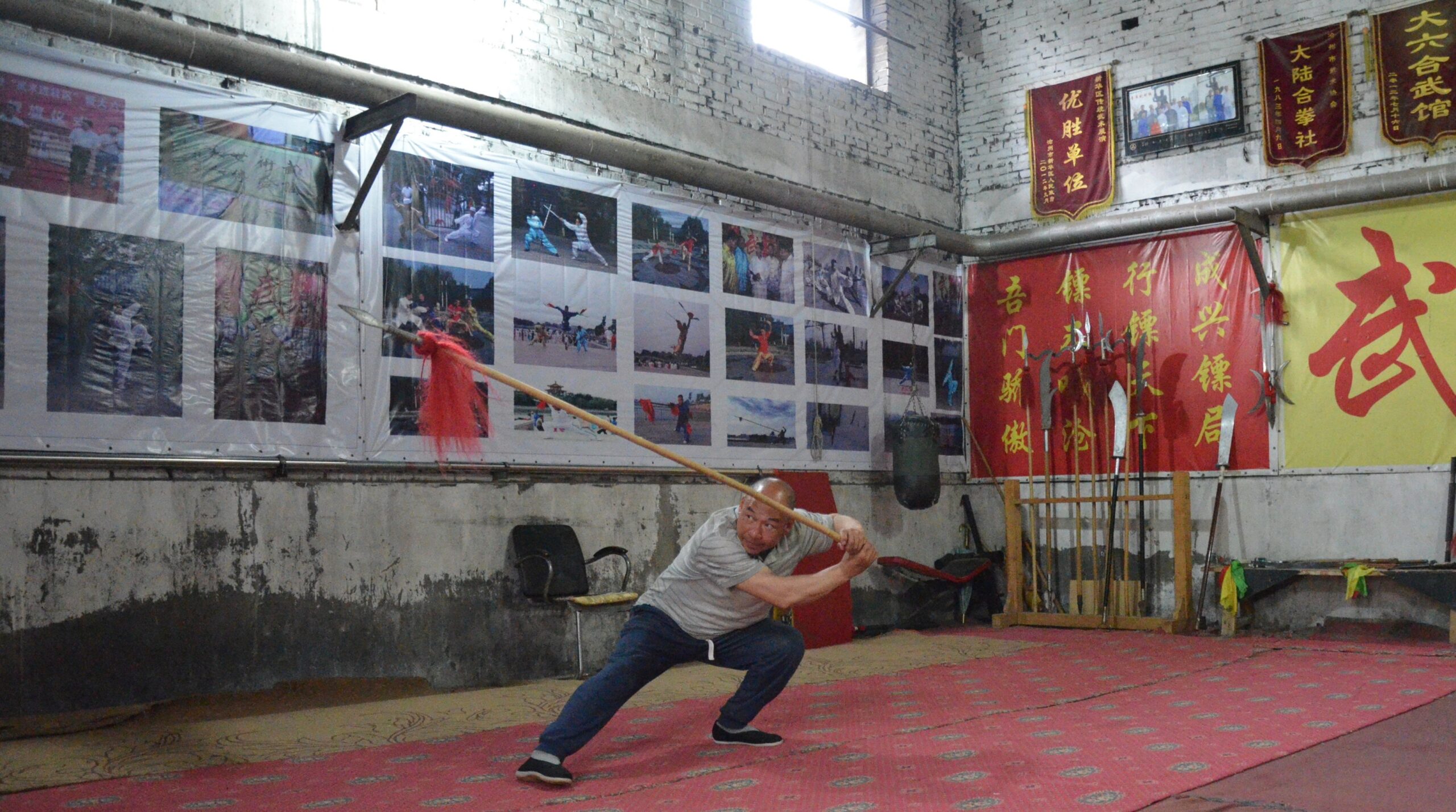
The Six Harmony Spear comes in two main types: the “flower spear” and the “large spear.” The large spear has a thick, full shaft and measures over ten feet in length, making it a weapon for those with a strong, imposing physique. The primary methods of the style are the eight “mother” techniques: hooking, hanging, coiling, seizing, frustrating, deflecting, advancing, and sealing. The style features a variety of stances and footwork, including the horse stance, bow stance, drop stance, rest stance, empty stance, crossed stance, advancing steps, retreating steps, sneaking steps, covering steps, circling steps, and leaping steps. The practice is characterized by its expansive and clear movements, precise force, and flexible, ever-changing techniques that blend offense and defense.
When holding the spear, the practitioner adheres to the four principles of “leveling”: a level head, level shoulders, level legs, and a level spear. When thrusting, the three points must be aligned: the tip of the spear aligns with the tip of the nose, the tip of the heart, and the tip of the big toe. The spear point should never stray from its target, just as a tiger never leaves the mountain. The style’s fighting methods are based on the six sealing and six closing techniques. For example, an upper thrust from the left is met with a “collapse and lean,” or a “blossoming flower covering the head.” A middle thrust is met with “coiling and seizing,” like a strong farmer chopping wood.
Li Shuting passed the Six Harmony Spear to his son, Li Zhiyun (1911-1984), the fourth-generation inheritor. Li Zhiyun was a great scholar of the art, and he refined the style by integrating the spear techniques of the Great Six Harmony School, the Wuxu Spear, and the Large Six Harmony Spear.
Li Zhiyun passed the art to his son, Li Junde, and his grandson, Li Baosheng. Li Junde continues to pass on the Six Harmony Spear, ensuring its preservation and development. He has taught his son, Li Jianming, and other students, including Ding Yulong, Xu Shuming, Jiang Yongxiang, Ma Aijun, and Wu Chanlong. Li Baosheng began practicing with his grandfather, Li Zhiyun, from a young age and is a dedicated student of the large Six Harmony Spear. For decades, he has participated in numerous martial arts competitions and demonstrations, including the Cangzhou International Martial Arts Festival, and various tournaments in Henan and Zhejiang. His performances of the large Six Harmony Spear have consistently earned him gold medals and high praise from fellow martial arts enthusiasts.
Thanks to the dedicated efforts of Li Junde and his nephew Li Baosheng, the Six Harmony Spear continues to be passed down and promoted to new generations.