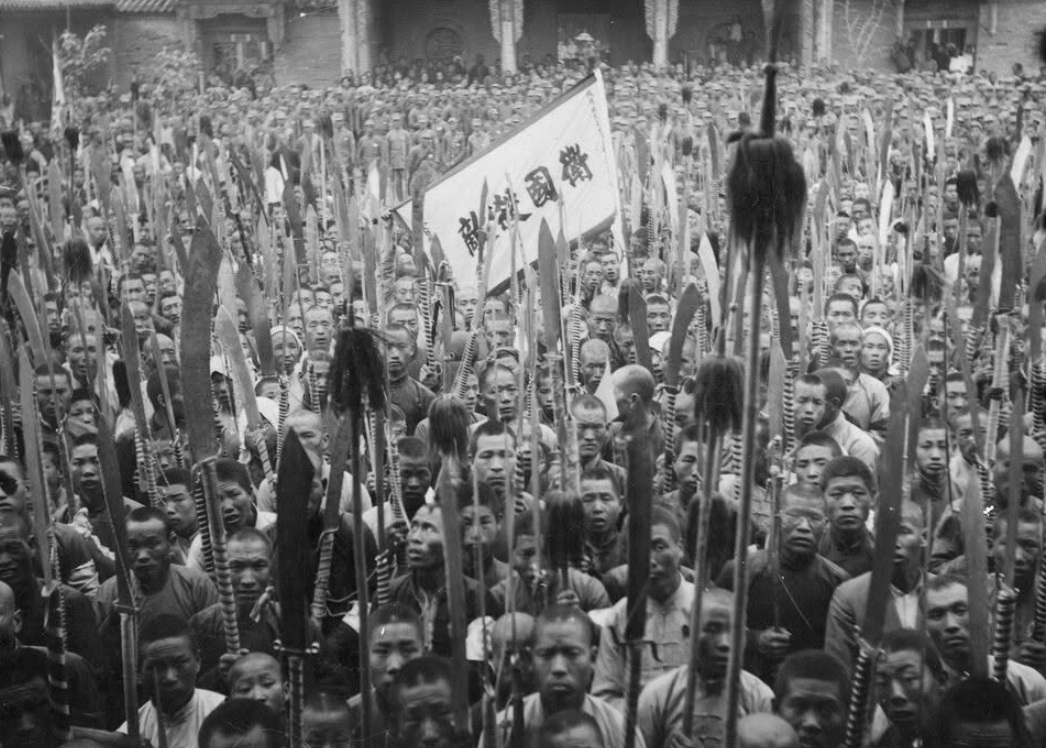
A haunting black-and-white photograph captures a moment of raw, defiant humanity in the early days of China’s full-scale war against Japanese invasion. It shows a vast assembly of ordinary peasants, farmers in tattered clothing, standing shoulder to shoulder on a dusty village field in North China. There are no uniforms, no modern rifles, no gleaming artillery. Instead, the frame is filled with a dense, bristling thicket of red-tasseled spears and broadswords raised toward the sky. At the front, a banner bears four characters that cut to the heart of their cause: “Defend the Homeland, Kill the Enemy”. These men were not soldiers by trade; they were tillers of the soil, fathers and sons who had picked up whatever weapons they could find to shield their villages and families from an invading army.
The Humble Spear That Became a Symbol of Defiance
The red-tasseled spear, hongyingqiang, was the signature weapon of this spontaneous army. It was not a sophisticated armament; it was a long wooden pole tipped with a simple iron blade, adorned with a red tassel that flickered like a flame in the wind. Yet in the hands of determined peasants, it became an iconic symbol of grassroots resistance. These spears had deep roots in North China’s rural society, where organizations like the Red Spear Society (Hongqianghui) had existed since the early Republic as village self-defense militias. When the Japanese army swept into North China after the Marco Polo Bridge Incident in July 1937, the regular Nationalist forces were forced into a hasty retreat. In the vacuum left behind, the countryside was left to fend for itself. The Communist Party, heeding the call of the Northern Bureau to “take off their long gowns and go to the villages,” mobilized farmers to form anti-Japanese self-defense units. These peasant militias transformed the humble red-tasseled spear from a farming tool into the foremost weapon of a people’s war.
Farmers by Day, Warriors by Night
Across the vast plains of North China, village after village answered the call. Men who spent their daylight hours tending crops would gather at dusk, taking up their spears and swords to guard their communities. They organized themselves into self-defense teams (zìwèiduì) that operated at the most local level, each village becoming a fortress, each family a barracks. In places like the Jilu Border Region (covering parts of today’s Hebei and Shandong), the first anti-Japanese armed forces were assembled within days of the Japanese advance. By October 1937, the North China People’s Anti-Japanese National Salvation Army had grown to over 1,500 fighters, its ranks filled with peasants armed with little more than spears and swords. “They are farmers in the fields and warriors defending their country,” the old photograph seems to say. This duality was the essence of the resistance, a war fought not by a professional army but by a mobilized nation.
A Guerrilla War Waged with Primitive Arms
The activities of these red-tasseled militias extended far beyond standing guard. With their simple weapons, they waged a persistent guerrilla campaign against a far better-equipped enemy. They conducted hit-and-run raids on Japanese patrols, sabotaged roads and communication lines, and cut enemy telegraph wires to disrupt coordination. They served as scouts and couriers, passing intelligence between villages and to regular Communist forces. In some regions, like the water networks of central Hebei around Baiyangdian Lake, militias such as the Yanling (“Wild Goose”) Team used their knowledge of the local terrain to ambush Japanese supply routes. Village blacksmiths worked day and night forging spearheads, while local gentry donated wood for shafts. Even children joined the effort, young members of the Children’s Corps stood guard at village entrances with their own miniature red-tasseled spears, checking the papers of passersby and reporting suspicious activities. The red tassel was everywhere, a visible declaration that every man, woman, and child was part of the resistance.
The Transformation of the Red Spear Societies
The phenomenon drew upon and transformed older rural organizations. The Red Spear Societies, which had emerged in the early Republic to protect villages from bandits and rogue soldiers, experienced a resurgence after 1937. These societies were rooted in local kinship networks and folk religion, but their patriotic character made them natural allies in the anti-Japanese struggle. Communist leaders like Peng Xuefeng, operating in the border region between Henan, Anhui, and Jiangsu, worked tirelessly to win them over, not through force, but through persuasion. When Peng’s troops were once surrounded by thousands of Red Spear members who believed their rituals made them invulnerable to bullets, he ordered his men not to fire a single shot. Instead, he spoke to them as fellow poor peasants, and within months, tens of thousands of Red Spear members had been won over to the anti-Japanese cause. Peng even helped rewrite the society’s anthem, replacing feudal verses with new words that still resonate today: “Red tassel spear, red tassel bright as fire / Spearhead gleaming silver light / Take up the red tassel spear / Go fight the little Japanese devils”.
An Enduring Testament to Ordinary Heroism
A century has passed since those desperate days. The red tassels have long since faded, the iron spearheads have rusted, and the men who raised them are gone. Yet the photograph endures, a frozen moment that speaks across time of a nation’s most basic instinct: to defend home and hearth when all else is lost. These peasant militias were never able to match the Japanese in firepower or training. But they possessed something that no amount of modern weaponry could overcome: an unbreakable will to resist. The forest of red-tasseled spears was not just a collection of primitive weapons; it was a declaration that the defense of China would not be left to armies alone. It would be fought in every village, by every family, with whatever tools were at hand. The photograph reminds us that the survival of a nation, in its darkest hour, depends not on the sophistication of its arms but on the courage of its ordinary people, farmers who became warriors, and a countryside that became a fortress.