Imagine an elite sprinter exploding from the blocks, a tennis player unloading a forehand winner, or a mixed martial artist throwing a perfectly timed cross. In the blink of an eye, each athlete accomplishes two distinct yet inseparable physiological tasks: generating raw mechanical force, and efficiently transmitting that force to the point of action. Modern sports science describes these tasks using the clinical terminology of posterior chain dominance and kinetic chain coordination. But long before electromyography machines and motion-capture laboratories, Chinese martial arts theory had already crystallised the exact same biological truths into two elegant, functional principles: Tongbei (通背) and Liuhe (六合). Understanding these ancient concepts not only validates contemporary sports medicine but offers a holistic framework that can elevate training and prevent injury across every athletic discipline.
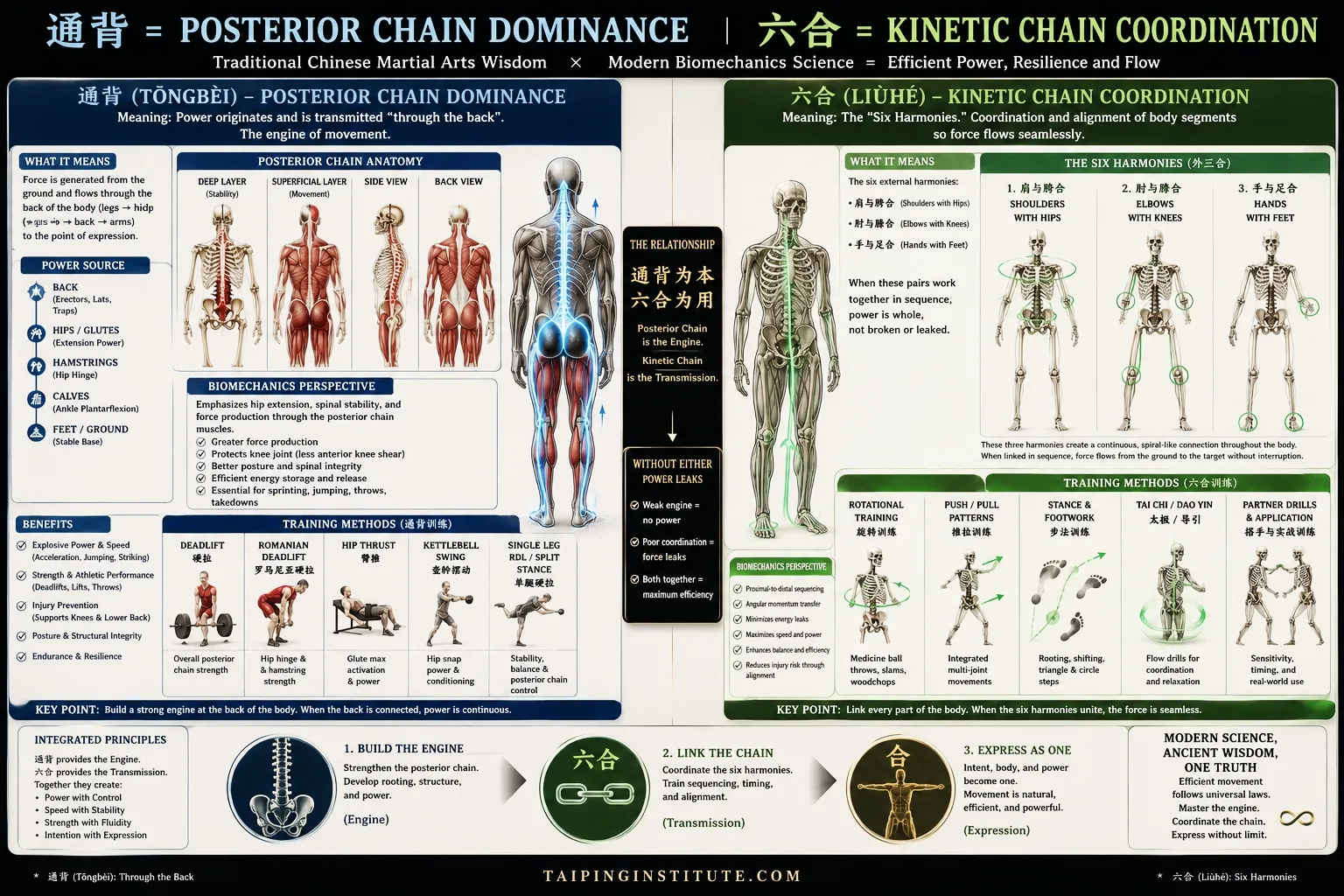
At its core, Tongbei, which translates literally to “through the back,” is the body’s primary engine. In scientific terms, it describes posterior chain dominance: the synergistic network of muscles running along the entire rear of the human frame, encompassing the calves, hamstrings, gluteus maximus, erector spinae, multifidus, and latissimus dorsi. This fascially-connected system is fundamentally responsible for hip extension, spinal stabilisation, and the generation of explosive ground reaction forces. Whether a weightlifter drives a deadlift off the floor or a karateka delivers a side kick, the posterior chain acts as the power plant. Studies in biomechanics repeatedly confirm that athletes with pronounced posterior chain strength exhibit superior vertical leap performance, optimised hamstrings-to-quadriceps ratios that drastically lower the risk of cruciate ligament injuries, and improved correction of anterior pelvic tilt, which is a known contributor to chronic lower back pain. Tongbei’s emphasis on issuing power “from the back, through the shoulders, to the extremities” is not esoteric mysticism; it is a precise anatomical roadmap to the body’s most potent source of kinetic energy.
However, raw power is useless without a transmission system to deliver it, and this is where the principle of Liuhe, or the “Six Harmonies”, becomes critical. In traditional Chinese martial arts, the six harmonies are divided into three external and three internal coordinations. The external harmonies specifically dictate that the shoulders must harmonise with the hips, the elbows with the knees, and the hands with the feet. This is not merely a poetic metaphor; it is a fundamental biomechanical rule for kinetic chain sequencing. Modern kinesiology defines the kinetic chain as the precise coordination of positioning, timing, and speed across multiple moving segments. When a pitcher throws a baseball or a badminton player smashes a shuttlecock, force must travel sequentially from the ground, up through the ankles, knees, and hips, across the lumbopelvic-hip complex, and finally out through the shoulder, elbow, and wrist. Liuhe ensures that this sequence remains unbroken. It creates a rigid yet fluid mechanical linkage where each joint locks out at precisely the right moment to transfer momentum to the next, much like the segments of a whip cracking in succession.
If Tongbei is the engine and Liuhe is the transmission system, then athletic performance is the result of their seamless integration. A powerful posterior chain means nothing if the kinetic chain is leaky; a disconnection at the shoulder-hip axis, for instance, allows precious mechanical energy to dissipate as heat or compensatory trunk rotation rather than reaching the fist or foot. Sports science refers to this loss as “energy leakage,” and it is a primary culprit in overuse injuries. When a segment fails to stabilise due to poor coordination, the downstream joints, such as the rotator cuff in throwers or the patellar tendon in runners, must absorb excessive loads, leading to pathological breakdown. This perfectly mirrors the martial arts adage that “the force is generated by the back but transmitted via the harmonies.” In practice, a fighter who practices Liuhe ensures that their hip rotation initiates the punch, their core stabilises the trunk, and their shoulder acts merely as a conduit, thus preserving the shoulder joint from undue stress while maximising the force delivered to the target.
Remarkably, the dialogue between these classical principles and contemporary empirical research is growing louder. Recent cross-sectional studies examining sex-based differences in posterior chain activation have found that neuromuscular strategies vary significantly, yet the fundamental requirement for sequential coordination remains universal. Furthermore, myofascial continuity, particularly along the dorsal line that Tongbei emphasises, means that a restriction in the plantar fascia of the foot can directly alter hamstring and lumbar mechanics during sprinting, a phenomenon that would be immediately recognised by a traditional Chinese medicine practitioner as a blockage within the Liuhe framework. This has profound implications for rehabilitation; treating an injured shoulder in isolation is often futile if the hip and core on the same side are not simultaneously retrained to maintain the six external harmonies.
For coaches, athletes, and physiotherapists, embracing the synergy of Tongbei and Liuhe offers a pragmatic blueprint for training. It shifts the focus away from isolated bodybuilding and toward compound, closed-chain movements like deadlifts, squats, and unilateral lunges, which simultaneously forge posterior chain power while forcing the kinetic chain to coordinate under load. It also underscores the critical importance of the lumbopelvic-hip complex as the intersection of the engine and the transmission. Ultimately, the ancient adage that “you are only as strong as your weakest link” is not just a philosophical warning; it is a strict physical law. By treating Tongbei as the generator and Liuhe as the conduit, we allow power, speed, stability, and efficiency to converge into a singular, integrated expression of human movement, proving that the most advanced sports science is, at times, simply a rediscovery of the wisdom already encoded in the forms and principles of the martial arts.
Cangzhou Liuhe Quan: The Embodiment of the Transmission
Liuhe Quan (Six Harmonies Boxing), which originated in Cangzhou over 400 years ago during the late Ming dynasty, takes the principle of Liuhe as its very foundation and technical core. The style’s name is not arbitrary; it is a direct reflection of its guiding philosophy. In Xinyi LIuhe, Xingyi Quan and Chuojiao, these principles are also ever present. The “six harmonies” it references are precisely the external coordinations we recognise in modern sports science: the hand with the foot, the elbow with the knee, and the shoulder with the hip. The goal of practice is to achieve the “Liuhe Jin” or “six harmonies power,” a force that is described as being “issued from the foot, braced by the leg, rushed through the hip, twisted by the waist, delivered through the shoulder, and opened by the hand”. This is a word-for-word description of a perfectly sequenced kinetic chain. (note: There are more advance elements of Liuhequan that we will cover in a separate article).
The Liuhequan system’s history is deeply intertwined with the practical demands of the martial world. It was a core art taught to and practised by the security escorts (biaoshi) of the Beijing-Tianjin region, who required this coordinated power for their very survival. Its effectiveness is legendary, with a lineage that produced such towering figures as the renowned swordsman “Big Sword Wang Wu” (Wang Zhengyi), who was taught by Li Fenggang, and Li Guanming, whose formidable skill earned him the fabled accolade “no one dared to shout the escort cry in Cangzhou”. In Liuhe Quan, the harmony is not just an ideal; it is a rigorously trained, battle-proven methodology for ensuring that the power generated by the body is transmitted without loss to its final destination.
Qi Style Tongbei Quan: Mastering the Engine
If Liuhe Quan perfects the transmission, then Qi Style Tongbei Quan (祁家通背拳) masters the engine. Created by Qi Xin of Hebei province during the Daoguang era of the Qing dynasty, this system took the principle of Tongbei to its highest expression. It fuses the harmonising principles of Liuhe Quan with the devastating power generation of great spear (da qiang) techniques. The very name, Tongbei, meaning “through the back”, signifies its core premise: power is generated from the back and emitted through the arms. This concept is also like liuhe applied across many styles such as Shaolin Tongbei, Jinghai Taizu Tongbei and others. In terms of Qi style Tongbeiquan, its techniques are characterised by large, expansive movements, emphasising the principle of “fang chang ji yuan” (放长击远), or “extending long to strike far”. The goal is to develop a whip-like power, where the body acts as a single, integrated unit. The system’s methods for forging this engine are extensive and systematic, built upon a foundation of dan cao (single-practice drills) and sanshou (free-fighting techniques), with forms serving a secondary role. The legendary master Xiu Jianchi, a fourth-generation inheritor, spent his life refining the art, eventually codifying the comprehensive Xiao Qi Pai or Wuxing Tongbeiquan (Five Elements Through-the-Back Boxing) system. In Qi Style Tongbei, the training is a relentless pursuit of generating maximum mechanical force from the body’s most powerful structural network.
A Living Legacy of Science
What makes these systems so remarkable is their organic, empirical development. They were not created in a laboratory but were forged in the most unforgiving of testing grounds: the battlefield, the secruity logistics escort business, and raw combat. The fact that Qi Style Tongbei Quan explicitly integrates Liuhe principles with its power-generation methods shows that these masters understood that a dominant engine is useless without a coordinated transmission. This is why the art encompasses not just empty-hand techniques but also weapons like the liuhe da qiang (six harmonies great spear), where the coordination of the entire body is paramount. Today, the legacy continues. Cangzhou Liuhe Quan is recognised as a national-level intangible cultural heritage, while Qi Style Tongbei Quan holds provincial status in Liaoning. The systems are now practiced worldwide, not just as martial arts, but as a profound and effective form of physical education and holistic health cultivation. Their enduring power is a testament to a simple truth: when you perfect the engine (Tongbei) and the transmission (Liuhe), you create a machine of unparalleled efficiency, proving that the most advanced principles of human movement were not discovered, but remembered.