Few institutions in early modern history rival the Eight Banners (八旗, Baqi) in ambition or consequence. Created by Nurhaci (努尔哈赤) in 1601 out of the traditional Jurchen (女真) hunting party, the banner system began as a modest solution to a modest problem: how to organize a growing following of warriors whose primary loyalties ran to kin and clan rather than to a state. Within half a century, it had become the skeleton of the Later Jin (后金) state and then of the Qing dynasty (清朝), which used it to conquer Ming (明) China and to govern the largest and most diverse empire East Asia had ever seen. By 1642 the “Eight” Banners were in fact twenty-four: eight Manchu (满洲八旗), eight Mongol (八旗蒙古), and eight Han Chinese (汉军八旗), and by 1644 roughly two million people lived inside the system. The Banners were not merely an army but a total social technology: the ultimate mechanism by which Manchu, Mongol, and Han cultures were bound into a single, cohesive, conquering superpower, even as the system itself slowly calcified into a gilded burden on the state it had created.
From Hunting Party to State Apparatus
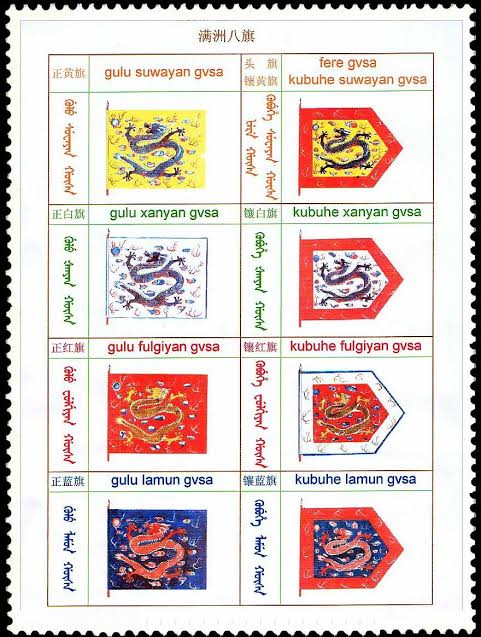
The Banners grew organically from Jurchen life. Nurhaci’s earliest followers were organised in small hunting parties of roughly a dozen men linked by blood, marriage, clan, or place of residence, the classic Jurchen custom. What Nurhaci did in 1601 was to take this familiar, intimate unit and scale it into a permanent, registered, state-owned structure: companies known as niru (牛录), each of 300 households, five companies forming a battalion and ten battalions a banner. Four banners were created first: Yellow, White, Red, and Blue, each named for the colour of its flag; in 1615 the system was doubled through “bordered” variants, producing the canonical eight.
The genius of the design was that it solved the fundamental weakness of tribal society: personal, shifting loyalty. Manchurian society was organised by clans and tribes whose allegiance could be bought, inherited, or lost. The Banners transcended these divisions, reorganising entire households – warriors, families, and slaves, into units defined by allegiance to Nurhaci and his appointed commanders. Defeated tribes could be absorbed simply by adding companies, which in turn reorganised them beyond their old clan affiliations. The banner was thus simultaneously a regiment, a census, a welfare system, a court of law, and a school of loyalty. In war it was an army; in peace it was society itself.
Incorporating the Mongols
The first great expansion of the system beyond the Jurchens came from the steppe. From the late 1620s, as Nurhaci’s heir Hong Taiji (皇太极) expanded the Later Jin across the Northeast Plain, nomadic Mongol cavalrymen, particularly of the Kharchin (哈剌沁) and Khorchin (科尔沁) tribes, and later some Chahars (察哈尔), were incorporated into the ranks, some through formal sworn alliances as early as 1622, others through piecemeal submission as small groups came to recognize the Jurchen leader as their khan.
In 1635, the same year Hong Taiji renamed his people from Jurchen to “Manchu” (满洲), these Mongols were separated into the Mongol Eight Banners, formally constituted with about 10,000 warriors. The move was as ideological as it was organizational: Mongol participation was essential to Manchu leaders who wished to present themselves as successors to Genghis Khan. Mongol noblemen joined the shamanic rituals of the imperial Aisin Gioro (爱新觉罗) lineage, and the Qing state patronized publications celebrating Mongol identity such as the Secret History of the Mongols. The Banners thus wove the steppe aristocracy into the very ritual core of the dynasty, converting a historic threat on China’s northern frontier into the empire’s cavalry arm.
Incorporating the Han: The Decisive Ingredient
The second , and ultimately largest, expansion came from the Han population of Liaodong (辽东). Han Chinese first entered the Banners as replacements for fallen Jurchen soldiers; as their numbers grew, they were grouped into the “Old Han Army” (旧汉军), used mainly as infantry support. The capture of Yongping (永平) in 1629 yielded a contingent of surrendered Ming artillerymen, organized in 1631 under the Han commander Tong Yangxing (佟养性) into a separate artillery corps, which proved decisive in defeating the Ming general Zu Dashou (祖大寿) at the siege of Dalinghe (大凌河) that same year. Four more Han banners followed in 1639, and by 1642 the full eight Han banners, the ujen cooha , were established.
This was more than recruitment; it was assimilation in both directions. Han bannermen, many of them prisoners of war or defectors, married Jurchen women and mixed their cultures with those of their Liaodong neighbors; some forged genealogies or chose whether to enroll under a Jurchen or a Han banner. Defectors were honored spectacularly: the early defector Li Yongfang (李永芳) was ennobled as a viscount and enrolled in a banner, and ethnic Han generals who defected were often given women of the imperial Aisin Gioro family in marriage, while ordinary soldiers received non-royal Manchu wives. The result was a genuinely hybrid elite: figures such as Geng Zhongming (耿仲明) rose to such prominence under the Shunzhi (顺治) Emperor that they were “barely distinguishable from Manchu nobility.”
The scale of this integration is startling. So many Han defected and swelled the Banners’ ranks that by 1648 ethnic Manchus were a minority within the system, only about 16%, while Han bannermen made up roughly 75% and Mongols the rest. The “conquest elite” that took Beijing (北京) in 1644 and defeated the rebel Li Zicheng (李自成) at the Battle of Shanhai Pass (山海关), alongside the Ming defector Wu Sangui (吴三桂) , was thus itself a Manchu–Mongol–Han composite. The Qing did not conquer China despite being a small minority; it conquered China through a machine that turned conquered and allied peoples into stakeholders.
One System, Three Cultures: The Mechanics of Cohesion
What made the Banners a blending mechanism rather than merely a coalition was their institutional uniformity. Each of the three ethnic divisions replicated the same eight color banners and the same company structure, so that a Khorchin Mongol, a Han artilleryman, and a Manchu archer occupied parallel, interacting positions within one architecture. Gunpowder weapons, muskets and artillery, were specifically the domain of the Han banners, Mongol cavalry provided mobility, and Manchu horse-archers provided the shock core: an ethnic division of labor that made each group indispensable to the whole. Status flowed through the system too: bannermen of all three groups received stipends, land, and legal privileges that separated them from the civilian population, though Manchu and Mongol bannermen enjoyed better material support and mobility than Han-martial bannermen.
Crucially, banner identity itself became a new kind of ethnicity. Until the Qianlong (乾隆) Emperor reasserted ethnic classifications, identity within the system was defined far more by culture, language, and participation in the Banners than by descent; anyone not sorted into a Mongol or Han banner simply became “Manchu.” The Qing enforced a policy of separate governance, bannermen were never listed on the civilian register, so that “Banner” (旗) and “civilian” (民), not “Manchu” and “Han,” became the fundamental legal divide of Qing society. In this sense the Banners did not erase the three cultures; they submerged them into a single superordinate identity, loyal to one ruling house, that could draw on the martial traditions of the forest, the steppe, and the farmland at once.
To maintain administrative clarity while incorporating massive populations, the Qing court divided the system into three ethnic components, all utilizing the same eight color-coded flags (such as Plain Yellow, Bordered White, and Plain Blue). The Manchu Eight Banners (Baqi Manzhou): The core of the empire. They primarily served as the elite heavy cavalry, imperial palace guards, and the top-tier political administrators of the state. The Mongol Eight Banners (Baqi Menggu): Established in 1635. They provided legendary light cavalry, rapid scouts, and archers, binding the fierce nomadic tribes of the steppes to the Qing throne. The Han Eight Banners (Hanjun): Formed fully by 1642. These were not standard civilian Chinese, but elite artillerymen, infantry support, and engineers (often defected Ming troops) who provided the heavy gunpowder technology necessary to breach walled Chinese cities.
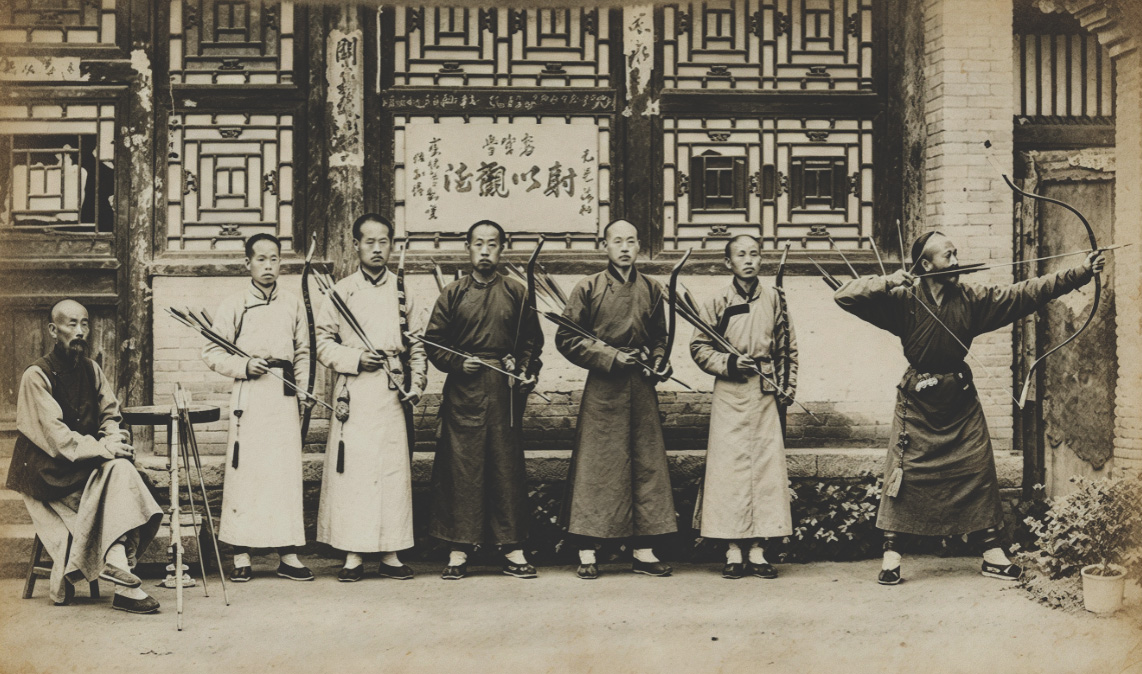
The Eight Banners did not just march together; they functioned as a hereditary, lifelong parallel society that separated “Bannermen” from ordinary civilian commoners. This institutional segregation forged a unique, blended hybrid culture. Han Chinese and Mongol bannermen were legally required to learn the Manchu language and master mounted archery. Conversely, because Han bannermen comprised a massive percentage of the early Banner population, they introduced Chinese bureaucratic forms, dietary habits, and literary styles directly into the daily lives of their Manchu neighbors.
A New “Upper Class” Identity: Over generations, the cultural lines between a Manchu, a Mongol, and a Hanjun (Han martial) bannerman began to blur. They lived in exclusive, state-subsidized garrison cities (like the Inner City of Beijing), drew imperial stipends, and intermarried within the broader Banner system. The Legacy of “Manchu” Identity: The blending was so complete that by the late Qing Dynasty, the term “Manchu” ceased to mean just a pure ethnic lineage. Instead, it became synonymous with anyone registered under the Eight Banners, meaning millions of modern-day descendants of “Manchus” actually trace their ancestry back to the Han or Mongol soldiers of the Hanjun.
Garrison Empire and the Long Decline
After the conquest, the Banners became an instrument of occupation. The largest garrison was Beijing, where over 100,000 bannermen and their families were settled in the inner city, what Western observers called the “Tartar city”, with elite units such as the Firearms Brigade (火器营) around the palace; a national garrison network stationed banner troops in strategic cities across China proper to police the commoners. Alongside them served the Green Standard Army (绿营), the vast Han force that remedied the Banners’ manpower limits of roughly 100,000 men; the two armies together formed a complementary system of elite mobility and mass presence.
Yet the very completeness of the system sowed its decline. Legally prohibited from trade or manual labor, bannermen depended on stipends whose purchasing power eroded; garrison posts were fixed in number while the banner population grew, swelling the ranks of unemployed xiansan (闲散) bannermen. Indebtedness and poverty appeared among Beijing Manchus as early as 1655; by the late eighteenth century many bannermen had become impoverished pensioners unable to ride or shoot, and Qianlong even permitted some to leave the Banners altogether. The failure of the once-elite banners to suppress the Taiping Rebellion (太平天国) in the mid-nineteenth century destroyed their military reputation; by the late 1800s defense had passed to regional Han armies such as the Xiang Army (湘军). When the dynasty fell in 1912, banner stipends were abolished and the institution that had defined a people for three centuries vanished, leaving its former members to poverty and discrimination.
The Eight Banners deserve to be understood as one of history’s most successful experiments in synthetic nation-building. Born from a Jurchen hunting party, the system scaled personal loyalty into bureaucratic structure, then deliberately folded in the cavalry aristocracy of the Mongols and the infantry, artillery, and administrative talent of the Han. It made conquered peoples into shareholders of conquest, gave them a common legal identity distinct from the civilian masses, and harnessed the complementary military strengths of forest, steppe, and farm into a single war machine that took the Ming empire and then held it for over two and a half centuries. Its later decay, the stipend-fed garrison poverty, the loss of martial skill, the fiscal drag of a hereditary warrior caste, does not diminish the originality of the design; rather, it illustrates the fate of an institution that conquered an empire and then had to live in it. The Banners were, in the truest sense, the ultimate mechanism by which Manchu, Mongol, and Han cultures were blended into a cohesive superpower: not by melting them down, but by wrapping them in a single banner-cloth of shared service, privilege, and allegiance.
Cangzhou Tong Family
The story of the Banners did not end in 1912 with the abolition of stipends; it flowed into modern China through individual lives. One of the clearest examples is Tong Zhongyi (佟忠义, 1879–1963), styled Liangchen (良臣), a Manchu master of the Tunggiya (佟佳) clan whose biography reads as a micro-history of the banner system itself, from the conquest to the garrison, to the fall, to the transformation of banner arts into a national heritage.
Tong’s ancestry traces directly to the foundation of the empire. His family belonged to the Tunggiya (佟佳) clan, an elite Manchu lineage registered under the Plain White Banner (正白旗) , one of the three “Upper Banners” commanded directly by the emperor. His founding ancestor, Yanqing Jueluo Tong Guorong (燕青觉罗 佟国荣 ), was a banner soldier who rode with the Manchu imperial family through the Shanhai Pass in 1644 as the Qing breached the Great Wall and established control over China proper, and who then settled his line in Cangzhou (沧州), in Hebei (河北) Province.
Note: In 1583, Nurhaci’s cousin (the granddaughter of Giocangga) was married to Atai, the Chieftain of Gule Castle. When the castle fell, her family survivors integrated directly with the regional forces. The ruling family of the Qing Dynasty created the surname “Aisin Gioro” (爱新觉罗) to build their imperial status. Before this, they were known simply as the “Aisin” (Gold) family, who were a branch of the Tunggiya / Tong (佟 / 童) clan. In fact, historical documents like the Korean 建州纪程图记 confirm that Nurhaci himself officially used the surname Tong (佟努尔哈赤) when dealing with foreign governments. Gioro (觉罗 / ġioro), originally meant a leader or a distant branch, and that many different sub-branches developed names based on their Mukun (clan branch based on place or status), such as Irgen Gioro (伊尔根觉罗), Shushu Gioro (舒舒觉罗), and Tongyan Gioro (通颜觉罗). During the late Ming Dynasty, the Yanja (颜扎) clan was a major Jurchen group. When the 1583 battle took place at Gule Castle, the families fighting alongside Atai against the Ming were fractured. When these northern tribes eventually registered in Chinese characters, the Manchu branch name “Yanja-Gioro” (颜扎觉罗) was written down phonetically using similar-sounding Chinese characters: “燕青觉罗” (Yan-qing Jue-luo). Following the fall of Gule Castle, surviving Jurchen households from the Yanja-Gioro (phonetically rendered as 燕青觉罗) group were fully integrated into the growing military banner system under Nurhaci. Because the ruling house and its close military allies originally shared the broader ancestral link to the Tong (佟) name, this specific family branch used the single character Tong (佟) for their local Chinese registrations. When the first ancestor entered China proper in 1644, his full legal, ethnic designation was written as 燕青觉罗·佟国荣
For over three hundred years the family transmitted both martial arts and medicine, opening a martial hall that taught hand-to-hand combat alongside bone-setting (正骨), acupuncture, and tuina massage, a classic banner household economy in which the healer’s art and the warrior’s art were two halves of one profession. The choice of Cangzhou was consequential. As a garrison town seeded with professional banner martial lineages, Cangzhou evolved into China’s single most famous focal point of traditional martial arts, so renowned for its fighters and security escorts that, as the local saying went, escort bureaus had to lower their flags when passing through.
Because bannermen were legally and socially distinct from civilians, prohibited from trade and farm labor, maintained by the state for war, physical readiness was not a hobby but a caste obligation. Tong began his education at age six under his father, Tong Cun (佟存), a Liuhequan (六合拳) expert and disciple of Tian Kechun (田春奎) who ran the Tianxing Security Bureau (天兴镖局) in Shenyang (沈阳). From his Manchu family he inherited the banner staples: mounted archery and shuaijiao (摔跤, Chinese wrestling) and he later travelled expressly to learn the fast, brutal Baoding (保定) shuaijiao method favored by the Qing military, even studying Mongolian wrestling from a martial brother: a curriculum that mirrors, at the individual level, the tri-ethnic Manchu–Mongol–Han division of martial labor built into the banner system itself. His mastery was comprehensive. He held the true transmission of the Cangzhou Da Liuhe Men (大六合门, Great Six Harmonies School) boxing, integrated the family’s inherited qinna (擒拿, joint-locking) and wrestling into a distinctive “Tong-style” method summarized as “first strike, second seize, third throw” (一打二拿三摔), and mastered over a hundred routines in sword, sabre, staff, spear, and paired weapons, alongside the mandatory banner disciplines of military equestrianism, heavy spear technique, and archery. Such was his reputation that he performed boxing and wrestling before the palace and was named a “Hall-Standing General” (站殿将军), and contemporaries called him “Divine Leg Tong” (神腿佟) and the “King of Shuaijiao”.
Tong’s career spanned the collapse of his dynasty and the birth of modern China, converting a hereditary banner education into a public legacy. In 1900 he served as a bone-setting medical officer in Huairen (怀仁) County in the Northeast; in 1902, in the dying days of the Qing, he became chief martial arts instructor of the Beijing Patrol and Police Battalion (京城巡捕营); in 1909 he was appointed instructor of wrestling and orthopedic medicine to the Imperial Guard at Nanyuan (南苑) barracks; and in 1910 he served as head martial arts instructor at the Baoding Military Academy (保定军校) , the cradle of the Republican officer corps. At Baoding he also absorbed new arts into the old banner repertoire, learning the Daoist “Eight Immortals Sword” (八仙剑) from a Daoist of exceptional skill while serving in the garrison of the warlord Cao Kun (曹锟), where he held command in the famous “Miao Dao Battalion” (苗刀营) of Cangzhou-born two-handed sabre men.
After the Xinhai Revolution (辛亥革命) destroyed the stipend system that had sustained banner families for centuries, Tong did what thousands of bannermen could not: he converted his caste inheritance into modern professions. He worked as an instructor to militia and army units through the early Republican years, then accepted an invitation to teach in Shanghai in 1922, formally founding the Zhongyi Martial Arts Society (忠义拳术社) in 1925, one of the first schools to systematize the once-guarded banner curriculum for the general public.
In 1928 he became director of the Shaolin Section and wrestling coach of the Shanghai Guoshu Academy (上海国术馆), and in the national examination at Nanjing (南京) he ranked among the top grade, defeating, among others, the Sichuan master Wu Shaoji, while his written works, including The Method of Chinese Shuaijiao (《中国摔角法》), systematically published the once-secret techniques of the Plain White Banner tradition to the nation for the first time. His teaching creed in the Essentials of the Martial Arts (《武术须知》) “love the nation, defend the nation’s rights“; “keep faith and honor righteousness; prize simplicity” shows a banner loyalist transmuting dynastic allegiance into modern Chinese patriotism.
Tong Zhongyi thus closes the this article. The same institution that organized Nurhaci’s hunting parties, absorbed the Mongol cavalry and the Han artillery, and garrisoned Cangzhou with hereditary soldier-healers, ultimately poured its last, most durable gift into the body of the modern Chinese nation: not an empire, but a martial heritage, Mongol wrestling, Manchu archery, and Han boxing fused into a single art, carried out of the fallen garrisons and into the public schools of the Republic. The banners as a military system died in 1912; as a cultural system, they survive every time a student takes a shuaijiao grip on a mat in Shanghai, Beijing, or Singapore.
Appendix:
1st Generation (1644) Tong Guorong (佟国荣) First Ancestor; Banner Cavalryman.
2nd Generation Tong Zhenhai (佟振海) Early Garrison Guard, Grand Canal Security.
3rd Generation Tong Keyong (佟克勇) Banner Guard, Strict military mandates of the Plain White Banner system, specializing in mounted archery.
4th Generation Tong Wanxuan (佟万选) Imperial Guard: Marksman Officer. Grand Canal trade routes
5th Generation Tong Zhendong (佟震东) Canghou Sub-Garisson Elite Wrestler; Martial Innovator.
6th Generation Tong Cun (佟存) Founder of the Tianxing Escort Bureau; Master of Liuhequan.
7th Generation Tong Zhongyi (佟忠义) The Imperial Guard Instructor; “Wrestling God.”
8th Generation Tong Peiyun (佟佩云) Olympic Archery, Singapore TCM Physician, Women’s Wrestling Champion 1948, Gold Medal Archery 1957
To learn about the landscape of China throughout history, note the tool below :