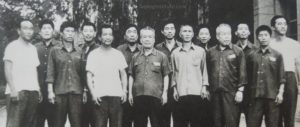
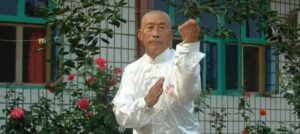
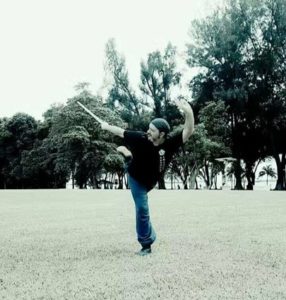
Chou Deji (仇德基 Chow Tak Gei) is an inheritor of Futsan Pak Mei, having learnt from both his father Chou Taisheng (仇太生) and martial uncle Liu Shaoliang (刘少良) whom where taught by Chou Deiji’s grandfather, Chou Wu (仇乌). Liu Shaoliang had also studied Choy Li Fut in addition to Pak Mei. Chou Wu (仇乌) studied under Xia Hanxiong (夏汉雄), who was one of the early disciples of Pak Mei Pai founder, M Zhang Lichun (张礼泉 Cheung Lai Chuen ).
Today, it is recognized that Chou Taisheng was the earliest practitioner of Pak Mei to teach in Futsan, can you explain the situation there at the time ?
Chou: After liberation, Father taught Pak Mei boxing as a means of supporting the family. In those days usually fees were charged monthly, I cannot recall the exact amount. There were very few students/disciples until Master Liu (Liu Shaoliang) came, thereafter the Pak Mei style was more widely practiced.
What is the difference between your father’s and Liu Shaoliang’s Pak Mei ?
Chou: Master Liu empasized fast and dynamic hand techniques whilst my father stressed the importance of power and weapons practice. Father often would mention that Master Liu’s skills were better and that is why he wanted me to also become a disciple of Master Liu.
You must have accepted quite a few students/disciples of Pak Mei right ?
Chou: I took students on from a very young age, in addition to the Futsan Jingwu association and the Futsan Martial arts association where I was the Coach for over 3 years, but the students usually take it for granted. In fact, there are very few in Futsan who really are interested in Pak Mei. However, there are many foreigners who are obsessed with Pak Mei, and I came across who had a lot of passion for studying our boxing. Some from nearby countries, like Malaysia and Singapore came to study our Futsan style, having studied Pak Mei previously. There was one specific foreign student who studied one routine (set) with me, a few years later he made the special trip of returning all the way from Argentina to ask me to teach him another routine. When he first came he could not speak chinese, but second time round he learnt to say “”Shifu'” to me and even showed pictures highlighting my father as “Zhe shi Shi Gong”” (This is grand master).
So how is the popularity and development of Pak Mei in Futsan today ?
Chou: In comparison to other boxing styles, today in Futsan there not many who study Pak Mei. It is likely that amongst all the counties in the city there are around 100 or so students/practitioners. In terms of really having a martial arts school for Pak Mei, only Liu Shaoliang son Liu Weiji opened a “Liu Shaoliang Memorial Hall”.
Why are there so few practitioners ?
Chou: This is actually a problem related to society and the pressures of other interests or objectives in modern life.
So are you dissappointed with the state of Pak Mei then ?
Chou: There can’t really be dissappointments since history always experiences it’s ups and downs. It would be a hope for me that in Futsan some sort of Pak Mei boxing centre could be establshed and that many more people do not think of it as just a hobby or casual activity since such a mindset is likely to change. Rather, I hope that they could embrace it as a form of life.
In terms of the content, Chou Deji highlighted that the most representative boxing are the Sup Ji Kuen, Gao Bo Toi, Sup Bat Mo Kiu and Fu Bo. The Sup Ji Kuen is seen as the most basic, yet it should not be seen as easy since its practice is very challenging. Gao Bo Toi is the most representative of the Pak Mei style, it has 9 basic hand methods, and each of the hand methods have nine variations which total over 81 combinations. Other than this, there is the Fu Bo (Tiger Step) which is considered highly powerful and specialized.
Appendix: Futsan Pak Mei and the Qiu Family
White Eyebrow Boxing (白眉拳) began to spread among the people by Zhang Liquan (张礼泉), and in Guangzhou (广州) taught Xia Hanxiong (夏汉雄), Xia Hanxiong then taught Qiu Taisheng (仇太生), and Qiu Taisheng then brought it into the old urban area of Foshan (佛山老城区).
Qiu Taisheng was a native of Chongbei Village (崇北村) in Gaoming (高明). From childhood he loved martial arts and once studied Hong Quan (洪拳) and other skills with village elders and his father’s younger cousin Qiu Wu (仇乌). At sixteen he followed his father to Guangzhou (广州) to make a living and worked in jade processing.
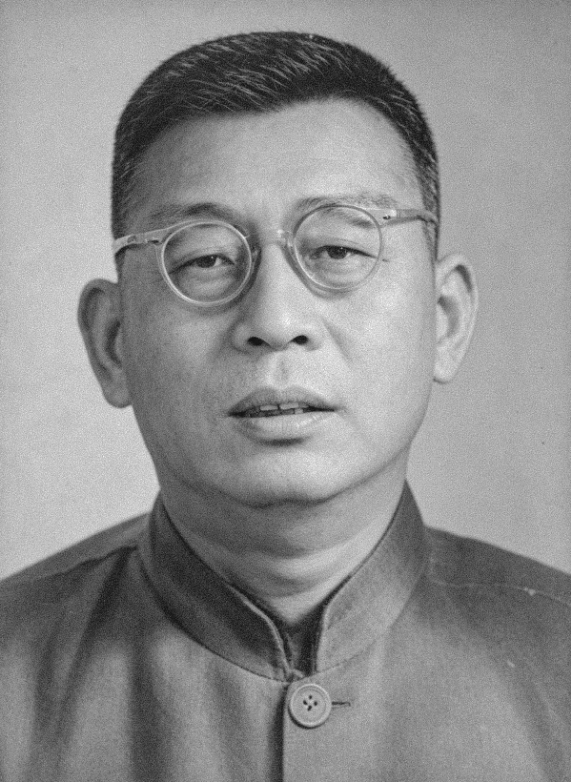
Qiu Wu (仇乌) recommended Qiu Taisheng (仇太生) to his own teacher, also a fellow townsman, Xia Hanxiong (夏汉雄), to study medicine. Xia Hanxiong was a favored disciple of Zhang Liquan and opened a medical clinic in Guangzhou. Qiu Taisheng often used his spare time to study medicine at the clinic. Because he was naturally intelligent and diligent in learning, Xia Hanxiong accepted Qiu Taisheng as a disciple and taught him White Eyebrow Boxing (白眉拳). Over several years he developed fine skill, especially outstanding in the weapon routines of the double headed staff (双头棍) and single headed staff (单头棍), and he also trained well in the single saber (单刀) and double sabers (双刀). In medicine, especially in dit da trauma treatment, he received Xia Hanxiong’s true transmission.
At the same time, he received guidance from Xia Hanxiong’s senior brother Ge Zhaohuang (葛肇煌). He not only mastered boxing routines such as “Fierce Tiger Emerges from the Forest” (猛虎出林), but also gained a glimpse of the mysteries of Zhang Liquan’s White Eyebrow Boxing. He gained deeper understanding of techniques such as “Mo Xi Palm” (摩吸掌) in Nine Step Push (九步推) and “Chuan Mo” (穿摩), “Gou Mo” (勾摩), “Lan Mo” (拦摩), “Na Mo” (捺摩), and “Mo Suo” (摩锁) in the Eighteen Mo Bridges (十八摩桥).
During the War of Resistance Against Japan (抗日战争), before the south fell, Qiu Taisheng returned to Foshan to work and marry, living at No. 21 Suoyi Street (簑衣街21号) near Pujun Market (普君墟). He began practicing medicine and teaching boxing in Foshan. Before Qiu Taisheng returned to Foshan, White Eyebrow Boxing had not spread in Foshan, so Qiu Taisheng is called the first person to bring White Eyebrow Boxing to Foshan. The famous Wing Chun (咏春拳) master Huo Chao (霍超) was then a neighbor of Qiu Taisheng’s family. Before learning Wing Chun, he had studied White Eyebrow Boxing with Master Qiu Taisheng, later followed Yao Cai (姚才) to learn Wing Chun, and then moved to Hong Kong (香港). Because the times were chaotic and it was hard to make a living, Qiu Taisheng practiced medicine and worked in both Guangzhou and Foshan . Until Guangzhou and Foshan fell, all trades declined, and Qiu Taisheng had to return with his family to his Gaoming hometown to avoid the chaos of war, carrying his medicine box and continuing to practice medicine around the countryside to make a living. After the victory of the War of Resistance, the traditional custom of inviting masters to teach boxing began to revive, so Qiu Taisheng first taught boxing and practiced medicine in places such as Xi’an and Mingcheng in Gaoming. The routines he taught were mainly weapons. The “Five Form Coiling Dragon Staff” (五形蟠龙棍) and “Greeen Dragon Left Staff” (青龙左棍) now spread in Chancheng (禅城) and Gaoming (高明) were passed down by him at that time. He also was invited to places such as Gangtou Village (岗头村), Baini (白坭), Sanshui (三水), to teach boxing.
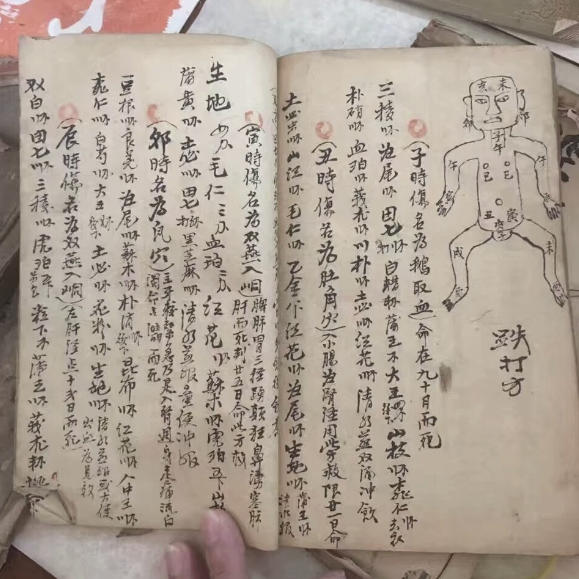
After the founding of New China, Qiu Taisheng returned from his hometown to live in Foshan. He first carried out his medical consultations at the medical clinic opened by Li Zibin (李梓彬) of Hong Quan and Huang Jing (黄精) of Wing Chun, now No. 89 Fuxian Road (福贤路89号), and taught boxing at night. White Eyebrow Boxing formally began to be taught and spread in Foshan. Qiu Taisheng was proficient in dit da (跌打) and especially good at treating sprains and internal injuries of the chest and back. In order to cure internal injuries, he self studied internal medicine of Chinese medicine and delved into medical books such as Ye Tianshi’s Collected Secret Recipes (《叶天士手集秘方》), Golden Mirror of Medical Ancestors (《医宗金鉴》), and Treatise on Warm Diseases (《温病条辨》). In his medical books he wrote down many excellent medical formulas.
In 2001, when the Foshan Huang Feihong Memorial Hall (佛山黄飞鸿纪念馆) was completed, Qiu Taisheng’s (仇太生) medical manuscripts and boxing manuals were borrowed for exhibition at the Foshan Huang Feihong Memorial Hall (佛山黄飞鸿纪念馆). Because Qiu Taisheng (仇太生) was good at treating old ailments, people often came specially from Guangzhou (广州) and other places to seek his treatment. He treated patients like family, often giving medical treatment and medicine, giving away self made dit da medicinal wine for treatment and reserve, and even teaching patients martial arts, using martial arts training to promote physical recovery. During the period of joint state private operation (公私合营), Qiu Taisheng was introduced by the Foshan Health Workers Association (佛山市卫生工作者协会) to Shengping Clinic (升平诊所), now Songgui Lane (松桂里), Shengping Road (升平路), as a dit-da doctor, and later transferred to Pujun Clinic (普君诊所), the predecessor of Foshan Second People’s Hospital (佛山市第二人民医院). While working at Pujun Clinic (普君诊所), every major festival, the Foshan Health Workers Association (佛山市卫生工作者协会) would hold celebrations. Qiu Taisheng’s performances of “Di Sha” (地煞) and “Nine Step Push” (九步推) were so deep in skill that even Wu Manfu (吴满福), then director of Pujun Clinic (普君诊所) and an expert of Mo Family Boxing (莫家拳), praised them without end.
During the Cultural Revolution (文化大革命), because Qiu Taisheng had a special status, he became reclusive and did not dare to teach boxing publicly. People who came to his door wanting to learn boxing were also refused. He could only secretly teach his own son at home, and life gradually became difficult. Master Qiu Taisheng died of illness in 1979. His disciples included Qiu Deji (仇德基), Lü Yangzhao (吕扬照), Zhu Caixing (朱才兴), Liao Zhiyi (廖知一), Li Yinxiang (李荫祥), Feng Yongqiang (冯永强), Chen San (陈三), Titou Ming (剃头明), Chen Qiu (陈秋), Liang Yuxi (梁裕熹), Xu Wenzheng (徐文正), and Ou Nianzhong (欧念中), among others.
Qiu Taisheng paid great attention to traditional martial arts cultivation. He attached great importance to basic skill practice and persisted for decades without slacking. He often said, “Punch a thousand times, the hand comes out naturally; punch ten thousand times, the divine dragon appears alive” (拳打千遍,出手自然,拳打万遍,神龙活现). At the same time he also paid great attention to physical and mental cultivation, often warning disciples that when practicing they should “alternate tension and relaxation, looseness and tightness, speed and slowness, and be neither arrogant nor impatient” (一弛一张,一松一紧,一快一慢,不骄不燥). Because of this, Qiu Taisheng (仇太生) often ground ink and took up the brush, wrote calligraphy, and read ancient prose and poetry, being both martial and literary. Besides often discussing martial arts with a group of good friends such as Huang Jing (黄精) of Wing Chun), Li Zibin (李子斌) of Hong Quan (洪拳), Longzi Xiong (聋子雄) Uncle Wu (吴), of Xia Quan (侠拳), Fang Mei (方妹), and Maiyu Tian (卖鱼添) of Choy Li Fut (蔡李佛), on holidays he would gather with a few close friends to talk of literature and martial arts and compose poems and match couplets.
Qiu Taisheng was obsessed with martial arts and was humble and eager to learn. He had a martial arts notebook in which he wrote down in detail his practice essentials and reflections on learning martial arts. It records many boxing routines such as Flying Phoenix Single Saber (飞凤单刀), Plum Blossom Spear (梅花枪), Single Whip (单鞭), Tiger Tail Staff Method (虎尾棍法), Great Formation Staff Method (大阵棍法), Plum Blossom Double Sabers (梅花双刀), Double Headed Staff Paired Dissection Method (双头棍对拆法), Five Tigers Descend to Jiangnan (五虎下江南), Night Tiger Emerges from the Forest (夜虎出林), Precious Duck Threads Through Lotus (宝鸭穿莲), and Woodcutter Strikes the Tiger (樵夫打虎). This shows that he learned widely from many masters and had deep martial arts knowledge. Besides martial arts, Qiu Taisheng was also proficient in the Futsan lion Dance, his drumming method was quite famous, and he played excellent drum flourishes, and was called “Ma Zi Tai” (孖指太).