The Three Propping Forces (三顶 San Ding)
Head propping upward (头顶 tou ding) carries the power of soaring to the heavens. The head is the master of the whole body; when it props upward, the three passes of the back open easily, and the internal breath (内气 nei qi) rises naturally from the base, traveling up the back through the Gate of Life (命门 ming men), continuing up through the Squeezing Spine point (夹脊 jia ji), passing through the Jade Pillow (玉枕 yu zhen), and reaching the Hundred Convergences point (百会 bai hui) at the crown.
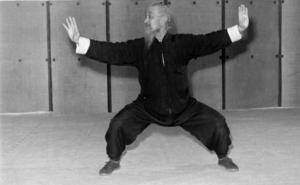
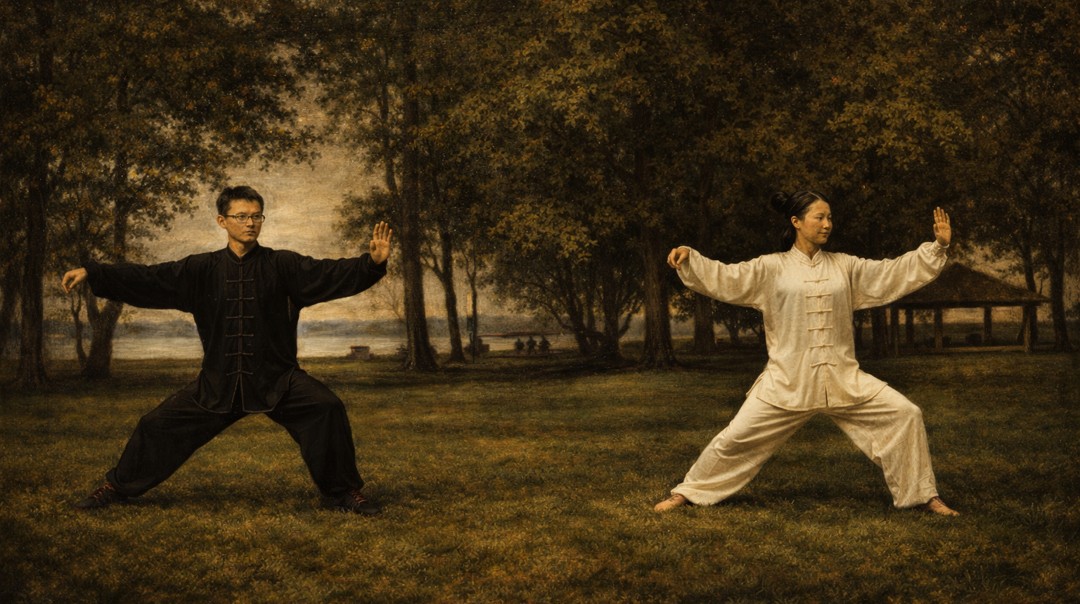
Hands propping outward (手顶 shou ding) carries the power of pushing mountains. The breath can then travel down the outer side of the arms and flow directly through to the center of the palms and the tips of the fingers.
Tongue propping upward (舌顶 she ding) carries the bearing of a roaring lion swallowing an elephant. When the tongue presses against the upper palate and breathing is conducted through the nose, the Conception Vessel (任脉 ren mai) and Governing Vessel (督脉 du mai) are connected. The breath descends from the Hundred Convergences point, enters through the mouth, travels past the tongue, and drops down into the Elixir Field (丹田 dan tian). From the lumbar vertebrae downward, the vertebrae are loosened one by one; the tailbone (尾闾 wei lu) turns upward, the anus is lifted, and the Conception and Governing Vessels are connected in the lower body.
The Three Hooking Forces (三扣 San Kou)
Shoulder hooking (肩扣 jian kou) directs breath and force to the elbows. Palm hooking (掌扣 zhang kou) directs breath and force to the hands. Fingers and toes hooking (指趾扣 zhi zhi kou) thickens the force throughout the whole body. When both shoulders hook inward, the shoulder blades naturally relax and the spine becomes rounded. When the back of the hand arches and hooks, the five fingers become like tiger claws and breath fills the fingertips. When the back of the foot arches and hooks, the five toes grip the ground and the stance becomes stable and firm. Understanding the Three Hookings brings one more refinement of skill.
The Three Roundnesses (三圆 San Yuan)
The spine must be round (脊背圆 ji bei yuan), so that force is driven through the body, the tailbone is centered and upright, and spirit flows up to the crown. The front chest must be round (前胸圆 qian xiong yuan), so that both arms possess their full force, the hollow of the chest is slightly drawn in, and breathing flows freely. The tiger’s mouth must be round (虎口圆 hu kou yuan), so that the wrist is seated and the palm is braced, producing a force that wraps and embraces. Understanding the Three Roundnesses brings one more subtlety of skill.
The Three Fierceness (三毒 San Du)
The heart must be fierce (心毒 xin du) like an enraged wildcat catching a mouse, enabling one to adapt to changing circumstances at every moment. The eyes must be fierce (眼毒 yan du) like a hungry eagle seizing a rabbit, enabling one to read and anticipate opportunities in advance. The hands must be fierce (手毒 shou du) like a starving tiger catching a sheep, enabling one to act first and seize the initiative. Understanding the Three Fierceness brings one more force of power.
The Three Embracings (三抱 San Bao)
The Elixir Field embracing (丹田抱 dan tian bao), the heart-breath embracing (心气抱 xin qi bao), and the arms embracing (胳膊抱 ge bo bao) are the Three Embracings. The Elixir Field must embrace the breath as its root, so that the breath does not scatter outward and strikes upon the opponent will be accurate. The heart-breath must embrace, so that when facing the opponent one remains centered and does not become confused under sudden change. The arms must embrace, so that whether extending or withdrawing they do not scatter, and facing the opponent holds no peril. Understanding the Three Embracings brings one more subtlety of skill.
The Three Sinkings (三垂 San Chui)
Breath sinking (气垂 qi chui), shoulder sinking (肩垂 jian chui), and elbow sinking (肘垂 zhou chui) are the Three Sinkings. The breath must sink, so that the breath descends into the Elixir Field and the body stands as stable as a mountain. Both shoulders must sink downward, so that the arms lengthen and the force becomes lively, with the shoulders driving the elbows forward. Both elbows must sink downward, so that both arms naturally round themselves and the two ribs are protected. Understanding the Three Sinkings brings one more nimbleness of skill.
The Three Crescent Moons (三月 San Yue)
The arms are like bows curving as full moons (弓如月圆 gong ru yue yuan), the wrists prop outward like crescent moons (月牙 yue ya), and the legs and knees continuously curve like crescent moons (月牙 yue ya). The Three Crescent Moons are also called the Three Curves (三曲 San Qu). Only from curving can straightness emerge; only from storing can issuing occur. The Three Crescent Moons embody the principle of seeking the straight within the curved and storing before issuing. When both arms curve like half-circles the force is substantial; when both knees continuously curve the force is thick and rich; when the wrists hold the crescent-moon shape the force gathers and concentrates. Understanding the Three Crescent Moons brings one more cleverness of skill.
The Three Brace-Uprights (三挺 San Ting)
The neck must brace upright (颈项挺 jing xiang ting), so that the head is upright and centered and spirit flows through to the crown. The body method must brace upright (身法挺 shen fa ting), extending force in all four directions; when the spine and waist brace upright, force reaches the four extremities and breath drums through the whole body. The legs and knees must brace downward (腿膝下挺 tui xi xia ting), like a tree growing roots into the earth. Understanding the Three Brace-Uprights brings one more method of skill.
Note
The eight principles and twenty-four methods above form a single unified whole, with no order of priority or emphasis among them. In practice, every movement must conform to these principles without leaning toward any one at the expense of others. Each posture must be practiced repeatedly until a correct and deeply ingrained movement pattern is formed. One must have patience and perseverance, advancing step by step. One must not rush, for it is well known that haste does not bring one to the destination.