Qi Jiguang’s (戚继光) staff techniques were learned from him, and so were the Shaolin (少林) staff methods, Yu Dayou (俞大猷), the underestimated martial arts master.
“I once saw General Yu (俞大猷) demonstrate his staff techniques to me; the wonderful aspects are already recorded in the Jian Jing (《剑经》).”
This was said by Qi Jiguang (戚继光) himself. In his book Ji Xiao Xin Shu (《纪效新书》), he openly admitted: “Yu Dayou (俞大猷) demonstrated staff techniques to me, and the essence of it is all written in the Jian Jing (《剑经》).” Not only did Qi Jiguang (戚继光) learn staff techniques from Yu Dayou (俞大猷), but he also included the full text of Yu’s Jian Jing (《剑经》) in Ji Xiao Xin Shu (《纪效新书》), praising it: “The most wonderful part lies in the moment you gain control, then every grab and thrust is like rolling a round stone down a cliff of a thousand ren (仞), unstoppable.” Once in control, it’s like a round stone rolling down a mountain, impossible to halt.
A man respected as a teacher by Qi Jiguang (戚继光), whose work was fully included in Ji Xiao Xin Shu (《纪效新书》), is barely known today.
His name is Yu Dayou (俞大猷). A renowned general of the Ming Dynasty (明代) who fought against Japanese pirates (Wokou 倭寇), he and Qi Jiguang (戚继光) were known as “Yu Long and Qi Hu” (俞龙戚虎), Qi Jiguang (戚继光) was the “Tiger,” and he was the “Dragon.”
Yu Dayou (俞大猷) was 25 years older than Qi Jiguang (戚继光). When Qi Jiguang (戚继光) began fighting the Wokou (倭寇), Yu Dayou (俞大猷) was already a legendary general. In the coastal regions of Southeast China at the time, folk songs like “Yu Long and Qi Hu, killing like cutting grass” (俞龙戚虎,杀人如土) were widely sung. The Fujian Tongzhi (《福建通志·列传》) also records, “The world says Qi Jiguang (戚继光) is like a tiger, and Yu Dayou (俞大猷) is like a dragon.” A man 25 years older than Qi Jiguang (戚继光), respected as his teacher, and whose work was fully included in Ji Xiao Xin Shu (《纪效新书》)—to say that Qi Jiguang (戚继光) was only “half a disciple” to him is not an exaggeration.
Yu Dayou’s (俞大猷) Martial Arts Lineage: Masters, “Mysterious Figures,” and the I Ching (《易经》)
Yu Dayou (俞大猷, 1503–1580), styled Zhi Fu (志辅), was from Jinjiang (晋江), Fujian (福建). From a young age, he was passionate about martial arts, but his pursuits went beyond that. He studied under three masters: Wang Xuan (王宣), Lin Fu (林福), and Zhao Benxue (赵本学), learning the I Ching (《易经》) and military strategy, absorbing the strengths of all three. Wang Xuan (王宣) and Lin Fu (林福) were disciples of Cai Qing (蔡清), a prominent figure in the Min (闽) School of Thought, while Zhao Benxue (赵本学) combined the I Ching (《易经》) with military strategy.
From Zhao Benxue (赵本学), Yu Dayou (俞大猷) learned the method of “using the I Ching (《易经》) to derive military strategy” and the Taizu Quan (太祖拳, a martial arts style). His later ability to use the I Ching (《易经》) for battlefield formations and to write systematic martial arts works like Jian Jing (《剑经》) stemmed from these three years of I Ching (《易经》) training.
In martial arts, he studied Jingchu Longsword (荆楚长剑) under Li Liangqin (李良钦). According to records, Li Liangqin (李良钦) “was a chivalrous man in his youth, gathering followers, and was taught staff techniques by a mysterious figure (异人). His skills were divine and ever-changing, unstoppable in all directions.” The Jingchu Longsword (荆楚长剑) that Yu Dayou (俞大猷) learned from Li Liangqin (李良钦) could trace its origins to this mysterious figure (异人). Who was this person? No one knows. A martial arts lineage that influenced Yu Dayou (俞大猷), Qi Jiguang (戚继光), and even Shaolin Temple (少林寺) originated from an anonymous master.
Yu Dayou (俞大猷) was a martial arts prodigy. He mastered the techniques in a short time, even astonishing his teacher Li Liangqin (李良钦), who exclaimed: “In the future, your swordsmanship will be unmatched in the world!” A general who fought against the Wokou (倭寇), backed by a complete lineage of scholars and martial artists: three I Ching (《易经》) teachers, one martial arts master, and one mysterious ancestor (异人).
Jian Jing (《剑经》): A “Staff Manual” Written in Southern Min (闽南语)
In the 36th year of the Jiajing Emperor’s reign (1557, 嘉靖三十六年), Yu Dayou (俞大猷) published his staff manual, Jian Jing (《剑经》), four years before Qi Jiguang’s (戚继光) Ji Xiao Xin Shu (《纪效新书》). This book was written in the Southern Min dialect (闽南语). A man from Quanzhou (泉州) wrote a book in his hometown dialect that would influence Chinese martial arts for 500 years. The title is Jian Jing (《剑经》, “Sword Classic”), but its content is about staff techniques. Yu Dayou (俞大猷) wrote in the preface: “I studied the Jingchu Longsword (荆楚长剑) and mastered its essential methods.” In ancient times, the staff was often referred to as a “sword,” and the Jingchu Longsword (荆楚长剑) he learned from Li Liangqin (李良钦) was a combat technique that treated the staff as a sword. But there is a harsh reality: the original printed edition of Jian Jing (《剑经》) has been lost. The only reason we can read Jian Jing (《剑经》) today is that Qi Jiguang (戚继光) included the full text in Ji Xiao Xin Shu (《纪效新书》). Without Qi Jiguang (戚继光), Yu Dayou’s (俞大猷) Jian Jing (《剑经》) might have disappeared entirely. The student copied his teacher’s book, ensuring its survival to this day.
Jian Jing (《剑经》) systematically summarizes the theory and practical experience of staff techniques. Yu Dayou (俞大猷) combined his studies of military strategy with Taizu Quan (太祖拳), Jingchu Longsword (荆楚长剑), and techniques from many famous martial artists across the country to write this martial arts classic. Yu Dayou (俞大猷) had a deep understanding of the fundamental principles of martial arts: “If you master the staff, you can understand the methods of all other weapons.”
Advising Shaolin Temple (少林寺): A General Tells the Source of All Martial Arts, “You’re Practicing Wrong”
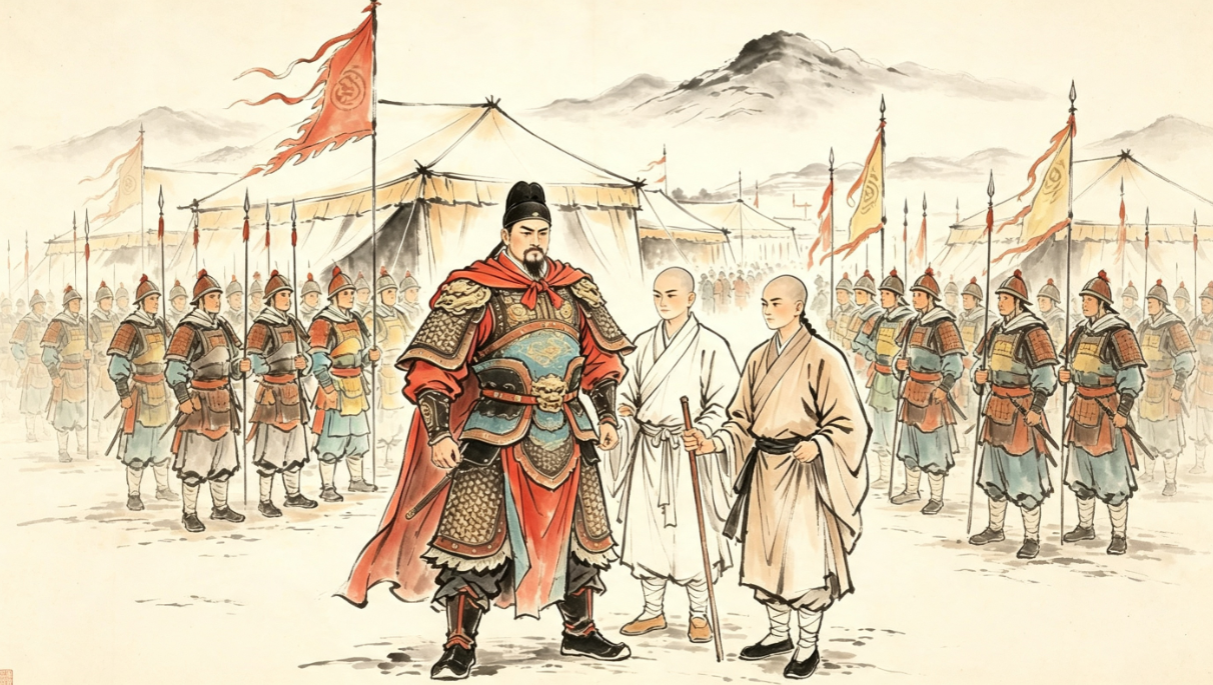
In the 40th year of the Jiajing Emperor’s reign (1561, 嘉靖四十年), Yu Dayou (俞大猷) was ordered to lead a southern campaign. On his way, he passed by Shaolin Temple (少林寺). Hearing that Shaolin Temple (少林寺) had “divinely transmitted sword techniques,” he paid a visit.
Shaolin Temple (少林寺) sent out over a thousand warrior monks to demonstrate their swordsmanship. After watching, Yu Dayou (俞大猷) bluntly told the abbot, Xiao Shan Zongshu (小山宗书): “This temple is famous for its sword techniques, but over time, the true essence has been lost.”
A general, in front of a thousand Shaolin warrior monks, told them, “You’re practicing wrong.” The abbot immediately asked for guidance. Yu Dayou (俞大猷) selected two young monks, Zong Qiao (宗擎) and Pu Cong (普从), to join his army on the southern campaign. The two monks “moved in and out of military formations,” and after three years of real combat, Yu Dayou (俞大猷) “earnestly taught them, and they mastered the true essence.” After completing their studies, the two monks returned to Shaolin Temple (少林寺) and spread the sword techniques they had learned among the monks. Fifteen years later, Zong Qiao (宗擎) reunited with Yu Dayou (俞大猷) in Beijing and reported that he had taught the techniques to the entire temple. Yu Dayou (俞大猷) was overjoyed and “taught him the Jian Jing (《剑经》) again, encouraging him to seek even greater precision.”
Today, if you visit Shaolin Temple (少林寺), you’ll find a Shifang Chan Yuan (十方禅院, Ten Directions Chan Monastery) across from it. At the entrance of the monastery stands a stele, over 400 years old. The inscription on the stele was written by a general”: Yu Dayou (俞大猷). Shifang Chan Yuan (十方禅院) was built on Yu Dayou’s (俞大猷) suggestion, and after its completion, he personally wrote the Stele of the Newly Built Shifang Chan Yuan (《新建十方禅院碑》). A stele erected by an anti-Wokou (倭寇) general still stands at the entrance of Shaolin Temple (少林寺) 400 years later.
A Complete Lineage of Martial Arts
Yu Dayou’s (俞大猷) martial arts lineage can be traced clearly:
Mysterious Figure (异人, Staff Techniques) → Li Liangqin (李良钦, Jingchu Longsword 荆楚长剑) → Yu Dayou (俞大猷, Jian Jing 《剑经》) → Qi Jiguang (戚继光, Ji Xiao Xin Shu 《纪效新书》 Full Inclusion) → Qi’s Army (戚家军)
Yu Dayou (俞大猷) → Zong Qiao (宗擎) and Pu Cong (普从) → Shaolin Temple’s (少林寺) Staff Techniques
These two lines lead to the training grounds of Qi’s Army (戚家军) and the gates of Shaolin Temple (少林寺). An anti-Wokou (倭寇) general simultaneously influenced the two most important branches of Chinese martial arts, military martial arts and temple martial arts.
Yu Dayou’s (俞大猷) staff techniques, later known as “Yu Family Staff” (俞家棍), have been passed down through generations in Quanzhou (泉州), Fujian (福建). In December 2011, Yu Family Staff (俞家棍) from Luojiang District, Quanzhou City (泉州市洛江区), was included in the fourth batch of Fujian Province’s Intangible Cultural Heritage list. It has since spread to the United States, Japan, Southeast Asia, and other regions.
The Underestimated Martial Arts Master
When people think of heroes who fought against the Wokou (倭寇), Qi Jiguang (戚继光) is the first name that comes to mind. But contemporaries evaluated them as: “Qi Jiguang (戚继光) is like a tiger, and Yu Dayou (俞大猷) is like a dragon.” The dragon comes before the tiger, and Yu Dayou (俞大猷) was not only on par with Qi Jiguang (戚继光) but even surpassed him.
Yu Dayou (俞大猷) spent almost his entire life fighting the Wokou (倭寇), achieving remarkable military successes. He served in the Ming Dynasty (明代) army for 47 years, experiencing hundreds of battles and repeatedly achieving extraordinary merits. In martial arts, his achievements were even more profound, he wrote a book that changed the course of Chinese martial arts. He taught a student who changed Chinese military history. He revived a Shaolin staff technique that was on the verge of being lost. A man respected as a teacher by Qi Jiguang (戚继光), whose work was fully included in Ji Xiao Xin Shu (《纪效新书》), and who corrected Shaolin Temple’s (少林寺) techniques, yet his fame today is far less than that of his student. Qi Jiguang’s (戚继光) staff techniques were learned from him, and so were Shaolin’s (少林) staff techniques.
A general who influenced Chinese martial arts for 500 years.
References
- Ji Xiao Xin Shu (《纪效新书》), Volume 14, Quan Jing Jie Yao Pian (《拳经捷要篇》) Written by Qi Jiguang (戚继光) of the Ming Dynasty (明)
- Zheng Qi Tang Ji (《正气堂集》) and Zheng Qi Tang Xu Ji (《正气堂续集》) Written by Yu Dayou (俞大猷) of the Ming Dynasty (明)
- History of Ming (《明史》), Volume 212, Lie Zhuan (列传第一百) Written by Zhang Tingyu (张廷玉) et al. of the Qing Dynasty (清)
- Stele of the Newly Built Shifang Chan Yuan (《新建十方禅院碑》) Written by Yu Dayou (俞大猷) of the Ming Dynasty (明), currently preserved at Shaolin Temple (少林寺), Henan (河南)