By reviewing precious old photographs and publications from the Republican era, we are able to glimpse the true appearance of the Jiangsu Provincial Martial Arts Institute (江苏省国术馆). It was the official orthodox martial arts institution of Jiangsu Province at that time, and also the most prosperous testament to the martial arts movement in Jiangsu during the Republic of China period.
It was officially founded on July 1, 1928 in Nanjing. Shortly after, on February 19, 1929, it relocated to Zhenjiang (then the provincial capital of Jiangsu). Then on June 1932, following the January 28 Incident (the Japanese attack on Shanghai), the region faced extreme economic hardship and social instability, forcing the academy to shut down permanently.
Unlike the private martial arts schools we often imagine, the provincial institute had a complete organizational structure and standardized regulations. It offered courses in boxing, weapons, teacher training programs, and special classes for women, allowing both men and women to practice martial arts. It served as the core base for promoting traditional martial arts and cultivating instructors at the time.
The institute gathered many masters, among whom two renowned figures in modern martial arts history stood out the most.
One was Sun Fuquan (Sun Lutang, 孙福全/孙禄堂). He was widely recognized as a grand master of martial arts in the Republican era, mastering Xingyi (形意), Bagua (八卦), and Taiji (太极) in one integrated system. His skills were exquisite, and he was equally accomplished in both martial arts and scholarly learning. During his tenure as the dean of academic affairs at the Jiangsu Provincial Martial Arts Institute, he coordinated the teaching system and personally imparted the essence of boxing techniques, laying a solid foundation for the transmission of martial arts in the Jiangnan region.


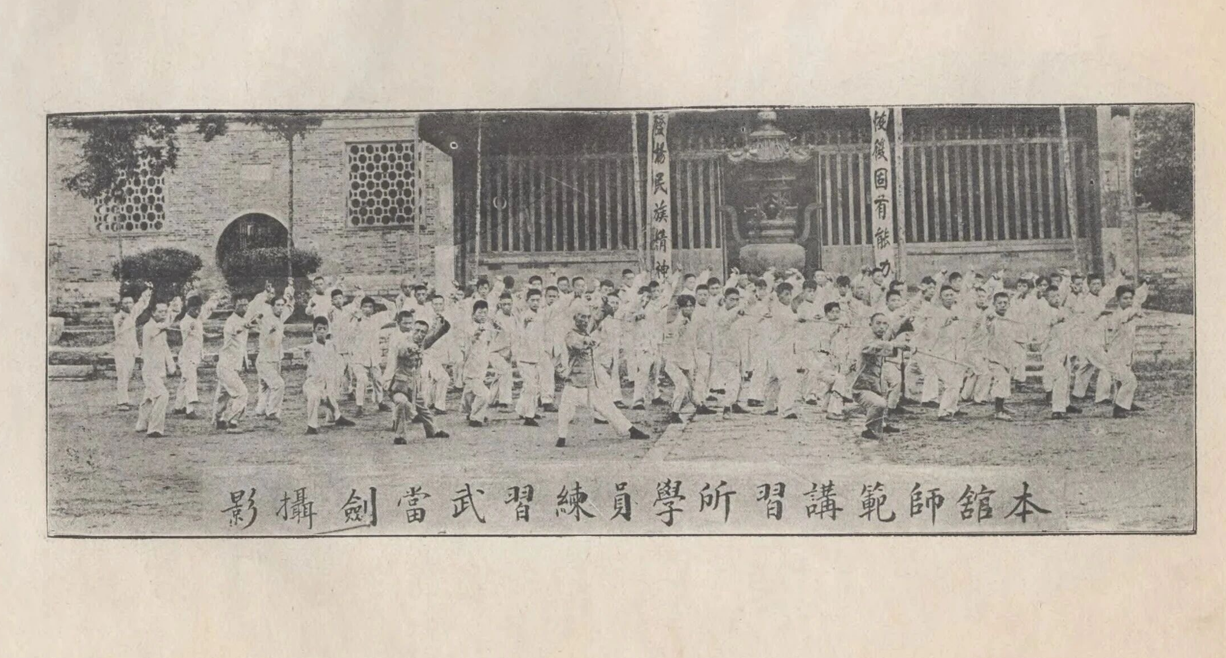
The other was the elderly martial artist Jin Jiafu (金佳福). As a well-known weapons expert in Jiangnan, he excelled in long weapons such as the saber and spear, with a solid and seasoned foundation. In the photographs, he was nearly eighty years old yet still maintained a steady posture, demonstrating saber techniques on stage, vigorous and spirited despite his age, fully embodying the demeanor of the older generation of martial artists.
In the surviving old photographs, we can see complete training scenes from those years: Wudang Sword, hook shields, Shaolin boxing, Xingyi boxing, and Taiji were all demonstrated in turn, covering solo routines, paired sparring, and group drills with hundreds of participants. What is even more remarkable is that the images show women systematically practicing martial arts during the Republican era, which was quite avant-garde a hundred years ago.
Unfortunately, due to the turbulent times, after the outbreak of the War of Resistance against Japan, the once-flourishing Jiangsu Provincial Martial Arts Institute was forced to close. The grand scene of intensive training, with renowned masters gathering and students crowding the halls, thus came to an end. Today, these yellowed old images have frozen the figures of a generation of martial arts predecessors such as Sun Fuquan and Jin Jiafu, and have preserved the most authentic and vibrant golden years of modern martial arts in Jiangsu.
![Read more about the article Yanqing Quan – Yanqing Jiazi [燕青门 – 燕青架子]](https://taipinginstitute.com/wp-content/uploads/2021/08/fegvdfbdfvdfv-300x169.jpg)