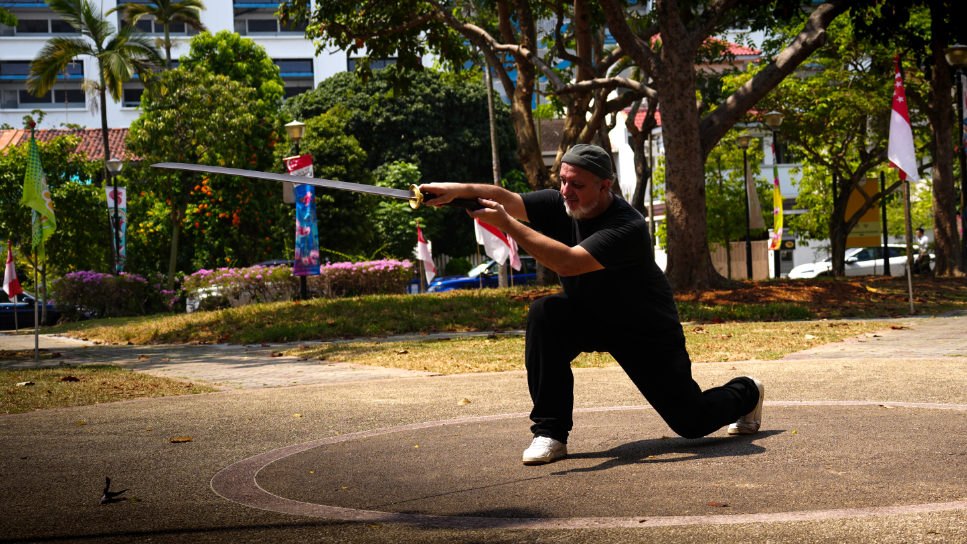
Chinese bronze ware had reached a very high level of development during the Shang and Zhou dynasties. By the Qin dynasty, it was possible to produce bronze swords about one metre in length, which were both extremely sharp and highly resilient. Although China entered the Iron Age relatively late, it quickly reached a relatively high level based on its bronze-working skills. Sword-making also developed from shorter to longer lengths. During the Warring States period, two-handed long swords had already appeared. By the Han dynasty, long swords became even more widespread; excavated Han dynasty long swords have been found up to 140 centimetres in length, capable of both slashing and thrusting when held with both hands. Since King Wuling of Zhao (赵武灵王) adopted “barbarian clothing and mounted archery” during the Warring States period, the mode of warfare gradually shifted from chariot-based combat to cavalry combat. By the Han dynasty, the Han army’s primary opponents were the mounted cavalry of the Xiongnu and other northern nomadic peoples, and Han military tactics also shifted to cavalry-based warfare, with cavalry becoming the main force on the battlefield. This change in warfare also led to changes in weapons. Swords, which focused primarily on thrusting, were no longer fully effective; their slashing power was insufficient, and they broke easily. Thus, the single-edged steel sabre, which excelled at slashing and was both sturdy and practical, gained people’s attention, and the quality of its manufacture increasingly improved.
The Han dynasty sabre had a straight back and a straight blade, with a relatively thick spine. There was no clear distinction between the hilt and the blade; the end of the hilt was invariably made into a flat, round ring shape, and the length was about one metre. It was named the “ring-headed sabre” (环首刀) or “ring-hilted sabre” (环柄刀). In essence, it was a sword modified to have a single edge, making it convenient for drawing, slashing, and cutting on horseback, a highly practical short weapon. This weapon spread widely; in particular, after being transmitted eastward to Japan, it became the prototype of the Japanese sword. By the end of the Eastern Han dynasty, the ring-hilted sabre, suited for slashing, had become the primary weapon on the battlefield. By the Three Kingdoms period, the only short weapon used in large quantities by the military was the sabre.
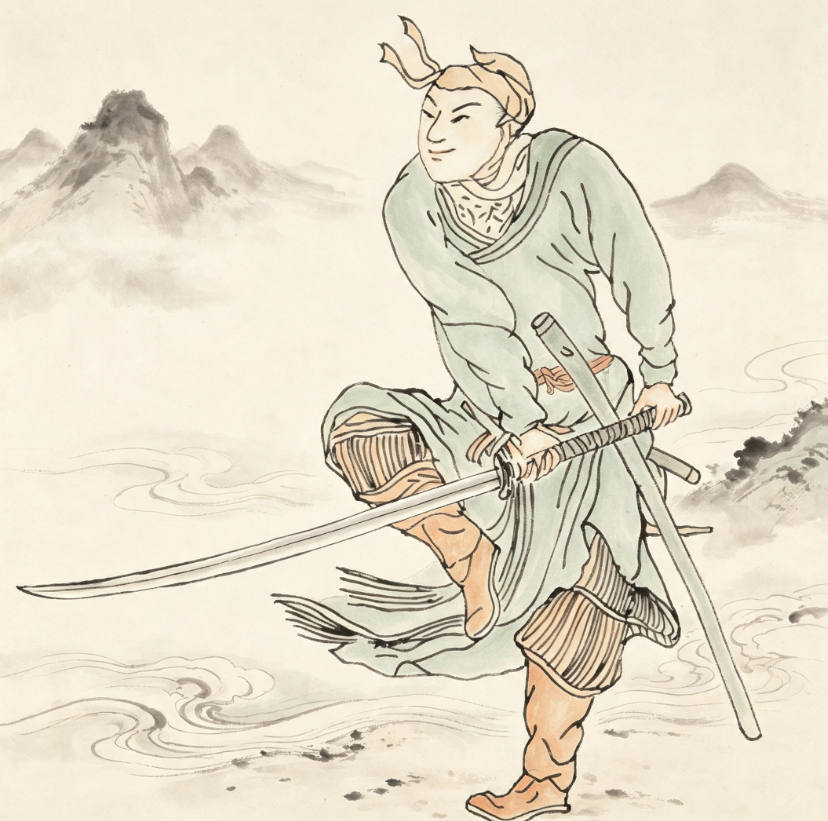
During the Northern and Southern Dynasties, the Sui dynasty, and the Tang dynasty, the sabre remained an important weapon. The Tang Liudian (唐六典, “The Six Codes of Tang”), in its section on the arsenal, lists only sabre categories and no sword categories. In the Tang dynasty, the design gradually changed to a ringless hilt and the addition of a handguard. According to the Tang Liudian: “There are four types of sabres: the first is the ceremonial sabre (仪刀), the second is the barrier sabre (鄣刀), the third is the cross sabre (横刀), and the fourth is the long sabre (陌刀). The ceremonial sabre is similar to the ancient ceremonial sword; from the Jin and Song dynasties onward it was called the imperial sabre, and in the Later Wei it was called the long sabre, all adorned with dragon and phoenix rings. By the Sui dynasty it was called the ceremonial sabre, decorated with gold and silver, and carried by ceremonial guards. The barrier sabre was used for self-defence against enemies. The cross sabre was a sidearm worn by soldiers; its name also originated in the Sui dynasty. The long sabre was a long weapon carried by infantry; it is the ancient horse-cutting sword. Most of these could be held with both hands, had slender, straight backs and straight blades, and the long sabre might have been double-edged at the tip. Their dimensions mostly exceeded one metre.” It can be seen that the Tang sabre was a synthesis of the sword and the sabre, inheriting and developing the Han dynasty sabre and sword. It fully utilised the sabre’s slashing function while retaining the sword’s thrusting function, and already possessed some of the characteristics of the modern Miao Dao.
Through Sino-Japanese cultural exchanges, it was also transmitted to Japan. The straight sabre that began in the Han dynasty continued to develop through the Tang dynasty and was used until the Southern Song dynasty. During the Yuan dynasty, influenced by the Mongolian curved sabre, the wider and more curved sabre style that had begun to appear during the Eastern Jin dynasty became the mainstream of Chinese sabre weapons. The Mongolian curved sabre may have been influenced by the Arabian curved sabre during the Mongol Empire’s western expeditions. However, the Han-Tang straight sabre did not completely disappear; it continued to be transmitted among the civilian population. Through the Ming dynasty and the early and middle Qing dynasty, the various strengths of the Tang sabre were consolidated, adapted to the specific circumstances of civilian life, suited to infantry combat, and further developed. By the late Qing dynasty, it had evolved into the present form of Miao Dao, which not only possessed the characteristics and techniques of sabres and swords, but also incorporated features and techniques of spears and staffs.
Passed down through generations, it reached the Xie family of Sangyuan in the late Qing dynasty. After the exchange of skills at Sangyuan, Ren Xiangrong (任向荣) had a craftsman forge a Miao Dao in Bengbu for sixty silver dollars, brought it back to Duliu, and practiced and studied it repeatedly with Liu Yuchun (刘玉春). On the basis of the Xie family’s eight routines of Miao Dao techniques, they further developed an additional eight routines, integrating the stylistic features and techniques of the Taizu school’s Duliu Tongbei Boxing (独流通背拳) into the Miao Dao. Later, when the Xie family’s martial arts were lost, the Duliu Miao Dao became a unique skill in the Chinese martial arts world. After Ren Xiangrong, Liu Yuchun, and Zhang Jingyuan (张景元) returned to their hometown from Beijing in 1924, Ren Xiangrong, through long and repeated study, further comprehended the true essence of Miao Dao. Based on his own understanding, he refined and improved the former and latter eight routines, finalising them as the twelve routines of Miao Dao. This system possesses the common characteristics of other sabre techniques, such as slashing, thrusting, shaving, pointing, upward slicing, and hooking, but also incorporates the strengths of the sabre, spear, sword, and staff, allowing multiple uses with a single weapon. During practice and application, the blade and body must move together, the blade and body must be in harmony, and advances and retreats must be natural. There is a high demand for body movement, it must have the fierce and powerful aspect of a “tiger-like sabre,” as well as the lightness, dexterity, and agility of a “phoenix-like sword” and a “dragon-like spear.” The twelve routines can be practiced consecutively, or each routine or individual posture can be repeated separately. The emphasis is on practical value, and it has been transmitted to this day without alteration.
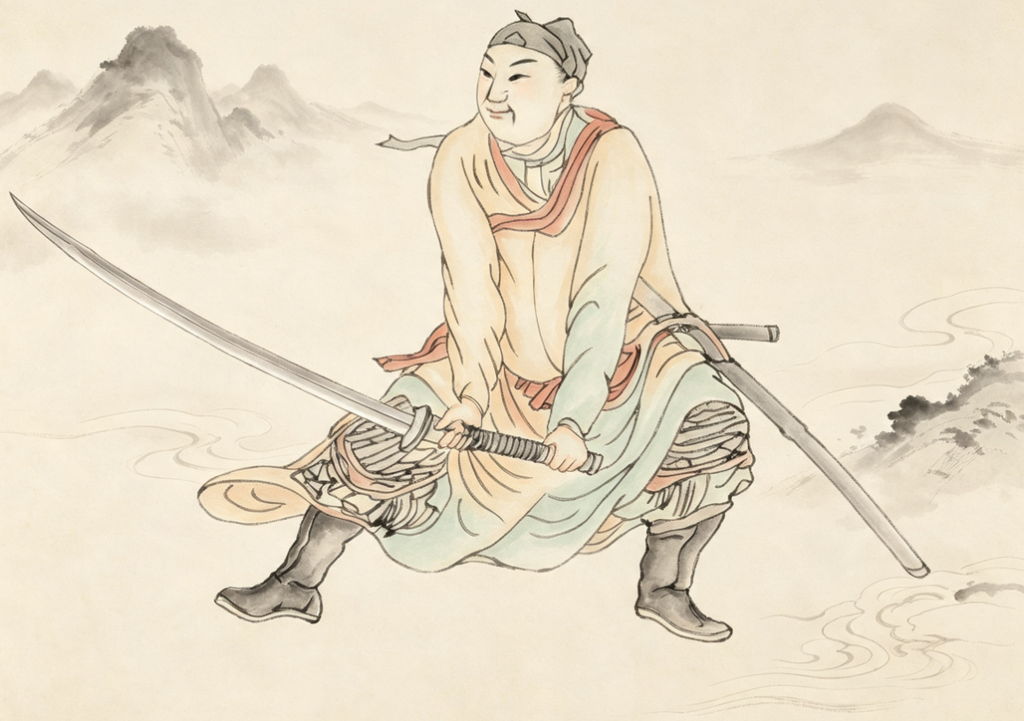
The Miao Dao passed down by Ren Xiangrong was forged exactly according to the Xie family’s design and dimensions. Its total length is four chi five cun eight fen (approximately 152 cm); the blade is three chi three cun eight fen (approximately 113 cm) long, and the hilt is one chi two cun (approximately 40 cm) long. The guard is elliptical in shape, and the pommel is shaped like a gourd; both are made of brass. The blade is extremely narrow, long, straight, and flat, with only the six-cun tip slightly upturned and double-edged. The blade is widest and thickest near the guard, where it is engraved with cloud patterns; the maximum width is one cun two fen (approximately 4 cm), and the thickest part of the spine is four millimetres. Near the centre of the blade, close to the spine, there is a ridge similar to that of a sword, which is thickest at the base – 10 millimetres – and tapers towards the tip, as does the spine. The ridge is about two chi seven cun (approximately 90 cm) long and becomes indistinct near the tip; overall, it resembles a sword-shaped sabre. The dimensions of the traditional Miao Dao are subject to very strict requirements. Generally speaking, when stood on the ground, the Miao Dao should reach the tip of the practitioner’s nose. It is about one chi five cun (approximately 50 cm) longer than the single or double sabre or sword, about half a chi to one chi (approximately 17–33 cm) shorter than a common staff, and about two chi (approximately 67 cm) shorter than a spear. Its length lies between long and short weapons.
It is precisely because Miao Dao is longer than ordinary sabres and swords, yet shorter than ordinary spears and staffs, combined with its unique shape, that it can possess the strengths of the sabre, spear, sword, and staff, serving multiple purposes with a single weapon, enjoying both the advantage of “one inch longer, one inch stronger” and the flexibility of “one inch shorter, one inch cleverer.” Regarding the naming of Miao Dao, it is closely related to the development of Miao Dao itself. Through generations of martial arts predecessors’ continuous research and practice, the techniques of Miao Dao have been greatly enriched, and accordingly its shape has become quite distinct from previous sabre types, making it a sword-shaped sabre. To distinguish it from other sabres, the martial arts predecessors named it Miao Dao, taking its narrow, long, straight, and flat blade, which resembles the shape of a seedling (苗, miao). At the latest, by the time it was transmitted to the Xie family in Sangyuan, Hebei, the name Miao Dao was already in use.
The two‑handed sabre technique (双手刀法) is a form of classical Chinese sabre play, a treasure within the Chinese martial arts heritage. The two Tongbei masters, Ma Fengtu (马凤图) and Ma Yingtu (马英图), always regarded the two‑handed sabre technique as an incomparable secret treasure. They studied it meticulously, nurtured it with great care, and never taught it lightly. They devoted their entire lives to preserving the purity and completeness of this martial arts legacy.
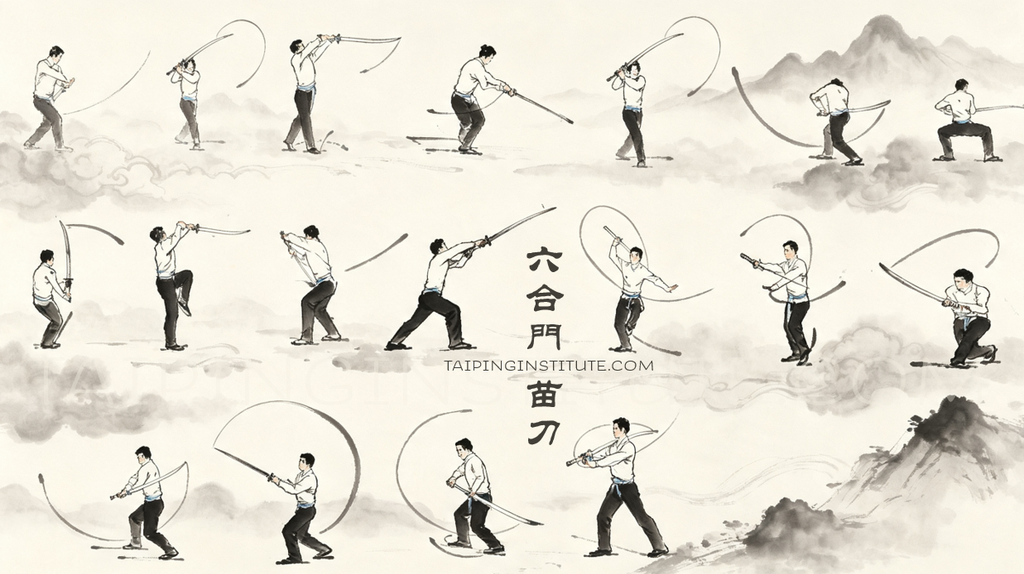
As far as is currently known, during the late Qing and early Republican periods, there were two main lineages of the two‑handed sabre technique preserved among the civilian martial arts community. One lineage was transmitted by Mr Huang Linbiao (黄林彪) of Yanshan County, Hebei, who received it from the Ji family (纪氏) of Tianjin. The Ji family had been renowned for their martial arts in Tianjin for generations, but the origin of their two‑handed sabre technique has already been lost to history. The illustrated manual passed down by Huang is primarily the Single Sabre Method Selections (单刀法选), whose postures and techniques follow Cheng Chongdou (程冲斗). However, some of its postures and names bear similarities to certain two‑handed sabre techniques that circulated in the north. According to Mr Ma Fengtu, the Ji family served for generations as martial arts instructors for the Green Standard Army of the Qing dynasty, and Huang Linbiao also once served as the chief instructor of the rifle and cavalry units of the Beijing Green Standard Patrol Five Battalions on behalf of Li Yunbiao (李云标). Therefore, the two men must have been familiar with the two‑handed sabre methods used in the military. It is also possible that they integrated Japanese two‑handed sabre techniques with the Qing military’s two‑handed sabre methods, as the two had obvious affinities.
Around the same period as Mr Huang Linbiao, the Xie brothers (谢氏) of Sangyuan, Wuqiao County, Hebei, also excelled in the two‑handed sabre. The Saber was learnt from Xie Yutang, of the Xie family (Sangyuan village, Wuqiao, south from Cangzhou). Ren Xiangrong and his martial brother, Liu Yuchun travelled via the grand canal (运河) there and exchanged their Taizu Tongbei methods for the Miao Dao. Then incorporated into their Duliu Taizu Men system. Xie Yutang’s Miao Dao came from the Yang family of Lianzhen, a town several dozen li north of Sangyuan. It is said that this Teacher Yang of Lianzhen learned it from a wandering Daoist from the Northeast.
Around the 10th year of the Republic of China (1921), the Northern Warlord Cao Kun (曹锟), noting the martial spirit of the Cangzhou region, specially recruited soldiers there to form a martial arts battalion. The battalion appointed Liu Yuchun, Ren Xiangrong, and others as instructors to teach the two‑handed sabre technique, which was called “Miao Dao” (苗刀). Hence, the battalion was also known as the “Miao Dao Battalion.” In fact, only one battalion specialised in training Miao Dao, and Tong Zhongyi (佟忠义) served as its company commander. Among the Cangzhou‑born soldiers in the Miao Dao Battalion were dozens of others, including Xiao Fushan (萧福善), Zhao Shikui (赵世魁), Guo Changsheng (郭长生), Sun Yumin (孙玉敏), Shi Qingshan (石青山), and Chen Fengqi (陈凤岐). Most had all received instruction from Liu Yuchun and Ren Xiangrong. However, although Liu and Ren came from the same school, their teachings were not entirely identical.
Tong Zhongyi personally received instruction from Ren Xiangrong, so his practice method was slightly different from that of Liu Yuchun’s lineage. Within Tong’s Liuhe Men, there are two sets of practise, the old 8 sequences of the Xie family, known as Xie family Miao Dao (谢氏苗刀), Lao Miao Dao or Xiao Miao Dao as the foundation, and a larger/longer set, which is referred to as Da Miao Dao (大苗刀).
In 1916, the office of the Zhili Military Governor issued an official document to Jinghai County, inviting Ren Xiangrong (任向荣) to serve as a martial arts instructor at the Baoding Military Governor’s Office. However, Ren Xiangrong was unwilling to deal with government officials and paid no attention to the summons. Cao Kun (曹锟) sent three successive official documents, but after more than a month still no one arrived. He then dispatched Liu Ganchen (刘干臣) to Duliu to invite him personally. Left with no choice, Ren Xiangrong led Liu Yuchun (刘玉春), Zhang Jingyuan (张景元), and his close friend Yue De’en (岳德恩) to Baoding. Cao Kun appointed Ren Xiangrong, Liu Yuchun, Zhang Jingyuan, and Yue De’en all as instructors of the martial arts battalion. Cao Kun also selected one company from the battalion to specialise in learning Miao Dao (苗刀). In 1923, after Cao Kun was elected president through bribery, the three men (Ren, Liu, Zhang) accompanied him to Beijing. In 1924, when Feng Yuxiang (冯玉祥) launched the “Beijing Coup” and forced Cao Kun from power, the four returned to their hometown and continued teaching disciples. Later, some members of the martial arts battalion taught the Duliu Tongbei Boxing (独流通背拳) and Miao Dao techniques they had mastered at the Central Martial Arts Institute and elsewhere, gradually making Miao Dao techniques known to the martial arts community and to society at large. This historical fact is recorded in the 1995 edition of the Jinghai County Gazetteer (静海县志).
At that time, the martial arts battalion contained many highly skilled martial artists from Cangzhou. Initially, some of them were sceptical of the skills of the four old masters. Among them was Cangzhou Da Liuhe Men M Tong Zhongyi (佟忠义), who was already famous and in his prime. He did not believe that these four unassuming old men possessed such high skill, and proposed to spar with them. During the exchange, Tong Zhongyi tried to throw Ren Xiangrong with an arm lock, but instead found himself controlled by Ren’s technique and unable to move. Convinced, he sincerely became a disciple. The old manuals of the Taizu school (太祖门) contain a passage recording a discussion on martial arts between the two men, which is transcribed below:
“Those who have trained for a long time and achieved mastery all have foundational skills to overcome others. The boxing postures are both aesthetically pleasing and practical. As the ancients said: ‘The soldier is the general’s might; the general is the soldier’s courage.’ Indeed, if one practices the single posture persistently for ten years before turning to boxing forms, and then to weapons, all can be applied effectively.
Over several generations, the ancestors of the Taizu school absorbed and integrated the essence of other schools, forming a style with its own local characteristics. Although they practised Taizu Boxing (太祖拳), they generated Tongbei power, hence the saying: “The form is the Ming Emperor’s Taizu, but the power is Tongbei.” This is why it is called the Taizu school. Taizu Boxing is also known as Tongbei Boxing (通背拳). The Taizu school’s transmission history with written records begins from the late Qing and early Republican periods. In the 23rd year of the Republic of China (1934), the revised and reprinted Jinghai County Gazetteer recorded Li Dengdi (李登弟), Li Dengshan (李登善), and Yang Xueshi (杨学士) as the first‑generation inheritors. Later, Ren Xiangrong, Liu Yuchun, Zhang Jingyuan, and Cui Yushan (崔玉山) were accepted as disciples, becoming the second generation. In 1902, Ren Xiangrong accepted Liu Shunian (刘树年) as a disciple. In 1926, Liu Shunian established the Jinghai Martial Arts Institute (静海国术馆) on Second Street, Jinghai Town, teaching Taizu school boxing and Miao Dao techniques free of charge.
In Jinghai, the Taizu Tongbei Quan system of Liu Yuchun and Ren Xiangrong, continued. Corresponding to the development of Miao Dao within this school, its transmission can be roughly divided into three periods: the first period is the Xie family Miao Dao Former Eight Sequences (苗刀 前八趟); the second period is the Miao Dao former and latter Eight Sequences (苗刀 前、后八趟); and the third period is the Miao Dao twelve‑routine period (苗刀 十二趟).
In the 17th year of the Republic of China (1928), the Central Martial Arts Institute (中央国术馆) was established. Ma Yingtu, as one of the principal aides of Zhang Zhijiang (张之江), participated in many of the specific administrative tasks during the institute’s early days and was put in charge of the teaching work of the first training class (i.e., the instructors’ class). He strongly advocated including the two‑handed sabre as one of the institute’s teaching materials, to replace the Japanese instructors’ kendo, and he recommended Tong Zhongyi, as well as training class students Guo Changsheng and Sun Yumin, to serve as Miao Dao instructors. Thus, “Miao Dao” became one of the institute’s teaching materials for a short time. However, not long after, it was cancelled amidst the complex sectarian struggles within the institute, and Ma Yingtu left the institute in frustration.
During the first training class period, Ma Yingtu had exchanged two‑handed sabre techniques with Tong, Guo, Sun, and others, and he had particularly extensive exchanges with Guo Changsheng. To suit the needs of teaching, they made some standardisations and compiled two routines, the first (Miao Dao Yi Lu, 苗刀一路) which was roughly based on the older Xie family set, and the second (Miao Dao Er Lu, 苗刀二路). To express the Chinese martial arts community’s indignation against the Japanese invaders, Ma Yingtu renamed the three opening thrusts, the “welcoming, pressing, and thrusting” movements, as “Three Thrusts at the Eastern Ocean” (三剌东洋). Through the institute’s promotion, these routines became quite popular and can still occasionally be seen in various places today. However, some versions have been diluted with many decorative flourishes, losing the power and tension, and gradually straying from their original ancient essence.
It should also be noted that since many of the Cangzhou martial arts practitioners were involved in the Cao Kun academy and the later Nanjing Guoshu Academy, Miao Dao was also trasmitted to different practitioners like those from Yanging Men Mizong Quan Sun Yunming (孙玉铭) and Chen Fengqi (陈凤岐). Thus there is Miao Dao practice across Cangzhou styles including but not limited to Da Liuhe Men, Yanqing Men and Tongbei Pigua.
There were also other subsequent transmissions for example, In the 1930s, Xia Heyi (夏鹤一), an officer of the Northeast Army, was stationed in Cangzhou. Xia invited his teacher Hao Mingjiu (郝鸣九) to Cangzhou, and also invited Li Shuwen (李书文), Li Linchun (李霖春), Ma Yingtu, and others to gather there. By coincidence, Yu Boqian (于伯谦) accompanied Hao Mingjiu on this visit. Taking this opportunity, Yu Boqian learned the two‑handed long sabre from Ma Yingtu. Thus, the two‑handed long sabre was also transmitted to the Northeast into the Dongbei Chuojiao Fanzi (东北戳脚翻子拳) system
The Wansheng Miao Dao (万胜苗刀) circulating in Bengbu, Anhui, is said to have been transmitted by the great master of Xingyi Liuhe Quan (心意六合拳), Song Guobin (宋国宾, 1882‑1960). In 1894, at only twelve years old, Song Guobin was sent by his father to the Wansheng Escort Agency in Zhoukou, Henan, to learn the Ten Routines of Spring Leg and Shaolin Kung Fu under Yang Shaotong (杨少同). Later, through the introduction of his sworn brother Lu Songgao (卢嵩高, 1875‑1961), he studied under Yuan Fengyi (袁凤仪) and systematically learned Xingyi Liuhe Quan. During the Republic of China period, Lu Songgao settled in Shanghai and Song Guobin in Bengbu, Anhui, where they taught Xingyi Liuhe Quan. The two and their disciples exchanged frequently and maintained close relations. Investigations have shown that there was no tradition of transmitting “Miao Dao” in the Zhoukou area of Henan, where Lu Songgao and Song Guobin originally came from. However, during the Republic of China period, Duliu Miao Dao practitioners such as Tong Zhongyi (佟忠义), Ren Heshan (任鹤山, also known as Ren Junfeng 任俊峰), Liu Jingyun (刘景云) in Shanghai, and Guo Changsheng (郭长生) in Nanjing all taught and spread Duliu Miao Dao with considerable influence. It is likely that Wansheng Miao Dao was learned under these circumstances. Wansheng Miao Dao is equipped with three small daggers, which is clearly influenced by Cheng Zongyou’s Single Sabre Method Selections (单刀法选). In Cheng’s work, there are two postures called “Hidden Sabre” (藏刀势) and “Flying Sabre” (飞刀势) in the section “Double Cutting Hands.” In “Hidden Sabre,” it is said: “Because the opponent’s spear changes unpredictably, one hangs two or three small daggers.” In “Flying Sabre,” it is said: “Throw the small dagger like a flying dart, then use this opportunity to cut in with the sabre,” thus achieving the principle of “using a short weapon for long purposes.”