Wang Delong (1921–2018, 王德龙) was born in late 1921 in Beiping (北平), which is now Beijing. According to his own account, around 1927 to 1928, when he was about seven years old, he came to Tianjin with his father to seek a livelihood. He had one older sister and two older brothers; he was the youngest child in the family. His original name was Wang Delong (王德龙), but later known as Wang Ensheng (王恩盛). After arriving in Tianjin, the family initially settled at No. 15, Zheng Ye Li (郑业里), Yueyang Dao (岳阳道), near the present-day Gymnasium in Heping District, which was then located in the British Concession on Route 47.
Wang Ensheng was also known by the studio name Huanmeng Tangzhu (幻梦堂主). He loved art from childhood. At the age of ten, he received careful guidance from the enlightenment art educator Pan Yunshan (潘蕴珊). Through diligent study and by drawing on the strengths of both Chinese and foreign masters, he became a self-taught artist.
Wang Ensheng was naturally gifted. According to his recollections, during his youth, an older neighbor brother, about five years his senior, named Liu Chonghou (刘崇厚), who was a student at the time, guided and helped him embark on his lifelong path of painting. This big brother was his first art teacher. When he was about sixteen years old, he had gone to Qingdao to work for several years. Wang Ensheng first studied and worked at the Wang Peizhi Portrait Studio (王培芝画像馆), located on the third floor of Tianjin’s most famous department store, Tianjin Quanye Chang (天津劝业场). Later, Wang Ensheng worked as a portrait artist at the Dazhong Shopping Arcade (大众商场) on Dongmalu (东马路) in the old city.
At that time, Wang Ensheng was only seventeen or eighteen years old, a talented young man. It was there that he became acquainted with the later comic book artist Jin Baolin (金宝临). Portrait painting was one of Wang Ensheng’s exceptional skills. This was because for a long period before and after the founding of the People’s Republic of China, many people could not afford to have photographs taken, or when family members passed away, relatives would bring small photographs for him to enlarge into portraits. In those days, this was a common trade in Tianjin and other major cities.
Wang Ensheng also operated the “Ensheng Portrait Studio” (恩盛画像馆) next to the Dingzhang Photo Studio (鼎章照相馆) on Heping Road. It was a small storefront near what later became the Zhonghua Quyuan theater and Baiji Dumpling Restaurant. This was a place where Wang worked as a portrait artist. Those familiar with Tianjin know that diagonally across the street was the Renmin Theater, and opposite the Renmin Theater was a retail outlet of the Seventh Printing Factory (第七印刷厂). After the founding of the People’s Republic of China, the Tianjin comic book artist Zhang Wei (张玮) worked as a graphic designer at the Seventh Printing Factory. It is remarkable how close these two artists’ workplaces were to each other.
When he was about twenty years old, Wang Ensheng established the “Ensheng Studio” (恩盛画室) at Zheng Ye Li on Yueyang Dao, as mentioned earlier. There he taught students. Among his students was an exceptional one: Xiao Yinghua (肖英华), a female disciple of the famous cartoonist Peng Di (朋弟). Besides portrait painting, another skill Wang Ensheng used to make a living was arts and crafts design and painting. As everyone knows, Tianjin was one of the earliest treaty ports in old China. During the “Five Ports Treaty” period, Tianjin was included. In the old days, Tianjin was home to concessions of nine different countries. There is a saying in modern historical studies: “To understand the last hundred years of modern China, look to Tianjin.” Why? Because Tianjin was very close to Beijing, which was the capital at the end of the Qing Dynasty and later the capital of the Beiyang government. Many warlords and politicians would shuttle between Beijing and Tianjin to plan, gather strength, and then return to Beijing to stage a comeback. Within the Tianjin concessions, dozens of presidents, premiers, ministers, and hundreds of warlords and politicians once resided. Many of their former residences still exist today. Therefore, Tianjin’s Five Great Avenues (五大道) and other famous old buildings are known as the “Museum of International Architecture.”
Wang Ensheng was particularly skilled in arts and crafts design and production. Therefore, for a considerable period before and after the founding of the People’s Republic of China, Teacher Wang Ensheng supported his entire family with his pen. At that time, he had elderly parents to care for, was married, and had four children, all of whom depended on his artistic work. Moreover, Teacher Wang Ensheng recalled in his later years that he was quick to accept new ideas. He mentioned that after watching Disney films at the Guangming Cinema (光明影院) in the 1940s, he drew a set of film introductions himself. The cinema manager then hired him at a high salary to create those small film brochures, which were sold and distributed during screenings. This practice significantly boosted ticket sales for the Guangming Cinema and prompted other cinemas in Tianjin to follow suit. Thinking about it now, that work was also a form of comic book art, and it laid a very solid foundation for his later work in other art forms.
Thus, Teacher Wang Ensheng was a self-taught artistic prodigy. Before the founding of the People’s Republic of China, he spent a long time engaged in work related to arts and crafts design and portrait painting. Moreover, he was able to establish the “Ensheng Studio” at the age of twenty to teach students and support his family. It can be said that Wang Ensheng’s long-term exploration and practice in art before the founding of the People’s Republic, including his study and copying of Western painting techniques, laid a solid foundation for his later work in comic book art.
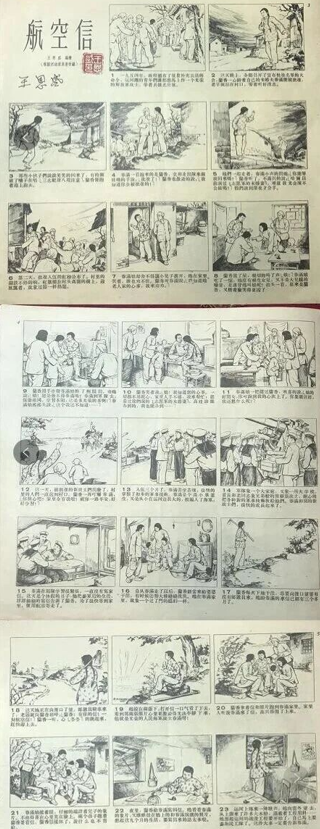
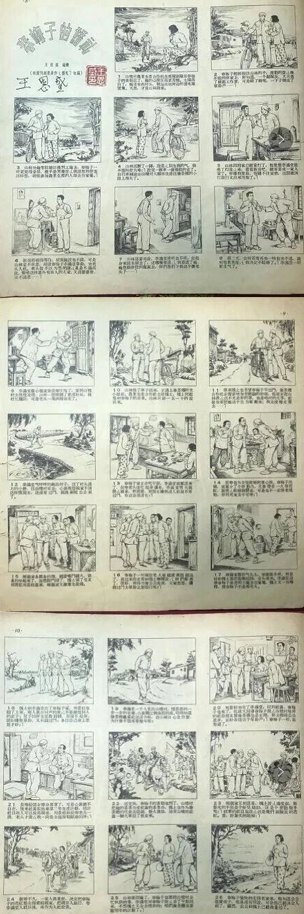
These two comic book works you see were created by Teacher Wang Ensheng for the Comics Magazine《连环画报》in the mid-1950s. According to Teacher Wang Ensheng’s oral account, around 1953, as comic books were beginning to flourish in various places across New China, Wang Ensheng also wanted to try his hand at creating comic books. He adapted a novella by Beijing writer Liu Shaotang (刘绍棠) titled “An Airmail Letter” (《一封航空信》) into a comic book script and began illustrating it. At that time, Comics Magazine《连环画报》was a semi-monthly publication; this was the second half of September issue, Issue 18, which is now exactly sixty-three years ago. Sixty-three years ago, Wang Ensheng’s first work published in Comics Magazine《连环画报》was titled “The Wedding of Chun Meizi” (《春梅子的婚礼》), also adapted from a novella by Liu Shaotang. A few months later, in Issue 5 of 1956, which was the early March issue, Comics Magazine《连环画报》published “Airmail Letter” (《航空信》).
It should be noted that while Wang Ensheng was actively trying his hand at painting and submitting works to Comics Magazine 《连环画报》, a major event occurred in Tianjin’s comic book publishing industry at that time: the emergence of the private Tianjin Zhonglian Bookstore (天津私营中联书店). In April 1952, with the approval of the Tianjin cultural authorities, Zhonglian Bookstore began trial operations. At that time, Zhonglian Bookstore was established by four shareholders including Zhang Ruisheng (张瑞生), who raised an investment of 180 million yuan in old currency. Using Zhang Ruisheng’s private residence, No. 18, Daxingcun (老大兴邨), Chongqing Dao, Heping District, Tianjin. They utilized the first and second floors of his three-story townhouse to run this private comic book publishing house. In my view, looking at the history of comic books in New China, Zhonglian Bookstore played a crucial transitional role. During its existence from April 1952 to early 1956, less than four years, it operated during the early development of New China’s comic book industry.
In 1952, Wang Ensheng was introduced by another artist, Mr. Zhang Wei (张玮), to meet Zhang Ruisheng, Hong Dongfan (洪东藩), Wang Shize (王士则), and other colleagues at Zhonglian Bookstore, and he expressed his willingness to draw comic books for them. Soon after, Wang Ensheng began working on several comic books. Wang Ensheng produced a total of twelve comic books during the Zhonglian period, ranking second only to Sun Xin (孙信) of Beijing, making him the second most prolific comic book artist for Zhonglian Bookstore.
During the three-odd years and less than four years of Zhonglian Bookstore’s operation, Mr. Wang Ensheng’s comic book creation reached a remarkably high level. Let me briefly list a few examples: The Story of the Bridge (《桥的故事》), The Burning Tail of the Moon (《燃烧的月尾岛》), The Heroic Youth of Korea (《朝鲜的英雄少年》), The Russian General Who Defeated Napoleon – Kutuzov (《大败拿破仑的俄罗斯名将——库图佐夫》), Looking for the Treasure Horse (《找宝马》), Golden Hand (《金手》), In Prison (《狱中》), Gulia’s Path (《古丽雅的道路》) – which was part of a series, Signal Gun (《信号枪》), and especially Defend Yan’an (《保卫延安》) in three volumes: Longdong Plateau (《陇东高原》), Panlong Town (《蟠龙镇》), and Yulin Front (《榆林前线》), along with several others, totaling about twelve comic books, all created for Zhonglian Bookstore. The two comic books he created for Comics Magazine 《连环画报》 made the young Wang Ensheng famous, and soon publishers from Shanghai, Liaoning, Hebei, and People’s Fine Arts Publishing House (人民美术出版社) all approached him for commissions. During this period, Mr. Wang Ensheng created many outstanding comic book works, including Huang Feilong (《黄飞龙》) and Lone Hero (《孤胆英雄》) for People’s Fine Arts Publishing House; Friendship and Love (《友谊和爱情》) for Shanghai People’s Fine Arts Publishing House (上海人美); Riding Trails on the Grassland (《草原骑踪》) for Liaoning Fine Arts Publishing House (辽宁美术出版社), along with another titled From Qilian Mountains to Longdong (《从祁连山到陇东》); and Unforgettable Winter (《难忘的冬天》) for Hebei People’s Fine Arts Publishing House (河北人美), among others.
Wang Ensheng created the most works for Tianjin publishers. Before the Cultural Revolution, Wang Ensheng painted approximately thirty comic books for various publishing houses in total. He also created some short comic book pieces for various comic book periodicals and art journals. It can be said that he was one of the representative outstanding comic book artists of the first generation in Tianjin and indeed in New China. His comic book creations were self-taught, yet whether they dealt with foreign subjects or war stories, they were highly engaging and won recognition from experts, truly achieving the ideal of appealing to both refined and popular tastes. Teacher Wang Ensheng once recounted that in his youth, drawing comic books was extremely strenuous, and for a time he suffered from neurasthenia and poor health. Around 1953, he met his Wudang Sword master, Meng Xiaofeng (孟晓峰), and began practicing the Wudang Sword, eventually becoming a lineage holder of the Tianjin Wudang School, became one of its twelfth-generation inheritors. In this way, he balanced literary and martial arts, each complementing the other.
Wang Ensheng not only achieved great success in comic books, but he was also an excellent New Year picture painter. He had produced a wonderful set of New Year picture works created in the 1950s and 1960s. His New Year pictures were exceptionally well done. One piece, titled Chairman Mao and Chairman Voroshilov (《毛主席与伏尔希洛夫主席》), based on the visit of the then Chairman of the Council of Ministers of the Soviet Union to China, was selected as the cover of Tianjin Pictorial (《天津画报》) and also won third prize in the 1956 National Youth Art Exhibition (全国青年美展). The old gentleman not only achieved in New Year pictures and comic books; in his later years, he also distinguished himself in Chinese painting, especially in his unique “Wudang Sword Soul” series. He merged his lifelong martial arts knowledge with figure painting in the Chinese style, creating a set of ethereal and dreamlike works titled Sword Soul Paintings (《剑魂图》), consisting of about twenty pieces. Today, these works are an artistic treasure that Mr. Wang left for us.
He once wrote an article in the Elderly Newspaper (《老年报》) about a humiliating incident in old China: at Minyuan Stadium, a football match between Chinese and foreigners ended with the Chinese team winning but being beaten afterwards. The Tianjin Archives still hold a record of another incident: before the founding of the PRC, Mr. Wang Ensheng was robbed of several dozen US dollars by American marines in the Five Great Avenues area. He angrily filed a complaint, which drew significant media attention and led to a lawsuit, ultimately resulting in the American soldiers losing the case and returning the money they had taken from the Chinese. Later, he mentioned this to me several times, commenting on how arrogant the Americans were, how they would drive around in jeeps recklessly, especially when drunk. Time flies; it has been over six months since he left us. Teacher Wang Yao said that whenever he drives past the old gentleman’s doorstep, he cannot help but look into the alleyway.
His comic book original manuscripts were not preserved; some that did exist, along with his materials and a few original drafts, were damaged during the “ten years of turmoil” (the Cultural Revolution) when his home was ransacked. In his later years, he had no original manuscripts around him. He did have some New Year picture originals, about a dozen or so, which in his later years he donated to the Tianjin Research Institute of Culture and History (天津市文史馆). Wang Ensheng produced almost no comic book works after the Cultural Revolution, nor in the 1970s and 1980s. During that period, most of his work was commercial collaborations, advertising for commercial products to support the family, as well as some graphic design work. During his lifetime, Mr. Wang had a book called The Ultimate Collector’s Edition (《绝品珍藏本》), which compiled his life experiences, paintings, and other works.
In the autumn of 1984, the elderly Wang was appointed by the Tianjin Municipal People’s Government as a librarian of the Tianjin Research Institute of Culture and History. The greatest honor of Mr. Wang’s life was being appointed as a librarian of the Research Institute of Culture and History. That was the greatest glory of his life. When he received that letter, he could hardly sleep at night. Now, he is a librarian of the Tianjin Research Institute of Culture and History.
Apart from painting, he also achieved greatly in Wudang Sword, and even authored a book on the subject, which was entirely filled with his own self-portraits. His life can be described as one of both literary and martial accomplishment. It is precisely because he could paint and practice martial arts that he lived to such an advanced age. He published two works on Wudang sword, the first was Wudang Sword (《武当剑》) published by Beijing Institute of Physical Education Press (北京体育学院出版社), cover illustration by Wang Ensheng. Later his Wudang Sword Art (《武当剑艺》) by Wang Ensheng, published by People’s Sports Publishing House (人民体育出版社).
Wang Ensheng’s comic books were almost never reprinted in the 1970s and 1980s. After 2000, some were included in the boxed sets produced by Ji Yuanye (季源业) and Jia Wentao (贾文涛), including a few titles such as In Prison (《狱中》) and Battle in the Desert (《沙漠里的战斗》) among others. Later, after 2006, several were selected for the three boxed sets of Revolutionary Heroes’ Chronicles (《革命英雄谱》), and Battle in the Desert was also published separately in a small hardcover format.
Wang Ensheng did not advocate drinking and disliked smoke, could not tolerate any smell of smoke in his room, so many local visitors (smoking was common in China) would step outside. In his later years, although he could no longer walk and needed a wheelchair, he lived a very carefree and joyful life. I remember that winter, he was still watching the Winter Olympics and enthusiastically explained to me the details of short track speed skating and ice hockey. The old gentleman loved sports all his life.