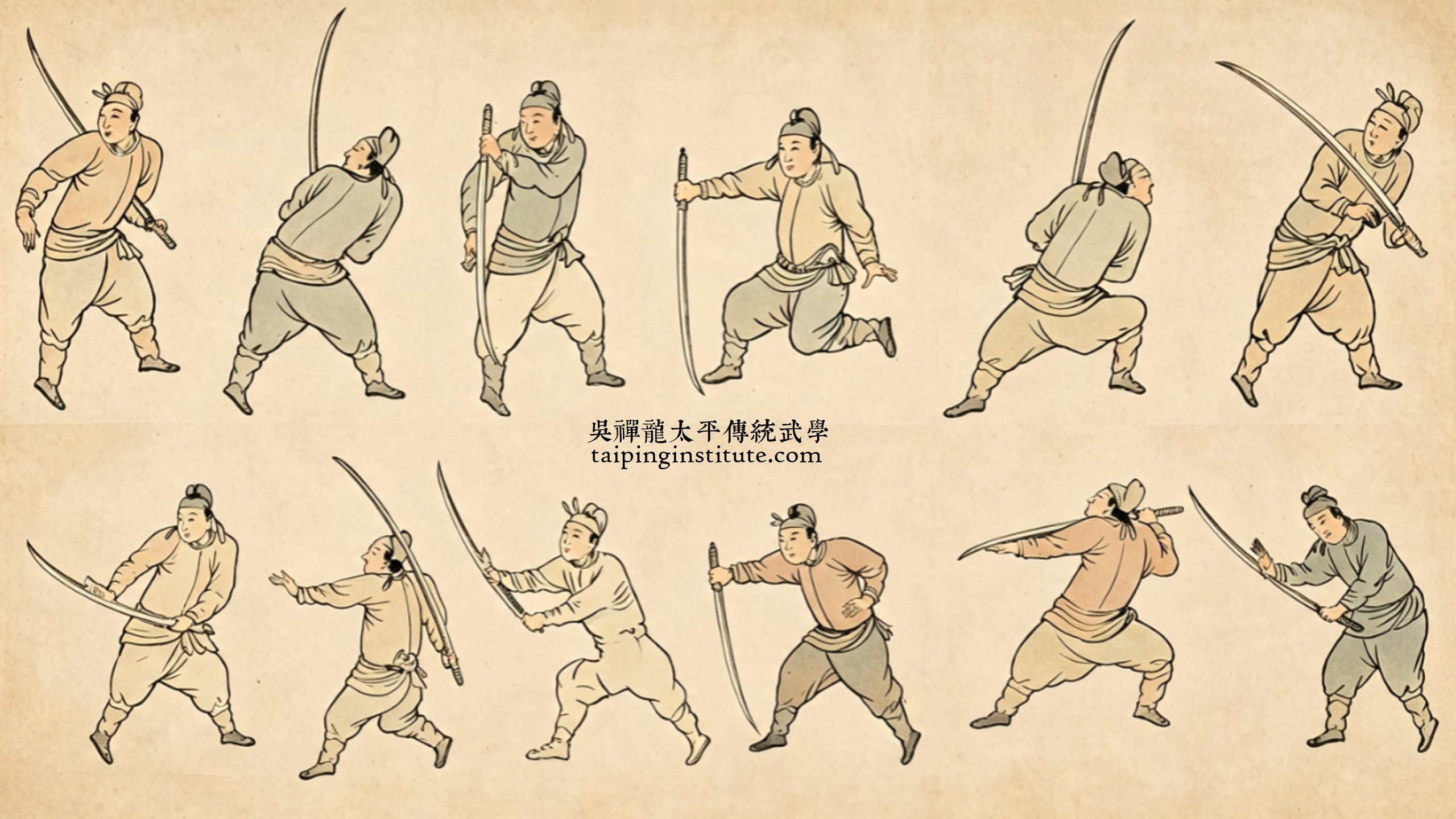
“Wang Wugong’s Sabre Method” (王五公刀法) is the Taiji Linked Sabre Method (太极连环刀法), also known as the Thirteen Sabre Method (十三刀法), created by Wang Yuyou (王余佑), a Confucian scholar of both literary and martial accomplishment in the late Ming and early Qing dynasties, who was known by the sobriquet Wugong Shanren (五公山人). The use of Taiji (太极), which is a common reference in chinese culture is not related to the style of Taijiquan. In this case it refers to the Daoist meaning of Taiji such as the interchange between hardness/softness, or deception/feints defense/attack, etc.
From his writings, including the General Discussion (总论), Explanation of the Sabre Placement Song (置刀歌解), Explanation of the Sabre Formulas (刀诀解), and Comparative Discussion (比较论), the core characteristics of Wang Wugong’s sabre method can be summarised in the following five aspects.
First, using the sabre to guide power and establishing postures through weight. Unlike the common preference for light sabres and the reliance on brute arm strength, Wang Wugong emphasised the use of a heavy sabre. Second, storing power and releasing from the rear, with the sabre emerging like lightning. In terms of drawing the sabre and the trajectory of power, he advocated “mostly issuing from the rear.” The sabre is placed at the side or behind the body to store momentum, and when released, the whole body twists to channel its full strength. This method of generating power not only enables the sabre to emerge with explosive speed, difficult to predict, but also prevents the opponent from parrying in advance, “so that their blocking and striking cannot find ground.” Third, the weapon must be sharp and substantial, with attention to form and construction. In selecting and forging the sabre, as detailed in the Explanation of the Sabre Placement Song, he proposed very specific practical standards. Fourth, using feints and deception, striking after the opponent but arriving first. In terms of tactical strategy, as detailed in the Explanation of the Sabre Formulas, it is filled with Daoist thought on softness overcoming hardness and military thought on deception. Fifth, emphasising the concepts of host and guest, with adaptability and fluency. In the philosophy of practical attack and defence, as detailed in the Comparative Discussion, he established clear concepts of “host and guest” and “offence.”
Taiji Linked Sabre Method: General Discussion
By Wang Yuyou (courtesy name Jieqi 介祺), Wugong Shanren of Xincheng
I observe that those who practise the sabre today mostly use strength to drive the sabre, rather than using the sabre to guide power. They do not realise that if one applies dead force to the sabre, the key to generating power becomes stagnant in the bones. Once the bones are constrained by the resistance of the sabre, the movements can no longer be agile, and speed and swiftness become impossible. The common fault of recent people is a preference for light sabres. My use of the sabre, on the contrary, requires it to be heavy. Why is this? People today drive the sabre with brute strength, so they prefer lightness. I use the momentum of the sabre to guide the power of the whole body, so I require weight. Moreover, a heavy sabre inherently has great momentum. When the sabre moves, the power of the whole body naturally follows, and although one does not consciously exert dead force, the strength of the entire body has already naturally gathered on the sabre. Someone may ask: “A light sabre weighs only a little over a jin, while a heavy one weighs thirty‑five or thirty‑six liang. If one does not use strength, how can one make it whirl and turn like a fan, achieving complete harmony between mind and hand?” I reply: there is a method to this. When ordinary people today wield the sabre, before the sabre has even emerged, their power is already rigidly gathered within. They consciously think of gathering power first, but this power is actually trapped within the bones. What does it have to do with the sabre? In my way of using the sabre, power penetrates the sinews and bones. The bones remain relaxed and supple, the tendons are stretched and extended, and the qi and blood channels of the whole body are integrated. Although one does not consciously add force to the sabre, the essence, energy, spirit, and power of the entire body are already fully poured into the tip of the sabre. This is like mercury placed in a bamboo tube. Lift it up, and the mercury instantly flows to the top of the tube. Draw it back, and the mercury instantly falls to the bottom. However, this subtle mechanism is very difficult to explain to those who do not understand its mystery. Why do I advocate mostly issuing the sabre from behind the body? It is to allow the full power of the whole body to flow out smoothly, to enable the sabre to emerge with divine speed, making it difficult for the enemy to predict, and also to prevent one’s own sabre from being easily parried and broken by the opponent. Pouring the full power of the body into the sabre, the sabre’s momentum is naturally immense. Add to this the swiftness of a lightning flash or a falling meteor, and one strikes the enemy and returns. The subtlety of this is not only unknown to the opponent but even difficult for the sabre wielder himself to perceive. As soon as the mind generates the slightest conscious intent, it departs from the natural state of spontaneous perfection.
Taiji Linked Sabre Method: Explanation of the Sabre Placement Song
The sabre is valued for its length, the body for its weight;
For every finger‑length of extra sabre, a portion of gold.
Where the blade meets the guard, distinguish hard and soft;
When steel is dipped for the edge, discern shallow and deep.
Only with a thick spine and pointed tip can it flourish;
A light body and slender tail cannot withstand attack.
To do good work, first sharpen the tool;
Seek fine steel and wrought iron within the fire.
Explanation: The sabre is valued for its length, the body for its weight; for every finger‑length of extra sabre, a portion of gold. The quality of the sabre lies in the blade being sufficiently long and the overall weight being substantial. For every extra finger‑length of blade, its value and power increase as if gaining a portion of gold. Where the blade meets the guard, distinguish hard and soft; when steel is dipped for the edge, discern shallow and deep. The part where the blade is set into the guard and hilt must be strictly differentiated in terms of material and structure, hard and soft. When quenching and forging the edge, one must precisely control the depth and degree of the quench. Only with a thick spine and pointed tip can it flourish; a light body and slender tail cannot withstand attack. Only with a thick spine and a sharp tip can one manoeuvre with ease in practical parrying and redirection. If the blade is too light and thin, and the tail of the hilt too slender and weak, it cannot withstand strong collisions and defence against enemies. To do good work, first sharpen the tool; seek fine steel and wrought iron within the fire. If one wishes to do a task well, one must first make the tool sharp. To obtain high‑quality steel for making a fine sabre, such as wrought iron and superior refined steel, one must seek it within the fierce fire of smelting and forging.
Taiji Linked Sabre Method: Explanation of the Sabre Formulas
To resist insult, crush the enemy’s edge, and win victory with strength,
In practice, one must examine every detail with care.
Remember well the depth of entry and the opening of techniques;
The enemy who encounters them will perish beneath the blade.
When the sabre rises and the body extends, follow the formulas;
To take the opponent is also to wound within this.
When the sabre is braced and the posture contracted, draw in the body and wait;
When the sabre rises and the body is high, advance swiftly with the step.
Let courage be great and the mind be small;
Let the sinews be stretched and the back be long.
To gain the opponent’s momentum, first conceal your own;
Lure the enemy to reveal movement, then change your edge.
When the opponent is high and I am low, I may try to use it;
When the enemy is occasionally low, I immediately raise.
Extending the back and probing forward, remember this well;
When the attack comes low, take it from high, matching appropriately.
If the enemy’s edge is not yet seen, do not advance rashly;
Use false thrusts and feints to lure and deceive.
If the lure does not bring them, sell a flaw deliberately;
Hold the sabre and wait for the enemy, never in panic.
Let the enemy be fierce as a tiger;
Constantly watch the enemy’s hands, that is the key.
When the eyes are bright, the hands are naturally fast;
Adjusting to their speed, slow or fast, is the finest way.
Whether shallow or deep, old or young, all must be parried and struck;
In advancing, retreating, flying, and leaping, one must know how to hide.
If they are behind and I am first, I can win;
If I am slow and they are busy, I must be on guard.
Only uninterrupted practice can be called mastery;
From mastery comes skill, and from skill comes fame.
Explanation: To resist insult, crush the enemy’s edge, and win victory with strength; in practice, one must examine every detail with care. To resist external aggression, destroy the enemy’s sharpness, and achieve a powerful victory, one must meticulously examine and investigate every detail during practice. Remember well the depth of entry and the opening of techniques; the enemy who encounters them will perish beneath the blade. The depth of advance and retreat and the opening and closing of techniques must always be kept in mind. Once the enemy encounters them, they will surely die beneath the blade. When the sabre rises and the body extends, follow the formulas; to take the opponent is also to wound within this. The rising of the sabre and the extension of the body must strictly follow the formulas. The key to killing the enemy and subduing the opponent also lies herein. When the sabre is braced and the posture contracted, draw in the body and wait; when the sabre rises and the body is high, advance swiftly with the step. When the sabre posture is in a defensive brace and the situation is urgent, one must contract the body, store power, and wait. When the sabre posture is raised and the body is tall, one must quickly step forward and follow up. Let courage be great and the mind be small; let the sinews be stretched and the back be long. When facing the enemy, courage must be great, but the mind must be meticulous and detailed. The sinews and tendons must be stretched, and the spine must be extended and lengthened. To gain the opponent’s momentum, first conceal your own; lure the enemy to reveal movement, then change your edge. To grasp the opponent’s real and false intentions, one must first conceal one’s own intent. Lure and guide the enemy into revealing their techniques, then follow the momentum and change the direction of one’s own blade. When the opponent is high and I am low, I may try to use it; when the enemy is occasionally low, I immediately raise. When the opponent’s technique is high, I may adopt a low body method to respond and try it. If the enemy is occasionally in a low posture, I immediately raise the sabre upward and launch an attack. Extending the back and probing forward, remember this well; when the attack comes low, take it from high, matching appropriately. The method of extending the spine and probing forward in attack must be firmly remembered. When the enemy attacks from a low position, one should meet it from a high position, and the two must match perfectly. If the enemy’s edge is not yet seen, do not advance rashly; use false thrusts and feints to lure and deceive. Before clearly seeing the enemy’s edge and intention, do not blindly cut in. One may use false thrusts, feints, and deceptive techniques to lure and cheat the opponent into a reaction. If the lure does not bring them, sell a flaw deliberately; hold the sabre and wait for the enemy, never in panic. If luring the enemy fails, one must deliberately sell a flaw to entice them. Hold the sabre in strict readiness, and never be flustered or panicked. Let the enemy be fierce as a tiger; constantly watch the enemy’s hands, that is the key. No matter how fierce the enemy may be, like a tiger, constantly watching the enemy’s hand movements is the mainstay of response. When the eyes are bright, the hands are naturally fast; adjusting to their speed, slow or fast, is the finest way. If one’s eyesight is keen and clear, the speed of the hands will naturally be fast. Adjusting one’s own rhythm to the speed of the enemy’s movements, fast or slow, is the highest method of responding to an opponent. Whether shallow or deep, old or young, all must be parried and struck; in advancing, retreating, flying, and leaping, one must know how to hide. Regardless of whether the opponent’s attack is deep or shallow, or whether their timing is raw or mature, one must be skilled at using the sabre to parry and strike. In advancing, retreating, soaring, and shifting, one must know how to cleverly evade. If they are behind and I am first, I can win; if I am slow and they are busy, I must be on guard. Striking after the opponent but arriving first is the way to overcome the enemy and win. If I am slow in movement while the opponent is frequently attacking, I must strictly guard against them. Only uninterrupted practice can be called mastery; from mastery comes skill, and from skill comes fame. Only practice without interruption can be called mature. After mastery, one naturally produces a hundred variations of skill, and one’s reputation will spread greatly.
Taiji Linked Sabre Method: Comparative Discussion
The sabre is divided into host and guest. The winner is the host, the loser is the guest. Within this are: the guest without a host, the host preceding the guest, the host offending the guest, and the guest offending the host. The one who offends becomes the host, striking the guest first. If the guest recognises the method and does not enter, or borrows momentum to injure the host, the host then changes posture to respond, and the final victor is the one who offends. The variations are endless and not uniform. The key is always to take the dismantled individual techniques and practise them in paired drills until extremely proficient and according to the standard. If the body method cannot enter, the power is unstable, or one is timid before the enemy and mentally flustered, these are all signs that one has not yet reached the level of mastery. After one has achieved mastery, when meeting others, one must never speak carelessly. When encountering gatherings, never lightly engage in combat, for fear of injury and disaster. Be warned, be warned!
The sabre is divided into host and guest. The winner is the host, the loser is the guest. In practical exchange and sparring, the sabre method is divided into two roles: “host” and “guest.” The party who ultimately achieves victory is the “host,” and the party who is defeated is the “guest.” Within this are: the guest without a host, the host preceding the guest, the host offending the guest, and the guest offending the host. Within this system there are four offensive and defensive configurations. The guest without a host: the opponent, as guest, attacks blindly and chaotically, without initiative or subjective awareness. The host preceding the guest: our side, as host, seizes the initiative and strikes before the opponent. The host offending the guest: our side, as host, actively launches an attack and offends the opponent. The guest offending the host: the opponent, as guest, actively launches an attack against our side, the host. The one who offends becomes the host, striking the guest first. If the guest recognises the method and does not enter, or borrows momentum to injure the host, the host then changes posture to respond, and the final victor is the one who offends. The party who actively launches an attack, that is, offends, occupies the dominant role and strikes the opponent first. If the opponent sees through my technique and method and does not fall for it and enter, or follows the momentum to turn around and injure our side, then our side, as host, must immediately change techniques to respond. And the one who ultimately defeats the opponent is still the one who successfully attacks again, that is, offends. The variations are endless and not uniform. The key is always to take the dismantled individual techniques and practise them in paired drills until extremely proficient and according to the standard. Among these, the various changes are bizarre and endless, each different. The key is certainly to take the dismantled individual techniques and practise them in paired drills strictly according to the standard until extremely proficient. If the body method cannot enter, the power is unstable, or one is timid before the enemy and mentally flustered, these are all signs that one has not yet reached the level of mastery. If in practical combat one encounters situations where the body method cannot enter, the power is loose and unstable, or one is timid before the enemy and flustered, these are all manifestations of kung fu that has not reached the realm of proficient mastery. After one has achieved mastery, when meeting others, one must never speak carelessly.
When encountering gatherings, never lightly engage in combat, for fear of injury and disaster. Be warned, be warned! After one’s kung fu has truly reached a deep and refined level, when meeting fellow practitioners, one must remember never to speak wildly or show off one’s martial skills. When encountering gatherings, one must absolutely not easily engage in combat with others. I fear that once one moves, one will injure others and bring disaster. Remember this, remember this!
Appendix: About Wang Yuyou