
The Eight Principles of Zhaobao Taijiquan
The Three Propping Forces (三顶 San Ding) Head propping upward (头顶 tou ding) carries the power of soaring to the heavens. The head is the…
The Three Propping Forces (三顶 San Ding) Head propping upward (头顶 tou ding) carries the power of soaring to the heavens. The head is the…
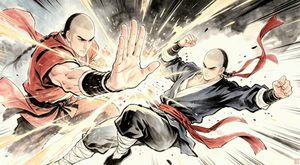
hen Li Shuwen arrived in Xiaoji in 1903, the 16-year-old Huo Diange began studying Bajiquan and Liuhe Daqiang under him. Recognized for his talent, diligence, and pure character, Huo quickly earned Li Shuwen’s favor and was formally accepted as a disciple. For the next twelve years, Huo trained relentlessly,often forgetting to eat or sleep, and earned such deep trust that Li Shuwen frequently stayed at the Huo household upon returning from military service, giving rise to famous anecdotes like “Li eats chicken but doesn’t spit out the bones.”

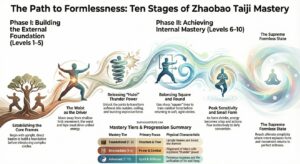
The "Ten Essentials" provide a roadmap for transforming Taijiquan practice from external choreography into an internal art of self-cultivation, health, and martial skill. They emphasize a mind-body connection where the mind (intent) leads, the body follows with relaxed structure, and energy flows accordingly. Progress involves moving from gross physical adjustments to subtle internal sensations and movements.
Pure skill requires cultivating mind. Learn to strike, but choose not to, halt violence, value peace. Nurture life, enjoy defense, unite fist and way, depth achieved. Martial arts lead to philosophy, philosophy to virtue, complete in both. Perfect character, emphasize benevolence, awaken to the cosmos, become a sage.

The original Six Harmony Spear techniques are comprised of six paths: Golden Child, Jade Maiden, Green Dragon, Black Tiger, White Horse, and Crimson Ox. The core principle is the central, level spear (zhongping qiang), and its techniques emphasize powerful hacking and splitting motions.
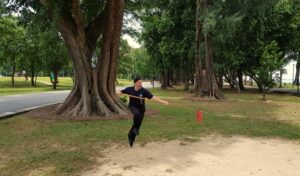
Chuojiao, one of China's traditional martial arts schools, unconsciously embodies and applies this philosophical thought. Every move in Chuojiao reflects the concept of unity of opposites, allowing two opposing elements to coexist and transform into each other. It skillfully combines contradictory elements such as attack and defense, advance and retreat, emptiness and solidity, upper and lower, hardness and softness, extension and contraction, movement and stillness, and applies them flexibly and masterfully, elevating one's combat skills to a new level.
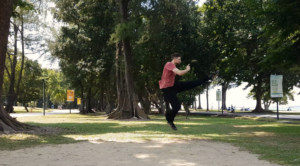
As stated in the Chuojiao Boxing Theory: "The hands are the vanguard, and the feet are the commander. The fists strike in six directions, and the feet kick in eight." In practical combat, Chuojiao emphasizes the coordinated use of hand and foot techniques. The hands defend the upper body, while the feet attack the lower body. The hands guide the feet, and when the hands move, the feet follow. When the feet retract, the hands defend. This synchronization is crucial.
Taijiquan is the art of softness containing hardness and hardness and softness complementing each other, and peng force is the most important of all. The combat principle of Taiji is to listen, neutralize, control, and issue, using the opponent's force against them, overcoming the hard with the soft. Therefore, whenever contact is made, peng comes first.